Kabbalah and Elites in Thirteenth-Century Spain
Total Page:16
File Type:pdf, Size:1020Kb
Load more
Recommended publications
-

TALMUDIC STUDIES Ephraim Kanarfogel
chapter 22 TALMUDIC STUDIES ephraim kanarfogel TRANSITIONS FROM THE EAST, AND THE NASCENT CENTERS IN NORTH AFRICA, SPAIN, AND ITALY The history and development of the study of the Oral Law following the completion of the Babylonian Talmud remain shrouded in mystery. Although significant Geonim from Babylonia and Palestine during the eighth and ninth centuries have been identified, the extent to which their writings reached Europe, and the channels through which they passed, remain somewhat unclear. A fragile consensus suggests that, at least initi- ally, rabbinic teachings and rulings from Eretz Israel traveled most directly to centers in Italy and later to Germany (Ashkenaz), while those of Babylonia emerged predominantly in the western Sephardic milieu of Spain and North Africa.1 To be sure, leading Sephardic talmudists prior to, and even during, the eleventh century were not yet to be found primarily within Europe. Hai ben Sherira Gaon (d. 1038), who penned an array of talmudic commen- taries in addition to his protean output of responsa and halakhic mono- graphs, was the last of the Geonim who flourished in Baghdad.2 The family 1 See Avraham Grossman, “Zik˙atah shel Yahadut Ashkenaz ‘el Erets Yisra’el,” Shalem 3 (1981), 57–92; Grossman, “When Did the Hegemony of Eretz Yisra’el Cease in Italy?” in E. Fleischer, M. A. Friedman, and Joel Kraemer, eds., Mas’at Mosheh: Studies in Jewish and Moslem Culture Presented to Moshe Gil [Hebrew] (Jerusalem, 1998), 143–57; Israel Ta- Shma’s review essays in K˙ ryat Sefer 56 (1981), 344–52, and Zion 61 (1996), 231–7; Ta-Shma, Kneset Mehkarim, vol. -

The Participation of God and the Torah in Early Kabbalah
religions Article The Participation of God and the Torah in Early Kabbalah Adam Afterman 1,* and Ayal Hayut‑man 2 1 Department of Jewish Philosophy and Talmud, Tel Aviv University, Tel Aviv 6997801, Israel 2 School of Jewish Studies and Archaeology, Tel Aviv University, Tel Aviv 6997801, Israel; ayalhay@gmail.com * Correspondence: afterman@tauex.tau.ac.il Abstract: All Abrahamic religions have developed hypostatic and semi‑divine perceptions of scrip‑ ture. This article presents an integrated picture of a rich tradition developed in early kabbalah (twelfth–thirteenth century) that viewed the Torah as participating and identifying with the God‑ head. Such presentation could serve scholars of religion as a valuable tool for future comparisons between the various perceptions of scripture and divine revelation. The participation of God and Torah can be divided into several axes: the identification of Torah with the Sefirot, the divine grada‑ tions or emanations according to kabbalah; Torah as the name of God; Torah as the icon and body of God; and the commandments as the substance of the Godhead. The article concludes by examining the mystical implications of this participation, particularly the notion of interpretation as eros in its broad sense, both as the “penetration” of a female Torah and as taking part in the creation of the world and of God, and the notion of unification with Torah and, through it, with the Godhead. Keywords: Kabbalah; Godhead; Torah; scripture; Jewish mysticism; participation in the Godhead 1. Introduction Citation: Afterman, Adam, and Ayal The centrality of the Word of God, as consolidated in scripture, is a central theme in Hayut‑man. -

I Think I Would Have Been a Nazirite… Parashat Naso June 15, 2019; 12 Sivan 5779 Rabbi Adam J
I think I would have been a Nazirite… Parashat Naso June 15, 2019; 12 Sivan 5779 Rabbi Adam J. Raskin, Congregation Har Shalom, Potomac, MD Once upon a time, a number of years ago, I shaved my head. I shaved every last lock of hair until I was bald as a cue ball. I know, some of you are thinking, too bad it never grew back! But it did…believe it or not, I used to have bangs. I shaved my head because back in the day I was a varsity swimmer. Our team was headed to the district competition, which was held at a collegiate pool and involved schools all over our region. The winners would qualify for states. As a senior and team captain, in order to get my teammates pumped up for the competition, all the guys shaved their heads. Usually we would wear silicone swim caps to eliminate drag in the water. But for this competition we wanted to feel the cool pool water coursing over our bald heads, and all the psychological supercharge that came along with it. It was a rush and we felt like really serious, committed athletes walking bear-headed down the halls of our high school. I do remember the utter disgust in my mother’s eyes when she first saw me. She said I looked like I was in a concentration camp. She definitely did not approve. In our parasha there is also a wild head-shaving ceremony, though it has nothing to do with athletic performance! At the end of the term of the Nazirite vow, the person who had voluntarily entered into this state of ritual purity by abstaining from grape products, haircuts, and contact with the dead, would appear before the Kohen, the priest with various sacrifices at the Tabernacle. -

When Does Human Life Begin? Christian Thinking and Contemporary Opposition
Salt&Light series When does human life begin? Christian thinking and contemporary opposition JOHN R LING Salt&Light series When does human life begin? Christian thinking and contemporary opposition JOHN R LING The substance of this booklet is an extract from The Morning-After Pill – Uncovering the Truth, published by The Christian Institute in 2007: http://www.christian.org.uk/resource/the-morning-after-pill Copyright © The Christian Institute 2017 The author has asserted his right under Section 77 of the Copyright, Designs & Patents Act 1988 to be identified as the author of this work. First printed in June 2011 Reprinted in May 2015 and August 2017 ISBN 978-1-901086-47-8 Published by The Christian Institute Wilberforce House, 4 Park Road, Gosforth Business Park, Newcastle upon Tyne, NE12 8DG All rights reserved No part of this publication may be reproduced, or stored in a retrieval system, or transmitted, in any form or by any means, mechanical, electronic, photocopying, recording or otherwise, without the prior permission of The Christian Institute. All scripture quotations, unless otherwise indicated, are taken from the HOLY BIBLE, NEW INTERNATIONAL VERSION®. NIV®. Copyright © 1973, 1978, 1984 by International Bible Society. Used by permission of Zondervan. All rights reserved. The Christian Institute is a Company Limited by Guarantee, registered in England as a charity. Company No. 263 4440, Charity No. 100 4774. A charity registered in Scotland. Charity No. SC039220 Contents 5 1 . Introduction 7 2 . The answer from the Bible 17 3 . The view of the early church 21 4 . The drift from the biblical worldview 25 5 . -

02 12. BIBLICAL EPIC for Week of March 19 PSALM (#2) OT-History OT-PROPHETS NT-CHURCH Psa 49:13-20 Num 5-6 Isa 25-26 Acts 14-15
02 12. BIBLICAL EPIC for Week of March 19 PSALM (#2) OT-History OT-PROPHETS NT-CHURCH Psa 49:13-20 Num 5-6 Isa 25-26 Acts 14-15 rown Ps 49:13-20: But God will ransom my soul from Sheol. Man in his pomp is like the beasts that perish. • 49:13-20. For We Go to God, not Sheol. In answering the problem of why the righteous suffer and the unrighteous prosper, the psalmist contrasts the eternal destinations of each. The unfaithful are like sheep who have Death as their shepherd, while God (the Shepherd of the righteous) will ransom the faithful person’s soul from the power of Sheol (vv. 14-15). Since the impious go to Sheol, and the pious do not, here it represents the grim place of destruction for the wicked, and not simply the grave. A genuine grasp of this will enable a person to resist being afraid when a man becomes rich (v. 16)—the fear that might lead the faithful to despair of God’s justice and goodness, or to give up piety in order to join the wicked and to get praise when they do well for themselves (v. 18). Regarding the futility of wealth and the certainty of death, the psalm recalls themes from the book of Ecclesiastes. aw Num 5: Anyone who sins shall make restitution and add a fifth. If a man suspects his wife of unfaithfulness he shall take her to the priest. Because a holy God was dwelling among the Israelites, and to prepare for their march to the Promised Land, their camp required ceremonial purity. -

Written for Our Learning Sermons with a Focus on the Old Testament
Written For Our Learning Sermons With A Focus On The Old Testament “For whatever things were written before were written for our learning, that we through the patience and comfort of the Scriptures might have hope” (Romans 15:4 ) © 2018 David Padfield www.padfield.com Scripture taken from the New King James Version. Copyright 1982 by Thomas Nelson, Inc. Used by permission. All rights reserved. Preface The older I get, the more I realize how shallow the preaching was at the congregations my parents attended as I was growing up. Preachers often presented “canned lessons” with little depth, and their knowledge of Old Testament manners and customs was either non-existent or just wrong. This little book of sermons contains some of my favorite lessons dealing with Old Testament themes. I claim originality for absolutely nothing in this book! Some of the notes I have used in developing these outlines were made many years ago, and I wasn’t always as careful back then about citing my sources as I should have been. You will probably find many things mentioned in this book that you have never heard anyone preach on before—and that is my goal. I have no desire to preach “new doctrines,” but I do enjoy preaching on topics that many brethren have neglected over the years. Sermon Titles Written For Our Learning .............................................................................................1 Life Under The Law .........................................................................................................3 Your Closest Friend (The Law of Sotah)..........................................................................9 The Nazarite Vow............................................................................................................14 Tisha B’Av..........................................................................................................................18 How To Study The Bible...............................................................................................24 Written For Our Learning Introduction I. -

The New Perspective on Paul: Its Basic Tenets, History, and Presuppositions
TMSJ 16/2 (Fall 2005) 189-243 THE NEW PERSPECTIVE ON PAUL: ITS BASIC TENETS, HISTORY, AND PRESUPPOSITIONS F. David Farnell Associate Professor of New Testament Recent decades have witnessed a change in views of Pauline theology. A growing number of evangelicals have endorsed a view called the New Perspective on Paul (NPP) which significantly departs from the Reformation emphasis on justification by faith alone. The NPP has followed in the path of historical criticism’s rejection of an orthodox view of biblical inspiration, and has adopted an existential view of biblical interpretation. The best-known spokesmen for the NPP are E. P. Sanders, James D. G. Dunn, and N. T. Wright. With only slight differences in their defenses of the NPP, all three have adopted “covenantal nomism,” which essentially gives a role in salvation to works of the law of Moses. A survey of historical elements leading up to the NPP isolates several influences: Jewish opposition to the Jesus of the Gospels and Pauline literature, Luther’s alleged antisemitism, and historical-criticism. The NPP is not actually new; it is simply a simultaneous convergence of a number of old aberrations in the late 20th and early 21st centuries. * * * * * When discussing the rise of the New Perspective on Paul (NPP), few theologians carefully scrutinize its historical and presuppositional antecedents. Many treat it merely as a 20th-century phenomenon; something that is relatively “new” arising within the last thirty or forty years. They erroneously isolate it from its long history of development. The NPP, however, is not new but is the revival of an old ideology that has been around for the many centuries of church history: the revival of works as efficacious for salvation. -

277 53 Anna D. Kartsonis, Anastasis
Book reviews 277 53 Anna D. Kartsonis, Anastasis: The Making of an Image (Princeton, Princeton Univ. Press), 1986, pp. 263 & 89 illustrations, 21 x 28 cm., $51.50, ISBN 0-691-04039-7. LEXIKON DES MITTELALTERS - II: JUDAISM. Lexikon des Mittelalters. Erster Band, 2110 col. (Oct.1977-Nov.1980): Aachen- Bettelordenskirchen. Zweiter Band, 2210 col. (May 1981-November 1983): Bettlerwesen-Codex von Valencia. Dritter Band, 2208 col. (May 1984-June 1986): Codex Wintoniensis- Erziehungs- und Bildungswesen). Vierter Band, Lief. 1-7 (1567 col.): Erzkanzler-Goslar (March 1987- - December 1988) München und Zürich, Artemis Verlag. The Lexikon des Mittelalters (hereafter: LM) aims at covering all aspects of the history of the European Middle Ages, viz. the period between A.D. 300 and 1500. It has already been illustrated in a previous review that LM, though primarily a reference-work for students of European medieval history, can be of great use to islamicists as well, in view of the high standard of the articles related, in one way or another, to Islam (Numen vol XXX, pp. 265-268). The present review aims at presenting an evaluation of the contributions of LM in the field of Jewish studies. At this point it should be stressed that the editorial preface of November 1980 stated:, "Ebenso ist die Geschichte des mittelalterlichen europaischen Judentums fester Bestandteil des Lexikons" (my italics, VK). In the volumes covering the letters A through G I have counted a total number of some 90 articles on Jewish subjects. This number has to be considered as an approximate one only, as I most likely have overlooked several items going through the enormous mass of articles published thus far. -
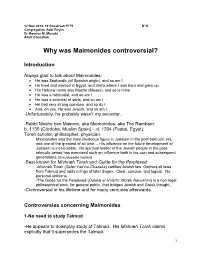
Why Was Maimonides Controversial?
12 Nov 2014, 19 Cheshvan 5775 B”H Congregation Adat Reyim Dr Maurice M. Mizrahi Adult Education Why was Maimonides controversial? Introduction Always glad to talk about Maimonides: He was Sephardic (of Spanish origin), and so am I He lived and worked in Egypt, and that's where I was born and grew up His Hebrew name was Moshe (Moses), and so is mine He was a rationalist, and so am I He was a scientist of sorts, and so am I He had very strong opinions, and so do I And, oh yes: He was Jewish, and so am I. -Unfortunately, he probably wasn’t my ancestor. -Rabbi Moshe ben Maimon, aka Maimonides, aka The Rambam: b. 1135 (Córdoba, Muslim Spain) – d. 1204 (Fostat, Egypt): Torah scholar, philosopher, physician: Maimonides was the most illustrious figure in Judaism in the post-talmudic era, and one of the greatest of all time… His influence on the future development of Judaism is incalculable. No spiritual leader of the Jewish people in the post- talmudic period has exercised such an influence both in his own and subsequent generations. [Encyclopedia Judaica] -Best-known for Mishneh Torah and Guide for the Perplexed: -Mishneh Torah (Sefer Yad ha-Chazaka) codifies Jewish law. Gathers all laws from Talmud and adds rulings of later Sages. Clear, concise, and logical. No personal opinions. -The Guide for the Perplexed (Dalalat al-Ha'erin; Moreh Nevukhim) is a non-legal philosophical work, for general public, that bridges Jewish and Greek thought. -Controversial in his lifetime and for many centuries afterwards. Controversies concerning Maimonides 1-No need to study Talmud -He appears to downplay study of Talmud. -

Wirtschaftsgeschichte Der Mittelalterlichen Juden Fragen Und Einschätzungen
Wirtschaftsgeschichte der mittelalterlichen Juden Fragen und Einschätzungen Herausgegeben von Michael Toch unter Mitarbeit von Elisabeth Müller- Luckner R. Oldenbourg Verlag München 2008 JcoS/ J_A+CJ Hans-Georg von Mutius Taking Interest from Non-Jews - Main Problems in Traditional Jewish Law Questions of money lending between Jews and non-Jews and the problems of in- terest-charged loans can be viewed through the mirror of Jewish law and have been discussed by rabbinical authorities. To begin with the legal sources: All Jewish communities of the Middle Ages in the Mediterranean area and in non-Mediterra- nean Europe have a common stock of Holy Scriptures constituting the basis of their legal culture and life. Apart from the Hebrew Bible with the Pentateuch as the main law book, they all have in common use a corpus of legal und ritual works written in Palestine and Babylonia during the Late Antiquities: the Mishna com- piled at the beginning of the 3rd century C.E. in Northern Palestine, constituting the first comprehensive law-book of normative Judaism after the destruction of the Second Temple with laws and legal discussions mainly from the 2nd century; then a commentary to the Mishna in form of the Babylonian Talmud containing laws and legal discussions from the Jrd to the 6th century; further legal corpora of secondary importance as the Tosefta and the Palestinian Talmud from the 4th and 5th centuries; and the bulk of the so-called Midrashic literature. Midrashic litera- ture, of Jewish Palestinian origin, presents the rabbinical expositions of scriptural verses. Embodied into this literature is a canonical corpus of Midrashim with laws and legal discussions from the 2nd to the yd centuries expounding the laws of the Pentateuch. -

The Early Ibn Ezra Supercommentaries: a Chapter in Medieval Jewish Intellectual History
Tamás Visi The Early Ibn Ezra Supercommentaries: A Chapter in Medieval Jewish Intellectual History Ph.D. dissertation in Medieval Studies Central European University Budapest April 2006 To the memory of my father 2 Table of Contents Acknowledgements .................................................................................................................... 6 Introduction............................................................................................................................... 7 Prolegomena............................................................................................................................ 12 1. Ibn Ezra: The Man and the Exegete ......................................................................................... 12 Poetry, Grammar, Astrology and Biblical Exegesis .................................................................................... 12 Two Forms of Rationalism.......................................................................................................................... 13 On the Textual History of Ibn Ezra’s Commentaries .................................................................................. 14 Ibn Ezra’s Statement on Method ................................................................................................................. 15 The Episteme of Biblical Exegesis .............................................................................................................. 17 Ibn Ezra’s Secrets ....................................................................................................................................... -
The Kuzari and the Shaping of Jewish Identity, 1167-1900 Adam Shear Index More Information
Cambridge University Press 978-0-521-88533-1 - The Kuzari and the Shaping of Jewish Identity, 1167-1900 Adam Shear Index More information Index Abarbanel, Isaac, 101, 112, 118–119, 121–122, 168 Alashkar, Moses, 122–123 Abdelhac, Aron, 35 Albalag, Isaac, 34 Abelard, Peter, 193 Albo, Joseph, 45, 50–51, 85–86, 123, 156, 211–212, Abendana, Isaac, 177 271, 272 Abendana, Jacob, 53, 176–177, 178, 294 Aldabi, Meir, 32 Aboab, Immanuel, 179 Alemanno, Yoh. anan, 101, 117, 121, 125–126, Aboab, Isaac, 177 128–130, 132–133, 156–157 Aboab, Samuel, 179 Alexander, Isaak, 215 Abraham bar H. iyya, 36 Alexander the Great, 105 Abraham ben David, of Posquieres` (Rabad), 28, Alexander-Frizer, Tamar, 175 32 al-Farabi, 221–222 Abraham ben Isaac, 33, 73 Alfasi, Isaac (the Rif), 28, 298 Abraham ben Judah, 80 al-Ghazali, 11, 128, 129 Abraham ibn Daud, 24, 104 al-Harizi, Judah, 24 Abraham ibn Ezra aliyah, 296, 299–300. See also Zionist movement Ascher influenced by, 263 Alkabetz, Solomon, 174 folktales of, 271 Allony, Nehemya, 7, 174 Halevi as associate of, 23, 296, 298 Almangari, 162. See also Sangari, Isaac Halevi’s daughter married to, 192 Almoli, Solomon, 102 on magic, 153–154 Altmann, Alexander, 216 Mendelssohn on, 233, 234 Amelander, Menahem, 192 neoplatonists influenced by, 35 Amos (prophet), 291 on worship and belief, 72, 118 Amsterdam, 176–177, 178–179 writings in Hebrew language, 36–37 Anatoli, Jacob, 40 Abraham (Patriarch), 3, 222 Andalusian Jewish intellectuals, 23–27, 31–32, 36, Abulafia, Abraham, 75–76, 101 66, 175–176, 230, 297–298, 308–309 Abulafia, Meir ben Todros ha-Levi, 31, 32–33 animals, 155–156 academic treatment of the Kuzari, 4–12, 293–295 anonymous preacher, 168 accidents of transmission, 21–22 anti-rationalism.