Download Publication
Total Page:16
File Type:pdf, Size:1020Kb
Load more
Recommended publications
-

Volume VIII, Issue-3, March 2018
Volume VIII, Issue-3, March 2018 March in History Nation celebrates Pakistan Day 2018 with military parade, gun salutes March 15, 1955: The biggest contingents of armoured and mech - post-independence irrigation anised infantry held a march-past. project, Kotri Barrage is Pakistan Army tanks, including the inaugurated. Al Khalid and Al Zarrar, presented March 23 , 1956: 1956 Constitution gun salutes to the president. Radar is promulgates on Pakistan Day. systems and other weapons Major General Iskander Mirza equipped with military tech - sworn in as first President of nology were also rolled out. Pakistan. The NASR missile, the Sha - heen missile, the Ghauri mis - March 23, 1956: Constituent sile system, and the Babur assembly adopts name of Islamic cruise missile were also fea - Republic of Pakistan and first constitution. The nation is celebrating Pakistan A large number of diplomats from tured in the parade. Day 2018 across the country with several countries attended the March 8, 1957: President Various aeroplanes traditional zeal and fervour. ceremony. The guest of honour at Iskandar Mirza lays the belonging to Army Avi - foundation-stone of the State Bank the ceremony was Sri Lankan Pres - Pakistan Day commemorates the ation and Pakistan Air of Pakistan building in Karachi. ident Maithripala Sirisena. passing of the Lahore Resolution Force demonstrated aer - obatic feats for the March 23, 1960: Foundation of on March 23, 1940, when the All- Contingents of Pakistan Minar-i-Pakistan is laid. India Muslim League demanded a Army, Pakistan Air Force, and audience. Combat separate nation for the Muslims of Pakistan Navy held a march-past and attack helicopters, March 14, 1972: New education the British Indian Empire. -

Page 01 March 22.Indd
ISO 9001:2008 CERTIFIED NEWSPAPER 22 March 2014 21 Jumadal I 1435 - Volume 19 Number 5611 Price: QR2 ON SATURDAY Missing plane’s debris may never be found LONDON: Even if the two unidentified objects shown on satellite images floating in the southern Indian Ocean are debris from the missing Malaysia Airlines plane, finding them could prove to be a long and difficult process that may rely on luck as much as on advanced technology, oceanographers and aviation experts have warned. If the objects are recovered, locating the rest of the Boeing 777 on the ocean floor could turn out to be harder still. And if the remains can eventually be pieced together, working out exactly what happened to flight MH370 may be the toughest job of all. See also page 11 Doha Theatre Festival opens at Katara DOHA: The Minister of Culture, Arts and Heritage H E Dr. Hamad bin Abdul Aziz Al Kuwari yesterday opened Doha Theatre Festival at Katara Drama Theatre. In his speech, the minister said many events in the theatrical field will be held in the com- ing days, including workshops and an contest in playwriting, and a forum for playwrights in Qatar which will be held in the last week of April every year. He said work was under way to create an electronic library for theatre documentation, and admission to the theatre studies programme will be announced soon in collaboration with the Community College in Doha. The programme will result in an applied science degree in the field of theatre. EU prepares for trade Debating war with Russia BRUSSELS: Europe began to prepare for a possible trade war with Russia over Ukraine yesterday, with the EU executive in Brussels ordered to draft plans for much more sub- stantive sanctions against Moscow if Vladimir Putin presses ahead with Russian territorial expansion. -
KLF-10 Programme 2019
Friday, 1 March 2019 Inauguration of the 10th Karachi Literature Festival Main Garden, Beach Luxury Hotel, Karachi 5.00 p.m. Arrival of Guests 5.30 p.m. Welcome Speeches by Festival Organizers 5.45 p.m. Speech by the Chief Guest: Honourable Governor Sindh, Imran Ismail Speeches by: Mark Rakestraw, Deputy Head of Mission, BDHC, Didier Talpain, Consul General of France, Enrico Alfonso Ricciardi, Deputy Head of Mission, Italian Consulate 6.00 p.m. Karachi Literature Festival-Infaq Foundation Best Urdu Literature Prize 6.05 p.m. Keynote Speeches by Zehra Nigah and Muneeza Shamsie 6.45 p.m. KLF Recollection Documentary 7.00 p.m. Aao Humwatno Raqs Karo: Performance by Sheema Kermani 7.45–8.45 p.m. Panel Discussions 9.00–9.30 p.m. Safr-e-Pakistan: Pakistan’s Travelogue in String Puppets by ThespianzTheatre MC: Ms Sidra Iqbal 7.45 p.m. – 8.45 p.m. Pakistani Cinema: Yesterday, Today, and Tomorrow Yasir Hussain, Munawar Saeed, Nabeel Qureshi, Asif Raza Main Garden Mir, Fizza Ali Meerza, and Satish Anand Moderator: Ahmed Shah Documentary: Qalandar Code: Rise of the Divine Jasmine Feminine Atiya Khan, David C. Heath, and Syed Mehdi Raza Shah Subzwari Moderator: Arieb Azhar Aquarius Voices from Far and Near: Poetry in English Adrian Husain, Arfa Ezazi, Farida Faizullah, Room 007 Ilona Yusuf, Jaffar Khan, Moeen Faruqi, and Shireen Haroun Moderator: Salman Tarik Kureshi Book Discussion: The Begum: A Portrait of Ra’ana Liaquat Ali Khan by Deepa Agarwal and Tahmina Aziz Princess Akbar Liaquat Ali Khan and Javed Aly Khan Moderator: Muneeza Shamsie Saturday, 2 March 2019 Hall Sponsor Main Garden Jasmine Aquarius Room 007 Princess 11 a.m. -

051-9208752 No. F 14/07/79/LJC-I Law & Justice Commission Of
051-9208752 No. F 14/07/79/LJC-I Law & Justice Commission of Pakistan Supreme Court Building, Constitution Avenue, Islamabad Deputy Secretary 03 June, 2011 Press Release A meeting of the Law and Justice Commission of Pakistan (LJCP) is scheduled on 04th June, 2011 in the Conference Room of the Supreme Court of Pakistan, Islamabad, under the Chairmanship of Mr. Justice Iftikhar Muhammad Chaudhry, Chief Justice of Pakistan/Chairman, LJCP. The Commission will consider Law Reform Proposals for amendments in Section 338 of the Pakistan Penal Code, 1860, Section 129 of the Income Tax Ordinance, 2001, Declaring Smoking in Public Vehicle as Cognizable Offence, Rule 5 of Order XLI Civil Procedure Code, 1908, Article 79 of Qanoon-e- Shahadat Order, 1984, Rule 21, Order VII and Rule 12, order VII of the Code of Civil Procedure, 1908, Section 27-A of Stamp Act, 1899, Pre-emption Laws, and Section 3 and 6 of the LJCP Ordinance, 1979, Section 3 of National Judicial (Policy Making) Committee Ordinance 2002. Besides, considering proposals for repeal of Federal Court Act, 1937, the Commission will also examine the draft Rules for regulating the functions of District Legal Empowerment Committees. The meeting will be attended by members of the Commission including Mr. Justice Agha Rafiq Ahmed Khan, Chief Justice Federal Shariat Court, Mr. Justice Qazi Faez Isa, Chief Justice High Court of Balochistan, Mr. Justice Ejaz Afzal Khan, Chief Justice, Peshawar High Court, Mr. Justice Ijaz Ahmad Chaudhry, Chief Justice, Lahore High Court, Mr. Justice Mushir Alam, Chief Justice High Court of Sindh, Maulvi Anwar-ul-Haq, Attorney General for Pakistan, Mr. -

The Feudal Tentacles: Is Feudalism Dead
Pakistan Perspectives Vol. 21, No.2, July-December 2016 Study of the Emergency Rule in Pakistan, 2007 Khan Faqir & Fakhrul Islam Abstract Some of the steps of public interest litigation that the judiciary took in 2007 were considered as a threat to the military government of Pervez Musharraf. He dismissed the Chief Justice of Pakistan, Iftikhar Muhammad Chaudhry, on the charges of corruption. This presidential move was not against the chief justice of Pakistan but against the judiciary. The executive intent to tarnish and erode judiciary’s image, integrity and authority was countered by a countrywide movement for the restoration of judiciary. A consolidated struggle of the bar and the bench lead to judicial revivalism in Pakistan. ______ Historical background Authoritarianism as a colonial legacy was incorporated in the political system of both Pakistan and India. From the very beginning India quite successfully tried to democratise itself. There ‘the rule of law was ever bent to subserve either executive action in the administration or the will of dominant elements of society’. On the other hand, Pakistan failed to make a worthwhile change to democratic rule after emerging from the debris of British colonialism. The colonial state was quickly replaced by authoritarian rulers, whether civilian or military. History of Pakistan has been defined by uneasy relationships between state institutions and civil society. In its executive-dominated state, the superior courts in particular have played unusually important part in determining the country’s political fate.1 The conflict between Pakistan’s executive orders and judicial authorities dates back to the era of Liaquat Ali Khan when the country was in its teething years. -

Defining Shariʿa the Politics of Islamic Judicial Review by Shoaib
Defining Shariʿa The Politics of Islamic Judicial Review By Shoaib A. Ghias A dissertation submitted in partial satisfaction of the Requirements for the degree of Doctor of Philosophy in Jurisprudence and Social Policy in the Graduate Division of the University of California, Berkeley Committee in Charge: Professor Malcolm M. Feeley, Chair Professor Martin M. Shapiro Professor Asad Q. Ahmed Summer 2015 Defining Shariʿa The Politics of Islamic Judicial Review © 2015 By Shoaib A. Ghias Abstract Defining Shariʿa: The Politics of Islamic Judicial Review by Shoaib A. Ghias Doctor of Philosophy in Jurisprudence and Social Policy University of California, Berkeley Professor Malcolm M. Feeley, Chair Since the Islamic resurgence of the 1970s, many Muslim postcolonial countries have established and empowered constitutional courts to declare laws conflicting with shariʿa as unconstitutional. The central question explored in this dissertation is whether and to what extent constitutional doctrine developed in shariʿa review is contingent on the ruling regime or represents lasting trends in interpretations of shariʿa. Using the case of Pakistan, this dissertation contends that the long-term discursive trends in shariʿa are determined in the religio-political space and only reflected in state law through the interaction of shariʿa politics, regime politics, and judicial politics. The research is based on materials gathered during fieldwork in Pakistan and datasets of Federal Shariat Court and Supreme Court cases and judges. In particular, the dissertation offers a political-institutional framework to study shariʿa review in a British postcolonial court system through exploring the role of professional and scholar judges, the discretion of the chief justice, the system of judicial appointments and tenure, and the political structure of appeal that combine to make courts agents of the political regime. -

Part 5 Sindh
Environmentalw ain Pakistan L Governing Natural Resources and the Processes and Institutions That Affect Them Part 5 Sindh Environmental Law in Pakistan Governing Natural Resources and the Processes and w in Pakistan Institutions That Affect Them Sindh Contents Abbreviations ........................................................................................................................ 5 Introduction to the Series .................................................................................................... 6 Foreword................................................................................................................................ 7 Acknowledgements .............................................................................................................. 9 1. Legislative Jurisdiction ............................................................................................ 10 1.1 Natural Resources .....................................................................................................................10 1.2 Processes and Institutions.........................................................................................................12 2. Methodology.............................................................................................................. 18 3. Hierarchy of Legal Instruments ............................................................................... 19 3.1 Legislative Acts..........................................................................................................................19 -
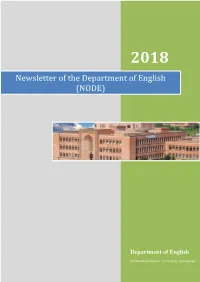
Newsletter of the Department of English (NODE)
2018 Newsletter of the Department of English (NODE) Department of English International Islamic University, Islamabad Editorial Team Dr. Muhammad Sheeraz Mr. Mahmood ul Hassan Editor Assistant Editor Muhammad Munhib Shah Muhammad Sarmad Faheem Student Editor Student Editor Student Editor 1 Table of Contents Editorial ……………………………………………………………………………………….3 News Section …………………………………………………………………………………4 Research and Publications ……………………………………………………………5 Fresh PhD and MPhil Scholars ………………………………………………………7 Book Launch ………………………………………………………………………….8 CASS Workshop ……………………………………………………………………8 Contemporary Poetics Forum …………………………………………………………9 Character Building and Career Counselling Society ………………………………10 English Literary Society (Male Section) ……………………………………………10 Awards and Achievements …………………………………………………………11 Student Corner ….……………………………………………………………………………12 Meet our Students ……………………………………………………………………13 Meet our International Students ……………………………………………………13 The Alumni Corner …………………………………………………………………14 Reviews and Recommendations ……………………………………………………15 The Cornell System for Taking Notes ………………………………………………16 Literary Awards ……………………………………………………………………………18 Major Literary Awards ………………………………………………………………19 Awards for Popular Fiction ………………………………………………………….21 Awards for Poetry …………………………………………………………………22 Awards for Drama …………………………………………………………………23 List of HEC Approved Journals (Back Cover) 2 Editorial In its fourth year, the node of our NODE has already grown into a fruit-laden branch! The sections that follow show how great this branch is in its -

2005 SCMR 577 [Supreme Court of Pakistan] Present
2005 S C M R 577 [Supreme Court of Pakistan] Present: Iftikhar Muhammad Chaudhry, Rana Bhagwandas and Muhammad Nawaz Abbasi, JJ ABDUL MAJEED and others---Appellants versus AMIR MUHAMMAD and others ---Respondents Civil Appeal No.191 of 1999, decided on 16th September, 2004. (On appeal from the judgment/order, dated 31-12-1998 passed by High Court of Balochistan, Quetta in R.F.A. No.35 of 1998). (a) Benami transaction--- ----Determination of question as to whether transaction was Benami or not---Factors to be taken into consideration---Burden of proof---Principles. For determining the question, whether a transaction is a Benami transaction or not, inter alia the following factors are to be taken into consideration:- (i) source of consideration; (ii) from whose custody the original title deed and other documents came in evidence; (iii) who is in possession of the suit property; and (iv) motive for the Benami transaction. The initial burden of proof is on the party who alleges that an ostensible owner is a Benamidar for him and that the weakness in the defence evidence would not relieve a plaintiff from discharging the above burden of proof. However, the burden of proof may shift from one party to the other during the trial of a suit. Once the burden of proof is shifted from a plaintiff on a defendant and if he fails to discharge the burden of proof so shifted on him, the plaintiff shall succeed. The question whether a transaction is Benami in character or not has to be decided keeping in view a number of factors/considerations. -

Current Affairs February 2015
_____________Download from www.JbigDeaL.com Powered By © JbigDeaL____________ Current Affairs February 2015 Q.1) Name the Indian cricketer who on 22 February 2015 was inducted into the International Cricket Council Hall of Fame at the Melbourne Cricket Ground, Australia. A. Kapil Dev B. Anil Kumble C. Sachin Tendulkar D. Saurav Ganguly Ans. B Q.2) Name the female cricketer who, posthumously on 22 February 2015, was inducted into the International Cricket Council Hall of Fame at the Melbourne Cricket Ground, Australia. A. Hazel Pritchard B. Mary Duggan C. Betty Wilson D. Molly Hide Ans. C Q.3) Name the golfer who won the Indian Open title on 22 February 2015. A. SSP Chowrasia B. Anirban Lahiri C. Siddikur Rahman D. Daniel Chopra Ans. B _____________Download from www.JbigDeaL.com Powered By © JbigDeaL____________ Q.4) Name the organisation that released a report, Heat on Power on 22 February 2015 which claimed that thermal power generating units of India are among the most inefficient in the world in terms of compliance of pollution norms. A. Centre for Science and Environment (CSE) B. Earth System Governance Project (ESGP) C. United Nations Environment Programme (UNEP) D. World Nature Organization (WNO) Ans. A Q.5) Name the Indian-American person who on 20 February 2015 was awarded with the J. Calvin Giddings Award 2015 given by the American Chemical Society (ACS) Division of Analytical Chemistry. A. Purnendu Dasgupta B. Tessy Thomas C. Gurpreet Singh D. Srikanth Jagabathula Ans. A Q.6) The rival parties of which country agreed on 19 February 2015 to set up a People’s Transitional Council to resolve the ongoing political crisis in the country and to ensure smooth governance? A. -

Social Science TABLE of CONTENTS
2015 Social Science TABLE OF CONTENTS Academic Tools 79 Labour Economics 71 Agrarian Studies & Agriculture 60 Law & Justice 53 Communication & Media Studies 74-78 Literature 13-14 Counselling & Psychotherapy 84 7LHJL *VUÅPJ[:[\KPLZ 44-48 Criminology 49 Philosophy 24 Cultural Studies 9-13 Policy Studies 43 Dalit Sociology 8 Politics & International Relations 31-42 Development Communication 78 Psychology 80-84 Development Studies 69-70 Research Methods 94-95 Economic & Development Studies 61-69 SAGE Classics 22-23 Education 89-92 SAGE Impact 72-74 Environment Studies 58-59 SAGE Law 51-53 Family Studies 88 SAGE Studies in India’s North East 54-55 Film & Theatre Studies 15-18 Social Work 92-93 Gender Studies 19-21 Sociology & Social Theory 1-7 Governance 50 Special Education 88 Health & Nursing 85-87 Sport Studies 71 History 25-30 Urban Studies 56-57 Information Security Management 71 Water Management 59 Journalism 79 Index 96-100 SOCIOLOGY & SOCIAL THEORY HINDUISM IN INDIA A MOVING FAITH Modern and Contemporary Movements Mega Churches Go South Edited by Will Sweetman and Aditya Malik Edited by Jonathan D James Edith Cowan University, Perth Hinduism in India is a major contribution towards ongoing debates on the nature and history of the religion In A Moving Faith by Dr Jonathan James, we see for in India. Taking into account the global impact and the first time in a single coherent volume, not only that influence of Hindu movements, gathering momentum global Christianity in the mega church is on the rise, even outside of India, the emphasis is on Hinduism but in a concrete way, we are able to observe in detail as it arose and developed in sub-continent itself – an what this looks like across a wide variety of locations, approach which facilitates greater attention to detail cultures, and habitus. -

In the Lahore High Court Lahore
Stereo. H C J D A 38. Judgment Sheet IN THE LAHORE HIGH COURT LAHORE JUDICIAL DEPARTMENT Case No: W. P. No. 25301/2011. Liaqat Ali Chugtai. Versus Federation of Pakistan etc. JUDGMENT Date of hearing: 17.02.2012. Petitioner by: Mr. Ali Akbar Qureshi, Advocate. Respondents by: Ms. Shaista Qaisar, Deputy Attorney General for Pakistan. Hafiz Ahsan Ahmad Khokhar, Advocate. Hafiz Tariq Nasim, Advocate for private respondents Mr. Muhammad Awais Kundi, Joint Secretary, Establishment Division. Mr. Shamas-ud-Din Baloch, Section Officer, Establishment Division, Islamabad. Mr. Bilal Ahmad, Assistant Ministry of Railways. Research Assistance M/s. M. Nadeem Ahmed Sohail and rendered by: Nadir Hussain Shah Gilani, learned Civil Judges/ Research Officers, Lahore High Court Research Centre. Syed Mansoor Ali Shah, J:- This judgment will decide the instant petition along with writ petitions listed in Schedule -A, as they raise common questions of law and facts. 2. Brief facts of the case are that the petitioners, who are senior officers (in BS-19 and BS-20) of Pakistan Railway, were considered for promotion by the Central Selection Board (“CSB”) under the W.P. No.25301/2011 2 Revised Promotion Policy dated 24.10.2007 (“Policy”) for the following posts: Sr. no. Name of the Petitioner/ W. P. No. Considered for promotion to grade the post of: 1 Liaqat Ali Chugtai 25301/2011. Chief Mechanical Engineer (BS-20) 2 Syed Hassan 25300/2011. Chief Mechanical Engineer (BS-20) 3 Muhammad Nawaz 25299/2011. Chief Mechanical Engineer (BS-20) 4 Imtiaz Hussain Rizvi 26541/2011. Railways Transportation (Traffic) and Commercial Group from BS20 to BS 21 5 Ahsan Mehmood Mian 25302/2011.