Congressional Record-House. Maroh 19
Total Page:16
File Type:pdf, Size:1020Kb
Load more
Recommended publications
-

Catherine Mary White Foster's Eyewitness Account of the Battle of Gettysburg, with Background on the Foster Family Union Soldiers David A
Volume 1 Article 5 1995 Catherine Mary White Foster's Eyewitness Account of the Battle of Gettysburg, with Background on the Foster Family Union Soldiers David A. Murdoch Follow this and additional works at: https://cupola.gettysburg.edu/ach Part of the Military History Commons, United States History Commons, and the Women's History Commons Share feedback about the accessibility of this item. Murdoch, David A. (1995) "Catherine Mary White Foster's Eyewitness Account of the Battle of Gettysburg, with Background on the Foster Family Union Soldiers," Adams County History: Vol. 1 , Article 5. Available at: https://cupola.gettysburg.edu/ach/vol1/iss1/5 This open access article is brought to you by The uC pola: Scholarship at Gettysburg College. It has been accepted for inclusion by an authorized administrator of The uC pola. For more information, please contact cupola@gettysburg.edu. Catherine Mary White Foster's Eyewitness Account of the Battle of Gettysburg, with Background on the Foster Family Union Soldiers Abstract Catherine Mary White Foster lived with her elderly parents in the red brick house on the northwest corner of Washington and High Streets in Gettysburg at the time of the battle, 1-3 July 1863. She was the only child of James White Foster and Catherine (nee Swope) Foster (a former resident of Lancaster county), who married on 11 May 1817 and settled in Gettysburg, Adams county, Pennsylvania. Her father, James White Foster, had served his country as a first lieutenant in the War of 1812. Her grandparents, James Foster and Catherine (nee White) Foster, had emigrated with her father and five older children from county Donegal, Ireland, in 1790, and settled near New Alexandria, Westmoreland county, Pennsylvania. -
Analysis of Annual Cbunci1
Analysis ofAnnual Cbunci1 The (burch and the \Xar in Lebanon A QuarterlyJournal of theAssociation ofAdventist fununs VolumeS, Number2 Reviews of Ronald Numbers' Book ' By Schwarz, G ,the White F5ttte Ana Others, Plus hers'Response SPECTRUM EDITORIAL BOARD Ottilie Stafford Richard Emmerson Margaret McFarland Alvin L. Kwiram, Chairman South Lancaster, Massachusetts College Place, Washington Ann Arbor, Michigan Seattle, Washington EDITORS Helen Evans La Vonne Neff Roy Branson Keene, Texas College Place, Washington Roy Branson Washington, D.C. Charles Scriven Judy Folkenberg Ronald Numbers Molleurus Couperus Washington, D.C. Madison, Wisconsin Lorna Linda, California CONSULTING Lawrence Geraty Edward E. Robinson Tom Dybdahl Berrien Springs, Michigan Chicago, Illinois Takoma Park, Maryland EDITORS Fritz Guy Gerhard Svrcek-Seiler Gary Land Kjeld' Andersen Berrien Springs, Michigan Lystrup, Denmark Riverside, California Vienna, Austria Roberta J. Moore Eric Anderson J orgen Henriksen Betty Stirling Riverside, California Angwin, California North Reading, Massachusetts Washington, D.C. Charles Scriven Raymond Cottrell Eric A. Magnusson L. E. Trader St. Helena, California Washington, D.C. Cooranbong, Australia Darmstadt, Germany Association of Adventist Forums EXECUTIVE Of Finance Regional Co-ordinator Rudy Bata COMMITTEE Ronald D. Cople David Claridge Rocky Mount, North Carolina Silver Spring, Maryland Rockville, Maryland President Grant N. Mitchell Glenn E. Coe Of International Affairs Systems Consultant Fresno, California West Hartford, Connecticut William Carey Molleurus Couperus Lanny H. Fisk Lorna Linda, California Silver Spring, Maryland Vice President Walla Walla, Washington Leslie H. Pitton, Jr. Of Outreach Systems Manager Reading, Pennsylvania Karen Shea Joseph Mesar Don McNeill Berrien Springs, Michigan Executive Secretary Boston, Massachusetts Spencerville, Maryland Viveca Black Stan Aufdemberg Treasurer Arlington, Virginia STAFF Lorna Linda, California Administrative Secretary Richard C. -
Timeline 1864
CIVIL WAR TIMELINE 1864 January Radical Republicans are hostile to Lincoln’s policies, fearing that they do not provide sufficient protection for ex-slaves, that the 10% amnesty plan is not strict enough, and that Southern states should demonstrate more significant efforts to eradicate the slave system before being allowed back into the Union. Consequently, Congress refuses to recognize the governments of Southern states, or to seat their elected representatives. Instead, legislators begin to work on their own Reconstruction plan, which will emerge in July as the Wade-Davis Bill. [http://www.pbs.org/wgbh/amex/reconstruction/states/sf_timeline.html] [http://www.blackhistory.harpweek.com/4Reconstruction/ReconTimeline.htm] Congress now understands the Confederacy to be the face of a deeply rooted cultural system antagonistic to the principles of a “free labor” society. Many fear that returning home rule to such a system amounts to accepting secession state by state and opening the door for such malicious local legislation as the Black Codes that eventually emerge. [Hunt] Jan. 1 TN Skirmish at Dandridge. Jan. 2 TN Skirmish at LaGrange. Nashville is in the grip of a smallpox epidemic, which will carry off a large number of soldiers, contraband workers, and city residents. It will be late March before it runs its course. Jan 5 TN Skirmish at Lawrence’s Mill. Jan. 10 TN Forrest’s troops in west Tennessee are said to have collected 2,000 recruits, 400 loaded Wagons, 800 beef cattle, and 1,000 horses and mules. Most observers consider these numbers to be exaggerated. “ The Mississippi Squadron publishes a list of the steamboats destroyed on the Mississippi and its tributaries during the war: 104 ships were burned, 71 sunk. -

The Sexual Politics of Meat by Carol J. Adams
THE SEXUAL POLITICS OF MEAT A FEMINISTVEGETARIAN CRITICAL THEORY Praise for The Sexual Politics of Meat and Carol J. Adams “A clearheaded scholar joins the ideas of two movements—vegetari- anism and feminism—and turns them into a single coherent and moral theory. Her argument is rational and persuasive. New ground—whole acres of it—is broken by Adams.” —Colman McCarthy, Washington Post Book World “Th e Sexual Politics of Meat examines the historical, gender, race, and class implications of meat culture, and makes the links between the prac tice of butchering/eating animals and the maintenance of male domi nance. Read this powerful new book and you may well become a vegetarian.” —Ms. “Adams’s work will almost surely become a ‘bible’ for feminist and pro gressive animal rights activists. Depiction of animal exploita- tion as one manifestation of a brutal patriarchal culture has been explored in two [of her] books, Th e Sexual Politics of Meat and Neither Man nor Beast: Feminism and the Defense of Animals. Adams argues that factory farming is part of a whole culture of oppression and insti- tutionalized violence. Th e treatment of animals as objects is parallel to and associated with patriarchal society’s objectifi cation of women, blacks, and other minorities in order to routinely exploit them. Adams excels in constructing unexpected juxtapositions by using the language of one kind of relationship to illuminate another. Employing poetic rather than rhetorical techniques, Adams makes powerful connec- tions that encourage readers to draw their own conclusions.” —Choice “A dynamic contribution toward creating a feminist/animal rights theory.” —Animals’ Agenda “A cohesive, passionate case linking meat-eating to the oppression of animals and women . -
'-Siiirma"N;'Willinm -Tecl~Mseh, Soldier, B. in Lancaster, Ohio, 8 Feb., 1820
'-siiiRMA"N;'willinm -Tecl~mseh, soldier, b. in Lancaster, Ohio, 8 Feb., 1820. His branch of the family is traced to Samuel Sherman, of Essex, England, who carne to this country in 1634 with his brother, the Rev. John Sherman, and his cousin. Capt. John Sherman. Roger Sherman. signer of the Declaration of Independence, traces his lineage to the captain, and Gen. Sherman to that of the Rev. John, whose family settled in Woodbury and Norwalk, Conn., whence some of them removed to Lancaster, Fairfield co., Ohio, in 1810. The father of Gen. Sherman was 1\ lawyer. and for five years before his death in 1829 judge of the snpreme court. His mother, who was married in 1810, was Mary Hoyt. They had eleven children. of whom William was the sixth and John the eighth. Will· iam was adopted by Thomas Ewing, and attended school in Lancaster till 1836. In July of that year he was sent as a cadet to West Point, where he was graduated in 1840 sixth in a class of forty-two members. Among his classmates was George H. Thomas. As a cadet, he is remembered as an earnest., high-spiriteo, honorable, and outspoken youth, deeply impressed, according to one of his early letters, with the grave responsibility propel']Y attaching to "serving the country." He also at that time expressed a wish to go to the far west, . out of civilization. He was commissioned as a 2d lieutenant in the Bd artillery, 1 July. 1840, and sent to Florida, where the embers of the Indian war were still smouldering. -

Historical Happenings
Historical Happenings Dansville Area Historical Society Box 481 • Dansville, NY 14437 • 585-335-8090 Website: dansvilleareahistoricalsociety.wordpress.com Email: dahs@stny.rr.com VOLUME 23, No. 1 “Caretakers of Our Area History” SPRING 2015 President’s Report Dear Members and Friends, will include upgrading the computer equipment to better catalog our collection and digitize our displays. We are also The mid-point of winter has just passed and hopefully making plans to reorganize one room for a manufacturing we’re on our way to an early spring. This season has taken exhibit to highlight Foster Wheeler. us back to the memories of our youth when the snow came early and stayed until Spring. As we begin a new year, our 2015 programs are taking shape already. Our first expectations are high for an exciting year at DAHS. program will spotlight Women in Medicine on March 8th. We have scheduled it for a Sunday afternoon to make The 2015 Membership renewal forms were mailed attendance easier during this season. You will see more recently. The membership funds support the newsletter as information on this later in the Newsletter. Committees well as much of the routine maintenance of the Museum. are busy planning the events of the year including more Utilities, supplies, and insurance costs increase each year public programs, 4th grade student visits to the museum, for us as they do for you. Please complete your renewal to Christmas Concert, and the Annual Dinner Meeting. If help us meet these expenses. If you have already sent in you have suggestions for programs or projects, please call your renewal, thank you. -
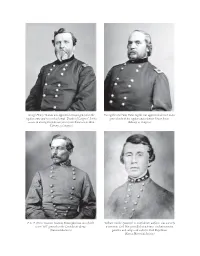
George Henry Thomas Was Appointed a Major General in the Regular Army
George Henry Thomas was appointed a major general in the During the Civil War, Rufus Ingalls was appointed a brevet major regular army and received a formal “Thanks of Congress” for his general in both the regular and volunteer Union forces. success in driving Confederate forces from Tennessee in 1864. (Library of Congress) (Library of Congress) P. G. T. (Pierre Gustave Toutant) Beauregard was one of only William Clarke Quantrill, in Confederate uniform, was not only seven “full” generals in the Confederate Army. a notorious Civil War guerrilla but a former civilian teamster, (National Archives) gambler, and camp cook with the Utah Expedition. (Kansas Historical Society.) APPENDIX A William P. MacKinnon ROOTED IN UTAH Civil War Strategy and Tactics, Generals and Guerrillas n addition to chapter 1, another way to illus- officers—Thomas and Ingalls—displayed Itrate the connection between the Utah and some nervousness over the “irregular” nature Civil Wars (and the impact of the former on of their communications; the more flamboy- the latter) is to probe the extent to which three ant Beauregard was unabashedly assertive. very prominent West Point–trained Civil War It may be helpful to provide a brief biogra- generals had earlier tried to influence pros- phy for each of these three officers, though it ecution of the Utah campaign. They did so will not do justice to their distinguished and by gratuitously sending long memos to their varied service careers. General George Henry military superiors or, in one case, to influen- Thomas (July 31, 1816–March 28, 1870) was tial politicians. These documents contained one of the Union army’s principal command- information about alternate approaches to the ers in the Western Theater and won Union Great Basin accompanied by strategic recom- victories across Kentucky and Tennessee. -

Loughborough, John Norton (1832–1924)
Loughborough, John Norton (1832–1924) BRIAN E. STRAYER Brian E. Strayer, Ph.D. (University of Iowa). Strayer taught history at Jackson (MI) Junior Academy, the University of Iowa, Southern Adventist University, and Andrews University for 41 years. He has written 10 books, 120 scholarly and professional articles, 40 reviews and critiques in French and Adventist history and directed three Adventist heritage tours of New England. He writes a weekly column (“The Past Is Always Present”) in the Journal Era and shares Adventist history at camp meetings, schools, and churches. John Norton Loughborough’s seventy-two years of ministry as a pioneering evangelist, missionary, author, organizer, and administrator had a major impact on the shaping Seventh-day Adventism.1 Early Life and Education Loughborough’s ancestors, John and Hannah Loofbourrow, emigrated from England to America in 1684 and settled in New Jersey. By the early nineteenth century, their descendants, the Loofboroughs, moved to Victor Township in upstate J. N. Loughborough 2 Photo courtesy of the General Conference of Seventh-day New York. Adventists Archives. John Norton Loofborough was born on Main Street in Victor on January 26, 1832, the second son of Nathan Benson Loofborough (1802-1839), a skilled carpenter, cabinet-maker, and Methodist exhorter, and Minerva Norton (1801-1894), daughter of a wealthy local family. Together they had five children: William Kerr (b. 1827), Minerva Jane (b. 1829), John Norton (b. 1832), Eber C. (b. 1837), and Sarah Diantha (b. 1840). Since John’s grandfather and father were lay preachers in the local Methodist Episcopal Church (which they had erected in 1820), John received a thorough indoctrination in Methodist beliefs at home and in Sunday school, church services, prayer meetings, and singing classes. -

Margaret Stafford Worth
University of Oklahoma College of Law University of Oklahoma College of Law Digital Commons American Indian and Alaskan Native Documents in the Congressional Serial Set: 1817-1899 5-23-1888 Margaret Stafford Worth. Follow this and additional works at: https://digitalcommons.law.ou.edu/indianserialset Part of the Indian and Aboriginal Law Commons Recommended Citation H.R. Rep. No. 2292, 50th Cong., 1st Sess. (1888) This House Report is brought to you for free and open access by University of Oklahoma College of Law Digital Commons. It has been accepted for inclusion in American Indian and Alaskan Native Documents in the Congressional Serial Set: 1817-1899 by an authorized administrator of University of Oklahoma College of Law Digital Commons. For more information, please contact darinfox@ou.edu. aOTH CoNGRESS, } HOUSE OF REPRESENTATIVES. REPORT 1st Session. { No.2292. MARGARET STAFFORD WORTH. MAY 23, 1888.-Committed to the Committee of the Whole House and ordered to be printed. M.r. BLISS, from the Committee on Pensions, submitted the following REPORT: [To accompanybill S. 867.1 The Committee on Pensions, to whom was referred the bill (S. 867) granting a pension to Margaret Stafford Worth, report that the case was considered and favorably reported by the Committee on Pensions at the last Congress. This committee again report the c) aim, with the recommendation that it do pass, adopting as its report the statement of facts presented with the former report, as follows: The claimant, Miss Margaret. Stafford Worth, is the only surviving unmarried daughter ofthe distinguished Maj. Gen. WilliamJ. Worth. She is now living in the city of Washington, with seven of her fathe1·'s grandchildren to support, in great povert.y and without adequate means of subsil:;tence. -

Interpretive Plan for the Shenandoah Valley Battlefields National Historic District Project No
Interpretive Plan for the Shenandoah Valley Battlefields National Historic District Project No. GA-2255-03-016 Prepared for the Shenandoah Valley Battlefields Foundation Prepared by John Milner Associates, Inc. and Riggs/Ward Design, PC November 2008 Interpretive Plan for the Shenandoah Valley Battlefields National Historic District Project No. GA-2255-03-016 Prepared for the Shenandoah Valley Battlefields Foundation New Market, Virginia Prepared by John Milner Associates, Inc. Architects, Landscape Architects, Archeologists, Planners West Chester, Pennsylvania with Riggs Ward Design Exhibit Designers Richmond, Virginia November 2008 The views and conclusions contained in this document are those of the authors and should not be interpreted as representing the opinions or policies of the U.S. Government. Mention of trade names or commercial products does not constitute their endorsement by the U.S. Government. Shenandoah Valley Battlefields National Historic District Interpretive Plan Table of Contents ACKNOWLEDGMENTS vii EXECUTIVE SUMMARY ix PART I: CONTEXT FOR INTERPRETATION Chapter 1 Vision, Purpose and Background 1-1 1.1 Shenandoah Valley Battlefields National Historic District 1-1 1.2 Management and Implementation Plans 1-3 1.3 Interpretive Plan Guidelines, 2001 1-3 1.4 Goals for Providing a Meaningful Interpretive Experience 1-4 1.5 Interpretive Vision and Approach 1-5 Chapter 2 Existing Interpretation in the Valley 2-1 2.1 An Overview of Existing Interpretation 2-1 2.2 Regional Attractions 2-1 2.3 Interpretive Attractions 2-2 2.4 -

The Western Health Reform Institute
Avondale College ResearchOnline@Avondale Science and Mathematics Book Chapters School of Science and Mathematics 11-2015 The Western Health Reform Institute Paul U. Cameron Monash University, paul.u.cameron@monash.edu Lynden Rogers Avondale College of Higher Education, lynden.rogers@avondale.edu.au Follow this and additional works at: https://research.avondale.edu.au/sci_math_chapters Part of the Other Medicine and Health Sciences Commons Recommended Citation Cameron, P. U., & Rogers, L. J. (2015). The western health reform institute. In L. Rogers (Ed.), Changing attitudes to science within Adventist health and medicine from 1865 to 2015 (pp. 1-13). Cooranbong, Australia: Avondale Academic Press. This Book Chapter is brought to you for free and open access by the School of Science and Mathematics at ResearchOnline@Avondale. It has been accepted for inclusion in Science and Mathematics Book Chapters by an authorized administrator of ResearchOnline@Avondale. For more information, please contact alicia.starr@avondale.edu.au. Chapter 1 The Western Health Reform Institute Paul U. Cameron and Lynden J. Rogers Introduction The grand opening of the Western Health Reform Institute (WHRI) in Battle Creek, Michigan, on September 5, 1866, was a gala occasion. It was only a short time after Ellen White had focussed attention on the need for such an institution during her stirring address to the 1866 General Conference Session. Despite having limited means, some $11,000 had been raised by gift or subscription loan during a fundraising campaign spearheaded by Elders John N. Loughborough in the West and John N. Andrews in the East. On September 11 the editor of the Review and Herald, Uriah Smith, reported on the successful opening, noting that, “it was less than four short months ago, for the time when this matter first began to take practical shape among our people.”1 J. -

Almira Russell Hancock
University of Oklahoma College of Law University of Oklahoma College of Law Digital Commons American Indian and Alaskan Native Documents in the Congressional Serial Set: 1817-1899 3-12-1886 Almira Russell Hancock. Follow this and additional works at: https://digitalcommons.law.ou.edu/indianserialset Part of the Indian and Aboriginal Law Commons Recommended Citation H.R. Rep. No. 1023, 49th Cong., 1st Sess. (1886) This House Report is brought to you for free and open access by University of Oklahoma College of Law Digital Commons. It has been accepted for inclusion in American Indian and Alaskan Native Documents in the Congressional Serial Set: 1817-1899 by an authorized administrator of University of Oklahoma College of Law Digital Commons. For more information, please contact darinfox@ou.edu. 49TH CONGRESS, } HOUSE OF REPRESENTATIVES. {REPORT lst Session. No.1023. • ALMIRA RUSSELL HANCOCK. MARCH 12, 1886.-Committed to the Committee of the Whole House and ordered to be printed. Mr. SwoPE, from the Committee on Invalid Pensions, submitted the following REPORT: [To accompany bill H. R. 5841.1 The Committee on Invalid Pensions, to whom was referred the bill (H. R. 5841) granting a pension to Alm,ira Rw;sell Hancock, having had the-same under catteful considera.tion, respectfully suMnit the following report : General Hancock was an illustrious actor in the critical hours and dark days which overshadowed the history of bis country. It will· never be disputed that he met all the demands of these great and mem or·able occasious with a patriotic self-consecration and with a matchless soldiership that was fruitful of good fortune to his country.