Annual Report
Total Page:16
File Type:pdf, Size:1020Kb
Load more
Recommended publications
-
41392-023: Decentralized Public Service and Financial Management
Due Diligence Report on Social Safeguard July 2019 CAM: Decentralized Public Service and Financial Management Sector Development Project, Subprogram 2: Sub-National Investment Fund (SNIF) Prepared by SNIF Secretariat for Asian Development Bank (ADB). The Due Diligence Report on Social Safeguard is a document of the borrower. The views expressed herein do not necessarily represent those of ADB's Board of Directors, Management, or staff, and may be preliminary in nature. In preparing any country program or strategy, financing any project, or by making any designation of or reference to a particular territory or geographic area in this document, the Asian Development Bank does not intend to make any judgments as to the legal or other status. 1 Contents CURRENCY EQUIVALENTS .......................................................................................................... 3 ABBREVIATIONS ........................................................................................................................... 3 I. BACKGROUND OF PROJECT AND RATIONALE ..................................................................................... 4 II. SUBPROJECT DESCRIPTION AND SCOPE OF WORKS ........................................................................ 5 III. OBJECTIVES OF THE DUE DILIGENCE REPORT ................................................................................. 10 IV. METHODOLOGY ....................................................................................................................................... 10 -

Occurrence of Sri Lankan Cassava Mosaic Virus
ACIAR-SRA Result-sharing Workshop PresentationPlace tle here of Results - 1 Occurrence of Sri Lankan cassava Date City, Country mosaic virus (SLCMV) th 19 Your Name Here July 2017, Phnom Penh, Cambodia Your e-mail here@cgiar.org Nami Minato Outline q Background – CMD and its distribution in Asia region q SRA cassava mosaic disease surveillance q Results and discussion q Notes for group discussion Cassava mosaic disease (CMD) Symptoms & Yield loss n Cassava mosaic disease infected cassava typically shows mosaic symptoms on leaves and leaf curl. n Yield losses attributed to CMD range 20 to (Photo by Sophearith Sok) 95%, and have been reported to be substantially increased following mixed infection. Transmission n Viruses causing CMD are transmitted by 1. Planting materials (cassava cuttings/seeds) 2. Insect vector, whiteflies Cassava mosaic geminiviruses (CMGs) Virus taxonomy n Viruses causing CMD (cassava mosaic geminiviruses: CMGs) belong to family Geminiviridae, genus Begomovirus. n CMD is caused by 11 species of virus, such as p African cassava mosaic virus (ACMV) p Indian cassava mosaic virus (ICMV) p Sri Lankan cassava mosaic virus (SLCMV) n CMD has been spread in Africa for over 200 years, and in South Asia (India and Sri Lanka). Spatial and temporal distribution Cassava mosaic disease in Asia Indian cassava mosaic virus (ICMV) Sri Lankan cassava mosaic virus (SLCMV) In December 2015, SLCMV was reported in Cambodia Initial report (Fauquet & Fargette, 1990, Plant Dis) 1894 African cassava mosaic disease 1956 Indian cassava mosaic disease -

Prakas on the Establishment of Secretariat of Kampot Provincial
The Khmer version is the official version of this document. Document prepared by the MLMUPC Cambodia, supported by ADB TA 3577 and LMAP TA GTZ. Ministry of Land Management, Urban Planning and Construction No. 086 Prakas/ August 01, 2002 Prakas on The Establishment of Secretariat of Kamot Provincial Cadastral Commission and Composition of Districts Cadastral Commission in the Kampot province - Referring to the Constitution Kingdom of Cambodia - Referring to Preah Reach Kret No NS/RKT/1189/72 of November 30, 1998 on the Appointment of Royal Govemment of Cambodia, - Referring to Preah Reach Kram No 02/NS/94 of July 20, 1994 promulgating the law on the Organization and Functioning of the Council of Ministers; - Referring to Preah Reach Kram No NS/RKM/0699/09 of June 23, 1999 promulgating the Law on the Establishment of the Ministry of Land Management, Urban Planning and Construction, - Referring to Preah Reach Kram No NS/RKM/0801/14 of August 30, 2001 promulgating the Land Law, - Referring to Sub-Decree No 47 ANK/BK of May 31, 2002 on the Organization and Functioning of the Cadastral Commission, - Referring to Sub-Decree No 347 ANK/BK of July 17, 2002 on Nomination of Composition of the National Cadastral Commission; - Referring to Joint Prakas No 077 PK. of July 16, 2002 on Nomination of Composition of the Provincial/Municipal Cadastral Commission; - Pursuant to the proposal of Kampot Cadastral Commission Decision Praka 1: The Secretariat of Kampot Provincial Cadastral Commission should have been established in which it was composed of the following members: - Mr. Yin Vuth, chief of the office LMUPC and Geog. -

Promoting Sustainable Agriculture in Samroung Commune, Prey Chhor District, Kampong Cham Province Through Network of RCE Greater Phnom Penh
Promoting Sustainable Agriculture in Samroung Commune, Prey Chhor District, Kampong Cham Province through Network of RCE Greater Phnom Penh Saruom RAN Cambodia Branch, Institute of Environment Rehabilitation and Conservation, Phnom Penh, Cambodia Email: cam-erecon@hotmail.com Kanako KOBAYASHI Extension Center, Institute of Environment Rehabilitation and Conservation, Tokyo, Japan Lalita SIRIWATTANANON Rajamangala University of Technology Thanyaburi, Pathum Thani, Thailand / Southeast Asia Office, Institute of Environment Rehabilitation and Conservation, Pathum Thani, Thailand Machito MIHARA Institute of Environment Rehabilitation and Conservation, Tokyo, Japan / Faculty of Regional Environment Science, Tokyo University of Agriculture, Tokyo, Japan Bunthan NGO Royal University of Agriculture, Phnom Penh, Cambodia / Institute of Environment Rehabilitation and Conservation, Tokyo, Japan Abstract: Agriculture is one of the important sectors in Cambodia, as more than 70 percent of populations are engaging in the agricultural sector. Phnom Penh is the capital of Cambodia having more than 1.3 million people. RCE Greater Phnom Penh (RCE GPP) was established in December 2009 to promote ESD in Cambodia. RCE Greater Phnom Penh covers not only Phnom Penh but also surrounding provinces, such as Kampong Cham, Kampong Chhnang, Kampong Speu, Kandal, Prey Veng and Takeo. Recently, in Kampong Cham province of Cambodia, subsistence agriculture tends to be converted to mono-culture. Also, more that 60 percent of farmers have been applying agricultural chemicals without understanding the impact on health and food safety. It is necessary to promote and enhance the understanding of sustainable agriculture among local people including farmers and elementary school students, as the students are the successors of local farmers. So, attention has been paid to Education for Sustainable Development (ESD) in the agricultural sector for achieving food safety, conserving environment and reducing expense for agricultural chemicals in Kampong Cham province. -
DC-Cam 2015 Annual Report
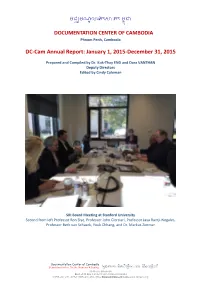
mCÄmNÐlÉkßrkm<úCa DOCUMENTATION CENTER OF CAMBODIA Phnom Penh, Cambodia DC-Cam Annual Report: January 1, 2015-December 31, 2015 Prepared and Compiled by Dr. Kok-Thay ENG and Dara VANTHAN Deputy Directors Edited by Cindy Coleman SRI Board Meeting at Stanford University Second from left Professor Ron Slye, Professor John Ciorciari, Professor Jaya Ramji-Nogales, Professor Beth van Schaack, Youk Chhang, and Dr. Markus Zimmer Documentation Center of Cambodia Searching for the Truth: Memory & Justice EsVgrkKrBitedIm, IK rcg©MnigyutþiFm‘’ 66 Preah Sihanouk Blvd.P.O.Box 1110Phnom PenhCambodia t(855-23) 211-875f (855-23) 210-358 dccam@online.com.kh www.dccam.org TABLE OF CONTENTS DOCUMENTATION CENTER OF CAMBODIA ............................................................................... 1 TABLE OF CONTENTS ........................................................................................................................ 2 ACRONYMS ................................................................................................................................ 3 Summary .................................................................................................................................... 4 AUGMENT AND MAINTAIN A PUBLICALLY ACCESSIBLE HISTORICAL RECORD OF THE KR PERIOD ...................... 4 SUPPORT THE KRT .......................................................................................................................... 5 INCREASE CAMBODIA’S PUBLIC KNOWLEDGE OF THE KR PERIOD ............................................................. -

Ggácmnmucrmhvisambaøkñú
01074906 E1/273.1 ŪĮйŬď₧şŪ˝˝ņįО ď ďijЊ ⅜₤Ĝ ŪĮйņΉ˝℮Ūij GgÁCMnMuCRmHvisamBaØkñúgtulakarkm <úCa Kingdom of Cambodia Nation Religion King Extraordinary Chambers in the Courts of Cambodia Royaume du Cambodge Chambres Extraordinaires au sein des Tribunaux Cambodgiens Nation Religion Roi Β₣ðĄеĕНеĄŪņй⅜ŵřеĠР₣ Trial Chamber Chambre de première instance TRANSCRIPT OF TRIAL PROCEEDINGS PUBLIC Case File Nº 002/19-09-2007-ECCC/TC 9 March 2015 Trial Day 254 Before the Judges: NIL Nonn, Presiding The Accused: NUON Chea YA Sokhan KHIEU Samphan Claudia FENZ Jean-Marc LAVERGNE YOU Ottara Lawyers for the Accused: Martin KAROPKIN (Reserve) Victor KOPPE THOU Mony (Reserve) SON Arun SUON Visal KONG Sam Onn Trial Chamber Greffiers/Legal Officers: Arthur VERCKEN SE Kolvuthy Matthew MCCARTHY Lawyers for the Civil Parties: For the Office of the Co-Prosecutors: Marie GUIRAUD Nicolas KOUMJIAN LOR Chunthy SONG Chorvoin VEN Pov Dale LYSAK For Court Management Section: UCH Arun SOUR Sotheavy 01074907 E1/273.1 Extraordinary Chambers in the Courts of Cambodia Trial Chamber – Trial Day 254 Case No. 002/19-09-2007-ECCC/TC 09/03/2015 I N D E X MR. NEANG OUCH ALIAS TA SAN (2-TCW-803) Questioning by the President .......................................................................................................... page 6 Questioning by Ms. Song Chorvoin .............................................................................................. page 10 Questioning by Mr. Koumjian ........................................................................................................ page 23 Page i 01074908 E1/273.1 Extraordinary Chambers in the Courts of Cambodia Trial Chamber – Trial Day 254 Case No. 002/19-09-2007-ECCC/TC 09/03/2015 List of Speakers: Language used unless specified otherwise in the transcript Speaker Language JUDGE FENZ English MR. KONG SAM ONN Khmer MR. -

A Field Trip's Report in Veal Veng District, Pursat
mCÄmNÐlÉkßrkm<úCa DC-Cam’s Promoting Accountability Project A Field Trip’s Report in Veal Veng District, Pursat Province May 18-24, 2011 By Long Dany General Description and Brief History of Districts After the integration of the Khmer Rouge forces by the Cambodian government in 1996, Veal Veng was created as a district in Pursat province. Previously, Veal Veng had been one of the communes included within the Kravanh district. Veal Veng is approximately 120 kilometers from Pursat, and it can be reached by Road Number 56 which links Pursat and Veal Veng across the Kavanh district. The road between Pursat and Kravanh district is paved and smooth, but the road from the Kravanh district to Veal Veng is bumpy and rough. It is a gravel paved road with several old and ailing bridges. The Veal Veng district town is located 75 kilometers from the Thai border of the Trat province. The border checkpoint is called Thma Da. Nowadays, the authorities of both countries allow their citizens to cross the border only on Saturdays. Approximately 60 kilometers south of the Veal Veng district is the O Ta Som commune, where a Chinese company is building a hydroelectric power station. O Ta Som is just about 40 kilometers from the Koh Kong provincial town. Veal Veng comprises of five communes: Pramoy, Anlong Reap, O Ta Som, Kra Peu Pi, and Thma Da. Veal Veng has a population of 13,822 people—3,197 families. At the present time, the government is drafting a decree to create more communes and villages for Veal Veng because of its huge space of land. -
20111031 01.Pdf
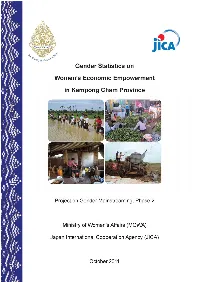
PREFACE Ministry of Women's Affairs (MOWA) is the national machinery for promoting gender equity and women's empowerment. MOWA also acts a catalyst and advocate to encourage public institutions, civil society and private sector to integrate gender equity into their policies and programs. In this regard, MOWA has developed Neary Rattanak III, Five-Year Strategic Plan (2009-2013) for gender equity and empowerment of women in Cambodia. Project on Gender Mainstreaming, Phase 2 (PGM 2) has been implemented since September 2010 with supports by Japan International Cooperation Agency (JICA). Its Project Purpose is "Effective system for implementing women's economic empowerment activities by partner line ministries becomes operational with coordination of MOWA through strengthening gender mainstreaming mechanism". As an important part of the PGM 2 Activities, this "Gender Statistics on Women's Economic Empowerment in Kampong Cham Province" was compiled with great efforts of MOWA counterparts together with technical supports by JICA Project Team. The data and information in this booklet highlight women's economic and social situation as well as their empowerment in KPC Province. Therefore, I believe that this booklet will be utilized by provincial government officials and other concerned parties for examining gender responsive policies and plans in KPC Province. ACKNOWLEDGEMENT Through both technical and financial supports from Japan International Cooperation Agency (JICA), in cooperation with the Ministry of Women's Affairs (MOWA), a booklet titled "Gender Statistics on Women's Economic Empowerment in Kampong Cham Province" has been published . This booklet is utilized for our provincial government officials, concerned departments, other development partners and stakeholders to formulate gender responsive plans and programs in the province for accelerating economic empowerment of women as a step for the country development. -

Social Safeguards Due Diligence Report (Kampong Cham)
Social Safeguards Due Diligence Report Project No. 50099 May 2018 CAM: Fourth Greater Mekong Subregion Corridor Towns Development Kampong Cham CONTENTS I. INTRODUCTION 1 II. KAMPONG CHAM SUBPROJECT DESCRIPTION AND COMPONENTS 1 III. OBJECTIVE OF DUE DILIGENCE AND METHODOLGY 3 A. Objective and Scope of Due Diligence 3 B. Methodology 4 IV. PROPOSED PROJECT IMPLEMENTATION ARRANGEMENTS 4 V. PHYSICAL WORKS 5 VI. DUE DILIGENCE FINDINGS 7 A. Land Acquisition and Impact Screening 7 B. Temporary Disturbance 11 C. Consultations 11 VII. GRIEVANCE REDRESS MECHANISM 11 VIII. VII.CONCLUSION AND RECOMMENDATION 12 APPENDIXES 1. Kampong Cham WWTP and Landfill Land Certificates 2. List of Persons Met and Photos FIGURES Figure 1 Location Map of the Participating Town Figure 2 Proposed Combined Sewer Service Area and Location of Wastewater Treatment Plant in Kampong Cham Figure 3 Location of the Proposed Kampong Cham Controlled Landfill Figure 4 Conceptual Layout of the Kampong Cham Wastewater Treatment Plant Figure 5 Conceptual Layout of the Proposed Kampong Cham Controlled Landfill Figure 6 Location map of the proposed Boeng Bassac Lagoon Figure 7 Photos of WWTP Site and the Pump House Figure 8 Photos of the Proposed Controlled Landfill Site in Kampong Cham I. INTRODUCTION 1. The Fourth Greater Mekong Subregion Corridor Towns Development Project (GMS- CTDP-4 or Project) will support the Governments of Cambodia and the Lao People’s Democratic Republic in enhancing the competitiveness of selected towns located along the Central Mekong Economic Corridor in the Greater Mekong Subregion (GMS). It is aligned with the Government of Cambodia’s Rectangular Strategy for national development. -
Evaluation Report on ECHO Funded Humanitarian Mine Action Pilot Projects in North-West of Cambodia
James Madison University JMU Scholarly Commons Center for International Stabilization and Global CWD Repository Recovery Fall 10-2003 Evaluation Report on ECHO Funded Humanitarian Mine Action Pilot Projects in North-West of Cambodia Marcel Durocher Agim Hoti Mok Tonh Keo Vut Follow this and additional works at: https://commons.lib.jmu.edu/cisr-globalcwd Part of the Defense and Security Studies Commons, Peace and Conflict Studies Commons, Public Policy Commons, and the Social Policy Commons Recommended Citation Durocher, Marcel; Hoti, Agim; Tonh, Mok; and Vut, Keo, "Evaluation Report on ECHO Funded Humanitarian Mine Action Pilot Projects in North-West of Cambodia" (2003). Global CWD Repository. 1132. https://commons.lib.jmu.edu/cisr-globalcwd/1132 This Article is brought to you for free and open access by the Center for International Stabilization and Recovery at JMU Scholarly Commons. It has been accepted for inclusion in Global CWD Repository by an authorized administrator of JMU Scholarly Commons. For more information, please contact dc_admin@jmu.edu. EVALUATION REPORT ON ECHO FUNDED HUMANITARIAN MINE ACTION PILOT PROJECTS IN NORTH-WEST OF CAMBODIA th October 6 2003 Marcel Durocher Agim Hoti Mok Tonh Keo Vuthy TABLE OF CONTENTS ACRONYMS AND ABBREVIATIONS.......................................................................................................... 5 ACKNOWLEDGEMENTS .............................................................................................................................. 6 INTRODUCTION............................................................................................................................................ -

Community Self-Reliance and Flood Risk Reduction (Financed by the Poverty Reduction Cooperation Fund)
Technical Assistance Consultant’s Report Project Number: 37290 September 2007 Kingdom of Cambodia: Community Self-Reliance and Flood Risk Reduction (Financed by the Poverty Reduction Cooperation Fund) Prepared by Asian Disaster Preparedness Center Bangkok, Thailand For Ministry of Water Resources and Meteorology This consultant’s report does not necessarily reflect the views of ADB or the Government concerned, and ADB and the Government cannot be held liable for its contents. Table of Contents A Background of the TA………………………………………………………………………...03 B Executive Summary of significant activities under the project……………………....05 C Details for each activity under the two phases of the TA………………………………08 1. Designing the community participation model…………………………………………09 1.1 Understanding NGO interventions in Flood Risk Reduction 1.1.1 Description of NGO projects in Cambodia 1.1. 2 NGO projects on flood risk reduction in 4 TA target provinces 1.1. 3 NGO approaches to flood risk reduction 1.1.4 Typical constraints to effectiveness of NGO interventions 1.2 Developing a simple GIS……………………………………………………………………21 1.2.1 Development of a Flood Vulnerability GIS Application 1.2.2 Flood vulnerability GIS – Atlas Interpretation Guide 1.2.3 GIS Maps for ready reference 1.3 Undertaking a brief survey within target provinces for identifying key community needs in flood and drought risk reduction………………………………………………………26 1.4 Identification of target areas and prioritizing areas for future interventions……..27 1.5 Selecting NGOs for undertaking pilot community based flood risk reduction action in the target areas identified………………………………………………………………………28 1.6 Developing a Community Based Disaster Risk Reduction (CBDRR) Strategy……29 1.7 Workshop on CBDRR Strategy…………………………………………………………….33 1.7.1 Consultative workshop on CBDRR Strategy 1.7.2 6th Meeting of the Cambodia Disaster Risk Reduction Forum 2. -

Effects of Microfinance on Agricultural Occupation
DOI: 10.7763/IPEDR. 2012. V46. 13 Effects of Microfinance on Agricultural Occupation Case Study in Battambang Province Svay Sopheana1, Chov Elen1, Leng Bunhor1, Touch Visalsok1, and Nigel Finch2 1 University of Battambang, National Road No.5, Sangkar Prek Preah Sdach, Battambang City, Cambodia 2 The University of Sydney Business School, Room 537, Economics and Business Building (H69), NSW 2006 AUSTRALIA Abstract. The study aims to explore the effects of micro-credit provided by microfinance institutes in changing the agricultural occupation of local famers. The hypothesis proposed that an improvement in the standard of living for micro-credit users’ is dependent on their occupation. A hundred sample households receiving micro-credit loans from microfinance institutes were selected for the interview from Sangkae, Thmar Koul and Sampov Loun district of Battambang province. Cluster Sampling Method was used to determine the location of the study, while Simple Random Sampling Method was used to select households. The results indicated that agriculture is the main occupation of most households. Most households therefore used micro-credit for buying agricultural equipment. It was found that microfinance contributes to increased income, household consumption and savings for households. Moreover, there was an increase in employment rate and economic activities in the districts. However, households which had not used micro-credit in the proper way have sold their property and land to repay the loans. Despite some negative effects, this study found that microfinance has generally improved agriculture works and the welfare of households. Keywords: Microfinance; Micro-credit; Agricultural Occupation 1. Introduction Microfinance is often defined as financial services such as credit services, money transfers and insurance for poor and low-income clients (Plamondon, 2001).