CANOEING at 1936 OLYMPIC GAMES Siarhei SHABLYKA 2011
Total Page:16
File Type:pdf, Size:1020Kb
Load more
Recommended publications
-

The Berlin Olympics: Sports, Anti-Semitism, and Propaganda in Nazi Germany Nathan W
Student Publications Student Scholarship Spring 2016 The Berlin Olympics: Sports, Anti-Semitism, and Propaganda in Nazi Germany Nathan W. Cody Gettysburg College Follow this and additional works at: https://cupola.gettysburg.edu/student_scholarship Part of the European History Commons, Political History Commons, Social History Commons, and the Sports Studies Commons Share feedback about the accessibility of this item. Cody, Nathan W., "The Berlin Olympics: Sports, Anti-Semitism, and Propaganda in Nazi Germany" (2016). Student Publications. 434. https://cupola.gettysburg.edu/student_scholarship/434 This is the author's version of the work. This publication appears in Gettysburg College's institutional repository by permission of the copyright owner for personal use, not for redistribution. Cupola permanent link: https://cupola.gettysburg.edu/student_scholarship/ 434 This open access student research paper is brought to you by The uC pola: Scholarship at Gettysburg College. It has been accepted for inclusion by an authorized administrator of The uC pola. For more information, please contact cupola@gettysburg.edu. The Berlin Olympics: Sports, Anti-Semitism, and Propaganda in Nazi Germany Abstract The aN zis utilized the Berlin Olympics of 1936 as anti-Semitic propaganda within their racial ideology. When the Nazis took power in 1933 they immediately sought to coordinate all aspects of German life, including sports. The process of coordination was designed to Aryanize sport by excluding non-Aryans and promoting sport as a means to prepare for military training. The 1936 Olympic Games in Berlin became the ideal platform for Hitler and the Nazis to display the physical superiority of the Aryan race. However, the exclusion of non-Aryans prompted a boycott debate that threatened Berlin’s position as host. -

A Leader's Guide To
A Leader’s Guide to couNT on me Brad Herzog A Leader’s Guide to Count on Me: Sports by Brad Herzog, copyright © 2014. Free Spirit Publishing Inc., Minneapolis, MN; 1-800-735-7323; www.freespirit.com. All rights reserved. A Leader’s Guide to Count on Me: Sports by Brad Herzog, copyright © 2014. Free Spirit Publishing Inc., Minneapolis, MN; 1-800-735-7323; www.freespirit.com. All rights reserved. CONTENTS A NOTE TO TEACHERS, COACHES, YOUTH LEADERS, PARENTS, AND OTHER ADULTS ...............4 INSPIRING STORIES OF SPORTSMANSHIP .................................................................................5 Questions for Reflection, Discussion, and Writing POWERFUL STORIES OF PERSEVERANCE IN SPORTS .................................................................8 Questions for Reflection, Discussion, and Writing REMARKABLE STORIES OF TEAMWORK IN SPORTS ................................................................. 11 Questions for Reflection, Discussion, and Writing AWESOME STORIES OF GENEROSITY IN SPORTS ..................................................................... 14 Questions for Reflection, Discussion, and Writing INCREDIBLE STORIES OF COURAGE IN SPORTS ........................................................................17 Questions for Reflection, Discussion, and Writing ABOUT THE AUTHOR....................................................................................................................21 A Note to Teachers, Coaches, Youth Leaders, Parents, and Other Adults The Count on Me: Sports series is a collection -

Uncanny Resemblances? Captive Audience Positions and Media-Conscious Performances in Berlin During the 1936 Summer Olympics and the 2006 FIFA World Cup
International Journal of Communication 13(2019), 5310–5332 1932–8036/20190005 Uncanny Resemblances? Captive Audience Positions and Media-Conscious Performances in Berlin During the 1936 Summer Olympics and the 2006 FIFA World Cup SAMI KOLAMO University of Tampere, Finland JANI VUOLTEENAHO University of Helsinki, Finland With an eye to attracting global media attention, the ordinary cityscape is purposefully transformed into an out-of-the-ordinary eventscape during major sports occasions. Focusing on the production of captive audience positions and event-goers’ associated media-conscious performances, this article compares the implementation of event spaces in the totalitarian-propagandist context of the 1936 Berlin Olympics with the commercially branded 2006 FIFA World Cup in Germany. Apart from blatant dissimilarities in ideological-commercial motifs and emotionally charged forms of audiencehood between these urban spectacles, variable media-densified audience positions were carefully built into the design of both events. The key commonalities include the turning of urban public spaces into strictly controlled event enclaves, civic education aimed at image leveraging through ambassadorial conduct, and atmospheric intensification by enthusiastic audience-performers. We conclude that these measures to maximize positive media publicity continue to steer, in increasingly multimedial ways, the production of urban megaevents even in the digitalized present. Keywords: cityscape–mediascape interplay, sports megaevents, propaganda, branding, captive -
How Successful Were the Nazi's in Presenting a Positive Image Of
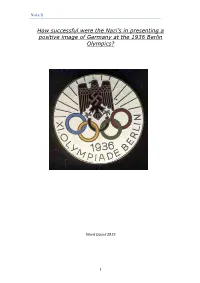
Nota D How successful were the Nazi’s in presenting a positive image of Germany at the 1936 Berlin Olympics? Word Count 3919 1 Nota D Index Introduction…………………………………….. Page 3 Body………………………………………………... Page 4 Nazi Germany……………………………………. Page 4 The Use of Propaganda………………………. Page 6 The Games………………………………………….. Page 10 Conclusion………………………………………. Page 11 Bibliography…………………………………… Page 12 2 Nota D Introduction The 1936 Berlin Olympics were held during the rule of Adolf Hitler, who had risen into power in 1934 and faced a lot of pressure from the countries inside Europe because they questioned their idea of a dictatorship. During the period between 1932, year in which the venue for the 1936 Olympics was decided and when the Games started in August 1936 there was a very big focus on using the Olympic Games as a mean of propaganda to attempt to show a positive image of Germany to the rest of the world and also to the people inside Germany. Throughout this essay I am going to analyze the ways in which Hitler attempted to create this positive image of Germany and how successful it was on displaying it. The idea is to understand how they managed to use the Olympic games and turn them into a political advantage that gain control over Germany and the start of the World War.1 The Berlin Games were a huge opportunity to ease the tension that Hitler’s regime was creating at that time, attempting to postpone any further political or social problems as far as possible. This was of great importance because the Games would draw peoples attention from the Nazi Party and the problems that Germany was facing at the time. -

Die Deutsche Olympiamannschaft the German Olympic Team London 2012
Die Deutsche Olympiamannschaft The German Olympic Team London 2012 DOSB l Sport bewegt! DOSB l Sport bewegt! Wann ist ein Geldinstitut gut für Deutschland? Wenn es nicht nur in Geld - an lagen investiert. Sondern auch in junge Talente. Sparkassen unterstützen den Sport in allen Regio- nen Deutschlands. Sport fördert ein gutes gesellschaft- liches Miteinander durch Teamgeist, Toleranz und fairen Wettbewerb. Als größter nichtstaatlicher Sportförderer Deutschlands engagiert sich die Sparkassen-Finanzgruppe im Breiten- und Spitzensport besonders für die Nach- wuchs förderung. Das ist gut für den Sport und gut für Deutschland. www.gut-fuer-deutschland.de Sparkassen. Gut für Deutschland. Deutscher Olympischer SportBund l Otto-Fleck-Schneise 12 l D-60528 Frankfurt am Main Tel. +49 (0) 69 / 67 00 0 l Fax +49 (0) 69 / 67 49 06 l www.dosb.de l E-Mail office@dosb.de SPK_115×200+3_Sport_Mannschaftsbrosch.indd 1 11.06.12 15:23 Vorwort l Foreword Thomas Bach London genießt gerade unter jungen London exerts an immense attraction, Menschen eine ungeheure Anziehungs- particularly among young people. The Präsident des Deutschen Olympischen Sportbundes (DOSB), kraft. Das britische Empire hat der Stadt ein British Empire has bequeathed an attrac- IOC-Vizepräsident, attraktives Erbe hinterlassen. Menschen aus tive ambience to the city. People from 160 Olympiasieger Florettfechten Montreal 1976 160 Nationen prägen ihr Bild. Ein Blick auf countries enliven the cityscape. A glance at President of the German Olympic Sports Confederation deren Teilnehmerzahlen -

000 CANOEING at 1936-2008 OLYMPIC GAMES MEDAL
OLYMPIC GAMES MEDAL WINNERS Sprint and Slalom 1936 to 2008 1 MEDAL WINNERS TABLE (SPRINT) 1936 to 2008 SUMMER OLYMPICS Year s and Host Cities Medals per Event Gold Silver Bronze MEN K-1, 10 000 m (collapsible) 1936 Berlin, Gregor Hradetzky Henri Eberhardt Xaver Hörmann Germany Austria (AUT) France (FRA) Germany (GER) MEN K-2, 10 000 m (collapsible) 1936 Berlin, Sven Johansson Willi Horn Piet Wijdekop Germany Erik Bladström Erich Hanisch Cees Wijdekop Sweden (SWE) Germany (GER) Netherlands (NED) MEN K-1, 10 000 m 1936 Berlin, Ernst Krebs Fritz Landertinger Ernest Riedel Germany Germany (GER) Austria (AUT) United States (USA) 1948 London, Gert Fredriksson Kurt Wires Eivind Skabo United Kingdom Sweden (SWE) Finland (FIN) Norway (NOR) 1952 Helsinki, Thorvald Strömberg Gert Fredriksson Michael Scheuer Finland Finland (FIN) Sweden (SWE) West Germany (FRG) 1956 Melbourne, Gert Fredriksson Ferenc Hatlaczky Michael Scheuer Australia Sweden (SWE) Hungary (HUN) Germany (EUA) MEN K-2, 10 000 m 1936 Berlin, Paul Wevers Viktor Kalisch Tage Fahlborg Germany Ludwig Landen Karl Steinhuber Helge Larsson Germany (GER) Austria (AUT) Sweden (SWE) 1948 London, Gunnar Åkerlund Ivar Mathisen Thor Axelsson United Kingdom Hans Wetterström Knut Østby Nils Björklöf Sweden (SWE) Norway (NOR) Finland (FIN) 1952 Helsinki, Kurt Wires Gunnar Åkerlund Ferenc Varga Finland Yrjö Hietanen Hans Wetterström József Gurovits Finland (FIN) Sweden (SWE) Hungary (HUN) 1956 Melbourne, János Urányi Fritz Briel Dennis Green Australia László Fábián Theodor Kleine Walter Brown Hungary -

Regras Básicas Resumo Principais Medalhistas Resultados Rio 2016 Ilustrações
Almanaque Olímpico Verônica Oliveira dos Santos Vitória Caroline Ferreira SUMÁRIO 1. MODALIDADES ESPORTIVAS ATLETISMO REGRAS BÁSICAS RESUMO PRINCIPAIS MEDALHISTAS RESULTADOS RIO 2016 ILUSTRAÇÕES CANOAGEM REGRAS BÁSICAS PRINCIPAIS MEDALHISTAS RESULTADOS RIO 2016 ILUSTRAÇÕES BADMINTON REGRAS BÁSICAS PRINCIPAIS MEDALHISTAS RESULTADOS RIO 2016 ILUSTRAÇÕES BASQUETE REGRAS BÁSICAS PRINCIPAIS MEDALHISTAS RESULTADOS RIO 2016 ILUSTRAÇÕES BOXE REGRAS BÁSICAS PRINCIPAIS MEDALHISTAS RESULTADOS RIO 2016 ILUSTRAÇÕES REGRAS BÁSICAS - Atletismo Em todas as corridas (inclusive a prova dos 400m), cada atleta deve ter uma raia separada, com uma largura máxima de 1,22m, incluindo as linhas das raias, que são marcadas por linhas brancas de 5cm de largura. Na prova da corrida com barreiras, os obstáculos devem ser feitos de metal e madeira. De acordo com a Confederação de Atletismo, a barreira tem que ser montada de uma forma que para derrubá- la seja necessária uma força pelo menos igual ao peso de 3,6Kg aplicada horizontalmente para o centro da borda de cima da barra superior. Se durante a prova do arremesso de peso, o competidor tocar com qualquer parte do seu corpo em qualquer parte do anteparo, além de seu lado interno, o arremesso não vai valer No lançamento de disco, o disco deve ter placas metálicas circulares cravadas no centro de suas faces. O lançamento de dardo só será validade somente se a ponta da cabeça metálica do dardo tocar o solo antes que qualquer outra parte. No salto com vara, o atleta pode iniciar sua corrida de aproximação na inclinação da pista oval, desde que os últimos 40 metros sejam corridos no corredor em superfície nivelada. -

Olympic Canoe/Kayak Flatwater Medals & USA Results
Olympic Canoe/Kayak Flatwater Medals & USA Results By Dan Henderson The goal of this paper is to provide the reader with a clear understanding of the history of USA Canoe/Kayak Sprint performance, and where it is trending. From the data it’s clear that the USA Team international performance has been in decline, and there’s not much farther down to go. The American Canoe Association, the National Governing Body for canoe/kayak racing in the United States, is tasked with a turnaround project to stop the decline and improve performance. I believe there’s a set of solutions and that those of us within the sport now can find it: that we can provide the opportunities for American youth to prepare for and successfully compete with the best in the world, that given the opportunity many American youth will step up to the challenge and prepare and compete. Fundamental is that national leadership initiate a discussion involving all stakeholders as to what is to be accomplished, and how to develop performance based structures and programs, to build an attitude of confidence and high expectations to move our nation’s performance forward in a positive direction. It is my hope that this paper will initiate that discussion. USA Canoe/Kayak Olympic Performance 100% % Entered 90% % Top 9 80% % Medal 70% 60% Trend Line 50% 40% 30% 20% 10% 0% 1992 2012 1936 1940 1944 1948 1952 1956 1960 1964 1968 1972 1976 1980 1984 1988 1996 2000 2004 2008 2016 Chart 1 – USA Canoe/Kayak Olympic Performance In a given Olympic year, the chart above displays the percentage of total canoe/kayak events the USA Team entered, in what percentage of the total events the USA Team reached the final 1 for sprints (or top 9 for 10,000m events through 1956), and the podium (medal). -

London 1908 Olympics Gold Medal Awarded for Wrestling Among
From: Mike Graff mikegraffpr@optonline.net Subject: London 1908 Olympics Gold Medal awarded for wrestling among Olympic Memorabilia to go under the hammer Date: July 22, 2020 at 4:22 PM To: Lanny Bryant lanny@wrestlingusa.com Lanny, Please let me know if you need any additional assistance. The Olympic Memorabilia auction from RR Auction will conclude July 23. For more information, go to www.rrauction.com. Regards, Mike Graff 203/807-2575 Item #3014 London 1908 Olympics Gold Winner's Medal Now At: USD $20,000, (Estimate: USD $25,000+) London 1908 Olympics Gold Winner's Medal among Olympic Memorabilia to go under the hammer Rare winner's medal issued for wrestling at the London 1908 Olympics will be auctioned by Boston-based RR Auction. This medal was awarded to 22-year-old British wrestler Stanley Bacon, who finished first in the men's freestyle middleweight bracket after ousting fellow countryman George de Relwyskow by decision in the final match. He also competed in the men's Greco-Roman middleweight competition but was defeated in the first round by eventual silver medalist Mauritz Andersson of Sweden. Bacon rounded out his Olympic career by wrestling at the 1912 Games in Sweden and the 1920 Games in Antwerp, ultimately losing in the second round on both occasions. Designed by Bertram Mackennal, Birmingham, manufactured by Vaughton & Sons, England, . Gold, 33.5 mm, 25 gm, The front, inscribed, "Olympic Games, London 1908," features a victorious athlete being crowned with a laurel wreath by two seated females; the reverse depicts St. George, the patron saint of England, slaying a dragon as a goddess looks on. -

000 CANOEING at 1936-2008 OLYMPIC
CANOEING AT OLYMPIC GAMES Sprint and Slalom 1936 to 2008 1 C A N O E I N G AT THE 1936 TO 2008 SUMMER OLYMPICS MEDAL TABLE (SPRINT) THE 1936 TO 2008 SUMMER OLYMPICS Medals Rank Nations Gold Silver Bronze Total 1 Soviet Union (USSR) 29 13 9 51 2 Germany (GER) 21 13 9 43 3 Hungary (HUN) 19 27 25 71 4 Sweden (SWE) 15 11 4 30 5 Romania (ROU) 10 10 14 34 6 East Germany (GDR) 10 7 8 25 7 Czechoslovakia (TCH) 6 3 1 10 8 Norway (NOR) 5 4 4 13 9 Finland (FIN) 5 2 3 10 10 New Zealand (NZL) 5 2 1 8 11 Canada (CAN) 4 9 8 21 12 Italy (ITA) 4 6 3 13 13 Bulgaria (BUL) 4 5 8 17 14 Germany (EUA) 4 5 2 11 15 United States (USA) 4 3 4 11 16 Denmark (DEN) 3 5 5 13 17 Austria (AUT) 3 4 5 12 18 Australia (AUS) 2 5 10 17 19 Spain (ESP) 2 5 2 9 20 West Germany (FRG) 2 3 5 10 21 Yugoslavia (YUG) 2 2 1 5 22 Belarus (BLR) 2 0 2 4 23 China (CHN) 2 0 0 2 Czech Republic (CZE) 2 0 0 2 25 France (FRA) 1 5 11 17 26 Russia (RUS) 1 3 3 7 27 Unified Team (EUN) 1 1 0 2 28 Great Britain (GBR) 1 0 3 4 29 Ukraine (UKR) 1 0 2 3 30 Poland (POL) 0 5 11 16 31 Nether lands (NED) 0 3 5 8 32 Cuba (CUB) 0 3 0 3 33 Slovakia (SVK) 0 2 1 3 34 Latvia (LAT) 0 2 0 2 35 Moldova (MDA) 0 1 0 1 Switzerland (SUI) 0 1 0 1 36 Israel (ISR) 0 0 1 1 Overall: 170 170 170 510 2 NATIONS TABLE (SPRINT) THE 1936 TO 2008 SUMMER OLYMPICS Medals Nations and Olympics Gold Silver Bronze Total Australia (AUS) 2 5 10 17 1956 the Games of the XVI Olympiad 0 0 1 1 in Melbourne, Australia 1980 the Games of the XX II Olympiad 0 1 0 1 in Moscow, USSR 1984 the Games of the XX III Olympiad in Los Angeles, USA 0 0 1 -

A Behavioral Law and Economics Approach to Legal Regulation of Doping in Sports Shayna M
Marquette Sports Law Review Volume 19 Article 7 Issue 1 Fall Are We All Dopes? A Behavioral Law and Economics Approach to Legal Regulation of Doping in Sports Shayna M. Sigman Follow this and additional works at: http://scholarship.law.marquette.edu/sportslaw Part of the Entertainment and Sports Law Commons Repository Citation Shayna M. Sigman, Are We All Dopes? A Behavioral Law and Economics Approach to Legal Regulation of Doping in Sports, 19 Marq. Sports L. Rev. 125 (2008) Available at: http://scholarship.law.marquette.edu/sportslaw/vol19/iss1/7 This Symposium is brought to you for free and open access by the Journals at Marquette Law Scholarly Commons. For more information, please contact megan.obrien@marquette.edu. ARE WE ALL DOPES? A BEHAVIORAL LAW & ECONOMICS APPROACH TO LEGAL REGULATION OF DOPING IN SPORTS SHAYNA M. SIGMAN* INTRODUCTION You should care about the prevalence of performance-enhancing drugs (PEDs) and doping methods currently being used and abused within elite sports. You should care, not because teenagers and youth are harmed by this, even though they most likely are. 1 You should care, not because elite athletes or those attempting to become elite athletes are harmed by this, even though they most likely are. 2 Whether you are a recreational athlete or a couch potato, whether you are a serious sports fan, a casual fan, or not a fan at all, you should care about the fact that it is highly likely that you have been harmed by doping in sports. Associate Professor of Law, Jacob D. Fuchsberg Touro Law Center. -

2021 : RRCA Distance Running Hall of Fame : 1971 RRCA DISTANCE RUNNING HALL of FAME MEMBERS
2021 : RRCA Distance Running Hall of Fame : 1971 RRCA DISTANCE RUNNING HALL OF FAME MEMBERS 1971 1972 1973 1974 1975 Bob Cambell Ted Corbitt Tarzan Brown Pat Dengis Horace Ashenfleter Clarence DeMar Fred Faller Victor Drygall Leslie Pawson Don Lash Leonard Edelen Louis Gregory James Hinky Mel Porter Joseph McCluskey John J. Kelley John A. Kelley Henigan Charles Robbins H. Browning Ross Joseph Kleinerman Paul Jerry Nason Fred Wilt 1976 1977 1978 1979 1980 R.E. Johnson Eino Pentti John Hayes Joe Henderson Ruth Anderson George Sheehan Greg Rice Bill Rodgers Ray Sears Nina Kuscsik Curtis Stone Frank Shorter Aldo Scandurra Gar Williams Thomas Osler William Steiner 1981 1982 1983 1984 1985 Hal Higdon William Agee Ed Benham Clive Davies Henley Gabeau Steve Prefontaine William “Billy” Mills Paul de Bruyn Jacqueline Hansen Gordon McKenzie Ken Young Roberta Gibb- Gabe Mirkin Joan Benoit Alex Ratelle Welch Samuelson John “Jock” Kathrine Switzer Semple Bob Schul Louis White Craig Virgin 1986 1987 1988 1989 1990 Nick Costes Bill Bowerman Garry Bjorklund Dick Beardsley Pat Porter Ron Daws Hugh Jascourt Cheryl Flanagan Herb Lorenz Max Truex Doris Brown Don Kardong Thomas Hicks Sy Mah Heritage Francie Larrieu Kenny Moore Smith 1991 1992 1993 1994 1995 Barry Brown Jeff Darman Jack Bacheler Julie Brown Ann Trason Lynn Jennings Jeff Galloway Norm Green Amby Burfoot George Young Fred Lebow Ted Haydon Mary Decker Slaney Marion Irvine 1996 1997 1998 1999 2000 Ed Eyestone Kim Jones Benji Durden Gerry Lindgren Mark Curp Jerry Kokesh Jon Sinclair Doug Kurtis Tony Sandoval John Tuttle Pete Pfitzinger 2001 2002 2003 2004 2005 Miki Gorman Patti Lyons Dillon Bob Kempainen Helen Klein Keith Brantly Greg Meyer Herb Lindsay Cathy O’Brien Lisa Rainsberger Steve Spence 2006 2007 2008 2009 2010 Deena Kastor Jenny Spangler Beth Bonner Anne Marie Letko Libbie Hickman Meb Keflezighi Judi St.