Microbial Communities of Lycaenid Butterflies Do Not Correlate With
Total Page:16
File Type:pdf, Size:1020Kb
Load more
Recommended publications
-

Bowenia Serrulata (W
ResearchOnline@JCU This file is part of the following reference: Wilson, Gary Whittaker (2004) The Biology and Systematics of Bowenia Hook ex. Hook f. (Stangeriaceae: Bowenioideae). Masters (Research) thesis, James Cook University. Access to this file is available from: http://eprints.jcu.edu.au/1270/ If you believe that this work constitutes a copyright infringement, please contact ResearchOnline@jcu.edu.au and quote http://eprints.jcu.edu.au/1270/ The Biology and Systematics of Bowenia Hook ex. Hook f. (Stangeriaceae: Bowenioideae) Thesis submitted by Gary Whittaker Wilson B. App. Sc. (Biol); GDT (2º Science). (Central Queensland University) in March 2004 for the degree of Master of Science in the Department of Tropical Plant Science, James Cook University of North Queensland STATEMENT OF ACCESS I, the undersigned, the author of this thesis, understand that James Cook University of North Queensland will make it available for use within the University Library and by microfilm or other photographic means, and allow access to users in other approved libraries. All users consulting this thesis will have to sign the following statement: ‘In consulting this thesis I agree not to copy or closely paraphrase it in whole or in part without the written consent of the author, and to make proper written acknowledgment for any assistance which I have obtained from it.’ ………………………….. ……………… Gary Whittaker Wilson Date DECLARATION I declare that this thesis is my own work and has not been submitted in any form for another degree or diploma at any university or other institution of tertiary education. Information derived from the published or unpublished work of others has been acknowledged in the text. -

Life Cycle of the Lime Blue Butterfly Chilades Lajus
Journal on New Biological Reports ISSN 2319 – 1104 (Online) JNBR 4(2) 164 - 168 (2015) Published by www.researchtrend.net Life Cycle of the Lime Blue Butterfly Chilades Lajus (Stoll) (Lepidoptera: Rhopalocera: Lycaenidae) from Sri Lankamalleswara Reserve Forest in the Eastern Ghats of Southern Andhra Pradesh P. Harinatha, K. Suryanarayanab, M. Venkata Reddyc, and S. P. Venkata Ramana*d a,b,d Department of Zoology, School of life Sciences, Yogi Vemana University Kadapa – 516 003, Andhra Pradesh, India c Department of Zoology, S. K. University, Anantapur, Andhra Pradesh, India Corresponding author: akshay@yogivemanauniversity.ac.in | Received: 06 July 2015 | Accepted: 06 August 2015 | ABSTRACT The Chilades lajus (Stoll) Lime blue was univalent and seasonal. It was on wing almost throughout the year breeds with high frequency during the periods of monsoon and post monsoon seasons. Studies were conducted during January 2014 to December 2014 at Sri Lankamalleswara Reserve forest study area in the Eastern Ghats of Southern Andhra Pradesh. The growth from egg to adult was 19 - 22 days with four larval instar stages. There was no dormancy stage in the life history. Short life cycle and high success development of life stages suggest the production of more number of broods yearly. Besides, the population index of Chilades lajus on same ovipostion host plant leaves was discussed. Key Words: Chilades lajus , Life cycle, Population index, Sri Lankamalleswara Reserve forest, Eastern Ghats. INTRODUCTION The lime blue butterfly (Chilades lajus) was a of The ‘Species biology’ help to define small butterfly found in India belongs to management needs. In India where the exact status Lycaenidaes or blue family. -
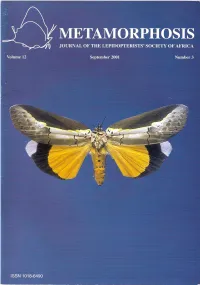
Metamorphosis Vol 12(3) Complete.Pdf
ELECTED COUNCILLORS Hermann Staude Chairman (2 years) staude@mweb.co.za Alf Curle Treasurer (2 years) elruc@mweb.co.za Alan Heath Secretary/ membership (2 years) aheath@mweb.co.za Bennie Coetzer Data processing (2 years) benniec@thales.co.za Doug Kroon Journal Editor (5 years) dougkroon@icon.co.za Graham Henning Conservation (2 years) safshenn@mweb.co.za Mark Williams Scientific Editor (2 years) mark.williams@up.ac.za Jonathan Ball Western Cape Branch (2 years) jonbal@iafrica.com Steve Woodhall Gauteng Branch (2 years) steve_woodhall@scottbader.co.za CO-OPTED MEMBERS Martin Krüger Transvaal Museum Representative kruger@nfi.co.za Peter Roos Webmaster proos@icon.co.za Reinier Terblanche Youth I Education drkrft@puknet.puk.ac.za AREA REPRESENTATIVES Steve Collins East Africa Branch collinsabri@iconnect.co.ke Alan Gardiner Zimbabwe Branch gardiner@zimbix.uz.zw Haydon Warren-Gash West Africa wgash@aviso.ci EDITORIAL Editor: Doug Kroon. Scientific advisers: Martin Krüger. Rolf Oberprieler, Stephen Henning, Malcolm Scoble, Henk Geertsema, Alan Gardiner, Dick Vane-Wright, Axel Hausmann. MEMBERSHIP The aims of the Lepidopterists' Society of Africa are to promote the scientific study and the conservation of Lepidoptera in Africa, and to provide a communication forum for all people who are interested in African Lepidoptera. Metamorphosis, which is the official journal of the Society, publishes original scientific papers as well as articles of a less technical nature. Fees indicated below refer to surface postage, but if airmail is required, notify the Treasurer and - per issue – add R32.00 for Africa or US $6.00 if Overseas. Membership of the Society is open to all persons who are interested in the study of Lepidoptera. -

African Butterfly News Can Be Downloaded Here
LATE SUMMER EDITION: JANUARY / AFRICAN FEBRUARY 2018 - 1 BUTTERFLY THE LEPIDOPTERISTS’ SOCIETY OF AFRICA NEWS LATEST NEWS Welcome to the first newsletter of 2018! I trust you all have returned safely from your December break (assuming you had one!) and are getting into the swing of 2018? With few exceptions, 2017 was a very poor year butterfly-wise, at least in South Africa. The drought continues to have a very negative impact on our hobby, but here’s hoping that 2018 will be better! Braving the Great Karoo and Noorsveld (Mark Williams) In the first week of November 2017 Jeremy Dobson and I headed off south from Egoli, at the crack of dawn, for the ‘Harde Karoo’. (Is there a ‘Soft Karoo’?) We had a very flexible plan for the six-day trip, not even having booked any overnight accommodation. We figured that finding a place to commune with Uncle Morpheus every night would not be a problem because all the kids were at school. As it turned out we did not have to spend a night trying to kip in the Pajero – my snoring would have driven Jeremy nuts ... Friday 3 November The main purpose of the trip was to survey two quadrants for the Karoo BioGaps Project. One of these was on the farm Lushof, 10 km west of Loxton, and the other was Taaiboschkloof, about 50 km south-east of Loxton. The 1 000 km drive, via Kimberley, to Loxton was accompanied by hot and windy weather. The temperature hit 38 degrees and was 33 when the sun hit the horizon at 6 pm. -

Biodiversity and Ecology of Critically Endangered, Rûens Silcrete Renosterveld in the Buffeljagsrivier Area, Swellendam
Biodiversity and Ecology of Critically Endangered, Rûens Silcrete Renosterveld in the Buffeljagsrivier area, Swellendam by Johannes Philippus Groenewald Thesis presented in fulfilment of the requirements for the degree of Masters in Science in Conservation Ecology in the Faculty of AgriSciences at Stellenbosch University Supervisor: Prof. Michael J. Samways Co-supervisor: Dr. Ruan Veldtman December 2014 Stellenbosch University http://scholar.sun.ac.za Declaration I hereby declare that the work contained in this thesis, for the degree of Master of Science in Conservation Ecology, is my own work that have not been previously published in full or in part at any other University. All work that are not my own, are acknowledge in the thesis. ___________________ Date: ____________ Groenewald J.P. Copyright © 2014 Stellenbosch University All rights reserved ii Stellenbosch University http://scholar.sun.ac.za Acknowledgements Firstly I want to thank my supervisor Prof. M. J. Samways for his guidance and patience through the years and my co-supervisor Dr. R. Veldtman for his help the past few years. This project would not have been possible without the help of Prof. H. Geertsema, who helped me with the identification of the Lepidoptera and other insect caught in the study area. Also want to thank Dr. K. Oberlander for the help with the identification of the Oxalis species found in the study area and Flora Cameron from CREW with the identification of some of the special plants growing in the area. I further express my gratitude to Dr. Odette Curtis from the Overberg Renosterveld Project, who helped with the identification of the rare species found in the study area as well as information about grazing and burning of Renosterveld. -

Phylogeny of the Aphnaeinae: Myrmecophilous African Butterflies
Systematic Entomology (2015), 40, 169–182 DOI: 10.1111/syen.12098 Phylogeny of the Aphnaeinae: myrmecophilous African butterflies with carnivorous and herbivorous life histories JOHN H. BOYLE1,2, ZOFIA A. KALISZEWSKA1,2, MARIANNE ESPELAND1,2,3, TAMARA R. SUDERMAN1,2, JAKE FLEMING2,4, ALAN HEATH5 andNAOMI E. PIERCE1,2 1Department of Organismic and Evolutionary Biology, Harvard University, Cambridge, MA, U.S.A., 2Museum of Comparative Zoology, Harvard University, Cambridge, MA, U.S.A., 3Museum of Natural History and Archaeology, Norwegian University of Science and Technology, Trondheim, Norway, 4Department of Geography, University of Wisconsin, Madison, WI, U.S.A. and 5Iziko South African Museum, Cape Town, South Africa Abstract. The Aphnaeinae (Lepidoptera: Lycaenidae) are a largely African subfamily of 278 described species that exhibit extraordinary life-history variation. The larvae of these butterflies typically form mutualistic associations with ants, and feed on awide variety of plants, including 23 families in 19 orders. However, at least one species in each of 9 of the 17 genera is aphytophagous, parasitically feeding on the eggs, brood or regurgitations of ants. This diversity in diet and type of symbiotic association makes the phylogenetic relations of the Aphnaeinae of particular interest. A phylogenetic hypothesis for the Aphnaeinae was inferred from 4.4 kb covering the mitochondrial marker COI and five nuclear markers (wg, H3, CAD, GAPDH and EF1) for each of 79 ingroup taxa representing 15 of the 17 currently recognized genera, as well as three outgroup taxa. Maximum Parsimony, Maximum Likelihood and Bayesian Inference analyses all support Heath’s systematic revision of the clade based on morphological characters. -

African Butterfly News!
LATE WINTER EDITION: JULY / AUGUST AFRICAN 2017-4 THE BUTTERFLY LEPIDOPTERISTS’ SOCIETY OF AFRICA NEWS LATEST NEWS Welcome to the Late Winter edition of African Butterfly News! African Butterfly News celebrates its first year of existence; the first edition, 2016-5, was circulated in September last year. The photographic competition commenced in August 2016, so the annual award will be made in the next, Spring Edition – for purposes of the photographic competition, the season starts in August and ends in July. A reminder that the newsletter is circulated every two months: Late Summer (January and February) – circulated in January Autumn (March and April) – circulated in March Early Winter (May and June) – circulated in May Late Winter (July and August) – circulated in July Spring (September and October) – circulated in September Early Summer (November and December) – circulated in November You will all be aware of the devastating fires that the southern Cape experienced in June. Dave and Hanna Edge, LepSoc Africa’s Treasurer and Membership Secretary respectively, were caught up in this drama, and had to evacuate their house (refer to Dave’s eyewitness account below). Fortunately, the building survived the fire, although the nearby Brenton Blue Reserve was incinerated. All fences, sign boards and marker-posts were destroyed – it is hoped that some larvae or pupae of the Brenton Blue (Orachrysops niobe) are still alive, safely underground. See a report under COREL under the “Projects” section. Some of you may have seen an article in the Sunday Times, by Aaron Hyman, a friend of Christopher Dobson. This magazine relies on material from you, the members of LepSoc Africa. -

Check-List of the Butterflies of the Kakamega Forest Nature Reserve in Western Kenya (Lepidoptera: Hesperioidea, Papilionoidea)
Nachr. entomol. Ver. Apollo, N. F. 25 (4): 161–174 (2004) 161 Check-list of the butterflies of the Kakamega Forest Nature Reserve in western Kenya (Lepidoptera: Hesperioidea, Papilionoidea) Lars Kühne, Steve C. Collins and Wanja Kinuthia1 Lars Kühne, Museum für Naturkunde der Humboldt-Universität zu Berlin, Invalidenstraße 43, D-10115 Berlin, Germany; email: lars.kuehne@museum.hu-berlin.de Steve C. Collins, African Butterfly Research Institute, P.O. Box 14308, Nairobi, Kenya Dr. Wanja Kinuthia, Department of Invertebrate Zoology, National Museums of Kenya, P.O. Box 40658, Nairobi, Kenya Abstract: All species of butterflies recorded from the Kaka- list it was clear that thorough investigation of scientific mega Forest N.R. in western Kenya are listed for the first collections can produce a very sound list of the occur- time. The check-list is based mainly on the collection of ring species in a relatively short time. The information A.B.R.I. (African Butterfly Research Institute, Nairobi). Furthermore records from the collection of the National density is frequently underestimated and collection data Museum of Kenya (Nairobi), the BIOTA-project and from offers a description of species diversity within a local literature were included in this list. In total 491 species or area, in particular with reference to rapid measurement 55 % of approximately 900 Kenyan species could be veri- of biodiversity (Trueman & Cranston 1997, Danks 1998, fied for the area. 31 species were not recorded before from Trojan 2000). Kenyan territory, 9 of them were described as new since the appearance of the book by Larsen (1996). The kind of list being produced here represents an information source for the total species diversity of the Checkliste der Tagfalter des Kakamega-Waldschutzge- Kakamega forest. -

Addenda to the Insect Fauna of Al-Baha Province, Kingdom of Saudi Arabia with Zoogeographical Notes Magdi S
JOURNAL OF NATURAL HISTORY, 2016 VOL. 50, NOS. 19–20, 1209–1236 http://dx.doi.org/10.1080/00222933.2015.1103913 Addenda to the insect fauna of Al-Baha Province, Kingdom of Saudi Arabia with zoogeographical notes Magdi S. El-Hawagrya,c, Mostafa R. Sharafb, Hathal M. Al Dhaferb, Hassan H. Fadlb and Abdulrahman S. Aldawoodb aEntomology Department, Faculty of Science, Cairo University, Giza, Egypt; bPlant Protection Department, College of Food and Agriculture Sciences, King Saud University, Riyadh, Kingdom of Saudi Arabia; cSurvey and Classification of Agricultural and Medical Insects in Al-Baha Province, Al-Baha University, Al-Baha, Saudi Arabia ABSTRACT ARTICLE HISTORY The first list of insects (Arthropoda: Hexapoda) of Al-Baha Received 1 April 2015 Province, Kingdom of Saudi Arabia (KSA) was published in 2013 Accepted 30 September 2015 and contained a total of 582 species. In the present study, 142 Online 9 December 2015 species belonging to 51 families and representing seven orders KEYWORDS are added to the fauna of Al-Baha Province, bringing the total Palaearctic; Afrotropical; number of species now recorded from the province to 724. The Eremic; insect species; reported species are assigned to recognized regional zoogeogra- Arabian Peninsula; Tihama; phical regions. Seventeen of the species are recorded for the first Al-Sarah; Al-Sarawat time for KSA, namely: Platypleura arabica Myers [Cicadidae, Mountains Hemiptera]; Cletomorpha sp.; Gonocerus juniperi Herrich-Schäffer [Coreidae, Hemiptera]; Coranus lateritius (Stål); Rhynocoris bipus- tulatus (Fieber) [Reduviidae, Hemiptera]; Cantacader iranicus Lis; Dictyla poecilla Drake & Hill [Tingidae, Hemiptera]; Mantispa scab- ricollis McLachlan [Mantispidae, Neuroptera]; Cerocoma schreberi Fabricius [Meloidae, Coleoptera]; Platypus parallelus (Fabricius) [Curculionidae, Coleoptera]; Zodion cinereum (Fabricius) [Conopidae, Diptera]; Ulidia ?ruficeps Becker [Ulidiidae, Diptera]; Atherigona reversura Villeneuve [Muscidae, Diptera]; Aplomya metallica (Wiedemann); Cylindromyia sp. -

Recent Diversification of Chrysoritis Butterflies in the South African Cape
Molecular Phylogenetics and Evolution 148 (2020) 106817 Contents lists available at ScienceDirect Molecular Phylogenetics and Evolution journal homepage: www.elsevier.com/locate/ympev Recent diversification of Chrysoritis butterflies in the South African Cape (Lepidoptera: Lycaenidae) T ⁎ ⁎ Gerard Talaveraa,b, ,Zofia A. Kaliszewskab,c, Alan Heathb,d, Naomi E. Pierceb, a Institut de Biologia Evolutiva (CSIC-UPF), Passeig Marítim de la Barceloneta 37, 08003 Barcelona, Catalonia, Spain b Department of Organismic and Evolutionary Biology and Museum of Comparative Zoology, Harvard University, 26 Oxford Street, Cambridge, MA 02138, United States c Department of Biology, University of Washington, Seattle, WA 98195, United States d Iziko South African Museum, Cape Town, South Africa ARTICLE INFO ABSTRACT Keywords: Although best known for its extraordinary radiations of endemic plant species, the South African fynbos is home Butterflies to a great diversity of phytophagous insects, including butterflies in the genus Chrysoritis (Lepidoptera: Chrysoritis Lycaenidae). These butterflies are remarkably uniform morphologically; nevertheless, they comprise 43 cur- Fynbos rently accepted species and 68 currently valid taxonomic names. While many species have highly restricted, dot- Phylogeny like distributions, others are widespread. Here, we investigate the phylogenetic and biogeographic history un- Radiation derlying their diversification by analyzing molecular markers from 406 representatives of all described species Speciation Taxonomy throughout their respective ranges. We recover monophyletic clades for both C. chrysaor and C. thysbe species- groups, and identify a set of lineages that fall between them. The estimated age of divergence for the genus is 32 Mya, and we document significantly rapid diversification of the thysbe species-group in the Pleistocene (~2 Mya). -

Nota Lepidopterologica
ZOBODAT - www.zobodat.at Zoologisch-Botanische Datenbank/Zoological-Botanical Database Digitale Literatur/Digital Literature Zeitschrift/Journal: Nota lepidopterologica Jahr/Year: 2002 Band/Volume: 25 Autor(en)/Author(s): Garcia-Barros Enrique Artikel/Article: Taxonomic patterns in the egg to body size allometry of butterflies and skippers (Papilionoidea & Hesperiidae) 161-175 ©Societas Europaea Lepidopterologica; download unter http://www.biodiversitylibrary.org/ und www.zobodat.at Nota lepid. 25 (2/3): 161-175 161 Taxonomic patterns in the egg to body size allometry of butter- flies and skippers (Papilionoidea & Hesperiidae) Enrique Garcia-Barros Departmento de Biologia (Zool.), Universidad Autönoma de Madrid, E-28049 Madrid, Spain e-mail: garcia.barros@uam.es Summary. Former studies have shown that there is an interspecific allometric relationship between egg size and adult body size in butterflies and skippers. This is here re-assessed at the family and subfamily levels in order to determine to what extent the overall trend is uniform through different taxonomic lineages. The results suggest that different subtaxa are characterised by different allometric slopes. Al- though statistical analysis across species means is known to be potentially misleading to assess evolu- tionary relations, it is shown that the comparison of apparent patterns (based on species means) with inferred evolutionary trends (based on independent contrasts) may help to understand the evolution of egg size in butterflies. Further, intuitive reconsideration of statistically non-significant results may prove informative. As an example, argumentation in favour of a positive association between large egg size and the use of monocotyledon plants as larval food is presented. Taxa where atypical allometric trends are found include the Riodininae and Theclini (Lycaenidae), the Graphiini (Papilionidae), and the Heliconiinae (Nymphalidae). -

Chilades Lempkei Blom, 1979, a Synonym of Chilades Parrhasius (Fabricius, 1793) (Lepidoptera, Lycaenidae) By
ENTOMOLOGISCHE BERICHTEN, DEEL 40, 1 .III. 1980 47 Chilades lempkei Blom, 1979, a synonym of Chilades parrhasius (Fabricius, 1793) (Lepidoptera, Lycaenidae) by TORBEN B. LARSEN ABSTRACT. — Chilades lempkei Blom, 1979, is sunk in synonymy of C. parrhasius Fabricius, 1793, a species often, but incorrectly, placed in Euchrysops. It is suggested that C. parrhasius and the narrowly sympatric C. galba (Freyer) are members of a superspecies complex. Recently in this journal a species of Lycaenidae from the Fars Province of Iran was described as Chilades lempkei by Blom (1979). This is a junior synonym of Chilades parrhasius (Fabricius, 1793), a solution which was probably overlooked by the author, because parrhasius (= contracta Butler, 1880) in Indian literature was conventionally placed in Euchrysops, an error which I have unfortunately been guilty of perpetuating (Larsen 1977), although for instance Howarth correctly placed it in Chilades (Howarth & Povolny 1976) and noted its presence in Iran. The genitalia of Chilades are very distinct from Euchrysops. The genitalia of C. lempkei figured by Blom match exactly specimens from Oman (Oman, Batina Coast, al Barqa, II. 1979, T. B. Larsen leg., slide AQX) and from India (India, New Delhi, VII. 1977, T. B. Larsen leg., slide AQY). The description is also in accordance with the normal habitus of C. parrhasius though it should be underlined that the species displays considerable variation, in fact so much that subspecies of parrhasius would be difficult to accept, although several names from the Indian subcontinent are available. However, in researching this relatively simple problem, a more interesting problem emerged. The genitalia of Chilades galba (Freyer, 1855) are almost identical to those of parrhasius in two specimens examined (Jordan, Ghor Nimrin, IV.1977, T.