Ukrainian Literature in the Twentieth Century
Total Page:16
File Type:pdf, Size:1020Kb
Load more
Recommended publications
-

The Ukrainian Weekly 1981
;?C свОБОДАJLSVOBODA І І і о "в УКРДШСШИИ щоліннмк ^Щ^У UKKAINIAHOAIIV PUBLISHEDrainia BY THE UKRAINIAN NATIONAL ASSOCIATIOnN INC . A FRATERNAWeekL NON-PROFIT ASSOCIATION l ї Ш Ute 25 cents voi LXXXVIII No. 45 THE UKRAINIAN WEEKLY SUNDAY, NOVEMBER 8, i98i Reagan administration Five years later announces appointment for rights post The Ukrainian Helsinki Group: WASHINGTON - After months of the struggle continues delay, the Reagan administration an– nounced on October 30 that it is no– When the leaders of 35 states gathered in Helsinki in minating Elliot Abrams, a neo-conser– August 1975 signed the Final Act of the Conference on vative Democrat and former Senate Security and Cooperation in Europe, few could aide, to be assistant secretary of state for have foreseen the impact the agreement would have in human rights and humanitarian affairs, the Soviet Union. While the accords granted the Soviets reported The New York Times. de jure recognition of post-World War ll boundaries, they The 33-year-old lawyer, who pre– also extracted some acquiescence to provisions viously worked as special counsel to guaranteeing human rights and freedom, guarantees Sen. Henry Jackson of Washington and that already existed in the Soviet Constitution and Sen. Daniel Patrick Moynihan of New countless international covenants. York, joined the administration last At the time, the human-rights provisions seemed January as assistant secretary of state unenforceable, a mere formality, a peripheral issue for international organization affairs. agreed to by a regime with no intention of carrying in announcing the nomination, Presi– them through. dent Ronald Reagan stated that hu– But just over one year later, on November 9,1976,10 man-rights considerations are an im– courageous Ukrainian intellectuals in Kiev moat of portant part of foreign policy, the Times them former political prisoners, formed the Ukrainian said. -
Representation of National Identity in Dokiia Humenna's Novels
Representation of national identity in Dokiia Humenna’s novels by Solomiya Shavala A thesis submitted to the Faculty of Graduate Studies of the University of Manitoba in partial fulfilment of the requirements of the degree of MASTER OF ARTS Department of German and Slavic Studies University of Manitoba Winnipeg Copyright © 2017 by Solomiya Shavala Abstract This thesis analyzes the formation and gradual development of national identity in Dokiia Humenna’s four novels: Dar Evdotei (Evdoteia’s gift, 1990), Khreshchatyi iar (Kyiv 1941-43: Roman-khronika) (The Cross-shaped Ravine (Kyiv 1941-43): A Novel-Chronicle, 1956), Mynule plyve v pryideshnie (The Past Flows into the Future, 1978), and Velyke Tsabe (The Great Tsabe, 1952). The research explores the way Humenna saw the circumstances and the challenges faced by Ukrainian society under two authoritarian and autocratic regimes (Nazi and Soviet) and the destructive effects of these regimes on the concept of national identification. The project utilizes the notions of myth, collective memory, and cultural trauma in understanding why society retains a certain group identity. Анотація Дисертація аналізує формування та подальший розвиток національної ідентичності у чотирьох романах Докії Гуменної: Дар Евдотеї (1990), Хрещатий Яр (Київ 1941-43: роман-хроніка) (1956), Минуле пливе в прийдешнє (1978) та Велике цабе (1952). В дипломній роботі розглянуто зображення Гуменною обставин та проблем, з якими стикнулося українське суспільство під час його окупації двома авторитарними режимами (нацистським і радянським), а також руйнівний вплив цих режимів на українську національну ідентичність. Дослідження застосовує поняття міфу, колективної пам’яті та культурної травми, задля ширшого розуміння причин збереження суспільством певної групової ідентичності. -

Destroying the National-Spiritual Values of Ukrainians
Historia i Polityka No. 18 (25)/2016, pp. 33–43 ISSN 1899-5160, e-ISSN 2391-7652 www.hip.umk.pl DOI: http://dx.doi.org/10.12775/HiP.2016.030 Nadia K indrachuk Vasyl Stefanyk Precarpathian National University, Ivano-Frankovsk, Ukraine Destroying the National-Spiritual Values of Ukrainians during the Anti-Religious Offensive of the Soviet Totalitarian State in the 1960s and 1970s Niszczenie wartości narodowo-duchowych Ukraińców podczas anty-religijnej ofensywy sowieckiego państwa totalitarnego w latach 60. i 70. XX wieku • A bst ra kt • • A bst ract • Artykuł zajmuje się kościelnym i religijnym The article deals with the church and religious życiem Ukraińców w kontekście narodowo- life of Ukrainians in the context of national ściowych i politycznych procesów mających and political processes during the 1960s and miejsce w latach 60. i 70. XX wieku. Autorka 1970s. The author characterizes the anti-reli- prezentuje charakterystykę anty-religijnej po- gious policy of the Soviet government, shows lityki rządu radzieckiego, pokazuje jej kierun- its directions, forms, and methods, studies the ki, formy i metody, bada stosunek przedstawi- attitude of Ukraine’s title nation representatives cieli tytularnego narodu wobec prześladowań to religious persecution and to manipulation of religijnych i manipulacji świadomością religij- religious consciousness by the communist lead- ną przez przywódców komunistycznych i pod- ership, and highlights comprehensive atheistic kreśla kompleksowość działań ateizacyjnych activities and the elimination of the ways for i eliminację możliwości odrodzenia religijno- reviving religiosity among people. The author ści wśród ludzi. Autorka odsłania istotę, proces reveals the essence, the process of creating and tworzenia i sztucznego egzekwowania nowego artificially enforcing the new Soviet ritualism radzieckiego rytualizmu w życiu Ukraińców. -

The Ukrainian Weekly 1998, No.25
www.ukrweekly.com INSIDE:• Libel verdict threatens press freedom — page 2. • Black Sea countries establish economic organization — page 3. • Ukrainian American astronaut awaits flight assignment — page 4. Published by the Ukrainian National Association Inc., a fraternal non-profit association Vol. LXVI HE KRAINIANNo. 25 THE UKRAINIAN WEEKLY SUNDAY, JUNE 21, 1998 EEKLY$1.25/$2 in Ukraine EconomicT advisor warnsU of consequences Still no chairmanW for Verkhovna Rada if Ukraine fails to receive IMF funding after eight rounds of deputies’ voting by Roman Woronowycz Mr. Sachs, however, said the country will by Roman Woronowycz said Mr. Chyzh. Kyiv Press Bureau have trouble meeting the 87 requirements Kyiv Press Bureau Mr. Symonenko’s near success came that the IMF has listed, and that the mone- after the nomination of Mykhailo Syrota, KYIV — A leading international econo- tary fund should ease its conditions. “Both KYIV — After two more rounds of a non-aligned centrist candidate, failed in mist said on June 15 that if Ukraine is sides should be highly realistic and endorse voting, Ukraine’s Verkhovna Rada still the previous round. Mr. Syrota is a per- denied a new loan program by the a workable program, said Mr. Sachs. has not settled on who will lead the par- son who many thought had a chance to International Monetary Fund, the country The IMF has withheld money that this liamentary body. unite the ideologically divided and would be left in dire financial straits. financially strapped country of 50.9 million During the latest attempts, which stalled Parliament. Jeffrey Sachs, the noted Harvard desperately needs because it is not moving brings the total to eight, the national However, in the seventh round of vot- University professor and leading economic on economic reform at the speed the inter- deputies again have failed to elect two ing, Mr. -

The Ukrainian Weekly, 2021
Part 3 of THE YEAR IN REVIEW pages 7-13 THE UKRAINIAN WEEKLY Published by the Ukrainian National Association Inc., a fraternal non-profit association Vol. LXXXIX No. 5 THE UKRAINIAN WEEKLY SUNDAY, JANUARY 31, 2021 $2.00 Ukraine celebrates Unity Day Ukraine’s SBU suspects former agency colonel of plotting to murder one of its generals by Mark Raczkiewycz KYIV – On January 27, the Security Service of Ukraine (SBU) said it had secured an arrest warrant for Dmytro Neskoromnyi, a former first deputy head of the agency, on suspicion of conspiring to murder a serving SBU general. Mr. Neskoromnyi, a former SBU colonel, allegedly plotted the assassination with currently serving Col. Yuriy Rasiuk of the SBU’s Alpha anti-terrorist unit. The alleged target was 38-year-old Brig. Gen. Andriy Naumov. Mr. Naumov heads the agency’s internal security department, which is responsible for preventing corruption among the SBU’s ranks. RFE/RL In a news release, the SBU provided video RFE/RL A human chain on January 22 links people along the Paton Bridge in Kyiv over the and audio recordings, as well as pictures, as Security Service of Ukraine Brig. Gen. Dnipro River that bisects the Ukrainian capital, symbolizing both sides uniting when evidence of the alleged plot. The former col- Andriy Naumov the Ukrainian National Republic was formed in 1919. onel was allegedly in the process of paying “If there is a crime, we must act on it. $50,000 for carrying out the murder plot. by Roman Tymotsko (UPR), Mykhailo Hrushevskyy. And, in this case, the SBU worked to pre- Mr. -

A Guide to the Archival and Manuscript Collection of the Ukrainian Academy of Arts and Sciences in the U.S., New York City
Research Report No. 30 A GUIDE TO THE ARCHIVAL AND MANUSCRIPT COLLECTION OF THE UKRAINIAN ACADEMY OF ARTS AND SCIENCES IN THE U.S., NEW YORK CITY A Detailed Inventory Yury Boshyk Canadian Institute of Ukrainian Studies University of Alberta Edmonton 1988 Canadian Institute of Ukrainian Studies University of Alberta Occasional Research Reports Publication of this work is made possible in part by a grant from the Stephania Bukachevska-Pastushenko Archival Endowment Fund. The Institute publishes research reports periodically. Copies may be ordered from the Canadian Institute of Ukrainian Studies, 352 Athabasca Hall, University of Alberta, Edmonton, Alberta, T6G 2E8. The name of the publication series and the substantive material in each issue (unless otherwise noted) are copyrighted by the Canadian Institute of Ukrainian Studies. PRINTED IN CANADA Occasional Research Reports A GUDE TO THE ARCHIVAL AND MANUSCRIPT COLLECTION OF THE UKRAINIAN ACADEMY OF ARTS AND SCIENCES IN THE U.S., NEW YORK CITY A Detailed Inventory Yury Boshyk Project Supervisor Research Report No. 30 — 1988 Canadian Institute of Ukrainian Studies University of Alberta Edmonton, Alberta Dr . Yury Boshyk Project Supervisor for The Canadian Institute of Ukrainian Studies Research Assistants Marta Dyczok Roman Waschuk Andrij Wynnyckyj Technical Assistants Anna Luczka Oksana Smerechuk Lubomyr Szuch In Cooperation with the Staff of The Ukrainian Academy of Arts and Sciences in the U.S. Dr. William Omelchenko Secretary General and Director of the Museum-Archives Halyna Efremov Dima Komilewska Uliana Liubovych Oksana Radysh Introduction The Ukrainian Academy of Arts and Sciences in the United States, New York City, houses the most comprehensive and important archival and manuscript collection on Ukrainians outside Ukraine. -

CIUS Annual Review
Table of Contents From the director 1 Dr. Zenon Kohut reappointed 2 In memoriam: Danylo Husar Struk 3 Laurence Decore 5 Canadian Institute of Ukrainian Studies Special Report 6 352 Athabasca Hall, University of Alberta Kowalsky Program 10 Edmonton, Alberta, Canada T6G 2E8 CIUS Press 13 Telephone: (780) 492-2972 Peter Jacyk Centre 15 FAX: (780) 492-4967 Canada Ukraine Legislative Cooperation E-mail: cius@ualberta.ca Project 22 Cl US Website: http://www.ualberta.ca/~cius/ Ukrainian Language Education Centre 25 Cl US Annual Review Ukrainian Church Studies Program 29 Reprints permitted with acknowledgement Stasiuk Program 32 ISSN 1485-7979 Journal of Ukrainian Studies 34 Editor: Della Goa Encyclopedia of Ukraine 35 Translator: Svitlana Semenko Ukrainian- Canadian Program 36 Editorial supervision: Myroslav Yurkevich Events 37 Design and layout: Peter Matilainen Lectures and seminars 38 Cover design: Lara Minja, Graphic Design and Photographic Services, University of Alberta Staff activities 39 Cl US Edmonton staff photos: Richard Siemensand Donations 42 Tina Chang, Graphic Design and Photographic Awards administered by CIUS 43 Services, University of Alberta Endowments 45 To contact the Cl US Toronto office (Encyclopedia Donors to Endowment Funds 49 Project, Journal of Ukrainian Studies, or Cl US Press), please write c/o: Department of Slavic Languages and Literatures University of Toronto 21 Sussex Avenue Toronto, Ontario, Canada M5S 1 A1 Telephone: CK«HH3<fetJl*K« 3sHS9T'£S'lUtraT'1i General office (416) 978-6934 H£ASK4B-6»"r& YASKH KftMTPpHCfi’fc CIUS Press (416) 978-8240 W BA HS%E-* T-XR'JTRItm&RTH £Aasa£«K-fc TJ»tA Encyclopedia (416) 978-6076 HTMMKfO hc ksnh i HIS JUS 978-8669 y KAT’Sf'B'XItTE (416) H TU MR K£A S3! VAlKimtS/UN'i IT’XKA'HMAKMiy FAX: (416)978-2672 YKT0JKfMtimCT& HOAN’ZfT'Jr^HAf E-mail: cius@chass.utoronto.ca K'Xt’XK-fc A"l> TEA & «TB# -AACiS-kAHTi “In the beginning was the Word...” Our cover features a detail of the headpiece and initial page of the Gospel of John from the Ostromir Gospel. -

A Microhistory of Ukraine's Generation of Cultural Rebels
This article was downloaded by: [Selcuk Universitesi] On: 07 February 2015, At: 17:31 Publisher: Routledge Informa Ltd Registered in England and Wales Registered Number: 1072954 Registered office: Mortimer House, 37-41 Mortimer Street, London W1T 3JH, UK Nationalities Papers: The Journal of Nationalism and Ethnicity Publication details, including instructions for authors and subscription information: http://www.tandfonline.com/loi/cnap20 The early 1960s as a cultural space: a microhistory of Ukraine's generation of cultural rebels Serhy Yekelchyka a Department of Germanic and Slavic Studies, University of Victoria, Victoria, Canada Published online: 10 Oct 2014. Click for updates To cite this article: Serhy Yekelchyk (2015) The early 1960s as a cultural space: a microhistory of Ukraine's generation of cultural rebels, Nationalities Papers: The Journal of Nationalism and Ethnicity, 43:1, 45-62, DOI: 10.1080/00905992.2014.954103 To link to this article: http://dx.doi.org/10.1080/00905992.2014.954103 PLEASE SCROLL DOWN FOR ARTICLE Taylor & Francis makes every effort to ensure the accuracy of all the information (the “Content”) contained in the publications on our platform. However, Taylor & Francis, our agents, and our licensors make no representations or warranties whatsoever as to the accuracy, completeness, or suitability for any purpose of the Content. Any opinions and views expressed in this publication are the opinions and views of the authors, and are not the views of or endorsed by Taylor & Francis. The accuracy of the Content should not be relied upon and should be independently verified with primary sources of information. Taylor and Francis shall not be liable for any losses, actions, claims, proceedings, demands, costs, expenses, damages, and other liabilities whatsoever or howsoever caused arising directly or indirectly in connection with, in relation to or arising out of the use of the Content. -

The Anti-Imperial Choice This Page Intentionally Left Blank the Anti-Imperial Choice the Making of the Ukrainian Jew
the anti-imperial choice This page intentionally left blank The Anti-Imperial Choice The Making of the Ukrainian Jew Yohanan Petrovsky-Shtern Yale University Press new haven & london Disclaimer: Some images in the printed version of this book are not available for inclusion in the eBook. Copyright © 2009 by Yale University. All rights reserved. This book may not be reproduced, in whole or in part, including illustrations, in any form (beyond that copying permitted by Sections 107 and 108 of the U.S. Copyright Law and ex- cept by reviewers for the public press), without written permission from the publishers. Set in Ehrhardt type by The Composing Room of Michigan, Inc. Printed in the United States of America. Library of Congress Cataloging-in-Publication Data Petrovskii-Shtern, Iokhanan. The anti-imperial choice : the making of the Ukrainian Jew / Yohanan Petrovsky-Shtern. p. cm. Includes bibliographical references and index. ISBN 978-0-300-13731-6 (hardcover : alk. paper) 1. Jewish literature—Ukraine— History and criticism. 2. Jews in literature. 3. Ukraine—In literature. 4. Jewish authors—Ukraine. 5. Jews— Ukraine—History— 19th century. 6. Ukraine—Ethnic relations. I. Title. PG2988.J4P48 2009 947.7Ј004924—dc22 2008035520 A catalogue record for this book is available from the British Library. This paper meets the requirements of ANSI/NISO Z39.48–1992 (Permanence of Paper). It contains 30 percent postconsumer waste (PCW) and is certified by the Forest Stewardship Council (FSC). 10987654321 To my wife, Oxana Hanna Petrovsky This page intentionally left blank Contents Acknowledgments ix Politics of Names and Places: A Note on Transliteration xiii List of Abbreviations xv Introduction 1 chapter 1. -

Ukrainian Literature
UKRAINIAN LITERATURE A Journal of Translations Volume 5 2018 Shevchenko Scientific Society of Canada Ukrainian Literature A Journal of Translations Editor Maxim Tarnawsky Manuscript Editor Uliana M. Pasicznyk Editorial Board Taras Koznarsky, Askold Melnyczuk, Michael M. Naydan, Marko Pavlyshyn www.UkrainianLiterature.org Ukrainian Literature publishes translations into English of works of Ukrainian literature. The journal appears triennially on the internet at www.UkrainianLiterature.org and in a print edition. Ukrainian Literature is published by the Shevchenko Scientific Society of Canada, 516 The Kingsway, Toronto, ON M9A 3W6 Canada. The editors are deeply grateful to its Board of Directors for hosting the journal. Volume 5 (2018) of Ukrainian Literature was funded by a generous grant from the Danylo Husar Struk Programme in Ukrainian Literature of the Canadian Institute of Ukrainian Studies, University of Alberta, and by a substantial donation from Marta Tarnawsky. Ukrainian Literature depends on funding provided by sponsors. Donations can be sent to the Shevchenko Scientific Society of Canada. Please visit the journal website for more information about supporting the journal. Ukrainian Literature welcomes submissions. Please visit our website for the details of our call for submissions. Translators with potential submissions should contact the editor at tarn@chass.utoronto.ca. ISSN 1552-5880 (online edition) ISSN 1552-5872 (print edition) Contents Introduction: Maxim Tarnawsky 5 YURI ANDRUKHOVYCH “Samiilo, or the Beautiful Brigand” Translated by Vitaly Chernetsky 9 VOLODYMYR DIBROVA “Savchuk” Translated by Lidia and Volodymyr Dibrova 17 MYKOLA KULISH The People’s Prophet Translated by George Mihaychuk 25 VALERIAN PIDMOHYLNY The City (Part 2) Translated by Maxim Tarnawsky 105 OLES ULIANENKO Stalinka (Part 1) Translated by Olha Rudakevych 235 MYKOLA RIABCHUK “Heron’s Birthday” Translated by Uliana M. -
Untitled Spreadsheet
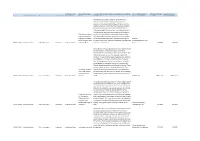
Priority sector for Name of the project in Summary of the project in English, including goal and results (up Full name of the applicant Total project budget Requested amount ID Competition program LOT Type of project culture and arts English to 100 words) organization in English (in UAH) from UCF (in UAH) The television program is based on facts taken from historical sources, which testify to a fundamental distortion of the history of the Russian Empire, aimed at creating a historical mythology that Muscovy and Kievan Rus have common historical roots, that Muscovy has "inheritance rights" on Kievan Rus. The ordinary fraud of the Muscovites, who had taken possession of the past of The cycle of science- the Grand Duchy of Kiev and its people, dealt a terrible cognitive television blow to the Ukrainian ethnic group. Our task is to expose programs "UKRAINE. the falsehood and immorality of Moscow mythology on Union of STATE HISTORY. Part the basis of true facts. Without a great past, it is impossible Cinematographers "Film 3AVS11-0069 Audiovisual Arts LOT 1 TV content Individual Audiovisual Arts I." Kievan Rus " to create a great nation. Logos" 1369589 1369589 New eight 15-minute programs of the cycle “Game of Fate” are continuation of the project about outstanding historical figures of Ukrainian culture, art and science. The project consists of stories of the epistolary genre and memoirs. Private world of talented personalities, complex and ambiguous, is at the heart of the stories. These are facts from biographies that are not written in textbooks, encyclopedias, or wikipedia, but which are much more likely to attract the attention of different audiences. -

Contours and Consequences of the Lexical Divide in Ukrainian
Geoffrey Hull and Halyna Koscharsky1 Contours and Consequences of the Lexical Divide in Ukrainian When compared with its two large neighbours, Russian and Polish, the Ukrainian language presents a picture of striking internal variation. Not only are Ukrainian dialects more mutually divergent than those of Polish or of territorially more widespread Russian,2 but on the literary level the language has long been characterized by the existence of two variants of the standard which have never been perfectly harmonized, in spite of the efforts of nationalist writers for a century and a half. While Ukraine’s modern standard language is based on the eastern dialect of the Kyiv-Poltava-Kharkiv triangle, the literary Ukrainian cultivated by most of the diaspora communities continues to follow to a greater or lesser degree the norms of the Lviv koiné in 1 The authors would like to thank Dr Lance Eccles of Macquarie University for technical assistance in producing this paper. 2 De Bray (1969: 30-35) identifies three main groups of Russian dialects, but the differences are the result of internal evolutionary divergence rather than of external influences. The popular perception is that Russian has minimal dialectal variation compared with other major European languages. Maximilian Fourman (1943: viii), for instance, told students of Russian that the language ‘is amazingly uniform; the same language is spoken over the vast extent of the globe where the flag of the Union of Soviet Socialist Republics flies; and you will be understood whether you are speaking to a peasant or a university professor. There are no dialects to bother you, although, of course, there are parts of the Soviet Union where Russian may be spoken rather differently, as, for instance, English is spoken differently by a Londoner, a Scot, a Welshman, an Irishman, or natives of Yorkshire or Cornwall.