ASIAN ALPINE E-NEWS Issue No 82. February 2021
Total Page:16
File Type:pdf, Size:1020Kb
Load more
Recommended publications
-

Impara Le Lingue Con I Film Al Cla
UNIVERSITÀ DEGLI STUDI DI PADOVA - CENTRO LINGUISTICO DI ATENEO IMPARA LE LINGUE CON I FILM AL CLA Vedere film in lingua straniera è un modo utile e divertente per imparare o perfezionare una lingua straniera. La scheda didattica ti propone delle attività da svolgere prima, durante o dopo la visione del film. Qui sotto sono specificati la lingua e il/i livello/i a cui si rivolgono le attività contenute nella scheda. TITOLO DEL FILM IN LINGUA ORIGINALE: Seven Years in Tibet TITOLO DEL FILM IN ITALIANO: Sette Anni in Tibet LINGUA: inglese LIVELLO: B2 (upper intermediate) LEGENDA DEI SIMBOLI: attività che richiede l’uso di carta e penna attività con domande a risposta chiusa attività con domande a risposta aperta senza correzione attività che richiede un computer e/o un collegamento ad Internet consigli per la visione del film e per le attività didattiche SCHEDA DIDATTICA SUL FILM: Seven Years in Tibet ATTIVITÀ PER IL LIVELLO: B2 (upper intermediate) ATTIVITÀ PRIMA DELLA VISIONE DEL FILM Esercizio 1: historical background This film is based on the incredible true adventures of Heinrich Harrer, an Austrian mountaineer who died in January 2006, aged 93. His story is intertwined with the history of World War II, and of Tibet. Can you put these events in order, by choosing the correct year for each? If you want, you can look at this website to help you: http://en.wikipedia.org/wiki/Heinrich_Harrer Heinrich Harrer and Peter Aufschnaiter are captured by the 1912 British army in British colony India when Britain and France declare war on Germany. -

Ling Ding AR 494: Senior Thesis Professor Weitz 9/25/17 Research Proposal
Ling Ding AR 494: Senior Thesis Professor Weitz 9/25/17 Research Proposal Research Question and Hypothesis: The main goal of this research paper is to analyze the historical and stylistic significance of the Buddhist wall paintings from Tholing Monastery in Ngari, Tibet, in the context from the first golden age of Western Himalayan culture to the heyday of Guge art from around 11th to 16th century. I will work specifically on “Portraits of Atisha and Te Shes’od” from the White Temple of Tholing Monastery, and talk about 1) how the subject matter of this painting represents the historical significance of Tholing Monastery, as the origination and religious center for Buddhism revival in 11th century in Western Tibet? 2) how does the artistic style of this painting represent a continuity of international style of Guge in previous period under strong Indian-Kashmir influence, at the same time preserved certain Western Tibetan idioms can be easily identified.1 1 Michael Henss, “Wall Paintings in Western Tibet: the Art of the Ancient Kingdom of Guge, 1000-1500”, Marg 48, no.I (1996): P35. Statement of Significance: A comprehensive investigation on Guge on its architectural sites, historical relics, religious significance, pilgrimage activities and local environment have already been taken, but more focused on the documentation of the buildings, artefacts, plans, inscriptions, photographs, and varies data. This paper will focus more on an analysis of subject matter, iconographical and art historical problems of the wall-paintings of Guge, specifically on a wall-paintings from around 15th century. Iconographic analysis will be done in comparison with paintings from the earlier period (around 11th century) in Guge area, as well as from mainland Tibetan area from the same time (around 15th century). -
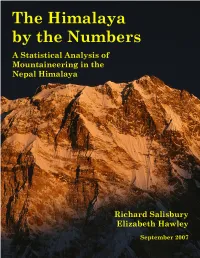
A Statistical Analysis of Mountaineering in the Nepal Himalaya
The Himalaya by the Numbers A Statistical Analysis of Mountaineering in the Nepal Himalaya Richard Salisbury Elizabeth Hawley September 2007 Cover Photo: Annapurna South Face at sunrise (Richard Salisbury) © Copyright 2007 by Richard Salisbury and Elizabeth Hawley No portion of this book may be reproduced and/or redistributed without the written permission of the authors. 2 Contents Introduction . .5 Analysis of Climbing Activity . 9 Yearly Activity . 9 Regional Activity . .18 Seasonal Activity . .25 Activity by Age and Gender . 33 Activity by Citizenship . 33 Team Composition . 34 Expedition Results . 36 Ascent Analysis . 41 Ascents by Altitude Range . .41 Popular Peaks by Altitude Range . .43 Ascents by Climbing Season . .46 Ascents by Expedition Years . .50 Ascents by Age Groups . 55 Ascents by Citizenship . 60 Ascents by Gender . 62 Ascents by Team Composition . 66 Average Expedition Duration and Days to Summit . .70 Oxygen and the 8000ers . .76 Death Analysis . 81 Deaths by Peak Altitude Ranges . 81 Deaths on Popular Peaks . 84 Deadliest Peaks for Members . 86 Deadliest Peaks for Hired Personnel . 89 Deaths by Geographical Regions . .92 Deaths by Climbing Season . 93 Altitudes of Death . 96 Causes of Death . 97 Avalanche Deaths . 102 Deaths by Falling . 110 Deaths by Physiological Causes . .116 Deaths by Age Groups . 118 Deaths by Expedition Years . .120 Deaths by Citizenship . 121 Deaths by Gender . 123 Deaths by Team Composition . .125 Major Accidents . .129 Appendix A: Peak Summary . .135 Appendix B: Supplemental Charts and Tables . .147 3 4 Introduction The Himalayan Database, published by the American Alpine Club in 2004, is a compilation of records for all expeditions that have climbed in the Nepal Himalaya. -

Heinrich Parler
Heinrich Parler Heinrich Parler the Elder (also Heinrich of Gmünd; German: Heinrich von Gemünd der Ältere; born between 1300 and 1310 â“ circa 1370), was a German architect and master builder of the Gothic period. Heinrich Parler was probably born in Cologne between 1300 and 1310, but later lived and worked in Gmünd, an Imperial City (German: Reichsstädte) of the Holy Roman Empire.[2] He became construction manager of Holy Cross Minster in Gmünd between 1325 and 1330. Heinrich Harrer (German pronunciation: [ˈhaɪnÊɪç ˈhaÊÉ]; 6 July 1912 â“ 7 January 2006) was an Austrian mountaineer, sportsman, geographer, and author. He is best known for being on the four-man climbing team that made the first ascent of the North Face of the Eiger in Switzerland, and for his books Seven Years in Tibet (1952) and The White Spider (1959). Heinrich Harrer was born 6 July 1912 in Hüttenberg, Austria, in the district of Sankt Veit an der Glan in the state of Carinthia. His father was a Heinrich Parler the Elder (also Heinrich of Gmünd, German: Heinrich von Gemünd der Ältere; c. 1310 â“ c. 1370), was a German architect and sculptor. His masterpiece is Holy Cross Minster, an influential milestone of late Gothic architecture in the town of Schwäbisch Gmünd, Baden- Württemberg, Germany. Parler also founded the Parler family of master builders and his descendants worked in various parts of central Europe, especially Bohemia. His son, Peter Parler, became one of the major architects of the Heinrich Harrer was an Austrian mountaineer who was part of the team that made the first ascent of the formidable north wall of the Eiger in Switzerland. -
TIBET, CHINA, and the OLYMPICS Introduction
TIBET, CHINA, AND THE OLYMPICS Introduction China has controlled Tibet since 1959. In end to Chinese rule. They also called on Focus This News in March 2008, a wave of violent protests the international community to use its Review story erupted in Lhasa, Tibet’s capital, and in influence to pressure China to change focuses on the other parts of the country. Ethnic Tibetans its policies toward Tibet. Some went so ongoing conflict took to the streets to vent their long- far as to urge an international boycott of between Tibet and pent-up fury over China’s heavy-handed the Games as a means of indicating the China. Tibetan occupation and their lack of freedom. world’s displeasure with China’s actions. activists who want Chinese settlers in the region were As the torch relay made its way to independence from China have targeted for especially harsh treatment. other world cities, the protesters grew targeted China’s Many of the protesters were Buddhist in numbers and determination. Tibetan preparations for monks, followers of the Dalai Lama, the exiles were joined by others in Australia, the 2008 Summer religious leader of the Tibetan people and India, Europe, and North and South Olympics. These a Nobel Peace Prize winner. He has lived America who sympathized with their protests have in exile in India ever since Chinese leader cause and criticized China’s poor human placed concerns about repression Mao Zedong ordered his troops into Tibet rights record in Tibet and elsewhere. in Tibet and other to consolidate China’s control over the In San Francisco, the demonstrations Chinese human long-rebellious territory. -
Reading List for Nepal
Suggested Reading List for Nepal Books Secrets of the Sky Caves: Danger and Discovery on Nepal's Mustang Cliffs (Sandra K. Athans) ‘Secrets of the Sky Caves: Danger and Discovery on Nepal’s Mustang Cliffs’ is a travel account by Sandra K. Athans. It chronicles the expedition of mountaineer Pete Athans and a team of archaeologists as they brave the unforgiving climate and forbidding cliffs to uncover the titular sky caves. The narrative tracks the intrepid explorers as they come across 3000-year-old burial chambers, ancient murals and mummies, priceless artefacts and manuscripts and learn about the early kingdom that once thrived there. East of Lo Monthang: In the Land of Mustang (Peter Matthiessen) ‘East of Lo Monthang: In the Land of Mustang’ written by Peter Mathiessen is in equal parts, thrilling and charming. Aided by correspondent-photographer Thomas Laird’s arresting images, the coffee table-style travelogue takes the reader on a journey to Lo Manthang, an arid region with awe-inspiring vistas. In the course of their travels, they attend local festivals, visit gompas, meet nomads, all of which is superbly portrayed in the book. The Living Goddess: A Journey into the Heart of Kathmandu (Isabella Tree) Isabella Tree delves wholeheartedly into the ancient Nepalese tradition of Kumari, where a young girl, yet to attain puberty, is chosen as the embodiment of the goddess or ‘Devi’, in her book ‘The Living Goddess: A Journey into the Heart of Kathmandu’. The author depicts this age-old practice shrouded in a veil of secrecy and myths, and examines the antiquities, beliefs and legends of this country where Hindu kings seek blessings from a Buddhist girl. -

EUROPEAN BULLETIN of HIMALAYAN RESEARCH European Bulletin of Himalayan Research
52 Winter 2018 EBHR EUROPEAN BULLETIN OF HIMALAYAN RESEARCH European Bulletin of Himalayan Research The European Bulletin of Himalayan Research (EBHR) was founded by the late Richard Burghart in 1991. It is the result of a partnership between France (Centre d’Etudes Himalayennes, CNRS, Paris), Germany (South Asia Institute, University of Heidelberg) and the United Kingdom (School of Oriental and African Studies [SOAS]). From 2014 to 2018 the editorial board is based at the South Asia Institute (SAI) in Heidelberg, Germany and comprises William Sax (SAI, Managing Editor), Christoph Bergmann (SAI), Christiane Brosius (Karl Jaspers Centre, Heidelberg), Julia Dame (SAI), Axel Michaels (SAI), Marcus Nuesser (SAI), Karin Polit (SAI), Mona Schrempf (Berlin), Anja Wagner, Astrid Zotter (SAI), Heleen Plaisier, and Arik Moran (University of Haifa, book reviews editor). The EBHR’s contributing editors are Martijn van Beek (University of Aarhus) Tone Bleie (University of Tromso) Ben Campbell (Durham University) Pascale Dollfus (CNRS, Paris) Martin Gaenszle (University of Vienna) David Gellner (University of Oxford) Ingemar Grandin (Linkoping University) Sondra Hausner (University of Oxford) Marie Lecomte-Tilouine (CNRS, Paris) Chiara Letizia (University of Milano-Bicocca) Fiona McConnell (University of Newcastle) Axel Michaels (University of Heidelberg) Matthew Nelson (SOAS) Judith Pettigrew (University of Limerick) Philippe Ramirez (CNRS, Paris) Anne de Sales (CNRS, Paris) Surya Subedi (University of Leeds) Mark Watson (Royal Botanic Garden, Edinburgh) -

Mehra on Zhai, JCWS 8.3
H-Diplo Article Review: Mehra on Zhai, JCWS 8.3 Article REVIEW Qiang Zhai. “Tibet and Chinese-British-American Relations in the Early 1950s”. Journal of Cold War Studies 8:3 (Summer 2006): 34-53. Doi: 10.1162/jcws.2006.8.3.34. http://dx.doi.org/10.1162/jcws.2006.8.3.34 Reviewed by Parshotam Mehra, Panjab University in Chandigarh (India) Published by H-Diplo on 9 September 2007 summary statement of Qiang Zhai’s detailed presentation will help put its major thrust into sharper focus. Washington was keen to help Tibet but keener still that Athe “primary responsibility” of supporting Tibet’s cause be taken up by India - and the U.K. It made a number of suggestions starting with the proposal that New Delhi serve as the venue for a U.S.-Tibet dialogue. Later it was prepared for “procurement and financing” of military aid - provided New Delhi would ensure delivery across its territory. More, it was ready to cooperate with India “in every possible way” to forestall a Chinese conquest of Tibet and proposed inter alia joint New Delhi-Western operations. Although it would not lodge any formal protest it was less than happy when India and the U.K. managed to get a discussion of the Chinese aggression in Tibet off the U.N. agenda. Reactions in New Delhi and Whitehall were, for most part, in consonance. Nehru responded by underlining that talks in New Delhi between the U.S. and Tibet would be counter-productive. They would attract wide publicity and only “speed up” Beijing’s plans for a take-over. -
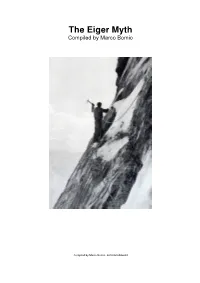
The Eiger Myth Compiled by Marco Bomio
The Eiger Myth Compiled by Marco Bomio Compiled by Marco Bomio, 3818 Grindelwald 1 The Myth «If the wall can be done, then we will do it – or stay there!” This assertion by Edi Rainer and Willy Angerer proved tragically true for them both – they stayed there. The first attempt on the Eiger North Face in 1936 went down in history as the most infamous drama surrounding the North Face and those who tried to conquer it. Together with their German companions Andreas Hinterstoisser and Toni Kurz, the two Austrians perished in this wall notorious for its rockfalls and suddenly deteriorating weather. The gruesome image of Toni Kurz dangling in the rope went around the world. Two years later, Anderl Heckmair, Ludwig Vörg, Heinrich Harrer and Fritz Kasparek managed the first ascent of the 1800-metre-high face. 70 years later, local professional mountaineer Ueli Steck set a new record by climbing it in 2 hours and 47 minutes. 1.1 How the Eiger Myth was made In the public perception, its exposed north wall made the Eiger the embodiment of a perilous, difficult and unpredictable mountain. The persistence with which this image has been burnt into the collective memory is surprising yet explainable. The myth surrounding the Eiger North Face has its initial roots in the 1930s, a decade in which nine alpinists were killed in various attempts leading up to the successful first ascent in July 1938. From 1935 onwards, the climbing elite regarded the North Face as “the last problem in the Western Alps”. This fact alone drew the best climbers – mainly Germans, Austrians and Italians at the time – like a magnet to the Eiger. -
Old Laws of Sikkim
OLD LAWS OF SIKKIM SIKKIM CODE Volume V PUBLISHED BY: LAW DEPARTMENT, GOVERNMENT OF SIKKIM, GANGTOK Price: SI.No. Notification No.& Date Year Subject Page No. 1 Notification No.6072/0. 1926 Maintenance of road reserve on either side of all 1 dated 10.5.1926 the estate bridle paths in Sikkim. 2 Notifiction No.6161/G. 1926 Rules to be observed in case of settlement in 1-2 dated 10.5.1926 Forest lands. Prohibition of washing of millet, cloths in the 3 Notice No. 850/J. 1927 3 ridge dated 15.6.1927 compound water. 4 Notifiction No. 5660-20/G. 1927 Refund of fine and fees. 3 dated 27.6.1927 5 Notification No. 6309/G. 1927 Prohibition for extraction of wax or honey from 4 dated 18.7.1927 the hives of wild bees. 6 Notification NO.11130/G. 1927 Collection of seedling of Chanp, Piple etc,for 4 dated 12.12.1927 roadside plantation. 7 Notification No.297/G. 1928 Rules for Importation of Cigarettes etc. 5 dated 9.4.1928 8 Notice No.436/J. 1928 Exemption from payment of Court fee/stamps 5-6 dated 25.5.1928 etc., for Monasteries. 9 Notification No.1816/G. 1928 Settlements of raiyats on Forest Lands. 6-7 dated 5.6.1928 10 Notification NO.1978/G. 1928 Direction to Landlords to submit monthly grazing 7 dated 7.6.1928 and forest account direct to the office. 11 Notification No.2022/G. 1928 Rules regulating marking of trees, poles, etc in 8-9 Khasmahal Forest by the landlord and dated 11.6.1928 - Managers of Estates in Sikkim. -

2000 in the Land of Five Treasures of Snow
SIKKIM : THE LAND OF FIVE TREASURES OF THE SNOWS To breathe the air of Sikkim free, To wander by her purling rills, And seek the beauty of her hills, The blueness of her sky. C. McCauley, Lay of Lachen The Sikkim region of the Himalaya is so small that originally it was classified as part of Nepal Himalaya in the 1860s in a study conducted by Sir Sydney Burrard, the Surveyor-General of India from 1910 to 1919. This diminutive state to the north of Darjeeling, the famous hill town in West Bengal, stretches for about 110 km from north to south, and for 65 km from east to west. The Kangchenjunga (now also known as the Khangchendzonga), at 8,586 m the third highest peak in the world, is situated here. The original inhabitants of Sikkim were the Lepchas whose language and physical features tend to identify them as the ancient tribe that is believed to have migrated from southern Tibet during the 15th century. Very few Lepchas remain today, and the population largely consists of the Nepalis who arrived in Sikkim during the early 20th century in search of livelihood. Sikkim was an independent kingdom until a series of events caused the British to take full control of the region in 1861. In the early 19th century, the East India Company settled a dispute between Sikkim and Nepal in favour of the former, in the process assuming certain protective rights and gaining control over the Sikkimese army. In 1834, the East India Company helped the Chogyal of Sikkim in repulsing the Nepalese army, and as a gesture of goodwill, the Chogyal presented it with the present day Darjeeling and the Singalila ridge, a small track immediately surrounding it. -

Celebrating Festivals, Negotiating Memories – a Study of the Drugpa Tseshi Festival Tradition in Contemporary Lhasa1
Celebrating festivals, negotiating memories – a study of the Drugpa Tseshi festival tradition in contemporary Lhasa1 By Astrid Hovden 1.0 Introduction Ritual practice related to the sacred landscape of Lhasa is performed daily by its residents and visiting pilgrims, but the activity is particularly extensive during the celebration of religious festivals. This essay seeks to describe and analyse the celebration of one such festival in contemporary Lhasa: the Drugpa Tseshi (Drug pa tshes bzhi) festival which commemorates the Buddha’s first sermon. In Lhasa the festival is celebrated by pilgrimage to hermitages in the mountains north of the city. The participants visit a range of monasteries, hermitages, caves, springs, self-emanated images and other sacred objects and features in the landscape. These places embody long and intriguing stories, illustrating how the memory of the religious history of Lhasa is weaved into the landscape. The Drugpa Tseshi festival constitutes a long tradition of communal events celebrated annually in the public space of Lhasa, only interrupted by the Cultural Revolution, which imposed a prohibition on all religious expressions. The Tibetans were gradually able to resume their traditions after the ban was lifted in 1978.2 But in the years since then, Tibetan society has undergone radical transformations and the conditions for religious practice have changed correspondingly. Despite of a vast body of literature on Tibetan religion, the festivals of Lhasa have received relatively little scholarly attention.3 References to the Drugpa Tseshi tradition can be found only in a few publications in western and Tibetan languages. A description of the celebration will therefore have documentary value in itself and will constitute the first part of the essay.