African-American Heritage Places in Helena, MT
Total Page:16
File Type:pdf, Size:1020Kb
Load more
Recommended publications
-

Negroes Are Different in Dixie: the Press, Perception, and Negro League Baseball in the Jim Crow South, 1932 by Thomas Aiello Research Essay ______
NEGROES ARE DIFFERENT IN DIXIE: THE PRESS, PERCEPTION, AND NEGRO LEAGUE BASEBALL IN THE JIM CROW SOUTH, 1932 BY THOMAS AIELLO RESEARCH ESSAY ______________________________________________ “Only in a Negro newspaper can a complete coverage of ALL news effecting or involving Negroes be found,” argued a Southern Newspaper Syndicate advertisement. “The good that Negroes do is published in addition to the bad, for only by printing everything fit to read can a correct impression of the Negroes in any community be found.”1 Another argued that, “When it comes to Negro newspapers you can’t measure Birmingham or Atlanta or Memphis Negroes by a New York or Chicago Negro yardstick.” In a brief section titled “Negroes Are Different in Dixie,” the Syndicate’s evaluation of the Southern and Northern black newspaper readers was telling: Northern Negroes may ordain it indecent to read a Negro newspaper more than once a week—but the Southern Negro is more consolidated. Necessity has occasioned this condition. Most Southern white newspapers exclude Negro items except where they are infamous or of a marked ridiculous trend… While his northern brother is busily engaged in ‘getting white’ and ruining racial consciousness, the Southerner has become more closely knit.2 The advertisement was designed to announce and justify the Atlanta World’s reformulation as the Atlanta Daily World, making it the first African-American daily. This fact alone probably explains the advertisement’s “indecent” comment, but its “necessity” argument seems far more legitimate.3 For example, the 1932 Monroe Morning World, a white daily from Monroe, Louisiana, provided coverage of the black community related almost entirely to crime and church meetings. -

A “Who's Who” of Bats
v o l u m e 1 5 • n u m b e r 3 • 2 0 0 7 A “Who’s Who” of Bats Lichens in Yellowstone National Park Who Are Yellowstone’s Backcountry Users? Yellowstone Denied NPS/HARLAN KREDIT A backcountry campsite (since removed) on the southeast arm of Yellowstone Lake, 1976. Celebrating the Less Noted HIS ISSUE OF YELLOWSTONE SCIENCE highlights a Lichens are partnerships of algae and fungi, and Sharon few less-noted park species, visitors, and historical per- Eversman shares results from various studies on these often Tsonalities. To enjoy such species, one needs to stay up overlooked organisms in her article. Besides being of interest a little later or get up a little earlier, and look a little closer. To for their symbiotic system and their many colors and shapes, understand the preferences of a small subset of park visitors, their presence is an indicator of environmental condition. one must seek them out and ask a lot of questions. And to Tim Oosterhous et al. surveyed those who choose a dif- appreciate one of these eccentrics from Yellowstone’s past, one ferent experience than most of the park’s three million annual needs to delve a little deeper into Yellowstone’s history. visitors—overnight backcountry recreationists. The results of Doug Keinath’s article on bats delights us with some this social science study will be of interest to park managers in incredible photos of these nocturnal animals. Until recently, defining a typical backcountry user and what kind of experi- no one really knew which species occurred in Yellowstone, but ences they are seeking. -
Montana Historical Society, Mining in the Far West, 1862-1920
Narrative Section of a Successful Proposal The attached document contains the narrative and selected portions of a previously funded grant application. It is not intended to serve as a model, but to give you a sense of how a successful proposal may be crafted. Every successful proposal is different, and each applicant is urged to prepare a proposal that reflects its unique project and aspirations. Prospective applicants should consult the program guidelines at http://www.neh.gov/grants/education/landmarks-american-history- and-culture-workshops-school-teachers for instructions. Applicants are also strongly encouraged to consult with the NEH Division of Education Programs staff well before a grant deadline. The attachment only contains the grant narrative and selected portions, not the entire funded application. In addition, certain portions may have been redacted to protect the privacy interests of an individual and/or to protect confidential commercial and financial information and/or to protect copyrighted materials. Project Title: The Richest Hills: Mining in the Far West, 1862-1920 Institution: Montana Historical Society Project Directors: Kirby Lambert and Paula Petrik Grant Program: Landmarks of American History and Culture Workshops 400 7th Street, S.W., 4th Floor, Washington, D.C. 20506 P 202.606.8500 F 202.606.8394 E education@neh.gov www.neh.gov LANDMARKS OF AMERICAN HISTORY TEACHER WORKSHOP THE RICHEST HILLS: MINING IN THE FAR WEST, 1862–1920 A. Narrative: The Montana Historical Society seeks support for a Landmarks of American History and Culture workshop for teachers that will examine the historical and cultural issues accompanying the development of mining in the far West. -
History of Navigation on the Yellowstone River
University of Montana ScholarWorks at University of Montana Graduate Student Theses, Dissertations, & Professional Papers Graduate School 1950 History of navigation on the Yellowstone River John Gordon MacDonald The University of Montana Follow this and additional works at: https://scholarworks.umt.edu/etd Let us know how access to this document benefits ou.y Recommended Citation MacDonald, John Gordon, "History of navigation on the Yellowstone River" (1950). Graduate Student Theses, Dissertations, & Professional Papers. 2565. https://scholarworks.umt.edu/etd/2565 This Thesis is brought to you for free and open access by the Graduate School at ScholarWorks at University of Montana. It has been accepted for inclusion in Graduate Student Theses, Dissertations, & Professional Papers by an authorized administrator of ScholarWorks at University of Montana. For more information, please contact scholarworks@mso.umt.edu. HISTORY of NAVIGATION ON THE YELLOWoTGriE RIVER by John G, ^acUonald______ Ë.À., Jamestown College, 1937 Presented in partial fulfillment of the requirement for the degree of Mas ter of Arts. Montana State University 1950 Approved: Q cxajJL 0. Chaiinmaban of Board of Examiners auaue ocnool UMI Number: EP36086 All rights reserved INFORMATION TO ALL USERS The quality of this reproduction is dependent upon the quality of the copy submitted. In the unlikely event that the author did not send a complete manuscript and there are missing pages, these will be noted. Also, if material had to be removed, a note will indicate the deletion. UMT Ois8<irtatk>n PuUishing UMI EP36086 Published by ProQuest LLC (2012). Copyright in the Dissertation held by the Author. Microform Edition © ProQuest LLC. -
I-5 Scar of Displacement Revisited
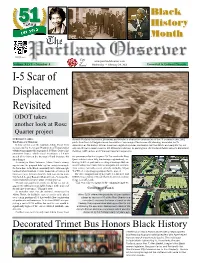
Black History Month PO QR code ‘City of www.portlandobserver.com Volume XLVV • Number 4 Roses’ Wednesday • February 24, 2021 Committed to Cultural Diversity I-5 Scar of Displacement Revisited ODOT takes another look at Rose Quarter project BY BEVERLY CORBELL A swath Portland centered at Broadway and Weidler is cleared for construction of the I-5 freeway in this 1962 THE PORTLAND OBSERVER photo from the Eliot Neighborhood Association. Even many of the homes still standing were later lost to In June of last year, the nonprofit Albina Vision Trust demolition as the historic African American neighborhood was decimated over the 1960s and early 1970s, not sent an email to the Oregon Department of Transportation only for I-5, but to make room for the Memorial Coliseum, its parking lots, the Portland Public School’s Blanchard withdrawing support for its proposed I-5 Rose Quarter Im- Building, I-405 ramps, and Emanuel Hospital’s expansion. provement Project, which would reconfigure a 1.8-mile stretch of I-5 between the Interstate 84 and Interstate 405 the grassroots effort that began in 2017 to remake the Rose interchanges. Quarter district into a fully functioning neighborhood, em- According to Winta Yohannes, Albina Vision’s manag- bracing its diverse past and re-creating a landscape that can ing director, the proposal didn’t go far enough to mitigate accommodate much more than its two sports and entertain- the harm done to the Black community in the Albina neigh- ment venues, but with several officials, including Mayor borhood when hundreds, maybe thousands, of homes and Ted Wheeler, also dropping support for the project. -
ABOR and the ~EW Peal: the CASE - - of the ~OS ~NGELES J~~~Y
~ABOR AND THE ~EW pEAL: THE CASE - - OF THE ~OS ~NGELES J~~~y By ISAIAS JAMES MCCAFFERY '\ Bachelor of Arts Missouri Southern State College Joplin, Missouri 1987 Submitted to the Faculty of the Graduate College of Oklahoma Siate University in partial fulfillment of the requirements for the Degree of MASTER OF ARTS December, 1989 { Oklahoma ~tate univ •.1...u..1u.Lu..1.; LABOR AND THE NEW DEAL: THE CASE OF THE LOS ANGELES ILGWC Thesis Approved: Dean of the Graduate College 1.i PREFACE This project examines the experience of a single labor union, the International Ladies' Garment Workers' Union (ILGWU), in Los Angeles during the New Deal era. Comparisons are drawn between local and national developments within the ILGWU and the American labor movement in general. Surprisingly little effort has been made to test prevailing historical interpretations within specific cities-- especially those lying outside of the industrial northeast. Until more localized research is undertaken, the unique organizational struggles of thousands of working men and women will remain ill-understood. Differences in regional politics, economics, ethnicity, and leadership defy the application of broad-based generalizations. The Los Angeles ILGWU offers an excellent example of a group that did not conform to national trends. While the labor movement experienced remarkable success throughout much of the United States, the Los Angeles garment locals failed to achieve their basic goals. Although eastern clothing workers won every important dispute with owners and bargained from a position of strength, their disunited southern Californian counterparts languished under the counterattacks of business interests. No significant gains in ILGWU membership occurred in Los Angeles after 1933, and the open shop survived well iii into the following decade. -

National Register of Historic Places Registration Form
NPS Form 10-900 OMB No. 1024-0018 (Rev. Oct. 1990) United States Department of the Interior National Park Service NATIONAL REGISTER OF HISTORIC PLACES REGISTRATION FORM 1. Name of Property historic name: Dearborn River High Bridge other name/site number: 24LC130 2. Location street & number: Fifteen Miles Southwest of Augusta on Bean Lake Road not for publication: n/a vicinity: X city/town: Augusta state: Montana code: MT county: Lewis & Clark code: 049 zip code: 59410 3. State/Federal Agency Certification As the designated authority under the National Historic Preservation Act of 1986, as amended, I hereby certify that this _X_ nomination _ request for detenj ination of eligibility meets the documentation standards for registering properties in the National Register of Historic Places and meets the proc urf I and professional requirements set forth in 36 CFR Part 60. In my opinion, the property X_ meets _ does not meet the National Register Criterfi commend thatthis oroperty be considered significant _ nationally X statewide X locafly. Signa jre of oertifying officialn itle Date Montana State Historic Preservation Office State or Federal agency or bureau (_ See continuation sheet for additional comments. In my opinion, the property _ meets _ does not meet the National Register criteria. Signature of commenting or other official Date State or Federal agency and bureau 4. National Park Service Certification , he/eby certify that this property is: 'entered in the National Register _ see continuation sheet _ determined eligible for the National Register _ see continuation sheet _ determined not eligible for the National Register_ _ see continuation sheet _ removed from the National Register _see continuation sheet _ other (explain): _________________ Dearborn River High Bridge Lewis & Clark County. -
In the Midst of the Mournful Discourse Concerning the Steady
REMEMBERING FREEDOM’S JOURNAL: CHERISHING AND CHALLENGING THE BLACK PRESS Los Angeles Sentinel, 032609, p. A7 DR. MAULANA KARENGA In the midst of the mournful discourse act for the wellbeing of the people and concerning the steady disintegration of big humankind. city and regional dailies and the continuing On March 16, 1827, when Samuel collapse of journalism as a professional, Cornish and John Russwurm established the principled and promising practice, we are first African American paper in the U.S., compelled to ask ourselves what this means, these views and values were the motivating not only for society, but also for our force for their actions. In their inaugural community. This is clearly a concern for editorial written in the midst of the those who rightfully hold that a free and Holocaust of enslavement, they laid out the functioning press is central to democracy, to reasons for their establishing the paper the quality of civic life, to independent which was instructively called Freedom’s investigations of things and to holding Journal. These same principles and practices officials accountable. But for us, especially inform the best of our media efforts today, with regard to the Black press, it is also a and offer guidelines for good and useful voice for the vulnerable and an advocate for print and electronic media from newspapers a just and good society and for the struggle and radio to TV and internet. These that seeks to bring it into being. And it is principles have also been reflected in clearly key to the ability of people to get various ways by a long list of major information needed and necessary to make newspapers in our history: the Chicago informed choices. -

The Army Post on the Northern Plains, 1865-1885
The Army Post on the Northern Plains, 1865-1885 (Article begins on page 2 below.) This article is copyrighted by History Nebraska (formerly the Nebraska State Historical Society). You may download it for your personal use. For permission to re-use materials, or for photo ordering information, see: https://history.nebraska.gov/publications/re-use-nshs-materials Learn more about Nebraska History (and search articles) here: https://history.nebraska.gov/publications/nebraska-history-magazine History Nebraska members receive four issues of Nebraska History annually: https://history.nebraska.gov/get-involved/membership Full Citation: Ray H. Mattison, “The Army Post on the Northern Plains, 1865-1885,” Nebraska History 35 (1954): 17-43 Article Summary: Frontier garrisons played a significant role in the development of the West even though their military effectiveness has been questioned. The author describes daily life on the posts, which provided protection to the emigrants heading west and kept the roads open. Note: A list of military posts in the Northern Plains follows the article. Cataloging Information: Photographs / Images: map of Army posts in the Northern Plains states, 1860-1895; Fort Laramie c. 1884; Fort Totten, Dakota Territory, c. 1867 THE ARMY POST ON THE NORTHERN PLAINS, 1865-1885 BY RAY H. MATTISON HE opening of the Oregon Trail, together with the dis covery of gold in California and the cession of the TMexican Territory to the United States in 1848, re sulted in a great migration to the trans-Mississippi West. As a result, a new line of military posts was needed to guard the emigrant and supply trains as well as to furnish protection for the Overland Mail and the new settlements.1 The wiping out of Lt. -

Brief Little History of Gallatin County Coloring Pages
A Brief History of Gallatin County Buffalo Jump The Madison Buffalo Jump, located just 32 miles miles from Bozeman, was used by Native Americans for 2,000 years ending just 200 years ago. Natives would stampede the bison towards the cliff’s face resulting in a mass killing that provided them with provisions, shelter, clothing and food for the winter. Lewis and Clark 1805 Under the direction of President Thomas Jefferson the Lewis & Clark Expedition endeavored to explore the western frontier. The three rivers were named in the area during this journey; the Jefferson for the President, the Madison for James Madison, the Secretary of State, and Gallatin for Albert Gallatin, Secretery of the US Tresury. These rivers come together at Three Forks, MT just 31 miles northwest of Bozeman. Fur Trade 1800s The fur trade lasted from about 1810 through the 1840s. The primary fur was beaver. Most of these seasons were celebrated with a rendevous of the mountain men trap- pers. Gold Rush 1860s The Gold Rush began in 1862 at Bannack an the following year in 1863 in Virginia City. Men traveled from all across the nation in search of “color.” Some of those who didn’t strike it rich found a new wealth in getting supplies to the miners and in the agricultural land of the Gallatin Valley. Bozeman Established 1864 The city of Bozeman was named after John Bozeman, failed miner and entrepeneur. He left his wife and kids in Georgia never to return. At the young age of 30 John was killed by either a band of Native Americans or his business partner Tom Cover. -

East Bench Unit History
East Bench Unit Three Forks Division Pick Sloan Missouri Basin Program Jedediah S. Rogers Bureau of Reclamation 2008 Table of Contents East Bench Unit...............................................................2 Pick Sloan Missouri Basin Program .........................................2 Project Location.........................................................2 Historic Setting .........................................................3 Investigations...........................................................7 Project Authorization....................................................10 Construction History ....................................................10 Post Construction History ................................................15 Settlement of Project Lands ...............................................19 Project Benefits and Uses of Project Water...................................20 Conclusion............................................................21 Bibliography ................................................................23 Archival Sources .......................................................23 Government Documents .................................................23 Books ................................................................24 Other Sources..........................................................24 1 East Bench Unit Pick Sloan Missouri Basin Program Located in rural southwest Montana, the East Bench Unit of the Pick Sloan Missouri Basin Program provides water to 21,800 acres along the Beaverhead River in -

A Female Factor April 12, 2021
William Reese Company AMERICANA • RARE BOOKS • LITERATURE AMERICAN ART • PHOTOGRAPHY ______________________________ 409 TEMPLE STREET NEW HAVEN, CONNECTICUT 06511 (203) 789-8081 FAX (203) 865-7653 amorder@reeseco.com A Female Factor April 12, 2021 Celebrating a Pioneering Day Care Program for Children of Color 1. [African Americana]: [Miller Day Nursery and Home]: MILLER DAY NURSERY AND HOME...THIRTY-FIFTH ANNIVERSARY PROGRAM... EBENEZER BAPTIST CHURCH [wrapper title]. [Portsmouth, Va. 1945]. [4]pp. plus text on inner front wrapper and both sides of rear wrapper. Quarto. Original printed wrappers, stapled. Minor edge wear, text a bit tanned. Very good. An apparently unrecorded program of activities planned to celebrate the thirty- fifth anniversary of the founding of the Miller Day Nursery and Home, the first day care center for children of color in Portsmouth, Virginia. The center and school were established by Ida Barbour, the first African-American woman to establish such a school in Portsmouth. It is still in operation today, and is now known as the Ida Barbour Early Learning Center. The celebration, which took place on November 11, 1945, included music, devotionals, a history of the center, collection of donations, prayers, and speeches. The work is also supplemented with advertisements for local businesses on the remaining three pages and the inside rear cover of the wrappers. In all, these advertisements cover over forty local businesses, the majority of which were likely African-American-owned es- tablishments. No copies in OCLC. $400. Early American Sex Manual 2. Aristotle [pseudonym]: THE WORKS OF ARISTOTLE, THE FAMOUS PHILOSOPHER. IN FOUR PARTS. CONTAINING I.