ADWR Low Water Use/Drought Tolerant Plant List
Total Page:16
File Type:pdf, Size:1020Kb
Load more
Recommended publications
-

Cassia Fistula (Golden Shower): a Multipurpose Ornamental Tree
Floriculture and Ornamental Biotechnology ©2007 Global Science Books Cassia fistula (Golden Shower): A Multipurpose Ornamental Tree Muhammad Asif Hanif1,2 • Haq Nawaz Bhatti1* • Raziya Nadeem1 • Khalid Mahmood Zia1 • Muhammad Asif Ali2 1 Department of Chemistry, University of Agriculture, Faisalabad - 38040, Pakistan 2 Institute of Horticultural Sciences, University of Agriculture, Faisalabad - 38040, Pakistan Corresponding author : * hnbhatti2005@yahoo.com ABSTRACT Cassia fistula Linn is a multipurpose, ornamental, fast growing, medium sized, deciduous tree that is now widely cultivated world wide for its beautiful showy yellow fluorescent flowers. This paper reviews the phenolic antioxidants, metal sorption, medicinal and free radical propensities of plant parts and cell culture extracts. This paper also appraises antimicrobial activities and commercial significance of C. fistula parts. The main objectives of present review study are to: (1) critically evaluate the published scientific research on C. fistula, (2) highlight claims from traditional, tribal and advanced medicinal lore to suggest directions for future clinical research and commercial importance that could be carried out by local investigators in developing regions. _____________________________________________________________________________________________________________ Keywords: antioxidant, medicinal plant, water treatment CONTENTS INTRODUCTION....................................................................................................................................................................................... -

Arcadia at Silverleaf
Section Six - Landscape Design Mature Size ADWR Common Name Botanical Name (H x W) Size Zone Natural and Transitional Zones Streetscape Enhanced Zone Private Zone TREES X Acacia abyssinica Abyssinian Acacia 20’-25’ 20-25’ M x x X Acacia aneura Mulga 20’ 12’ M x x X Acacia berlandieri Berlandier Acacia 15’ 15’ S x x X Acacia constricta Whitethorn Acacia 10’ 15’ S x x x X Acacia craspedocarpa Leatherleaf Acacia 18’ 10’ M x x X Acacia crassifolia Butterfly-leaf Acacia 10’-15’ 10’-15’ S x x X Acacia gerrardii Gray-thorn Acacia 25’ 25’ M x x X Acacia greggii Catclaw Acacia 10’ 15’ S x x x x X Acacia rigidula Black-brush acacia 10’-15’ 7’-9’ S x April24,2015 October21,2005,revised Design,LLC.,andDCRanchLLC.Allrightsreserved. ©2005 DaleGardon X Acacia roemeriana Roemer Acacia 20’ 25’ M x X Acacia saligna Willow Acacia 15’-25’ 10’-20’ M x X Acacia schaffneri Twisted Acacia 15’-25’ 15’-25’ M x X Acacia smallii (farnesiana) Sweet Acacia 15’-20’ 15’-20’ M x x x X Acacia tortillia Umbrella Thorn 20’-30’ 30’ L x X Acacia willardiana Palo Blanco 20’ 10’ M x x Albizia julibrissin Mimosa 20’-40’ 40’ L x Apple ‘Anna’ Anna Apple Tree 15’ 15’ S x X Bauhinia congesta Anacacho Orchid Tree 6’-12’ 6’-12’ S x X Bauhinia congesta ‘Lunarioides’ Pink Orchid Tree 6’-12’ 6’-12’ S x X Caesalpinia cacalaco Cascalote 15’-20’ 15’ M x x X Caesalpinia mexicana Mexican Bird of Paradise 10’-15’ 6’-12’ S x x X Canotia holacantha Crucifixion Thorn 15’ 10’ S x x x X Cercidium ‘Desert Museum’ Hybrid Palo Verde 25’ 15’ M x x x X Cercidium floridum Blue Palo Verde 30’ 30’-40’ L x x x x Cercidium microphyllum Foothills Palo Verde 20’ 25’ M x x x x X Cercidium praecox Palo Brea 20’ 25’ M x x x X Cercis canadensis v. -

Vascular Plant and Vertebrate Inventory of Montezuma Castle National Monument Vascular Plant and Vertebrate Inventory of Montezuma Castle National Monument
Schmidt, Drost, Halvorson In Cooperation with the University of Arizona, School of Natural Resources Vascular Plant and Vertebrate Inventory of Montezuma Castle National Monument Vascular Plant and Vertebrate Inventory of Montezuma Castle National Monument Plant and Vertebrate Vascular U.S. Geological Survey Southwest Biological Science Center 2255 N. Gemini Drive Flagstaff, AZ 86001 Open-File Report 2006-1163 Southwest Biological Science Center Open-File Report 2006-1163 November 2006 U.S. Department of the Interior U.S. Geological Survey National Park Service In cooperation with the University of Arizona, School of Natural Resources Vascular Plant and Vertebrate Inventory of Montezuma Castle National Monument By Cecilia A. Schmidt, Charles A. Drost, and William L. Halvorson Open-File Report 2006-1163 November, 2006 USGS Southwest Biological Science Center Sonoran Desert Research Station University of Arizona U.S. Department of the Interior School of Natural Resources U.S. Geological Survey 125 Biological Sciences East National Park Service Tucson, Arizona 85721 U.S. Department of the Interior Dirk Kempthorne, Secretary U.S. Geological Survey Mark Myers, Director U.S. Geological Survey, Reston, Virginia: 2006 Note: This document contains information of a preliminary nature and was prepared primarily for internal use in the U.S. Geological Survey. This information is NOT intended for use in open literature prior to publication by the investigators named unless permission is obtained in writing from the investigators named and from the Station Leader. Suggested Citation Schmidt, C. A., C. A. Drost, and W. L. Halvorson 2006. Vascular Plant and Vertebrate Inventory of Montezuma Castle National Monument. USGS Open-File Report 2006-1163. -

(Caesalpiniaceae) D.E
J. Adelaide Bot. Gard. 18(2): 101-102 (1998) SENNA PHYLLODINEA A NEW COMBINATION IN SE1VNA (CAESALPINIACEAE) D.E. Symon State Herbarium of South Australia, Botanic Gardens of Adelaide, North Terrace, Adelaide, South Australia 5000 Abstract The combination Senna phyllodinea (R. Br.)Symon is made to facilitate the use of the name for those who wish to distinguish it from Senna artemisioides ssp. petiolaris. Introduction The presence of agamospermy, polyploidy and hybridity (Randell 1970) has resulted in a bewildering array of morphological forms in Senna in our arid areas. The discovery of abundant polyembryony (Symon 1956) led Randell (1970) to examine its causes and with this new understanding to present a new taxonomic account of the genus in Australia (Randell 1988, 1989, 1990). The division of the genus Cassia L. into three genera Cassia L. s.str., Senna Miller and Chamaecrista Moench has been widely accepted. It is ahnost solely in Australia in Senna ser. Subverrucosae that the taxonomic problems are acute. Randell (1989) has grouped the variants under three core taxa, S. glutinosa, S. cardiosperma and S. artemisioides, and one can agree with much of this grouping with some particular misgivings. A problem Under S. artemisioides ssp. petiolaris Randell has grouped all the variants that possess a flaftened petiole. Within this grouping are three widespread entitiesthat may be summarised as follows:- 1. A form with relatively broad phyllodes, green in aspect, straight or slightly curved, pubescent with minute appressed hairs, the lamina readilyvisible,glabrescent, sometimes pruinose, often with generally short, flattened, terminal leaflets. The pods are (6-) 7 (-9) mm wide, straight or slightly curved. -

December 2012 Number 1
Calochortiana December 2012 Number 1 December 2012 Number 1 CONTENTS Proceedings of the Fifth South- western Rare and Endangered Plant Conference Calochortiana, a new publication of the Utah Native Plant Society . 3 The Fifth Southwestern Rare and En- dangered Plant Conference, Salt Lake City, Utah, March 2009 . 3 Abstracts of presentations and posters not submitted for the proceedings . 4 Southwestern cienegas: Rare habitats for endangered wetland plants. Robert Sivinski . 17 A new look at ranking plant rarity for conservation purposes, with an em- phasis on the flora of the American Southwest. John R. Spence . 25 The contribution of Cedar Breaks Na- tional Monument to the conservation of vascular plant diversity in Utah. Walter Fertig and Douglas N. Rey- nolds . 35 Studying the seed bank dynamics of rare plants. Susan Meyer . 46 East meets west: Rare desert Alliums in Arizona. John L. Anderson . 56 Calochortus nuttallii (Sego lily), Spatial patterns of endemic plant spe- state flower of Utah. By Kaye cies of the Colorado Plateau. Crystal Thorne. Krause . 63 Continued on page 2 Copyright 2012 Utah Native Plant Society. All Rights Reserved. Utah Native Plant Society Utah Native Plant Society, PO Box 520041, Salt Lake Copyright 2012 Utah Native Plant Society. All Rights City, Utah, 84152-0041. www.unps.org Reserved. Calochortiana is a publication of the Utah Native Plant Society, a 501(c)(3) not-for-profit organi- Editor: Walter Fertig (walt@kanab.net), zation dedicated to conserving and promoting steward- Editorial Committee: Walter Fertig, Mindy Wheeler, ship of our native plants. Leila Shultz, and Susan Meyer CONTENTS, continued Biogeography of rare plants of the Ash Meadows National Wildlife Refuge, Nevada. -

(12) Patent Application Publication (10) Pub. No.: US 2009/0263516 A1 CYR (43) Pub
US 20090263516A1 (19) United States (12) Patent Application Publication (10) Pub. No.: US 2009/0263516 A1 CYR (43) Pub. Date: Oct. 22, 2009 (54) PLANT EXTRACT COMPOSITION AND Publication Classification THEIR USE TO MODULATE CELLULAR (51) Int. Cl. ACTIVITY A636/8962 (2006.01) A636/00 (2006.01) (75) Inventor: Benoit CYR, St. Augustin de A6IP35/00 (2006.01) Desmaures (CA) CI2N 5/06 (2006.01) Correspondence Address: A6IR 36/3 (2006.01) SHEPPARD, MULLIN, RICHTER & HAMPTON A 6LX 36/899 (2006.01) LLP (52) U.S. Cl. ......... 424/754; 424/725; 435/375; 424/774; 990 Marsh Road 424/779; 424/755; 424/750; 424/777 Menlo Park, CA 94025 (US) (57) ABSTRACT (73) Assignee: Biopharmacopae Design Extracts from plant material, or semi-purified/purified mol International Inc., Saint-Foy (CA) ecules or compounds prepared from the extracts that demon strate the ability to modulate one or more cellular activities (21) Appl. No.: 12/263,114 are provided. The extracts are capable of slowing down, inhibiting or preventing cell migration, for example, the (22) Filed: Oct. 31, 2008 migration of endothelial cells or neoplastic cells and thus, the use of the extracts to slow down, inhibit or prevent abnormal Related U.S. Application Data cell migration in an animal is also provided. Methods of selecting and preparing the plant extracts and methods of (63) Continuation of application No. 10/526,387, filed on screening the extracts to determine their ability to modulate Oct. 6, 2005, now abandoned, filed as application No. one or more cellular activity are described. The purification or PCT/CA03/01284 on Sep. -

Palm Trees for Landscapes in Tulare & Kings Counties
Palm Trees for Landscapes in Tulare & Kings Counties Suggested by Nancy Gravender, UC Master Gardener MEDIUM-SIZED PALM TREES (10-25 Ft. Tall) FAN PALMS: Guadalupe Palm (Brahea edulis) – Grows to 20 ft., spread 15 ft., solitary trunk, large handsome fan leaves, (old leaves self-prune), slow growth, temperature range 20-105 °F. Mexican Blue Palm (Brahea armata) – Grows to 20 ft., spread 10 ft., solitary trunk, stiff, palmate fan covered with pale blue bloom, slow growth, temp. range 20-120 °F. Mediterranean or European Fan Palm (Chamerops humilus) – Grows to 15 ft., spread 15 ft., clumping or multiple trunks, 4-5 ft. in diameter; fan, 2-3 ft. diameter stiff leaflets, petiole has sharp spines, slow growth, temp. range 20-120 °F. Windmill Palm (Trachycarpus fortunei) – Grows to 15 ft. spread 5 ft., solitary trunk covered with old leaf bases, and brown fibrous matted hairy fibers; fan irregularly divided, if not trimmed, the old leaves hang down; temp. range 10–115 °F. FEATHER PALMS: Pigmy Date Palm (Phoenix roebelinii) – Grows to 10 ft., solitary trunk, 4-8 in. in diameter, feather with leaflets much softer than those of other Phoenix palms, although the lower leaflets still contain sharp spines, slow growth, temperature range 28-105 °F. Requires shade in this area. Pindo Palm (Butia capitata) - Grows to 20 ft., spread 15 ft., solitary trunk, blue green pinnate feather, slow growth, temp. range 15-120 °F. Queen Palm (Syagrus romanzoffiana) – Grows to 25 ft. spread 12 ft., solitary trunk ringed with old leaf bases, feather, plumose (leaflets radiating at different angles), fast growth with abundant summer water and fertilizer, temp. -

Characteristics of the Stem-Leaf Transitional Zone in Some Species of Caesalpinioideae (Leguminosae)
Turk J Bot 31 (2007) 297-310 © TÜB‹TAK Research Article Characteristics of the Stem-Leaf Transitional Zone in Some Species of Caesalpinioideae (Leguminosae) Abdel Samai Moustafa SHAHEEN Botany Department, Aswan Faculty of Science, South Valley University - EGYPT Received: 14.02.2006 Accepted: 15.02.2007 Abstract: The vascular supply of the proximal, middle, and distal parts of the petiole were studied in 11 caesalpinioid species with the aim of documenting any changes in vascular anatomy that occurred within and between the petioles. The characters that proved to be taxonomically useful include vascular trace shape, pericyclic fibre forms, number of abaxial and adaxial vascular bundles, number and relative position of secondary vascular bundles, accessory vascular bundle status, the tendency of abaxial vascular bundles to divide, distribution of sclerenchyma, distribution of cluster crystals, and type of petiole trichomes. There is variation between studied species in the number of abaxial, adaxial, and secondary bundles, as seen in transection of the petiole. There are also differences between leaf trace structure of the proximal, middle, and distal regions of the petioles within each examined species. Senna italica Mill. and Bauhinia variegata L. show an abnormality in their leaf trace structure, having accessory bundles (concentric bundles) in the core of the trace. This study supports the moving of Ceratonia L. from the tribe Cassieae to the tribe Detarieae. Most of the characters give valuable taxonomic evidence reliable for delimiting the species investigated (especially between Cassia L. and Senna (Cav.) H.S.Irwin & Barneby) at the generic and specific levels, as well as their phylogenetic relationships. -

Split Rock Trail Most Diverse Vegetation Types in North America
Species List Species List National Park Service U.S. Department of the Interior Color Species Habit Season Color Species Habit Season Section 2, ■ • Section 1 W Ambrosia dumosa (burrobush) S C Y Opuntia chlorotica (pancake cactus) C c Joshua Tree National Park W Brickellia atractyloides (pungent brickellia) S c Y Rhus aromatica (skunk bush) s C w Caulanthus cooperi (Cooper's caulanthus) A c Y Senegalia greggii (cat's claw acacia) s H % w Chaenacf/s srew'o('c/es (Esteve's pincushion) A c Y Senna armata (desert senna) s C, H w Cryptantha barbigera (bearded forget-me-not) A c Y Tetradymia stenolepis (Mojave cottonthorn) s H w Cryptantha nevadensis (Nevada forget-me-not) A c 0 Adenophyllum porophylloides (San Felipe dyssodia) SS C, H tv w Eriogonum davidsonii (Davidson's buckwheat) A c, H 0 Sphaeraicea ambigua (apricot mallow) p C V w Eriogonum fasciculatum (California buckwheat) S C, H p Allium parishii (Parish's onion) B C \ w Eriogonum wrightii (Wright's buckwheat) SS H p Cylindropuntia ramosissima (pencil cholla) c H t Section 4 w Euphorbia albomarginata (rattlesnake weed) A C, H I p Echinocereus engelmannii (hedgehog cactus) c C P- ♦ Section 31 w Galium stellatum (starry bedstraw) SS C p Krameria erecta (littieleaf ratany) s C W/P Giliastellata (stargiiia) A C P/W Mirabilis laevis (wishbone bush) p c w Lepidium lasiocarpum (white pepperweed) A c _PJ Opuntia basilaris (beavertai! cactus) c c N w Lycium andersonii (Anderson's boxthorn) S c p Stephanomeria exigua (small wirelettuce) A C,H A w Lydum cooperi (Cooper's boxthorn) s c p Stephanomeria parryi (Parry's wirelettuce) P c w Nolina parryi (Parry nolina) s c p IStephanomeria paudflora (brownplume wirelettuce) SS c 0 500 2000 Feet w Pectocarya recurvata (arched-nut comb-bur) A c Boechera xylopoda (bigfoot hybrid rockcress) P c 0 150 600 Meters w Pecfocarya serosa (round-nut comb-bur) A c Delphinium parishii (Parish's larkspur) P c See inside of guide for plants found in each section of this map. -
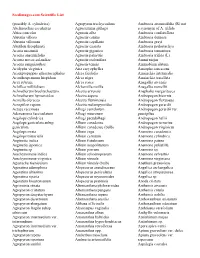
Seedimages Species Database List
Seedimages.com Scientific List (possibly A. cylindrica) Agropyron trachycaulum Ambrosia artemisifolia (R) not Abelmoschus esculentus Agrostemma githago a synonym of A. trifida Abies concolor Agrostis alba Ambrosia confertiflora Abronia villosa Agrostis canina Ambrosia dumosa Abronia villosum Agrostis capillaris Ambrosia grayi Abutilon theophrasti Agrostis exarata Ambrosia psilostachya Acacia mearnsii Agrostis gigantea Ambrosia tomentosa Acaena anserinifolia Agrostis palustris Ambrosia trifida (L) Acaena novae-zelandiae Agrostis stolonifera Ammi majus Acaena sanguisorbae Agrostis tenuis Ammobium alatum Acalypha virginica Aira caryophyllea Amorpha canescens Acamptopappus sphaerocephalus Alcea ficifolia Amsinckia intermedia Acanthospermum hispidum Alcea nigra Amsinckia tessellata Acer rubrum Alcea rosea Anagallis arvensis Achillea millifolium Alchemilla mollis Anagallis monellii Achnatherum brachychaetum Alectra arvensis Anaphalis margaritacea Achnatherum hymenoides Alectra aspera Andropogon bicornis Acmella oleracea Alectra fluminensis Andropogon flexuosus Acroptilon repens Alectra melampyroides Andropogon gerardii Actaea racemosa Alhagi camelorum Andropogon gerardii var. Adenostoma fasciculatum Alhagi maurorum paucipilus Aegilops cylindrica Alhagi pseudalhagi Andropogon hallii Aegilops geniculata subsp. Allium canadense Andropogon ternarius geniculata Allium canadense (bulb) Andropogon virginicus Aegilops ovata Allium cepa Anemone canadensis Aegilops triuncialis Allium cernuum Anemone cylindrica Aeginetia indica Allium fistulosum Anemone -

Lake Havasu City Recommended Landscaping Plant List
Lake Havasu City Recommended Landscaping Plant List Lake Havasu City Recommended Landscaping Plant List Disclaimer Lake Havasu City has revised the recommended landscaping plant list. This new list consists of plants that can be adapted to desert environments in the Southwestern United States. This list only contains water conscious species classified as having very low, low, and low-medium water use requirements. Species that are classified as having medium or higher water use requirements were not permitted on this list. Such water use classification is determined by the type of plant, its average size, and its water requirements compared to other plants. For example, a large tree may be classified as having low water use requirements if it requires a low amount of water compared to most other large trees. This list is not intended to restrict what plants residents choose to plant in their yards, and this list may include plant species that may not survive or prosper in certain desert microclimates such as those with lower elevations or higher temperatures. In addition, this list is not intended to be a list of the only plants allowed in the region, nor is it intended to be an exhaustive list of all desert-appropriate plants capable of surviving in the region. This list was created with the intention to help residents, businesses, and landscapers make informed decisions on which plants to landscape that are water conscious and appropriate for specific environmental conditions. Lake Havasu City does not require the use of any or all plants found on this list. List Characteristics This list is divided between trees, shrubs, groundcovers, vines, succulents and perennials. -

03-Aclp-2-Plant-Id-Shrubs.Pdf
Plants and Trees of the Southwest Shrubs Used in the Landscape Learn about the shrubs you see around you everyday! Photos and text shared by Dr. Chris Martin Professor of Sustainable Horticulture Arizona State University 22 Acca sellowiana pineapple guava Formerly Feijoa sellowiana Afrocarpus gracilior 23 yew pine Formerly Podocarpus macrophyllus 24 Anisacanthus quadrifidus var. wrightii desert honeysuckle 25 Bahiopsis parishii goldeneye Formerly Viguiera deltoidea 26 Buddleja marrubiifolia butterfly bush 27 Cordia boissieri Texas olive 28 Cordia parvifolia little leaf cordia 29 Dalea frutescens black dalea 30 Dalea greggii trailing indigo bush 31 Dalea pulchra indigo bush 32 Ericameria laricifolia turpentine bush 33 Eremophila hygrophana blue bells 34 Euonymus japonicus evergreen euonymus 35 Euryops pectinatus yellow daisy, golden bush daisy 36 Gardenia jasminoides gardenia 37 Guaiacum coulteri guayacan 38 Hamelia patens firecracker bush 39 Ilex vomitoria dwarf yaupon holly Jasminum laurifolium var. laurifolium 40 angelwing jasmine Formerly Jasminum nitidum 41 Jasminum sambac Arabian jasmine 42 Juniperus spp. junpier Juniperus chinensis Chinese juniper Juniperus horizontalis creeping juniper Juniperus sabina arcadia juniper 43 Lagerstroemia indica crape myrtle Leucophyllum langmaniae 44 ‘Rio Bravo’ 45 Leucophyllum zygophyllum ‘Cimmaron’ 46 Melaleuca viminalis ‘Little John’ 47 Myrtus communis myrtle Myrtus communis ‘Boetica’ Myrtus communis ‘Compacta’ 48 Nandina domestica heavenly bamboo 49 Pittosporum tobira Japanese pittosporum 50 Plumbago