Nordic Resistance Movement (NRM)
Total Page:16
File Type:pdf, Size:1020Kb
Load more
Recommended publications
-

1 European Ethno-Nationalist and White Supremacy Groups Key
European Ethno-Nationalist and White Supremacy Groups Key Findings • European far-right ethno-nationalist groups have cast immigrants as a scapegoat for economic hardship faced by young Europeans. Rather than promote overt white supremacy, these groups denigrate minorities—particularly Muslim immigrants—as detrimental to European culture. • Far-right political parties like Germany’s Alternative für Deutschland and Italy’s Lega Nord have been able to generate substantial popular support by promising to defend their respective countries against the cultural attacks of immigrants and foreign influences, and have consequently made gains in domestic parliamentary elections. • Groups like Les Identitaires and its youth wing, Generation Identity, have renounced violence in favor of utilizing social media and public demonstrations to portray themselves as legitimate, mainstream movements protecting European culture. These groups have directly targeted Europe’s youth through social media and public demonstrations. • Groups including Combat 18 and the Nordic Resistance Movement, which openly embrace neo-Nazi ideology and violent tactics, are still able to recruit for violent activities, despite the rise of non-violent, populist groups. Executive Summary More than 70 years after the defeat of Nazi Germany, ethno-nationalist and white supremacist movements in Europe continue to thrive. They include far-right political parties, neo-Nazi movements, and apolitical protest groups. Some groups openly espouse violent white supremacy, while others have -

Right-Wing Extremism in Europe I Ii Right-Wing Extremism in Europe Right-Wing Extremism
Ralf Melzer, Sebastian Serafin (Eds.) RIGHT-WING EXTREMISM IN EUROPE Country Analyses, Counter-Strategies and Labor-Market Oriented Exit Strategies COUNTRY ANALYSES SWEDEN FES GEGEN RECHTS EXTREMISMUS Forum Berlin RIGHT-WING EXTREMISM IN EUROPE I II RIGHT-WING EXTREMISM IN EUROPE RIGHT-WING EXTREMISM IN EUROPE Country Analyses, Counter-Strategies and Labor-Market Oriented Exit Strategies COUNTRY ANALYSES SWEDEN n Ralf Melzer, Sebastian Serafi (Eds.) ISBN: 978-3-86498-940-7 Friedrich-Ebert-StiftungEdited for: by Ralf Melzer(Friedrich and SebastianEbert Foundation) Serafin “Project on Combatting Right-Wing Extremism” Forum Berlin/Politischer Dialog Hiroshimastraße 17, 10785 Berlin Sandra Hinchman, Lewis Hinchman Proofreading: zappmedia GmbH,Translations: Berlin Pellens Kommunikationsdesigndpa PictureGmbH, Alliance BonnPhotos: Design: Projekt „GegenCopyright Rechtsextremismus“, 2014 by Friedrich-Ebert-Stiftung, Forum Berlin RIGHT-WINGThe spelling, grammar, and other linguistic conventions in this publication reflect The judgments and opinions expressed in this article are those of the author. They do not necessarily represent the views of the Friedrich Ebert Foundation or of the editors. This publication was compiled as part of a project entitled “Confronting right-wing extremism Editors’ notes: by developing networks of exit-oriented assistance.” That project, in turn, is integral to the American English usage. XENOS special program known as “exit to enter” which has received grants from both the EXTREMISMGerman Federal Ministry of Labor and Social Affairs and the European Social Fund. IN CountryEUROPE analyses, Counter-strategies and labour-market oriented Exit-strategies RECHTSEXTREMISMUS IN EUROPA IN RECHTSEXTREMISMUS ISBN: 978 - 3 - 86498 - 522 - 5 S FE GEGEN S RECHT S Forum Berlin MISMU EXTRE Inhalt 1. Introduction .............................................................................................. -
Volume XIV, Issue 6 December 2020
ISSN 2334-3745 Volume XIV, Issue 6 December 2020 Special Issue Restraint in Terrorist Groups and Radical Milieus Guest Editors Joel Busher and Tore Bjørgo PERSPECTIVES ON TERRORISM Volume 14, Issue 6 Table of Contents Welcome from the Editors...............................................................................................................................1 Articles Restraint in Terrorist Groups and Radical Milieus: Towards a Research Agenda.........................................2 by Joel Busher and Tore Bjørgo Non-Involvement in Terrorist Violence: Understanding the Most Common Outcome of Radicalization Processes........................................................................................................................................................14 by Bart Schuurman Learning from the Lack of Political Violence: Conceptual Issues and Research Designs...........................27 by Leena Malkki Why the Nordic Resistance Movement Restrains Its Use of Violence..........................................................37 by Tore Bjørgo and Jacob Aasland Ravndal The Internal Brakes on Violent Escalation within the British Extreme Right in the 1990s........................49 by Graham Macklin On the Permissibility of Homicidal Violence: Perspectives from Former US White Supremacists...........65 by Steven Windisch, Pete Simi, Kathleen M. Blee, and Matthew DeMichele Internal Debates, Doubts and Discussions on the Scope of Jihadi Violence: The Case of the Turnup Terror Squad..................................................................................................................................................77 -

Pro-Violence and Anti-Democratic
Foreword The standard media image of violent extremism may seem to be far from the ordinary work of the Swedish Media Council. While extremism is often described in dramatic terms of terrorism, attacks and riots, the Council’s work concerns more everyday things, such as age limits for cinema films and media awareness teaching in pre-school. But no person is born to be a perpetrator of violence for political or religious purposes. Being recruited to and radicalised within the framework of pro- violence and anti-democratic extremist groups is a question of adopting, more or less uncritically, an image of the world where hate is the driving force and violence the legitimate means. In today’s information society, the Internet has become, to an ever increasing extent, the tool for spreading anti-democratic messages for the purpose of recruiting new members. This fact places great demands on people young and old to retain a critical view of information and sometime sharply angled messages that we come across in both traditional and digital media. In October 2011, the Government mandated the Swedish Media Council to describe the presence of anti-democratic messages on the Internet and in social media. The focus is on messages aimed at young persons, and that encourage violence for political or ideological reasons. The aim is to create broader knowledge about extremist Internet milieux, their content, and how recruitment strategies are formulated and communicated. The overall purpose is to strengthen young persons in preparation for encounters with such messages. To carry out the work, the Swedish Media Council has employed three researchers, each of whom has contributed one constituent study about three different extremist Internet milieux. -

Lagom: Intersects of Nationalism and Populism in Swedish Parliamentary Elections
Lagom: Intersects of nationalism and populism in Swedish parliamentary elections Vernon Neil Ferguson Thesis submitted to the faculty of the Virginia Polytechnic Institute and State University in partial fulfillment of the requirements for the degree of Master of Arts in Political Science Charles L. Taylor Ryan C. Briggs Courtney I. P. Thomas April 21, 2017 Blacksburg, Virginia Keywords: Sweden, nationalism, nativism, fascism, Sverigedemokraterna, elections, political theory, political parties, populism, Europe, lagom Lagom: Intersects of nationalism and populism in Swedish parliamentary elections Vernon Neil Ferguson ABSTRACT This thesis examines the unique set of circumstances which led to the rapid rise of a supposed right-wing populist party in Sweden. The Sverigedemokraterna (Sweden Democrats) are not the first nationalist party to enter the Swedish parliament, but are the first to survive multiple parliamentary elections and are currently the third largest party in parliament. This thesis argues the Sverigedemokraterna do not constitute a political party, but remain a populist movement within Swedish politics, are not right-wing but rather a lagom-inspired hybrid, and the stabilizing effects of the culture of lagom prevents the permanence of extremism in Swedish politics. The increase in immigrants from predominantly Muslim states due to the Arab Spring and the Syrian civil war stoke the anti-Islamic rhetoric of this nationalist group, but did not cause their rapid ascent and neither did the entry of Sweden into the European Economic Community. The Sverigedemokraterna are a single-point culmination of a century of nationalist and fascist groups splitting and merging within Sweden, but as other groups continue to appear the SD cannot be the only culmination. -
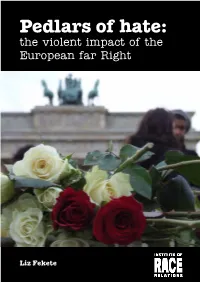
Pedlars of Hate: the Violent Impact of the European Far Right
Pedlars of hate: the violent impact of the European far Right Liz Fekete Published by the Institute of Race Relations 2-6 Leeke Street London WC1X 9HS Tel: +44 (0) 20 7837 0041 Fax: +44 (0) 20 7278 0623 Web: www.irr.org.uk Email: info@irr.org.uk ©Institute of Race Relations 2012 ISBN 978-0-85001-071-9 Acknowledgements We would like to acknowledge the support of the Joseph Rowntree Charitable Trust and the Open Society Foundations in the researching, production and dissemination of this report. Many of the articles cited in this document have been translated into English by over twenty volunteers who assist the IRR’s European Research Programme. We would especially like to thank Sibille Merz and Dagmar Schatz (who translate from German into English), Joanna Tegnerowicz (who translates from Polish into English) and Kate Harre, Frances Webber and Norberto Laguía Casaus (who translate from Spanish into English). A particular debt is due to Frank Kopperschläger and Andrei Stavila for their generosity in allowing us to use their photographs. In compiling this report the websites of the Internet Centre Against Racism in Europe (www.icare.to) and Romea (www.romea.cz) proved invaluable. Liz Fekete is Executive Director of the Institute of Race Relations and head of its European research programme. Cover photo by Frank Kopperschläger is of the ‘Silence Against Silence’ memorial rally in Berlin on 26 November 2011 to commemorate the victims of the National Socialist Underground. (In Germany, white roses symbolise the resistance movement to the Nazi -

Radical Right Narratives and Norwegian
RADICAL RIGHT NARRATIVES AND NORWEGIAN COUNTER-NARRATIVES IN THE DECADE OF UTØYA AND BÆRUM SOLO-ACTOR ATTACKS The CARR-Hedayah Radical Right Counter Narratives Project is a year-long project between CARR and Hedayah that is funded by the EU STRIVE programme. It is designed to create one of the first comprehensive online toolkits for practitioners and civil society engaged in radical right extremist counter-narrative campaigns. It uses online research to map nar- ratives in nine countries and regions (Australia, Canada, Germany, Hungary, New Zealand, Norway, Ukraine, United Kingdom, and the United States), proposes counter-narratives for these countries and regions, and advises on how to conduct such campaigns in an effec- tive manner. This country report is one of such outputs. ABOUT THE AUTHOR Dr. Mette Wiggen is a lecturer in the School of Politics and International Studies (POLIS) at the University of Leeds. She teaches on the Extreme Right in Europe, and politics for the Introduction to Social Sciences foundation course aimed at Widening Participation- and international social science students at Leeds. Mette is the Widening Participation Officer for the University’s Social Science Cluster where she engages with non traditional students who are exploring and entering higher education. She has taught languages and politics, in Norway and the UK, with guest lectures and conference papers in Egypt, Spain, Portugal, The Netherlands, Norway, UK and USA. Mette has also given papers at teaching and learning conferences in the UK on intercultural communication, on student lead discussion groups and on how to engage with students and teach the undergraduate dissertation. -

Sven Wimnell 19 Mars 2017: Påminnelser Om Inrikespolitiken
Sven Wimnell 19 mars 2017: Påminnelser om inrikespolitiken. Introduk- tion med korta kommentarer om inrikes- problem och läget i världen. Sedan mänsk- liga verksamheter som styr världen och regeringens verksamheter. http://wimnell.com/omr36-39zzzzf.pdf Sven Wimnell 19 mars 2017: 38 Tullnotan kan slå hårt efter Brexit Påminnelser om inrikespolitiken. Introduktion med korta 40 Brexit blir inte bättre av att Skoxit följer efter kommentarer om inrikesproblem och läget i världen. Sedan 42 May lovar starta Brexit före mars månads slut mänskliga verksamheter som styr världen och regeringens 43 Om två år börjar Brexitkostnaderna slå mot Sverige verksamheter. 45 En falskspelare på valturné http://wimnell.com/omr36-39zzzzf.pdf 46 Stora skillnader mellan Le Pen och Wilders 48 Erdoganeffekt bakom segern över PVV 50 Merkel andas ut efter valet i Nederländerna Innehåll: 51 Konsten att välja som vanligt Sida 52 Flyktingavtal hotas av gräl med Turkiet 5 Den ljusa bilden av Sverige. Introduktion 55 Ryssland största hotet mot svenska intressen 10 Därför har inte Trump lyckats rubba den ljusa bilden av 56 Flera misstänkta spioner utreddes av Säpo under 2016 Sverige 13 En jättelik ö, helt ensam i sitt slag 58 Dags för en politisk satsning på kunskap i samhällsdebatten 15 Trumps republikaner i behov av intensivvård 60 Bakom de populistiska och högerextrema sajterna finns 17 Slopad Obamacare slår mot miljoner brottsdömda, nolltaxerare och personer som söks av 18 Trumps islamofobi fäller de egna lagförslagen kronofogden 19 Donald Trumps budget slår hårt mot kulturen -

Lundström & Lundström (2016)
Det vita fältet III. Samtida forskning om högerextremism specialnummer av Arkiv. Tidskrift för samhällsanalys, nr 5 (2016) Hundra år av radikal nationalism Markus Lundström & Tomas Lundström sammandrag: Markus Lundström och Tomas Lundströms artikel analyserar vad förfat- tarna benämner som ”radikal nationalism” i Sverige mellan 1915–2015. Utifrån tidigare forskning sammanställs en historisk översikt över de aktörer vars politiska projekt tar sin utgångspunkt i nationalismens själva rot: att knyta en nedärvd folkgemenskap till en specifik plats. Till skillnad från tidigare konceptualiseringar av denna politiska miljö utgår ”radikal nationalism” från aktörernas egen idévärld, och genom att betona aktö- rernas gemensamma ideologiska drag framträder en bild av ett historiskt föränderligt flätverk där olika aktörer skapas och splittras, interagerar, förgrenas och återuppstår. För- fattarna identifierar tre olika idéströmningar som präglar miljön och som under hundra år av radikal nationalism korsat varandras färdriktning. Medan den rasorienterade och socialkonservativa nationalismen historiskt sett stått i konflikt med varandra, tycks den identitära idéströmningen på senare tid ha skapat nya kontaktytor aktörerna emellan. Artikelns historisering av svensk radikal nationalism föreslår, med andra ord, en analys- ram för att studera dessa aktörer, och för att begripliggöra nationalistisk radikalisering i Sverige. nyckelord: radikal nationalism; högerextremism; fascism; rasism; socialkonservatism; den identitära rörelsen. publiceringshistorik: Originalpublicering. markus lundström är doktorand i ekonomisk historia vid Stockholms universitet. e-postadress: markus.lundstrom@ekohist.su.se tomas lundström studerar masterprogrammet i religion i fred och konflikt vid Uppsala universitet. förslag på källangivelse: Lundström, Markus & Tomas Lundström (2016) ”Hundra år av radikal nationalism”, i Det vita fältet III. Samtida forskning om högerextremism, specialnummer av Arkiv. Tidskrift för samhällsanalys, nr 5, s. -

1 European Ethno-Nationalist and White Supremacy Groups Key
European Ethno-Nationalist and White Supremacy Groups Key Findings • European far-right ethno-nationalist groups have cast immigrants as a scapegoat for economic hardship faced by young Europeans. Rather than promote overt white supremacy, these groups denigrate minorities—particularly Muslim immigrants—as detrimental to European culture. • Far-right political parties like Germany’s Alternative für Deutschland and Italy’s Lega Nord have been able to generate substantial popular support by promising to defend their respective countries against the cultural attacks of immigrants and foreign influences, and have consequently made gains in domestic parliamentary elections. • Groups like Les Identitaires and its youth wing, Generation Identity, have renounced violence in favor of utilizing social media and public demonstrations to portray themselves as legitimate, mainstream movements protecting European culture. These groups have directly targeted Europe’s youth through social media and public demonstrations. • Some U.S. neo-Nazi groups have created a European presence. Atomwaffen Division and other U.S.-based groups have inspired European offshoots such as the Feuerkrieg Division. The Nationalist Social Club has established a following in countries such as Germany and Bulgaria. • Groups including Combat 18 and the Nordic Resistance Movement, which openly embrace neo-Nazi ideology and violent tactics, are still able to recruit for violent activities, despite the rise of non-violent, populist groups. Executive Summary More than 70 years after the defeat of Nazi Germany, ethno-nationalist and white supremacist movements in Europe continue to thrive. They include far-right political parties, neo-Nazi movements, and apolitical protest groups. Some groups openly espouse violent white supremacy, while others have propagated their radical stances under the guise of populism. -
Why the Nordic Resistance Movement Restrains Its Use of Violence by Tore Bjørgo and Jacob Aasland Ravndal
PERSPECTIVES ON TERRORISM Volume 14, Issue 6 Why the Nordic Resistance Movement Restrains Its Use of Violence by Tore Bjørgo and Jacob Aasland Ravndal Abstract The Nordic Resistance Movement (NRM) is a militant National Socialist organization that in principle embraces violent strategies, including terrorism, given the “right” circumstances. However, in practice, the organization restrains its use of violence considerably. To understand why, this article examines three interrelated topics. First, when and why does the NRM leadership permit its members to use violence? Second, why and how does the current NRM leadership restrain the organization’s use of violence? Third, how does the NRM leadership respond to cases where NRM members carry out acts of severe violence that clearly overstep the boundaries set by their leaders? Our main finding is that the NRM leadership does not – at least in principle – have any moral restraints against political violence, including mass murder, and that the main reason why the NRMrefrains from using terrorist methods is strategic calculation: such methods are perceived as counter-productive and likely to undermine the NRM’s prospects of gaining popular support and opportunities to propagate its political views via public and legal channels. As such, the NRM leaders are highly sensitive to the legal boundaries set by the government. However, they also continuously try to test and expand these boundaries through violent behaviour against the police and political enemies, and by honouring rather than punishing activists who overstep the limits officially drawn by the leadership. Keywords: political violence, terrorism; extreme right; restraints on violence Introduction The Nordic Resistance Movement (NRM) is a National Socialist organization with branches in Sweden, Norway, Finland, Denmark and Iceland – although its origin, core and stronghold are in Sweden. -

Antisemitism Worldwide 2014
The Lester and Sally Entin Faculty of Humanities Moshe Kantor Database for the Study of Contemporary Antisemitism and Racism Antisemitism Worldwide 2014 General Analysis Draft European Jewish Congress Ze'ev Vered Desk for the Study of Tolerance and Intolerance in the Middle East, Stephen Roth Institute for the Study of Contemporary Antisemitism and Racism 1 The Lester and Sally Entin Faculty of Humanities Moshe Kantor Database for the Study of Contemporary Antisemitism and Racism Antisemitism Worldwide 2014 General Analysis Draft European Jewish Congress Ze'ev Vered Desk for the Study of Tolerance and Intolerance in the Middle East, Stephen Roth Institute for the Study of Contemporary Antisemitism and Racism 2 This brochure is dedicated to the memory of those murdered at the Jewish Museum in Brussels, at the Charlie Hebdo offices and the HyperCasher in Paris, and at the synagogue in Copenhagen, 2014-2015. Editor Dina Porat, Head of the Kantor Center Kantor Center Researchers Irena Cantorovich – Post Soviet Region Lidia Lerner – Latin America and Spain Sarah Rembiszewski – Western Europe and Germany Mikael Shainkman – Scandinavia Raphael Vago – Hungary, Romania and Slovakia Contributors Esther Webman – Arab Countries Michal Navoth - Greece Jean Yves Camus – France Renee Dayan Shabott (CI) - Mexico Simon Erlanger – Switzerland Stefano Gatti and Betti Guetta (CDEC) - Italy Jeremy Jones (AIJAC) – Australia Vyacheslav Likhacher (EAJC), Ukraine Guy Muller (CIDI) – Netherlands Louiz Nazario - Brazil Beatriz Rittigstein (CAIV) – Venezuela Petra Koutská Schwarzová (Prague Jewish Community) – Czech Republic Patrick Studer (SIG) - Switzerland (German Speaking) Jason Turetsky and Oren Segal (ADL) - USA Mike Whine (CST) – UK Statistics Haim Fireberg Website http://kantorcenter.tau.ac.il/ The Kantor Center team would like to express its deep gratitude to all contributors.