Sphecos: a Forum for Aculeate Wasp Researchers
Total Page:16
File Type:pdf, Size:1020Kb
Load more
Recommended publications
-
Cavity-Nest Boxes for Solitary Bees: a Century of Design and Research J
Cavity-nest boxes for solitary bees: a century of design and research J. Scott Macivor To cite this version: J. Scott Macivor. Cavity-nest boxes for solitary bees: a century of design and research. Apidologie, 2017, 48 (3), pp.311-327. 10.1007/s13592-016-0477-z. hal-02973424 HAL Id: hal-02973424 https://hal.archives-ouvertes.fr/hal-02973424 Submitted on 21 Oct 2020 HAL is a multi-disciplinary open access L’archive ouverte pluridisciplinaire HAL, est archive for the deposit and dissemination of sci- destinée au dépôt et à la diffusion de documents entific research documents, whether they are pub- scientifiques de niveau recherche, publiés ou non, lished or not. The documents may come from émanant des établissements d’enseignement et de teaching and research institutions in France or recherche français ou étrangers, des laboratoires abroad, or from public or private research centers. publics ou privés. Apidologie (2017) 48:311–327 Review article * INRA, DIB and Springer-Verlag France, 2016 DOI: 10.1007/s13592-016-0477-z Cavity-nest boxes for solitary bees: a century of design and research J. Scott MACIVOR Department of Biological Sciences, University of Toronto Scarborough, 1265 Military Trail, Toronto, ON M1C 1A5, Canada Received 25 May 2016 – Revised 3 September 2016 – Accepted 26 September 2016 Abstract – A variety of solitary bee species that naturally nest in wood and plant stems aboveground also readily accept nest boxes, which are human-made devices that aggregate these nesting conditions. Nest boxes are sheltered bundles of hollow plant stems, bamboo or reeds, and holes drilled into wood or cavities made of other materials such as glass or polystyrene. -
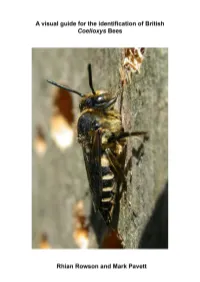
A Visual Guide for the Identification of British Coelioxys Bees
1 Introduction The Hymenoptera is an order of insects that includes bees, wasps, ants, ichneumons, sawflies, gall wasps and their relatives. The bees (family Apidae) can be recognised as such by the presence of feather-like hairs on their bodies, particularly near the wing bases. The genus Coelioxys Latreille belongs to the bee subfamily Megachilinae. There are six species of Coelioxys present in mainland Britain. Two other species are found in Guernsey but not mentioned in this pictorial key (C. afra Lepeletier and C. brevis Eversmann). Natural History Coelioxys (their various English names are: Sharp-tailed Bees, Sharp-abdomen Bees and Sharp-bellied Bees) are among those known as cuckoo bees because the larvae grow up on food stolen from Leaf-cutter Bees (Megachile Latreille) or Flower Bees (Anthophora Latreille). The genus Megachile probably includes the closest relatives of Coelioxys. Female Megachile construct nests of larval cells from leaves and provision each cell with a mixture of pollen and nectar for the young. A female Coelioxys will seek these out and apparently uses its sharp abdomen to pierce the cells. An egg is then laid in the Megachile cell. The egg of the Coelioxys hatches before that of the Megachile and the newly-hatched larva crushes the Megachile egg with its large jaws. The Coelioxys larva can then feed on the contents of the cell. Pupation occurs within a cocoon spun within the host cell where the larva overwinters as a prepupa. The genus Anthophora excavates nest burrows in sandy soil or rotting wood, where they may also become the hosts of Coelioxys larvae. -

Hymenovaria 15 Een Boekbespreking Te Maken Van Environmental Context
nummer 15 november 2017 Nieuwsbrief Sectie Hymenoptera Nederlandse Entomologische Vereniging In dit nummer onder meer: Meewerken aan de bijenatlas voor België Veldobservaties Bijen en wespen in het natte natuurgebied De Bruuk Ephialtes manifestator gekweekt uit nest van Ancistrocerus trifasciatus De Mexicaanse zwartsteel nestelt in mijn tuin Op zoek naar Leucospis dorsigera nr. 15, november 2017 ISSN 1387-1773 Foto voorpagina: Vespa velutina nigrithorax , werkster. Foto: Albert de Wilde. Nieuwsbrief sectie Hymenoptera van de Nederlandse Entomologische Vereniging Vormgeving: Jan Smit. Redactie J. D’Haeseleer, T. Peeters, J. Smit, E. van der Spek Redactieadres Voermanstraat 14, 6921 NP Duiven e-mail: smit.jan@hetnet.nl Website www.hymenovaria.nl Redactioneel Een redelijk gevuld en gevarieerd nummer. Bij ‘Literatuur’ de HymenoBiblio over 2016, twee Allereerst de aankondiging van de voorjaarsexcursie in boekbesprekingen door Theo Peeters en een 2018 naar de Peel in Brabant. Een verslag van de boekbespreking door Jan Smit. voorjaarsexcursie naar ’t Roegwold in Groningen, Bij ‘Oproepen’ de vraag om de bijdrage voor komend afgelopen voorjaar. Erik van der Spek doet verslag van jaar (2018) over te maken, gegevens op te sturen voor het Aculea-weekend, afgelopen zomer in België. Kort de rubriek ‘Leuke waarnemingen’ in HymenoVaria 16, verslag van de cursusdag ‘Bijen’, georganiseerd door de vraag om gegevens aan de deelnemers van de de NEV. En we hebben een viertal opmerkelijke excursie naar de Chaamse bossen, plus nog een ‘Veldobservaties’. oproep om medewerking aan De Wilde Bijenlinie. Bij ‘Artikelen’ vertelt Stijn Schreven over het Verder de aankondiging van de studiedag onderzoek in het natuurgebied De Bruuk, René ‘Goudwespen van de Chrysis ignita -groep’ op 13 januari Veenendaal kweekte een sluipwesp uit het nest van 2018, in Amsterdam. -

Seasonal and Spatial Patterns of Mortality and Sex Ratio in the Alfalfa
Seasonal and spatial patterns of mortality and sex ratio in the alfalfa leafcutting bee, Megachile rotundata (F.) by Ruth Pettinga ONeil A thesis submitted in partial fulfillment of the requirements for the degree of Master of Science in Entomology Montana State University © Copyright by Ruth Pettinga ONeil (2004) Abstract: Nests from five seed alfalfa sites of the alfalfa leafcutting bee Megachile rotundata (F.) were monitored over the duration of the nesting season in 2000 and 2001, from early July through late August. Cells containing progeny of known age and known position within the nest were subsequently analyzed for five commonly encountered categories of pre-diapause mortality in this species. Chalkbrood and pollen ball had the strongest seasonal relationships of mortality factors studied. Chalkbrood incidence was highest in early-produced cells. Pollen ball was higher in late-season cells. Chalkbrood, parasitism by the chalcid Pteromalus venustus, and death of older larvae and prepupae , due to unknown source(s) exhibited the strongest cell-position relationships. Both chalkbrood and parasitoid incidence were highest in the inner portions of nests. The “unknown” category of mortality was highest in outer portions of nests. Sex ratio was determined for a subset of progeny reared to adulthood. The ratio of females to males is highest in cells in inner nest positions. Sex ratio is female-biased very early in the nesting season, when all cells being provisioned are the inner cells of nests, due to the strong positional effect on sex ratio. SEASONAL AND SPATIAL PATTERNS OF MORTALITY AND SEX RATIO IN THE ALFALFA LEAFCUTTING BEE, Megachile rotundata (F.) by . -
Additions to the Checklist of Scoliidae, Sphecidae, Pompilidae and Vespidae of Peru, with Notes on the Endemic Status of Some Species (Hymenoptera, Aculeata)
A peer-reviewed open-access journal ZooKeys 519:Additions 33–48 (2015) to the checklist of Scoliidae, Sphecidae, Pompilidae and Vespidae of Peru... 33 doi: 10.3897/zookeys.519.6501 CHECKLIST http://zookeys.pensoft.net Launched to accelerate biodiversity research Additions to the checklist of Scoliidae, Sphecidae, Pompilidae and Vespidae of Peru, with notes on the endemic status of some species (Hymenoptera, Aculeata) Eduardo Fernando dos Santos1, Yuri Campanholo Grandinete1,2, Fernando Barbosa Noll1 1 Departamento de Zoologia e Botânica, Instituto de Biociências, Letras e Ciências Exatas, Universidade Esta- dual Paulista “Júlio de Mesquita Filho”. Rua Cristóvão Colombo, 2265, Jd. Nazareth, 15054-000, São José do Rio Preto, SP, Brazil 2 Departamento de Biologia, Faculdade de Filosofia, Ciências e Letras de Ribeirão Preto, Universidade de São Paulo. Av. Bandeirantes, 3900, 14040-901, Ribeirão Preto, SP, Brazil Corresponding author: Eduardo Fernando dos Santos (efs.wasp@gmail.com) Academic editor: Michael Engel | Received 22 May 2015 | Accepted 19 August 2015 | Published 31 August 2015 http://zoobank.org/DA5A298F-BEF0-4AF5-AA08-FB8FF41FE6A4 Citation: dos Santos EF, Grandinete YC, Noll FB (2015) Additions to the checklist of Scoliidae, Sphecidae, Pompilidae and Vespidae of Peru, with notes on the endemic status of some species (Hymenoptera, Aculeata). ZooKeys 519: 33–48. doi: 10.3897/zookeys.519.6501 Abstract The first checklist of the Peruvian Hymenoptera listed 1169 species and subspecies of aculeate wasps, including 173 species of Pompilidae, seven of Scoliidae, 39 of Sphecidae and 403 of Vespidae. Herein are reported 32 species as new for Peru based mainly on the collection of the Natural History Museum, London. -
A Sur Hamp Peter 25 Ju Autho Rvey of Th Pton Brow Borough Ne 2015
A survey of the inverttebrates of the Hampton brownfield study site, Peterborough 25 June 2015 Authors: Buglife and BSG Ecology BLANK PAGE Acknowledgements: Buglife and BSG would like to thank O&H Hampton Ltd for undertaking the habitat creation work and providing access and support Report title A survey of the invertebrates of the Hampton brownfield study site, Peterborough Draft version/final FINAL File reference OH Hampton Draft Report_Final_240715 Buglife - The Invertebrate Conservation Trust is a registered charity at Bug House, Ham Lane, Orton Waterville, Peterborough, PE2 5UU Company no. 4132695, Registered charity no. 1092293, Scottish charity no. SC04004 BSG Ecology - Registered in: England and Wales | No. OC328772 | Registered address: Wyastone Business Park, Monmouth, NP25 3SR Contents 1 Summary ....................................................................................................................................................... 2 2 Introduction .................................................................................................................................................... 3 3 Site Description ............................................................................................................................................. 4 4 Methods ......................................................................................................................................................... 9 5 Results ........................................................................................................................................................ -

Scientific Report 2014
SCIENTIFIC REPORT 2014 1 SCIENTIFIC REPORT 2014 TABLE OF CONTENT THE PRESIDENT EDITORIAL ......................................................................... 2 MESSAGE OF THE SCIENTIFIC DIRECTOR .................................................... 4 IDENTITY & MISSION ..................................................................................... 6 SMART LOIRE VALLEY PROGRAMMES .......................................................... 8 MATERIALS AND ENERGY SCIENCES ........................................................... 12 LIFE AND HEALTH SCIENCES ....................................................................... 30 EARTH, ECOLOGY AND ENVIRONMENTAL SCIENCES .................................. 46 COMPUTER SCIENCE, MATHEMATICS AND MATHEMATICAL PHYSICS ....... 56 HUMAN AND SOCIAL SCIENCES ................................................................... 64 TRANSDISCIPLINARY APPROACH: LE STUDIUM THURSDAYS ..................... 74 LIFE OF FOREIGN RESEARCHERS IN THE REGION CENTRE-VAL DE LOIRE 76 GOVERNANCE & SCIENTIFIC COUNCIL ......................................................... 80 KEY STATISTICS ............................................................................................. 81 LE STUDIUM EVENTS IN 2014 ........................................................................ 82 2 1 THE PRESIDENT Pr Paul Vigny EDITORIAL Founding President of LE STUDIUM The year 2014 was a pivotal year for LE STUDIUM Loire Valley Institute for Advanced L’année 2014 aura été une année charnière pour LE STUDIUM Loire Valley -

Behavioural and Biological Notes on Crabronidae (Hymenoptera: Apoidea) and New Geographic Records to the Espírito Santo State (Southeast Brazil)
BOL. MUS. BIOL. MELLO LEITÃO (N. SÉR.) 33:19-24. JANEIRO DE 2014 19 Behavioural and biological notes on Crabronidae (Hymenoptera: Apoidea) and new geographic records to the Espírito Santo State (Southeast Brazil) Sandor Christiano Buys1* ABSTRACT: The following species of crabronid wasps are added to the list of Hymenoptera of Espírito Santo State: Stictia maccus (Handlirsch, 1895), Hoplisoides vespoides (F. Smith, 1873), Trachypus fulvipennis (Tachenberg, 1875), Trachypus romandi (Saussure, 1854). Notes on nesting behaviour of H. vespoides, S. maccus and T. fulvipennis in the Biological Station of Santa Lúcia (city of Santa Teresa) are presented. Hoplisoides vespoides used as prey Umbonia spinosa (Fabricius, 1775) (Hemiptera: Membracidae) and T. fuvipennis used as prey three species of stingless bees (Hymenoptera: Apidae: Meliponinae): Plebeia remota (Holmberg, 1903), Partamona aff. cupira (Smith, 1863), Schwarziana quadripunctata (Lepeletier, 1836). Key-words: Trachypus, Stictia, Hoplisoides, Meliponinae bee, solitary wasps, Atlantic Forest. RESUMO: Notas biológicas e comportamentais sobre Crabronidae (Hymenoptera: Apoidea) e novos registros geográficos para o Estado do Espírito Santo (Sudeste do Brasil). As seguintes espécies de vespas crabronídeas são adicionadas à lista de Hymenoptera do Estado do Espírito Santo: Stictia maccus (Handlirsch, 1895), Hoplisoides vespoides (F. Smith, 1873), Trachypus fulvipennis (Tachenberg, 1875), Trachypus romandi (Saussure, 1854). Notas sobre comportamento de nidificação de Hoplisoides vespoides, S. maccus e T. fulvipennis na Estação Biológica de Santa Lúcia (Santa Teresa) são apresentadas. Hoplisoides vespoides usou como presa Umbonia spinosa (Fabricius, 1775) (Hemiptera: Membracidae) e T. fuvipennis usou como presa três espécies de abelhas meliponíneas (Hymenoptera: Apidae: Meliponinae): Plebeia remota (Holmberg, 1903), Partamona aff. cupira (Smith, 1863), Schwarziana quadripunctata (Lepeletier, 1836). -

Biological Control of Taro Scarab Beetle (Papuanauninodis Coleoptera: Scarabaeidae) Instars Via Scoliid and Voria Tachinidae Parasitoid Wasps
Biological control of taro scarab beetle (Papuanauninodis Coleoptera: Scarabaeidae) instars via Scoliid and Voria Tachinidae parasitoid wasps Article (Published Version) Faithpraise, Fina, Idung, Joseph, Chatwin, Chris, Young, Rupert and Birch, Philip (2014) Biological control of taro scarab beetle (Papuanauninodis Coleoptera: Scarabaeidae) instars via Scoliid and Voria Tachinidae parasitoid wasps. International Journal of Applied Biology and Pharmaceutical Technology, 5 (3). pp. 47-55. ISSN 0976-4550 This version is available from Sussex Research Online: http://sro.sussex.ac.uk/id/eprint/53633/ This document is made available in accordance with publisher policies and may differ from the published version or from the version of record. If you wish to cite this item you are advised to consult the publisher’s version. Please see the URL above for details on accessing the published version. Copyright and reuse: Sussex Research Online is a digital repository of the research output of the University. Copyright and all moral rights to the version of the paper presented here belong to the individual author(s) and/or other copyright owners. To the extent reasonable and practicable, the material made available in SRO has been checked for eligibility before being made available. Copies of full text items generally can be reproduced, displayed or performed and given to third parties in any format or medium for personal research or study, educational, or not-for-profit purposes without prior permission or charge, provided that the authors, title and full bibliographic details are credited, a hyperlink and/or URL is given for the original metadata page and the content is not changed in any way. -

Fauna Europaea: Hymenoptera – Apocrita (Excl
Biodiversity Data Journal 3: e4186 doi: 10.3897/BDJ.3.e4186 Data Paper Fauna Europaea: Hymenoptera – Apocrita (excl. Ichneumonoidea) Mircea-Dan Mitroiu‡§, John Noyes , Aleksandar Cetkovic|, Guido Nonveiller†,¶, Alexander Radchenko#, Andrew Polaszek§, Fredrick Ronquist¤, Mattias Forshage«, Guido Pagliano», Josef Gusenleitner˄, Mario Boni Bartalucci˅, Massimo Olmi ¦, Lucian Fusuˀ, Michael Madl ˁ, Norman F Johnson₵, Petr Janstaℓ, Raymond Wahis₰, Villu Soon ₱, Paolo Rosa₳, Till Osten †,₴, Yvan Barbier₣, Yde de Jong ₮,₦ ‡ Alexandru Ioan Cuza University, Faculty of Biology, Iasi, Romania § Natural History Museum, London, United Kingdom | University of Belgrade, Faculty of Biology, Belgrade, Serbia ¶ Nusiceva 2a, Belgrade (Zemun), Serbia # Schmalhausen Institute of Zoology, Kiev, Ukraine ¤ Uppsala University, Evolutionary Biology Centre, Uppsala, Sweden « Swedish Museum of Natural History, Stockholm, Sweden » Museo Regionale di Scienze Naturi, Torino, Italy ˄ Private, Linz, Austria ˅ Museo de “La Specola”, Firenze, Italy ¦ Università degli Studi della Tuscia, Viterbo, Italy ˀ Alexandru Ioan Cuza University of Iasi, Faculty of Biology, Iasi, Romania ˁ Naturhistorisches Museum Wien, Wien, Austria ₵ Museum of Biological Diversity, Columbus, OH, United States of America ℓ Charles University, Faculty of Sciences, Prague, Czech Republic ₰ Gembloux Agro bio tech, Université de Liège, Gembloux, Belgium ₱ University of Tartu, Institute of Ecology and Earth Sciences, Tartu, Estonia ₳ Via Belvedere 8d, Bernareggio, Italy ₴ Private, Murr, Germany ₣ Université -

Studies on a Collection of Aculeate Hymenoptera from Nayachar Island, West Bengal P
Studies on a collection of aculeate Hymenoptera from Nayachar Island, West Bengal P. Girish Kumar1 and Gaurav Sharma2 Aculeata is a subgroup of the order Hymenoptera whose significant peculiarity is the transformation of the female ovipositor into a venom-injecting device or stinger and the members of which are commonly called as ants, bees and wasps. They play an important role in the terrestrial ecosystems as pollinators, predators and producers. India has a rich fauna of Aculeata and Bingham (1897, 1903) was the first to publish a consolidated account of aculeate Hymenoptera (Wasps & Bees and Ants & Cuckoo wasps) of the region, including Burma and Ceylon. Batra (1977), Das Image 1. Vespa affinis (Linnaeus)♀ & Gupta (1989) and Gupta & Jonathan (2003) were also made comprehensive studies on Indian species of Apidae, Vespidae and Scoliidae respectively. The present account is based on a collection of Hymenoptera (Aculeata) obtained from Nayachar Island of West Bengal which includes the report of 8 species under 7 genera belonging to the families Vespidae (5 species), Scoliidae (2 species) and Apidae (1 species). Nayachar is an island located at the confluence of the Hooghly River and the Haldi River at the northern extent of the Bay of Image 2. Polistes (G.) olivaceus (De Geer)♀ Bengal in the East Midnapore district of West Bengal state of India. It is a small island with an area of 64 square kilometers located at 22°02' N 88°04' E coordinates and is believed to have accreted from alluvial derived sediment over the past 100 years. Material and Methods The specimens were collected from various localities of Nayachar Island during the period 1994-2000 by using sweep net specially made for the purpose. -

The Taxonomy of the Side Species Group of Spilochalcis (Hymenoptera: Chalcididae) in America North of Mexico with Biological Notes on a Representative Species
University of Massachusetts Amherst ScholarWorks@UMass Amherst Masters Theses 1911 - February 2014 1984 The taxonomy of the side species group of Spilochalcis (Hymenoptera: Chalcididae) in America north of Mexico with biological notes on a representative species. Gary James Couch University of Massachusetts Amherst Follow this and additional works at: https://scholarworks.umass.edu/theses Couch, Gary James, "The taxonomy of the side species group of Spilochalcis (Hymenoptera: Chalcididae) in America north of Mexico with biological notes on a representative species." (1984). Masters Theses 1911 - February 2014. 3045. Retrieved from https://scholarworks.umass.edu/theses/3045 This thesis is brought to you for free and open access by ScholarWorks@UMass Amherst. It has been accepted for inclusion in Masters Theses 1911 - February 2014 by an authorized administrator of ScholarWorks@UMass Amherst. For more information, please contact scholarworks@library.umass.edu. THE TAXONOMY OF THE SIDE SPECIES GROUP OF SPILOCHALCIS (HYMENOPTERA:CHALCIDIDAE) IN AMERICA NORTH OF MEXICO WITH BIOLOGICAL NOTES ON A REPRESENTATIVE SPECIES. A Thesis Presented By GARY JAMES COUCH Submitted to the Graduate School of the University of Massachusetts in partial fulfillment of the requirements for the degree of MASTER OF SCIENCE May 1984 Department of Entomology THE TAXONOMY OF THE SIDE SPECIES GROUP OF SPILOCHALCIS (HYMENOPTERA:CHALCIDIDAE) IN AMERICA NORTH OF MEXICO WITH BIOLOGICAL NOTES ON A REPRESENTATIVE SPECIES. A Thesis Presented By GARY JAMES COUCH Approved as to style and content by: Dr. T/M. Peter's, Chairperson of Committee CJZl- Dr. C-M. Yin, Membe D#. J.S. El kin ton, Member ii Dedication To: My mother who taught me that dreams are only worth the time and effort you devote to attaining them and my father for the values to base them on.