Ficha Artistica
Total Page:16
File Type:pdf, Size:1020Kb
Load more
Recommended publications
-

SP3145 the Cinema of Luis Buñuel | Readinglists@Leicester
09/25/21 SP3145 The Cinema of Luis Buñuel | readinglists@leicester SP3145 The Cinema of Luis Buñuel View Online Acevedo-Munoz, Ernesto R. 2003a. Buñuel and Mexico: The Crisis of National Cinema. Berkeley: University of California Press. Acevedo-Munoz, Ernesto R. 2003b. Buñuel and Mexico: The Crisis of National Cinema. Berkeley: University of California Press. Adamowicz, Elza. 2010. Un Chien Andalou: (Luis Buñuel and Salvador Dali, 1929). Vol. Ciné-files : the French film guides. London: I.B. Tauris. Andrew. 2006. ‘L’Âge D’or and the Eroticism of the Spirit.’ Pp. 111–37 in Masterpieces of modernist cinema. Bloomington, Ind: Indiana University Press. Annella, McDermott. 2000. ‘“Viridiana”.’ in European Cinema: An Introduction, edited by J. Forbes and S. Street. Basingstoke: Palgrave. Aranda, J. Francisco. 1976. Luis Buñuel: A Critical Biography. American ed. New York: Da Capo Press. Baxter, John. 1994. Buñuel. London: Fourth Estate. Bazin, André. 1984. Buñuel, Dreyer, Welles. Madrid: Editorial Fundamentos. Bazin, André. 2013. The Cinema of Cruelty: From Buñuel to Hitchcock. New York: Arcade Publishing. Begin, P. 2007. ‘Entomology as Anthropology in the Films of Luis Bunuel.’ Screen 48(4):425–42. doi: 10.1093/screen/hjm046. Bermúdez, Xavier. n.d. Buñuel: Espejo Y Sueño. Vol. Contraluz, libros de cine. Valencia: Ediciones de la Mirada. Bikandi-Mejias, Aitor. n.d. El Carnaval de Luis Buñuel: Estudios Sobre Una Tradición Cultural. Vol. Colección Hermes. Madrid: Laberinto. Bordwell, David, and Thompson, Kristin. 2013. Film Art: An Introduction. 10th ed., international ed. New York, N.Y.: McGraw-Hill. Brook, Claudio, Pinal, Silvia, and Buñuel, Luis. 2009. ‘Simón Del Desierto =: Simon of the Desert.’ Criterion collection. -

Acevedo-Muñoz 1 Los Olvidados
Acevedo-Muñoz 1 Los olvidados: Luis Buñuel and the Crisis of Nationalism in Mexican Cinema by Ernesto R. Acevedo-Muñoz The University of Iowa Prepared for delivery at the 1997 meeting of the Latin American Studies Association, Continental Plaza Hotel, Guadalajara, Mexico April 17-19, 1997 Acevedo-Muñoz 2 Los olvidados: Luis Buñuel and the Crisis of Nationalism in Mexican Cinema The release of Los olvidados in 1950 is one of the historical markers of what I call the “crisis of nationalism” in Mexican cinema. The film was widely received as the “return” of Buñuel by European critics after the period of unnoticeable activity between 1932, the year of Las Hurdes, and 1946, the year of Buñuel’s incorporation into Mexican cinema and of the production of Gran Casino, which led to Buñuel’s Mexican career of almost twenty years and almost twenty movies. Nevertheless, it is known that at the time of the premiere of Los olvidados in Mexico City (November 9, 1950) the movie was mainly taken as an insult to Mexican sensibilities and to the Mexican nation. The stories of the detractors of Los olvidados are, of course, many and well documented.1 As it was often to be the case with Buñuel’s Mexican period, it took for Los olvidados to gather some prestige abroad before it was welcome in Mexico City. After its triumph at Cannes, where Buñuel won the best director award, Los olvidados had a successful season in a first run theater. Acevedo-Muñoz 3 Buñuel’s relationship with Mexican cinema went through several different stages, but it is significant that Los olvidados is recognized both by international critics and Mexican film historians as the turning point in the director’s entire career. -

La Obra Mexicana De Luis Buñuel. Análisis De Los Olvidados (1950): Su Influencia En El Arte Cinematográfico Y Recepción Crítica
La obra mexicana de Luis Buñuel. Análisis de Los Olvidados (1950): su influencia en el arte cinematográfico y recepción crítica Pablo Viñamata Viñamata ADVERTIMENT. La consulta d’aquesta tesi queda condicionada a l’acceptació de les següents condicions d'ús: La difusió d’aquesta tesi per mitjà del servei TDX (www.tdx.cat) i a través del Dipòsit Digital de la UB (diposit.ub.edu) ha estat autoritzada pels titulars dels drets de propietat intel·lectual únicament per a usos privats emmarcats en activitats d’investigació i docència. No s’autoritza la seva reproducció amb finalitats de lucre ni la seva difusió i posada a disposició des d’un lloc aliè al servei TDX ni al Dipòsit Digital de la UB. No s’autoritza la presentació del seu contingut en una finestra o marc aliè a TDX o al Dipòsit Digital de la UB (framing). Aquesta reserva de drets afecta tant al resum de presentació de la tesi com als seus continguts. En la utilització o cita de parts de la tesi és obligat indicar el nom de la persona autora. ADVERTENCIA. La consulta de esta tesis queda condicionada a la aceptación de las siguientes condiciones de uso: La difusión de esta tesis por medio del servicio TDR (www.tdx.cat) y a través del Repositorio Digital de la UB (diposit.ub.edu) ha sido autorizada por los titulares de los derechos de propiedad intelectual únicamente para usos privados enmarcados en actividades de investigación y docencia. No se autoriza su reproducción con finalidades de lucro ni su difusión y puesta a disposición desde un sitio ajeno al servicio TDR o al Repositorio Digital de la UB. -

En Los Cruces De La Literatura Y El Cine
En los cruces de la literatura y el cine Edición de Eduardo Ramos-Izquierdo Roberta Previtera Comité scientifique : Antonio Garrido, Universidad Complutense de Madrid Claudia Hammerschmidt, Friederich-Schiller-Universität Jena Rafael Olea Franco, El Colegio de México Susanna Regazzoni, Università Ca’ Foscari Venezia Illustration de couverture : Zootropos. Gravure du XIXème siècle. Maquette : Gerardo Centenera et Jérôme Dulou Mise en page : Sofía Mateos En application des articles L. 122-10 à L. 122-12 du code de la propriété intellectuelle, toute reproduction à usage collectif par photocopie, intégralement ou partiellement, du présent ouvrage est interdite sans autorisation du Centre français d’exploitation du droit de copie (CFC, 20 rue des Grands-Augustins, 75006 Paris). Toute autre forme de reproduction, intégrale ou partielle, est également interdite sans autorisation de l’éditeur. Droits réservés. © 2017, Eduardo Ramos-Izquierdo ISSN : en cours ISBN : en cours Índice En el umbral: el cruce literatura cine 5 De la literatura al cine 9 Aura, entre la página escrita y el cine Stefano Tedeschi 11 “La llovizna” de Juan de la Cabada: el relato y el filme Margarita León Vega 31 Espacio literario y espacio fílmico: de “El lobo, el bosque y el hombre nuevo” (1990) de Senel Paz a Fresa y chocolate (1993) de Tomás Gutiérrez Alea Nancy Berthier 45 Imágenes del silencio: el discurso de lo fantástico contemporáneo y su transposición cinematográfica Anna Boccuti 65 Del cine a la literatura 85 Del Cid a Cagliostro: ecos cinematográficos en las páginas -

De Luis Buñuel: Ambivalencias Entre La Diáspora Republicana En México Y La ‘Época De Oro’ Como Cine Nacional
Vol. 11, No. 2, Winter 2014, 221-256 Pedagogía, subalternidad y fatum en Los Olvidados (1950) de Luis Buñuel: ambivalencias entre la diáspora republicana en México y la ‘Época de Oro’ como cine nacional Hernán Medina Jiménez University of Pittsburgh I Después del éxito en taquilla de El gran calavera (1949)—luego de tres años de inactividad cinematográfica debido al fracaso comercial de su primer largometraje mexicano Gran Casino (1947)—Luis Buñuel (Calanda, 1900-México D.F., 1983), junto con el poeta español Juan Larrea (Bilbao, 1895-Córdoba, 1980), le presentan al productor de origen judío-francés Oscar Dancigers (Moscú, 1902-México D.F., 1976) el argumento para una película de tipo comercial cuyo título original debía llamarse ¡Mi pobre huerfanito, jefe!, proyecto que Dancigers cuestiona y califica de “folletoncito”. La recomendación del productor general de Ultramar Films S.A., por el contrario, fue abandonar aquella historia basada en un niño vendedor de loterías—el último billete se denominaba ‘huerfanito’—para desarrollar “Una historia sobre los niños pobres de México” (Buñuel, en Medina Jiménez 222 Pérez Turrent y de la Colina 49). Por confesión propia, Buñuel no gustaba de escribir guiones solo, se auto-consideraba ágrafo, necesitaba de un colaborador; y si damos fe de las correcciones en los créditos finales de la reciente edición especial de Los olvidados (1950)—bajo la coordinación general de la Fundación Televisa en el año 2004—, el argumento principal de este nuevo proyecto se realizó finalmente con la participación de un equipo de producción que establece una directa correspondencia transatlántica.1 En realidad, la dirección y el guión fueron elaborados, en su mayoría, por artistas e intelectuales españoles exiliados en México como consecuencia de la derrota de la República durante la Guerra Civil Española, y cuya permanencia legal en el país se debía a la gestión del presidente mexicano Lázaro Cárdenas hacia finales de los años treinta. -

Formato Para Nominación
NOMINATION FORM MEMORY OF THE WORLD REGISTER MEXICO - ORIGINAL NEGATIVE OF “LOS OLVIDADOS”, FILM BY LUIS BUÑUEL PART A: ESSENTIAL INFORMATION 1.- SUMMARY The film Los olvidados (in the USA “The Young and the Damned”), made in 1950 by Spanish- Mexican director Luis Buñuel, is the most important document in Spanish about the marginal lives of children in contemporary large cities, and it is also a crude, realist vision, without any concessions, of one part of Mexican society, focalized in a Mexico City slum in which the characters, who have been observed carefully and truthfully, follow their necessary destiny as a result of the social and economic circumstances that surround them. With Los olvidados, Buñuel brings to world cinematography a complete work where, without abandoning the surrealist aesthetics of his first films such as El perro andaluz (1928), and La edad de oro (1930), he gives a passionate portrayal of the forgotten ones, in a brutal but honest way, both tragic and poetic; in sum, a film that will always be 1contemporary Los olvidados faced many difficulties from the start. Buñuel devoted two years of research prior to writing his script, then he had to convince producer Oscar Dancigers to grant him stylistic and ideological freedom, and finally even some of his collaborators, scared of repercussions, asked that their names not be included on the screen credits. Dancigers was aware of the problems that this film could face from censorship as well as from conservative groups of Mexican society, or that it might even not be shown at all. He therefore had a “second ending” filmed, almost in secret, which was contrary to the tragic sense of the movie. -

TESIS DOCTORAL Los Profesionales Cinematográficos Republicanos
TESIS DOCTORAL Los profesionales cinematográficos republicanos exiliados en México en los años cuarenta y cincuenta Jorge Chaumel Fernández Licenciado en Geografía e Historia DEPARTAMENTO DE HISTORIA CONTEMPORÁNEA FACULTAD DE GEOGRAFÍA E HISTORIA UNED 2015 UNIVERSIDAD NACIONAL DE EDUCACIÓN A DISTANCIA FACULTAD DE GEOGRAFÍA E HISTORIA Tesis doctoral Los profesionales cinematográficos republicanos exiliados en México en los años cuarenta y cincuenta Jorge Chaumel Fernández Licenciado en Geografía e Historia Directora: Alicia Alted Vigil Codirector: Juan Rodríguez Madrid, 2015 AGRADECIMIENTOS Siendo fácil que caiga en algún imperdonable olvido del que me disculpo por adelantado, quiero citar varios nombres como lista de agradecimientos cuyas ayudas o ánimos han sido de gran utilidad para el término de este trabajo. Espero que el resultado final sea merecedor de sus apoyos. En primer lugar querría destacar a los directores del mismo, Alicia Alted y Juan Rodríguez. Alicia me mostró un tema por desarrollar que fue un descubrimiento para mis inquietudes en historiografía cinematográfica, y del mismo modo, los escritos y comentarios de Juan suponen una influencia constante en el desarrollo del estudio. En México quería agradecer el interés, ayuda y orientación de mi investigación a María Luisa Capella, sin su colaboración no hubieran sido posibles muchos de los contactos y documentos que recopilé en mi estancia allí. Mis visitas en el Ateneo Español, el Instituto Dr. Mora, o la Filmoteca de la UNAM fueron gracias a ella. A Karen Witt del Instituto Mexicano de Cinematografía que desde nuestro contacto desde Madrid se dispuso a ayudarme, conseguirme documentación y contactos y facilitarme mis pasos por la Cineteca Nacional y los estudios Churubusco. -

Ten Reasons to Love Or Hate Mexican Cinema
Ten Reasons to Love or Hate phenomenon, the principal historian of Mexican Mexican Cinema silent cinema, Aurelio de los Reyes, writes without hesitation in 1977: This first Mexican cinema constituted Mexico's principal contribution to world cinema. As time Paulo Antonio Paranaguti went by, this cinema has become doubly important. Firstly, because it showed images of the Revolution that no literary practice could match. Secondly, because its faithfulness to the geographic and chronological sequence of events and its desire to record 'historical events' was a local vernacular form of presenting newsreels ... Allow me to use the first person to emphasise the particular importance of this volume. Although I am In face, during its initial nomadic phase, travelling Brazilian by birth, Mexican cinema interests me, noc camera operators carried the cinema all over Mexico . because of Latin American solidarity (which is all too These projectionist-operator s thus acquired ofcen reduced to a kind of sacrosanct rhetoric to important experience (decentralisation had not yet commemorate the dead) , buc for a series of reasons become fashionable). In 1910, on the eve of the lisced below that stir up the whole spectrum of armed insurrection against the dictatorship, emotions, ranging from delight to depression . production and exhibition were nationally controlled. The foreign presence was limited to a few I . Undoubtedly for the first time in Latin America, if distributors and to technological dependence . The not in the world, Mexico witnessed the birth of a film business enjoyed its first boom in 1906 with the contemporary political cinema directly Linked to major opening of the first real movie theatres. -

Charles Ramírez Berg Joe M. Dealey, Sr. Professor in Media Studies
Charles Ramírez Berg Joe M. Dealey, Sr. Professor in Media Studies University Distinguished Teaching Professor Board of Regents' Outstanding Teacher Top Ten Great Professor at the University of Texas at Austin Distinguished University Lecturer Department of Radio-Television-Film The University of Texas at Austin Austin, Texas 78712-1091 (512) 471-4071 (RTF Dept.) (512) 471-4077 (RTF fax) Charles.RamirezBerg@austin.utexas.edu http://rtf.utexas.edu/faculty/charles-ramirez-berg __________________________________________________________________ Education 1987 University of Texas at Austin Ph. D. Communication 1975 University of Texas at Austin M.A. Communication 1969 Loyola University, New Orleans, La. B.S. Biological Sciences Teaching Experience 2003- Professor, Department of Radio-Television-Film, UTexas-Austin 1993-2003 Associate Professor, Department of Radio-Television-Film, UTexas-Austin 2007, 1993-96 Graduate Adviser, Department of RTF, UTexas-Austin 1987-1993 Assistant Professor, Department of RTF, UTexas-Austin 1983-1987 Assistant Instructor, Department of RTF, UTexas-Austin 1979-1983 Lecturer, Departments of English, Communication, Linguistics, UTexas-El Paso 1970-1972 Edgewood High School, San Antonio, TX; Biology, Chemistry, Physiology Publications Books The Classical Mexican Cinema: The Poetics of the Exceptional Golden Age Films, University of Texas Press, 2015. Grand Prize Winner, 2016 University Co-Op Robert W. Hamilton Book Awards. Choice Magazine Outstanding Academic Title, American Library Association, 2016. Latino Images in Film: Stereotypes, Subversion, and Resistance. Austin: UTexas Press, 2002. Poster Art from the Golden Age of Mexican Cinema, 1936-1957. U. Guadalajara Press/IMCINE (Mexican Film Institute)/Agrasánchez Film Archive, 1997. Second Ed., 1998. Third Ed. published as Cine Mexicano: Posters from the Golden Age, 1936-1956. -

Gabriel Figueroa---Art and Film CHECKLIST
^ Under the Mexican sky: Gabriel Figueroa---art and film CHECKLIST Manuel Ramos Landscape, 1920s Gelatin silver print 5 × 7 in. (12.7 × 17.78 cm) Fundación Televisa Manuel Ramos Landscape, 1920s Gelatin silver print 5 x 7 in. Fundación Televisa Archivo Fotográfico Manuel Ramos Manuel Ramos Mountainous Landscape with Clouds, 1920s Gelatin silver print 5 x 7 in. aprox. Fundación Televisa Archivo Fotográfico Manuel Ramos Manuel Ramos Patzcuaro Lake, Michoacan, 1920s Gelatin silver print 5 x 7 in. aprox. Fundación Televisa Archivo Fotográfico Manuel Ramos Manuel Ramos Landscape, 1920s Gelatin silver print 5 x 7 in. aprox. Fundación Televisa Archivo Fotográfico Manuel Ramos Fernando Sosa; Enrique Díaz Álbum Fiestas del centenario de la consumación de la Independencia de México, 1921 Book Fundación Televisa Colección Horacio Quiroga Fernando Sosa; Enrique Díaz Álbum Fiestas del centenario de la consumación de la Independencia de México, 1921 Book Fundación Televisa Colección Horacio Quiroga Manuel Ramos Ixtachihuatl and Popocatepetl views from the top of Chiquihuite, Cordiller de Guadelupe, 1923 Gelatin silver print 5 x 7 in. aprox. Fundación Televisa Archivo Fotográfico Manuel Ramos Diego Rivera Flower Day (Día de Flores), 1925 Oil on canvas 58 x 47 1/2 in. (147.32 x 120.65 cm) Los Angeles County Museum of Art Los Angeles County Fund Edward Weston; Tina Modotti Images of The Rural Teacher, one of the Diego Rivera murals painted on the building of the Ministry of Public Education in Mexico City, 1926 Gelatin silver print 8 x 10 in. Fundación Televisa Colección Particular Edward Weston Pulqueria, Mexico D.F., 1926 Gelatin-silver print 7 1/2 x 9 1/2 in. -
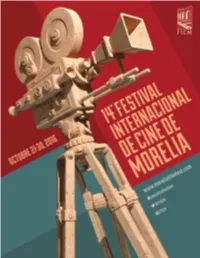
Ficm Cat16 Todo-01
Contenido Gala Mexicana.......................................................................................................125 estrenos mexicanos.............................................................................126 Homenaje a Consuelo Frank................................................................... 128 Homenaje a Julio Bracho............................................................................136 ............................................................................................................ introducción 4 México Imaginario............................................................................................ 154 ................................................................................................................. Presentación 5 Cine Sin Fronteras.............................................................................................. 165 ..................................................................................... ¡Bienvenidos a Morelia! 6 Programa de Diversidad Sexual...........................................................172 ..................................................... Mensaje de la Secretaría de Cultura 7 Canal 22 Presenta............................................................................................... 178 Mensaje del Instituto Mexicano de Cinematografía ������������9 14° Festival Internacional de Cine de Morelia.............................11 programas especiales........................................................................ 179 -

Ebousurrealism and Violence
“Surrealism and Violence. Luis Buñuel’s Los olvidados (The Forgotten Ones)”, Hispanic Horizons. Journal of the Centre of Spanish, Portuguese, Italian & Latin Amerian Studies. Jawaharlal Nehru University New Delhi, 2010: 33-44. ISSN: 0970-7522 SURREALISM AND VIOLENCE, LUIS BUÑUEL'S THE LOS OLVIDADOS (THE FORGOTTEN ONES) Enric Bou Brown University Buñuel, surrealist director In January of 1950 Luis Buñuel writes to his friend José Rubia Barcia about his latest film project. It is a project which he considers to be fundamental for the future of his film career (and his personal destiny) in Mexico, where he arrived in 1947 from Hollywood. The new film will be a "mixture of Tierra sin pan (Land Without Bread) and L’âge d’or (The Golden Age), with the addition of elements from the last fifteen years"1. A few months earlier he had divulged his general idea for the project: "I hope that [Los Olvidados] will be something extraordinary in the current panorama of international cinema. It is harsh and rough and does not spare the audience. Realist, but with a subtle vigorous poetic vein, and at times erotic"2. Los Olvidadosis the third film which Buñuel, after various failures, makes in Mexico. He had gone there to make a cinematic version of Garcia Lorca's play, The House of Bernarda Alba, but the project was never realized. In Mexico he meets the producer Oscar Dancigers and he is commissioned to do a series of jobs. The first is Gran Casino (1947), which is followed by El gran calavera (The Great Madcap, 1949) and, finally, Los Olvidados.