The Islamic Republic of Pakistan
Total Page:16
File Type:pdf, Size:1020Kb
Load more
Recommended publications
-

Who Is Who in Pakistan & Who Is Who in the World Study Material
1 Who is Who in Pakistan Lists of Government Officials (former & current) Governor Generals of Pakistan: Sr. # Name Assumed Office Left Office 1 Muhammad Ali Jinnah 15 August 1947 11 September 1948 (died in office) 2 Sir Khawaja Nazimuddin September 1948 October 1951 3 Sir Ghulam Muhammad October 1951 August 1955 4 Iskander Mirza August 1955 (Acting) March 1956 October 1955 (full-time) First Cabinet of Pakistan: Pakistan came into being on August 14, 1947. Its first Governor General was Muhammad Ali Jinnah and First Prime Minister was Liaqat Ali Khan. Following is the list of the first cabinet of Pakistan. Sr. Name of Minister Ministry 1. Liaqat Ali Khan Prime Minister, Foreign Minister, Defence Minister, Minister for Commonwealth relations 2. Malik Ghulam Muhammad Finance Minister 3. Ibrahim Ismail Chundrigar Minister of trade , Industries & Construction 4. *Raja Ghuzanfar Ali Minister for Food, Agriculture, and Health 5. Sardar Abdul Rab Nishtar Transport, Communication Minister 6. Fazal-ul-Rehman Minister Interior, Education, and Information 7. Jogendra Nath Mandal Minister for Law & Labour *Raja Ghuzanfar’s portfolio was changed to Minister of Evacuee and Refugee Rehabilitation and the ministry for food and agriculture was given to Abdul Satar Pirzada • The first Chief Minister of Punjab was Nawab Iftikhar. • The first Chief Minister of NWFP was Abdul Qayum Khan. • The First Chief Minister of Sindh was Muhamad Ayub Khuro. • The First Chief Minister of Balochistan was Ataullah Mengal (1 May 1972), Balochistan acquired the status of the province in 1970. List of Former Prime Ministers of Pakistan 1. Liaquat Ali Khan (1896 – 1951) In Office: 14 August 1947 – 16 October 1951 2. -

Rainfall Trends in Different Climate Zones of Pakistan Salma, S.1, S
Pakistan Journal of Meteorology Vol. 9, Issue 17: Jul 2012 Rainfall Trends in Different Climate Zones of Pakistan Salma, S.1, S. Rehman1, M. A. Shah2 Abstract In this paper, the study was conducted across the country to assess the rainfall trend in different climate zones of Pakistan over the past three decades. For this purpose dataset comprising 30 years for the period 1976 to 2005 were acquired from 30 meteorological observatories from different parts of the country. The whole data was analyzed through Analysis Of Variations (ANOVA) along Dunnett T3 test. The result has shown a decreasing trend (-1.18mm/decade) all over the country, which may be attributed to the presence of drought period during 1998- 2001. Stations located in different zones of the country mainly from North, North West, West and Coastal areas respectively show overall significant decreasing trend whereas plain areas and South West of the country have been observed with no significant trend. Adverse consequences of the rainfall have already been observed in Pakistan in the form of droughts and super floods which have badly affected human settlements, water management and agriculture sectors. Keywords: Rainfall trend, Climate zones, ANOVA test along Dunnett T3 test. Introduction The issue of climate change has emerged very strongly during the last two decades on global scale in view of its projected implications on the environment of vulnerable states. Steadily rising temperature and its impacts on the cryosphere and rainfall are evident in many regions around the world. There are indications that Pakistan has had its share of the large climatic variations that are known to have taken place in northwest India in the past. -
Memo Provided By: Globaledge.Msu.Edu and EXPORT.GOV
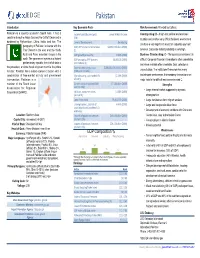
Pakistan Introduction Key Economic Facts Risk Assessment (Provided by Coface) Pakistan is a country located in South Asia. It has a Income Level (by per capita Lower Middle Income Country rating: D - A high-risk political and economic coastline along the Arabia Sea and the Gulf of Oman and is GNI): situation and an often very difficult business environment bordered by Afghanistan, China, India, and Iran. The Level of Development: Developing can have a very significant impact on corporate payment geography of Pakistan is diverse with the GDP, PPP (current international $1,060.75 billion (2019) Thar Desert in the east and the Hindu $): behavior. Corporate default probability is very high. Kush and Pamir mountain ranges in the GDP growth (annual %): 0.99% (2019) Business Climate rating: C - The business environment is north. The government system is a federal GDP per capita, PPP (current $4,898.05 (2019) difficult. Corporate financial information is often unavailable parliamentary republic; the chief of state is international $): and when available often unreliable. Debt collection is the president, and the head of government is the prime External debt stocks, total $100,818,526,514.40 (2019) unpredictable. The institutional framework has many minister. Pakistan has a mixed economic system with a (DOD, current US$): combination of free-market activity and government Manufacturing, value added (% 12.46% (2019) troublesome weaknesses. Intercompany transactions run intervention. Pakistan is a of GDP): major risks in the difficult environments rated C. member of the South Asian Current account balance (BoP, -$7.14 billion (2019) Strengths current US$): Association for Regional • Large internal market supported by dynamic Cooperation (SAARC). -

The Pakistan Army's Repression of the Punjab
Human Rights Watch July 2004 Vol. 16, No. 10 (C) Soiled Hands: The Pakistan Army’s Repression of the Punjab Farmers’ Movement Map 1: Pakistan – Provinces........................................................................................................ 1 Map 2: Punjab – Districts ............................................................................................................ 2 Table 1: Population Distribution across Okara District ......................................................... 3 I. Summary ..................................................................................................................................... 4 II. Key Recommendations........................................................................................................... 8 III. Background ............................................................................................................................. 9 Struggle Against Eviction ........................................................................................................ 9 “Ownership or Death”: Radicalization of the farmers’ movement ................................12 The Pakistan Rangers.............................................................................................................14 The Response of the Pakistan Army ...................................................................................17 IV. Human Rights Violations....................................................................................................19 Killings......................................................................................................................................20 -
Most Important Mcqs (Set IV) for CSS, PMS, PCS, NTS
Pakistan Studies/Affairs: Most Important MCQs (Set IV) for CSS, PMS, PCS, NTS Chashma Barrage was built in: (a) 1960 (b) 1965 (c) 1971 (d) 1975 Answer: c Rasul Barrage was constructed in: (a) 1968 (b) 1970 (c) 1971 (d) 1972 Answer: a Rasul Barrage was built on the river: (a) Jhelum (b) Ravi (c) Chenab (d) Indus Answer: a Marala Barrage was constructed on the river: (a) Indus (b) Ravi (c) Chenab (d) Jehlum Answer: c Check Also: Important and Most Wanted MCQs about Current Federal Cabinet of Pakistan Tirich Mir is the highest peak of: (a) Salt Range (b) Hindukash (c) Koh-i-Sulman (d) K-2 Answer: b The total height of the Tirich Mir is: Downloaded from www.csstimes.pk | 1 Pakistan Studies/Affairs: Most Important MCQs (Set IV) for CSS, PMS, PCS, NTS (a) 7000 metres (b) 7300 metres (c) 7600 metres (d) 7699 metres Answer: d The second highest peak of Hindukash is: (a) Sikeram (b) Sakesar (c) Noshaq (d) K-2 Answer: c The southern side of the Himalayas is called: (a) Sakesar (b) Siwalik (c) Koh-e-Sufaid (d) Swat Answer: b The highest peak of the Koh-e-Safaid is: (a) Takatu (b) Sikeram (c) Kalachitta (d) Swat Answer: b Tanda Dam is on the river: (a) Kabul (b) Kohat Toi (c) Swat (d) Ravi Answer: b Ras Koh lies between: (a) Balochistan Plateau and Indus Plains (b) Balochistan Plateau and Punjab Plains (c) Murree and Abbottabad (d) Multan and D. G. Khan Answer: a Downloaded from www.csstimes.pk | 2 Pakistan Studies/Affairs: Most Important MCQs (Set IV) for CSS, PMS, PCS, NTS Check also: Geography of Pakistan MCQs | Pakistan Studies/Affairs Notes (Set-I) The Salt Range is located in the ____ side of the river Indus. -

Freshwater Fishes and Zoogeography of Pakistan by Department of Zoology, College, Lahore, Acknowledgements Geographical Physio
Freshwater fishes and zoogeography of Pakistan by MuhammadR. Mirza Department of Zoology, GovernmentCollege, Lahore, Pakistan Contents Abstract 144 I. Introduction 144 Acknowledgements 145 II. Geographical account 145 Location 145 Physiography 145 1. The Northern Montane Region 146 2. The northwestern hills 147 3. The Submontane Indus Region 147 4. The Indus plain 147 5. The Baluchistan Plateau 148 Climate 148 Natural vegetation 148 Hydrography 149 1. The Indus drainage system 149 2. Internal drainage system 150 3. Coastal drainage system 150 III. Historical sketch 150 IV. Freshwater fishes of Pakistan 152 Class Teleostomi 152 . Subclass Actinopterygii 152 Cohort Taeniopaedia 153 Cohort Archaeophylaces 153 Cohort Euteleostei 153 Superorder Ostariophysi 153 Order Cypriniformes 153 Order Siluriformes 160 Superorder AcantJhopterygii 162 Order Atheriniformes 163 Order Channiformes 163 Order Synbranchiformes 163 Order Perciformes 163 Class Elasmobranchii 164 V. Zoogeography of Pakistan 164 Zoogeographical classification of freshwater fishes 165 Primary freshwater fishes 165 Secondary freshwater fishes 166 Peripheral freshwater fishes 166 144 M. R. MIRZA - FRESHWATER FISHES OF PAKISTAN Zoogeographical divisions of Pakistan 167 I. High Asian Division 167 II. Aba-Sinh Division 168 III. Northwestern Montane Division 169 IV. Indus plain, hills & South Baluchistan Division 171 adjoining . V. Northwestern Baluchistan Division 171 VI. Discussion and conclusion 174 I Oriental . Region 175 II. West Asian Transitional Region 176 Summary 176 References 176 Abstract on the fishes of North West Frontier Province; and Ahmad & Khan (1974) on the freshwater The freshwater fish fauna of Pakistan is briefly discuss- of and fishes Sind. In addition, several new species ed. It is predominantly South Asian but High Asian and subspecies have been described from various West Asian elements are also present. -

Electoral Politics of Pakistan People's Party in Punjab with Special
Muhammad Abrar Ahmad* Electoral Politics of Pakistani People’s Party in Punjab With Special Reference to General Election 2008 Abstract This study attempts to analyze Pakistan People’s party’s electoral politics and campaigning with special reference to General Election 2008 in the province of the Punjab. This election has been significant in the electoral history of Pakistan because PPP showed signs of revival in the province after some time. This election in Pakistan was also significant because it demonstrated the continuity of electoral process which was restarted in 1988 and helped strengthen the democracy in the country. The charter of Democracy had provided a strong platform for the main stream parties to fight against dictatorship and even after the sudden death of Benazir Bhutto that agreement continued and both parties made seat adjustments during the election campaign. This policy of seat adjustment helped PMLN to win more seats than PPP and thus PPP lost initiative in the Punjab though remained successful at the Centre. Therefore, this paper tries to understand the electoral politics in Punjab and the role of PPP in the general election of 2008 in the province of the Punjab. The underlying hypothesis of this paper is that PPP failed to capitalize the political vacuum created by the PMLN leaders because of their exile from Pakistan. The study also conducted to investigate the place and position of the Pakistan People’s Party in the political fabric of the province of the Punjab which had been under question for a long time because of the popularity of the Pakistan Muslim League and the unique leadership of Nawaz Sharif. -

DR. SHAMSHAD AKHTAR Associate Professor Department of Geography University of Karachi Karachi – 75270, Pakistan
DR. SHAMSHAD AKHTAR Associate Professor Department of Geography University of Karachi Karachi – 75270, Pakistan. Phone Office: +92-21- 99261300-6 Ext.2292 E-mail: shamshadgeog@yahoo.com JOB EXPERIENCES Lecture (Geography) Federal Government College H-9, Islamabad, Pakistan from 1992 to 1994 Lecture (Geography) Department of Geography, University of Karachi, Pakistan from 1994 to 2004 Assistant Professor (Geography) Department of Geography, University of Karachi, Pakistan from 2004 to 2009 Associate Professor (Geography) Department of Geography, University of Karachi, Pakistan from 2009 to date OTHER PROFESSIONAL EXPERIENCES Expert Curriculum (Commercial Geography): Agha Khan University Board, 2004-2005 Visiting Professor under HEC Teacher Exchange Program at Geography Department, Shah Abdul Latif University, (20th April to 30th April) , 2007 Visiting Professor : Allama Iqbal Open University (courses: Research Methods and Geography of Pakistan) Educational Expert (Geography): Oxford University Press, Karachi Editorial Consultant (Geography): Oxford University Press, Karachi Review Expert : Higher Education , Oxford University Press, Karachi Review Expert : Pakistan Journal Geography , University of Peshawar Review Expert : Journal Geography, Pakistan Geographical Association M.Phil Examiner : University of Peshawar, Pakistan M.Phil Examiner : Geology, University of Sindh M.Sc Examiner : University of Balochistan M.Sc. Examiner : Islamia University, Bahawalpur Page 1 of 5 Dr Shamshad Akhtar – Geography University of Karachi ADMINISTRATIVE AND STATUARY EXPERIENCES 1. Member Departmental Research Committee (DRC) 2. Member Board of Studies, Department of Geography, University of Karachi. (1998-2006) and 2013 to date. 3. Member Board of Studies, Dean Faculty of Arts, University of Karachi 1998-2009 and 2013 to date. 4. Member Board of Studies, Dean Faculty of Science, University of Karachi 1998- 2009 and 2013 to date. -

Chapter 17-Pakistan Citizens Crossed the Line of Control in Kashmir
Chapter 17 PAKISTAN Islamic Republic of Pakistan Area: 803,900 km2 Population: 152.53 million (June 30, 2005) Capital: Islamabad Language: Urdu, English, and four other major languages Religion: Islam Government type: Federal republic Chief of state: President General Pervez MUSHARRAF Currency: rupee (PKR) (US$1 = Rs 59.36; FY2005 average) Fiscal year: July–June 541 Citizens Crossed the Line of Control in Kashmir MOMOE MAKINO n August 2005, local body elections were held for the second time after I President General Pervez Musharraf seized power in 1999. Formally, all candidates were designated as independent, nonpartisan candidates, but in fact the election was a sweeping victory for the ruling party, the Pakistan Muslim League (PML). The election proclaimed itself to be grassroots democracy in action; however, in Pakistan the local landed elite are strong powerbrokers, and so even if elections are held, votes are affected by the influence of the local landowners. These local landowners used government decentralization to increase their power, and President Musharraf’s power base was also thereby strengthened. The earthquake that struck northern Pakistan on October 8 killed more than 73,000 people. International institutions, relief agencies from multiple countries, and domestic NGOs, etc., went to the scene of the dis- aster, where they continue their vigorous emergency support and recon- struction efforts. The massive damage in the area of Kashmir under Pakistani administration (Azad Kashmir) led to an improvement in the relations between Pakistan and India. While bus service across the Line of Control (LoC) had been already restored in April, five checkpoints on the LoC were opened up following the earthquake so that the LoC could be crossed even on foot. -

History and Geography of Pakistan Classes Ix-X
Secondary School Certificate Examination Syllabus HISTORY AND GEOGRAPHY OF PAKISTAN CLASSES IX-X (based on National Curriculum 1993) Published by Aga Khan University Examination Board Bungalow # 233 / E.I.Lines, Daudpota Road, Karachi, Pakistan. March 2005 Latest Revision June 2012 All rights reserved This syllabus is developed by Aga Khan University Examination Board for distribution to all its affiliated schools. Secondary School Certificate Examination Syllabus HISTORY AND GEOGRAPHY OF PAKISTAN CLASSES IX-X This subject is examined in both May and September Examination sessions S. No. Table of Contents Page No. Preface 5 1. Aims/Objectives of the National Curriculum (1993) 7 2. Rationale of the AKU-EB Examination Syllabus 7 3. Topics and Student Learning Outcomes of the Examination Syllabus 10 4. Scheme of Assessment 28 5. Teaching-Learning Approaches and Classroom Activities 31 6. Recommended Text and Reference Material 32 7. Definition of Cognitive Levels and Command Words 33 Annex: SSC Scheme of Studies 36 For queries and feedback Address: The Aga Khan University Examination Board Bungalow No. 233/ E.I.Lines, Daudpota Road, Karachi-Pakistan. Phone: (92-21) 35224702-10 Fax: (92-21) 35224711 E-mail: examination.board@aku.edu Website: http://examinationboard.aku.edu http://learningsupport.akueb.edu.pk Facebook: www.facebook.com/akueb Latest Revision June 2012 Page 4 PREFACE In pursuance of National Education Policy (1998-2010), the Curriculum Wing of the Federal Ministry of Education has begun a process of curriculum reform to improve the quality of education through curriculum revision and textbook development (Preface, National Curriculum documents 2000 and 2002). AKU-EB was founded in August 2003 with the same aim of improving the quality of education nationwide. -

Teacher's Workshop, 1999: Islam in South Asia and the United States
DOCUMENT RESUME ED 447 011 SO 032 160 AUTHOR Dybola, Ellen; Andino, Ann; Arnold, Harriet; Asvos, Maria; Robles, Ivette TITLE Teacher's Workshop, 1999: Islam in South Asia and the United States. Lesson Plans. INSTITUTION Chicago Univ., IL. PUB DATE 1999-00-00 NOTE 23p. AVAILABLE FROM South Asia Educational Outreach Project, Kelly 309, University of Chicago, Chicago, IL 60637; Tel: 773-702-8635; Fax: 773-702-1309; E-mail: (south-asia-outreach@uchicago.edu); Web site: (http://humanities.uchicago.edu/southasia/lesson.htm). PUB TYPE Guides - Classroom - Teacher (052) EDRS PRICE MF01/PC01 Plus Postage. DESCRIPTORS Elementary Secondary Education; Foreign Countries; *Islam; *Islamic Culture; Language Arts; Muslims; Preschool Education; *Religion Studies; Social Studies; Special Needs Students; Student Educational Objectives IDENTIFIERS *Asia (South); Multicultural Literature ABSTRACT This booklet consists of four lesson plans to be used with students in preschool through grade 9. The first lesson, for preschool children with special needs, is titled "Introduction to Islamic Customs and Practices." It introduces new vocabulary and concepts while focusing on Islamic customs and practices. The second lesson, "Islam Lesson Plan" (focused on language arts), is for third grade students. It is designed for a group of students receiving tutorial help for a 45-minute reading period and entails work in cooperative groups. The third lesson is titled "Using the Novel Shabanu, Daughter of the Wind as a Window into Islamic Religion and Culture in Pakistan" and is for grades 6-8. It suggests using the juvenile fiction book, "Shabanu, Daughter of the Wind," both for its literary merits and as a window into religious beliefs. -
Distribution Pattern Assessment of Physicochemical Components Of
ISSN:2372‐0743 print Vol. 06 ISSN:2373‐2989 on line International Journal of Ground Sediment & Water 2017 ◆Research Paper Distribution Pattern Assessment of Physicochemical Components of Keenjhar Lake Water, Sindh, Pakistan Adnan Khan*, Asal Eghbal Bkhatiari, Sumaira Asif Khan, Muhammad Arsalan Department of Geology, University of Karachi, Karachi, Pakistan. * Corresponding author E‐mail: adkhan@uok.edu.pk Abstract: Keenjhar Lake is one of the largest fresh water lakes in Pakistan which is present in Thatta district, Sindh. It is the main source of drinking water supply for Karachi city. The present study was carried out to assess the depth controlled variation pattern of physicochemical components of Keenjhar lake water. For this purpose, water samples were collected at three depth interval (1. Surface 2.Depth of 30 m 3.Near bottom). Studied parameters include physical character (color, odor, taste, temperature, pH, electrical conductivity, hardness, oxidation reduction potential) major chemistry (Na, K, Ca, Mg, HCO3, SO4, Cl, NO3) and minor/trace elements (Fe, Cr, Co, Mn, Cu, Ni and Zn). Data reveal that there is no significant variation in the physical parameters and chemical components with depth change. All parameters in lake water are in compliance with the guideline values of WHO set for drinking water. The lake water is suitable for the survival and sustenance of aquatic life. Keywords: Keenjhar Lake, physicochemical parameters, depth variation, distribution pattern. Introduction Lakes are large bodies of inland water which serve as source for drinking, irrigation as well as industrial purpose. The quality and quantity of lake water depend upon the climate, catchments, geography of the area and the inputs and outputs both natural and manmade.