How Starbucks Failed in Israel
Total Page:16
File Type:pdf, Size:1020Kb
Load more
Recommended publications
-

The Turkish Diaspora in Europe Integration, Migration, and Politics
GETTY GEBERT IMAGES/ANDREAS The Turkish Diaspora in Europe Integration, Migration, and Politics By Max Hoffman, Alan Makovsky, and Michael Werz December 2020 WWW.AMERICANPROGRESS.ORG Contents 1 Introduction and summary 4 Key findings 9 Detailed findings and country analyses 34 Conclusion 37 About the authors and acknowledgments 38 Appendix: Citizenship laws and migration history in brief 44 Endnotes Introduction and summary More than 5 million people of Turkish descent live in Europe outside Turkey itself, a human connection that has bound Turkey and the wider European community together since large-scale migration began in the 1960s.1 The questions of immigra- tion, citizenship, integration, assimilation, and social exchange sparked by this migra- tion and the establishment of permanent Turkish diaspora communities in Europe have long been politically sensitive. Conservative and far-right parties in Europe have seized upon issues of migration and cultural diversity, often engaging in fearmonger- ing about immigrant communities and playing upon some Europeans’ anxiety about rapid demographic change. Relations between the European Union—as well as many of its constituent member states—and Turkey have deteriorated dramatically in recent years. And since 2014, Turks abroad, in Europe and elsewhere around the world, have been able to vote in Turkish elections, leading to active campaigning by some Turkish leaders in European countries. For these and several other reasons, political and aca- demic interest in the Turkish diaspora and its interactions -

HRI FOOD SERVICE SECTOR 2017 Israel
THIS REPORT CONTAINS ASSESSMENTS OF COMMODITY AND TRADE ISSUES MADE BY USDA STAFF AND NOT NECESSARILY STATEMENTS OF OFFICIAL U.S. GOVERNMENT POLICY Required Report - public distribution Date: 12/28/2017 Israel HRI FOOD SERVICE SECTOR 2017 Approved By: Mariano J. Beillard, Senior Regional Agricultural Attaché Prepared By: Jessica Sullum Shay, Marketing Specialist and Bret Tate, Regional Agricultural Attaché ` Report Highlights: The Israeli Hotel Restaurant Institutional (HRI) sector is stable. Sales in hotels and resorts are growing, in spite of the dip in tourism starting in 2015. The restaurant sector is evolving. The number of full service restaurants is stable, though they are facing financial strains due to high fixed costs. Concurrently, the number of restaurants with low-fixed costs, like street vendors and kiosks, are growing. Institutional sales are strong and steady, as a few large firms vie for control of a limited market. 1 SECTION I. MARKET SUMMARY Israel is a parliamentary democracy of approximately 8.75 million people (September 2017 estimate). Of that population, around 75 percent are Jewish and 25 percent are non-Jewish, mostly Arab (Muslims and Christians). The country’s area is 20,330 square kilometers, making it slightly smaller than the U.S. state of New Jersey. Current population growth is 1.8 percent per annum. Israel is a sophisticated, industrialized free-market economy, with a diversified manufacturing sector. Israel’s main export market is the European Union (EU). Israel’s gross domestic product (GDP) growth in recent years has ranged from two to five percent per annum. Israeli GDP increased by four percent in 2016. -

Decentralising Immigrant Integration: Denmark's Mainstreaming Initiatives in Employment, Education, and Social Affairs
Decentralising Immigrant Integration Denmark’s mainstreaming initiatives in employment, education, and social affairs By Martin Bak Jørgensen MIGRATION POLICY INSTITUTE EUROPE Decentralising Immigrant Integration Denmark’s mainstreaming initiatives in employment, education, and social affairs By Martin Bak Jørgensen September 2014 ACKNOWLEDGMENTS This report, part of a research project supported by the Kingdom of the Netherlands, is one of four country reports on mainstreaming, covering Denmark, France, Germa- ny, and the United Kingdom. Migration Policy Institute Europe thanks key partners in this research project, Peter Scholten from Erasmus University and Ben Gidley from Compas, Oxford University. © 2014 Migration Policy Institute Europe. All Rights Reserved. Cover design: April Siruno Typesetting: Rebecca Kilberg, MPI No part of this publication may be reproduced or transmitted in any form by any means, electronic or mechanical, including photocopy, or any information storage and retrieval system, without permission from MPI Europe. A full-text PDF of this document is available for free download from www.mpieurope.org. Information for reproducing excerpts from this report can be found at www.migrationpolicy.org/about/copyright-policy. Inquiries can also be directed to communications@migrationpolicy.org. Suggested citation: Jørgensen, Martin Bak. 2014. Decentralising immigrant integra- tion: Denmark’s mainstreaming initiatives in employment, education, and social affairs. Brussels: Migration Policy Institute Europe. TABLE OF CONTENTS -
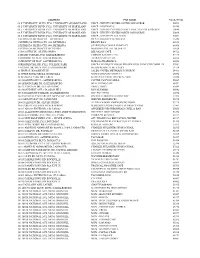
FSE Permit Numbers by Address
ADDRESS FSE NAME FACILITY ID 00 E UNIVERSITY BLVD, FY21, UNIVERSITY OF MARYLAND UMCP - XFINITY CENTER SOUTH CONCOURSE 50891 00 E UNIVERSITY BLVD, FY21, UNIVERSITY OF MARYLAND UMCP - FOOTNOTES 55245 00 E UNIVERSITY BLVD, FY21, UNIVERSITY OF MARYLAND UMCP - XFINITY CENTER EVENT LEVEL STANDS & PRESS P 50888 00 E UNIVERSITY BLVD, FY21, UNIVERSITY OF MARYLAND UMCP - XFINITY CENTER NORTH CONCOURSE 50890 00 E UNIVERSITY BLVD, FY21, UNIVERSITY OF MARYLAND UMCP - XFINITY PLAZA LEVEL 50892 1 BETHESDA METRO CTR, -, BETHESDA HYATT REGENCY BETHESDA 53242 1 BETHESDA METRO CTR, 000, BETHESDA BROWN BAG 66933 1 BETHESDA METRO CTR, 000, BETHESDA STARBUCKS COFFEE COMPANY 66506 1 BETHESDA METRO CTR, BETHESDA MORTON'S THE STEAK HOUSE 50528 1 DISCOVERY PL, SILVER SPRING DELGADOS CAFÉ 64722 1 GRAND CORNER AVE, GAITHERSBURG CORNER BAKERY #120 52127 1 MEDIMMUNE WAY, GAITHERSBURG ASTRAZENECA CAFÉ 66652 1 MEDIMMUNE WAY, GAITHERSBURG FLIK@ASTRAZENECA 66653 1 PRESIDENTIAL DR, FY21, COLLEGE PARK UMCP-UNIVERSITY HOUSE PRESIDENT'S EVENT CTR COMPLEX 57082 1 SCHOOL DR, MCPS COV, GAITHERSBURG FIELDS ROAD ELEMENTARY 54538 10 HIGH ST, BROOKEVILLE SALEM UNITED METHODIST CHURCH 54491 10 UPPER ROCK CIRCLE, ROCKVILLE MOM'S ORGANIC MARKET 65996 10 WATKINS PARK DR, LARGO KENTUCKY FRIED CHICKEN #5296 50348 100 BOARDWALK PL, GAITHERSBURG COPPER CANYON GRILL 55889 100 EDISON PARK DR, GAITHERSBURG WELL BEING CAFÉ 64892 100 LEXINGTON DR, SILVER SPRING SWEET FROG 65889 100 MONUMENT AVE, CD, OXON HILL ROYAL FARMS 66642 100 PARAMOUNT PARK DR, GAITHERSBURG HOT POT HERO 66974 100 TSCHIFFELY -

1 the Turks and Europe by Gaston Gaillard London: Thomas Murby & Co
THE TURKS AND EUROPE BY GASTON GAILLARD LONDON: THOMAS MURBY & CO. 1 FLEET LANE, E.C. 1921 1 vi CONTENTS PAGES VI. THE TREATY WITH TURKEY: Mustafa Kemal’s Protest—Protests of Ahmed Riza and Galib Kemaly— Protest of the Indian Caliphate Delegation—Survey of the Treaty—The Turkish Press and the Treaty—Jafar Tayar at Adrianople—Operations of the Government Forces against the Nationalists—French Armistice in Cilicia—Mustafa Kemal’s Operations—Greek Operations in Asia Minor— The Ottoman Delegation’s Observations at the Peace Conference—The Allies’ Answer—Greek Operations in Thrace—The Ottoman Government decides to sign the Treaty—Italo-Greek Incident, and Protests of Armenia, Yugo-Slavia, and King Hussein—Signature of the Treaty – 169—271 VII. THE DISMEMBERMENT OF THE OTTOMAN EMPIRE: 1. The Turco-Armenian Question - 274—304 2. The Pan-Turanian and Pan-Arabian Movements: Origin of Pan-Turanism—The Turks and the Arabs—The Hejaz—The Emir Feisal—The Question of Syria—French Operations in Syria— Restoration of Greater Lebanon—The Arabian World and the Caliphate—The Part played by Islam - 304—356 VIII. THE MOSLEMS OF THE FORMER RUSSIAN EMPIRE AND TURKEY: The Republic of Northern Caucasus—Georgia and Azerbaïjan—The Bolshevists in the Republics of Caucasus and of the Transcaspian Isthmus—Armenians and Moslems - 357—369 IX. TURKEY AND THE SLAVS: Slavs versus Turks—Constantinople and Russia - 370—408 2 THE TURKS AND EUROPE I THE TURKS The peoples who speak the various Turkish dialects and who bear the generic name of Turcomans, or Turco-Tatars, are distributed over huge territories occupying nearly half of Asia and an important part of Eastern Europe. -

Audit and Accountability in Local Government in Sweden
Audit and Accountability in Local Government in Sweden Anna Eklöf Lotta Ricklander Swedish Association of Local Authorities and Regions Sweden in short facts Population: 10 million inhabitants Form of government: Constitutional monarchy, parliamentary democracy. Parliament: The Riksdag, with 349 members in one chamber. Capital: Stockholm. The largest city in Sweden. Population 942 000 The three democratic levels The task of the municipalities Social services Childcare and preschools Elderly care Care for the physically and intellectually disabled Primary and secondary education Planning and building issues Health and environmental protection Refuse collection and waste management Emergency services and emergency preparedness Water and sewerage The task of the regions Healthcare Regional development Infrastructure and public transport Cultural institutions Revenues of the municipalities and regions Other revenue 5% Other revenue 5% Rents and leases 4% Fees and charges 3% Sale of services and Targeted government grants contracts 1% 3% Fees and charges 7% Grant for pharmaceutial benefits 10% General government Government grants 14% grants 5% Tax renvenue 69% Tax revenue 74% The Swedish Association of Local Authorities and Regions (SALAR) SALAR represents all 290 municipalities and all 20 regions. Negociates with national government SALAR decides upon the Code of audit in Local government Municipal audit in Sweden – the role of the SAI Locally owned audit (like in Norway, Denmark, UK, the Netherlands) The SAI Riksrevisionen -
THE RIGHT LIVELIHOOD WAY: a Sourcebook for Changemakers
THE RIGHT LIVELIHOOD WAY: A Sourcebook for Changemakers Compiled by Anwar Fazal & Lakshmi Menon Right Livelihood College & International People’s Agroecology Multiversity (IPAM) The Right Livelihood Way: A Sourcebook for Changemakers July 2016 Published by Right Livelihood College (RLC) C/o RLC Global Secretariat, Walter Flex Str. 3, 53113 Bonn, Germany Tel: +49(0)228/73-4907 Fax: +49 (0) 228/73-1972 Email: anwar.fazal@gmail.com / college@rightlivelihood.com Website: www.rightlivelihood.org/college & International People’s Agroecology Multiversity (IPAM) C/o PAN International Asia Pacific P.O. Box 1170 10850 George Town Penang, Malaysia Tel: +604-657 0271 / +604-656 0381 • Fax: +604-658 3960 Email: ipam@panap.net Website: www.ipamglobal.org Design & layout: Cecilia Mak Cover: Recycled card Cover design: The graphic “DNA Tree of Life” on the cover is designed by B. Egan, a tattoo artist from the USA. See http://tattoosbybegan.deviantart.com/art/DNA-Tree-of-Life- 207411060 for more about her work. CONTENTS I Introduction 1 II Multiversities – 55 Inspirational Resources 4 III Projects of Hope – 155 Right Livelihood Champions 23 IV Doing the Right Livelihood Way 50 I. Social Justice: 1) Sima Samar, Afghanistan; 2) Raji Sourani, Palestine 52 Social Justice: II. Ecological Sustainability: Sulak Thai NGO, Sathirakoses-Nagapradeepa 57 Ecological Foundation; 2) Agro-ecology – IPAM-PANAP, Malaysia Sustainability: III. Cultural Vibrancy: 1) International Poetry Festival of Medellin, 63 Cultural Vibrancy: Columbia; 2) Jose Antonio Abreo, Venezuela -
CES Open Forum Series 2019-2020
CES Open Forum Series 2019-2020 WHAT STORIES DOES EUROPE TELL? A VIEW FROM TURKEY by: Ayşe Kadıoğlu About the Series The Open Forum Paper Series is designed to present work in progress by current and former affiliates of the Minda de Gunzburg Center for European Studies (CES) and to distribute papers presented at the Center’s seminars and conferences. Any opinions expressed in the papers are those of the authors and not of CES. Editors Grzegorz Ekiert and Andrew Martin Editorial Board Peter Hall, Roberto Stefan Foa, Alison Frank Johnson, Torben Iverson, Maya Jasanoff, Jytte Klausen, Michele Lamont, Mary D. Lewis, Michael Rosen, Vivien Schmidt, Kathleen Thelen, Daniel Ziblatt, Kathrin Zippel About the Author Ayşe Kadıoğlu is Professor of Political Science at Sabancı University since 1998. She was the Acting President of Sabancı University and the Dean of the Faculty of Arts and Social Sciences at Sabancı University. She is a Fellow at Harvard University, John F. Ken- nedy School of Government, Carr Center for Human Rights Policy. She will be a Visiting Scholar at Columbia University, Sakıp Sabancı Center for Turkish Studies during the 2019-2020 academic year. Her fields of research are migration and citizenship studies, new authoritarian regimes, comparative nationalisms, early twentieth century liberal- ism in Turkey, and Turkish secularism. Link to Ayşe Kadıoğlu’s webpage: http://myweb.sabanciuniv.edu/ayse/ ABSTRACT Turkey’s omnipresence at the margins of Europe throughout history has given shape to both Turkish and European identities. This paper sheds light onto this relationship by endeavoring to go beyond the much-studied institutional relationship between Turkey and the European Union (EU). -
It's Not About the Money. EU Funds, Local Opportunities, And
Regional Science and Urban Economics 84 (2020) 103556 Contents lists available at ScienceDirect Regional Science and Urban Economics journal homepage: www.elsevier.com/locate/regec It’s not about the money. EU funds, local opportunities, and Euroscepticism Riccardo Crescenzi a,MarcoDiCataldoa,b,∗,MaraGiuac a London School of Economics, United Kingdom b Ca’ Foscari University of Venice, Italy c Roma Tre University, Italy ARTICLE INFO ABSTRACT Keywords: Growing Euroscepticism across the European Union (EU) leaves open questions as to what citizens expect to gain EU funds from EU Membership and what influences their dissent for EU integration. This paper looks at the EU Structural Euroscepticism Funds, one of the largest and most visible expenditure items in the EU budget, to test their impact on electoral Cohesion policy support for the EU. By leveraging the Referendum on Brexit held in the United Kingdom, a spatial RDD analysis Brexit Regression discontinuity offers causal evidence that EU money does not influence citizens’ support for the EU. Conversely, the analysis shows that EU funds mitigate Euroscepticism only where they are coupled with tangible improvements in local labour market conditions, the ultimate objective of this form of EU intervention. Money cannot buy love for the EU, but its capacity to generate new local opportunities certainly can. 1. Introduction prices and quantities that are difficult for citizens to link to EU member- ship. Conversely, a set of concrete policy actions are intended to visibly The European Union (EU) is increasingly seen by its detractors as and clearly impact the economic opportunities available to EU citizens. distant from the real day-to-day economic challenges of its citizens Among those the lion’s share of financial resources goes to regional and as a binding constraint to the capacity of national governments development interventions under the EU Cohesion Policy (Begg, 2008), to deliver a more equitable distribution of prosperity. -
Promoting Well-Being and Inclusiveness in Sweden
Better Policies Series PROMOTING WELL-BEING AND INCLUSIVENESS IN SWEDEN www.oecd.org/countries/sweden OCDE Paris 2, rue André Pascal, 75775 Paris Cedex 16 Tel.: +33 1 45 24 82 00 August 2016 ORGANISATION FOR ECONOMIC CO-OPERATION AND DEVELOPMENT This document is published on the responsibility of the Secretary-General of the OECD. The opinions expressed and arguments employed herein do not necessarily reflect the official views of OECD member The OECD is a unique forum where governments work together to address the economic, social and countries. environmental challenges of globalisation. The OECD is also at the forefront of efforts to understand and to *** help governments respond to new developments and concerns, such as corporate governance, the information economy and the challenges of an ageing population. The Organisation provides a setting where governments This document and any map included herein are without prejudice to the status of or sovereignty over any can compare policy experiences, seek answers to common problems, identify good practice and work to co- territory, to the delimitation of international frontiers and boundaries and to the name of any territory, city or ordinate domestic and international policies. area. The OECD member countries are: Australia, Austria, Belgium, Canada, Chile, the Czech Republic, Denmark, Estonia, Finland, France, Germany, Greece, Hungary, Iceland, Ireland, Israel, Italy, Japan, Korea, Latvia, The statistical data for Israel are supplied by and under the responsibility of the relevant Israeli authorities. Luxembourg, Mexico, the Netherlands, New Zealand, Norway, Poland, Portugal, the Slovak Republic, Slovenia, The use of such data by the OECD is without prejudice to the status of the Golan Heights, East Jerusalem Spain, Sweden, Switzerland, Turkey, the United Kingdom and the United States. -

Activity Report 2017/2018 Light for the World
Activity Report 2017/2018 FOREWORD Dear friends of Light for the World, Together we look back on a successful year 2017. Thanks to more than 143,000 donors and supporters we were able to make a difference in this world. In total, we reached 1.3 million people with eye care, rehabilitation and education and fought for the rights of people with disabilities. • More than 93,000 eye operations ( including over 43,700 cataract surgeries) saved eye-sight in our projects. • Over 9,000 children with disabilities accessed inclusive education, more than 33,900 received rehabilitation, enabling them to lead independent and self- sustained lives in the future. • Our Senior Inclusion Advisor Yetnebersh Nigussie has been awarded the Right Livelihood Award 2017, honoring her achievements in disability inclusion and human rights. • We distributed close to 13 million doses of medication against trachoma and other infectious causes of blindness. Looking forward to 2018, we continue to have big ambitions too. All this is only possible due to the dedication and tireless efforts of our local partners, who pour their energy into removing barriers for people living in some of the poorest countries in the world. And we want to thank you, that you too contribute to creating a world, where everybody can take part and no one is left behind. Karin Krobath Rupert Roniger Chairperson CEO Light for the World Light for the World OUR APPROACH CONTENT 4 Highlights LIGHT FOR 6 Facts & Numbers FOCUS TOPICS THE WORLD 8 Eyesight 10 Education 12 People Light for the World is a global disability & 14 Empowerment development organization, breaking down 16 Expertise & Skill Sharing barriers to enrich society and unlock the COUNTRIES potential in all of us. -

Germany Switzerland
ESRC Scottish Centre on Constitutional Change Spotlight on Borders Insights from the German-Swiss border Bettina Petersohn and Nicola McEwen Key points : Different currencies do not form a significant barrier to the mobility of people or trade, but the Swiss National Bank intervened when the Euro crisis posed a threat to Swiss exports. A stronger economy on one side of the border encourages increases on frontier workers, while lower consumer prices can attract cross-border shoppers. Local councils and transportation networks cooperate along the border to facilitate cross- border mobility and ensure the functioning of public transport and freight traffic. EU-Relations : Switzerland holds strong ties with EU institutions based on bilateral agreements . In exchange, the Swiss government had to allow for the free movement of persons and extend the same level of public services to citizens of EU member-states. The border between Germany and Switzerland separates an EU member-state from a non-member-state with Schengen Area different currencies. As Switzerland is associated member All members of the EU are part of to the Schengen area, passport controls have been the Schengen Agreement, except the abolished at the border. However, custom controls remain UK and Ireland. in place as Switzerland is not part of the custom union and Norway, Iceland and Switzerland duties apply whenever exemption limits are exceeded. The are associated members to the case of the German-Swiss border sheds light on how Schengen area. differences in EU membership, currency, taxes or salaries Participation in Schengen includes : impact on cross-border movements, trade and cooperation.