Belarus Joint United Nations Programme on HIV/AIDS (UNAIDS)
Total Page:16
File Type:pdf, Size:1020Kb
Load more
Recommended publications
-
PAP-10-GB.Pdf
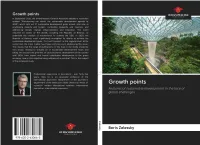
!"#$%&'()*')' +&&$*'* , ! ! "- ! . / ! , 0 1%- ! " " %12*3- , 4" 5 4 )*)* " - ! . / ! , 0 Boris Zalessky Growth points Features of development in the face of global challenges 1 2 Table of contents Sustainable development goals and media ................................................................................. 5 Global information security and regional press ........................................................................ 12 From strategy to attract foreign investment to international cooperation ................................ 20 Honorary Consuls Institute: project-specific orientation.......................................................... 28 Export culture and mass consciousness .................................................................................... 31 Exports to distant arc countries as an important factor for development ................................. 34 Food exports: growth trends ..................................................................................................... 37 Export of services: among priorities - tourism ......................................................................... 40 Import substitution: growth reserves - in modernization.......................................................... 43 From green economy to green cities........................................................................................ -
The Childrens' Names That Appear on This List Were Taken from Pages of Testimony Submitted to Yad Vashem
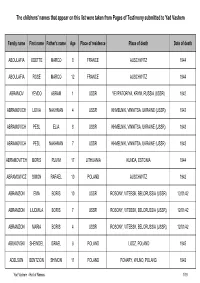
The childrens' names that appear on this list were taken from Pages of Testimony submitted to Yad Vashem Family name First name Father's name Age Place of residence Place of death Date of death ABOULAFIA ODETTE MARCO 8 FRANCE AUSCHWITZ 1944 ABOULAFIA ROSE MARCO 12 FRANCE AUSCHWITZ 1944 ABRAMOV YEVDO ABRAM 1 USSR YEVPATORIYA, KRYM, RUSSIA (USSR) 1942 ABRAMOVICH LIOVA NAKHMAN 4 USSR KHMELNIK, VINNITSA, UKRAINE (USSR) 1943 ABRAMOVICH PESL ELIA 8 USSR KHMELNIK, VINNITSA, UKRAINE (USSR) 1943 ABRAMOVICH PESL NAKHMAN 7 USSR KHMELNIK, VINNITSA, UKRAINE (USSR) 1943 ABRAMOVITCH BORIS RUVIM 17 LITHUANIA KUNDA, ESTONIA 1944 ABRAMOWICZ SIMON RAFAEL 10 POLAND AUSCHWITZ 1942 ABRAMZON EMA BORIS 10 USSR ROSONY, VITEBSK, BELORUSSIA (USSR) 12/01/42 ABRAMZON LIUDMILA BORIS 7 USSR ROSONY, VITEBSK, BELORUSSIA (USSR) 12/01/42 ABRAMZON MARIA BORIS 4 USSR ROSONY, VITEBSK, BELORUSSIA (USSR) 12/01/42 ABUKOVSKI SHEINDEL ISRAEL 8 POLAND LODZ, POLAND 1945 ADELSON BENTZION SHIMON 11 POLAND PONARY, WILNO, POLAND 1942 Yad Vashem - Hall of Names 1/79 The childrens' names that appear on this list were taken from Pages of Testimony submitted to Yad Vashem Family name First name Father's name Age Place of residence Place of death Date of death ADLER ADEL DEZSO 6 HUNGARY AUSCHWITZ 1944 ADLER ENDRE GYULA 11 HUNGARY AUSCHWITZ 1944 ADLER JENO DEZSO 4 HUNGARY AUSCHWITZ 1944 ADLER LASZLO KAROLY 12 HUNGARY AUSCHWITZ 1944 ADLER MARIANNE MANO 10 HUNGARY AUSCHWITZ 1944 ADLER OTTO KAROLY 6 HUNGARY AUSCHWITZ 1944 ADLER WOLF ANSHEL 17 POLAND AUSCHWITZ 1943 AHARONOVIZ YTZKHAK KHAYIM 12 -
Elaboration of Priority Components of the Transboundary Neman/Nemunas River Basin Management Plan (Key Findings)
Elaboration of Priority Components of the Transboundary Neman/Nemunas River Basin Management Plan (Key Findings) June 2018 Disclaimer: This report was prepared with the financial assistance of the European Union. The views expressed herein can in no way be taken to reflect the official opinion of the European Union. TABLE OF CONTENTS EXECUTIVE SUMMARY ..................................................................................................................... 3 1 OVERVIEW OF THE NEMAN RIVER BASIN ON THE TERRITORY OF BELARUS ............................... 5 1.1 General description of the Neman River basin on the territory of Belarus .......................... 5 1.2 Description of the hydrographic network ............................................................................. 9 1.3 General description of land runoff changes and projections with account of climate change........................................................................................................................................ 11 2 IDENTIFICATION (DELINEATION) AND TYPOLOGY OF SURFACE WATER BODIES IN THE NEMAN RIVER BASIN ON THE TERRITORY OF BELARUS ............................................................................. 12 3 IDENTIFICATION (DELINEATION) AND MAPPING OF GROUNDWATER BODIES IN THE NEMAN RIVER BASIN ................................................................................................................................... 16 4 IDENTIFICATION OF SOURCES OF HEAVY IMPACT AND EFFECTS OF HUMAN ACTIVITY ON SURFACE WATER BODIES -

ZRBG – Ghetto-Liste (Stand: 01.08.2014) Sofern Eine Beschäftigung I
ZRBG – Ghetto-Liste (Stand: 01.08.2014) Sofern eine Beschäftigung i. S. d. ZRBG schon vor dem angegebenen Eröffnungszeitpunkt glaubhaft gemacht ist, kann für die folgenden Gebiete auf den Beginn der Ghettoisierung nach Verordnungslage abgestellt werden: - Generalgouvernement (ohne Galizien): 01.01.1940 - Galizien: 06.09.1941 - Bialystok: 02.08.1941 - Reichskommissariat Ostland (Weißrussland/Weißruthenien): 02.08.1941 - Reichskommissariat Ukraine (Wolhynien/Shitomir): 05.09.1941 Eine Vorlage an die Untergruppe ZRBG ist in diesen Fällen nicht erforderlich. Datum der Nr. Ort: Gebiet: Eröffnung: Liquidierung: Deportationen: Bemerkungen: Quelle: Ergänzung Abaujszanto, 5613 Ungarn, Encyclopedia of Jewish Life, Braham: Abaújszántó [Hun] 16.04.1944 13.07.1944 Kassa, Auschwitz 27.04.2010 (5010) Operationszone I Enciklopédiája (Szántó) Reichskommissariat Aboltsy [Bel] Ostland (1941-1944), (Oboltsy [Rus], 5614 Generalbezirk 14.08.1941 04.06.1942 Encyclopedia of Jewish Life, 2001 24.03.2009 Oboltzi [Yid], Weißruthenien, heute Obolce [Pol]) Gebiet Vitebsk Abony [Hun] (Abon, Ungarn, 5443 Nagyabony, 16.04.1944 13.07.1944 Encyclopedia of Jewish Life 2001 11.11.2009 Operationszone IV Szolnokabony) Ungarn, Szeged, 3500 Ada 16.04.1944 13.07.1944 Braham: Enciklopédiája 09.11.2009 Operationszone IV Auschwitz Generalgouvernement, 3501 Adamow Distrikt Lublin (1939- 01.01.1940 20.12.1942 Kossoy, Encyclopedia of Jewish Life 09.11.2009 1944) Reichskommissariat Aizpute 3502 Ostland (1941-1944), 02.08.1941 27.10.1941 USHMM 02.2008 09.11.2009 (Hosenpoth) Generalbezirk -

Contemporary Recordings of Belarusian Folk Biblical and Non-Biblical Etiological Legends in the Comparative-Historical Aspect
https://doi.org/10.7592/FEJF2018.72.boganeva CONTEMPORARY RECORDINGS OF BELARUSIAN FOLK BIBLICAL AND NON-BIBLICAL ETIOLOGICAL LEGENDS IN THE COMPARATIVE-HISTORICAL ASPECT Elena Boganeva Center for Belarusian Culture, Language and Literature Research National Academy of Sciences, Belarus e-mail: elboganeva@gmail.com Abstract: The article considers some rare etiologies in contemporary record- ings – non-biblical cosmogonic and folk biblical anthropogenic etiologies in the comparative and historical aspect. Cosmogonic etiologies are stories about the predetermination of spatial and temporal parameters of the world (texts about the origins of the elements of the earthscape, in particular, mountains; about the agreement made between God and Satan concerning the distribution of as- cendancy over people at the beginning of the world and at the end of it; about the determination of the time of the existence of the world and the change of time); about the structure of the current status of the Universe (the Earth is round, it revolves and is supported by a giant turtle or tortoise); about the primary entity or body, from which the following emerges: the world (out of a child’s body), a part of cultural space – a group of inhabited localities (out of a felled statue), and one of the primary elements – fire (out of a human). Anthropogenic folk biblical etiologies include stories about the origins of sexual relations between the first people (two versions); the birth of children out of different body parts (the head, through the side of the body); and the origins of hair on male bodies. Keywords: anthropogenic etiologies, etiological legend, etiologies of cosmogonic legends, folk Bible, folk biblical etiologies, folk narratives, non-biblical etiologies, vernacular Christianity INTRODUCTION According to its administrative division, there are 6 regions (oblasts) and 118 districts in Belarus. -

Lobach the Sacred Lakes of the Dvina Region (Northwest Belarus)
THE SACRED LAKES OF THE DVINA REGION (NORTHWEST BELARUS) ULADZIMER LOBACH BALTICA 15 BALTICA Abstract The subject of research is the sacral geography of the Dvina region (in northwest Belarus), the sacred lakes situated in this region, and place-legends about vanished churches relating to these lakes. The author bases his research on the analytical method, and interprets folkloric sources, historical facts and data collected during ethnographic field trips. The main con- clusion of the article attests to the fact that place-legends about a vanished church (they relate to the majority of the lakes) ARCHAEOLOGIA indicate the sacrality of these bodies of water. In the past, sacrality might have contained two closely interrelated planes: an archaic one, which originated from pre-Christian times, and that of the Early Middle Ages, related to the baptism of the people of the Duchy of Polotsk. Key words: Belarusian Dvina region, sacral geography, sacred lakes, ancient religion, Christianisation, folklore. During ethnographic field trips organised by research- been found (four in the Homiel, and three in the Mahil- I ers from Polotsk University between 1995 and 2008, iou region). It should also be pointed out that the con- NATURAL HOLY a large amount of folklore data about lakes that still centration of lakes in the Dvina region (no more than PLACES IN ARCHAEOLOGY occupy a special place in the traditional vision of the 35 per cent of all the lakes in Belarus) is not as high AND world of the rural population was recorded. This means as is commonly supposed. Due to popular belief, the FOLKLORE IN THE BALTIC objects of ‘sacral geography’, which for the purposes region is often referred to as ‘the land of blue lakes’. -
Biomass from Reeds As a Substitute for Peat in Energy Production in Belarus
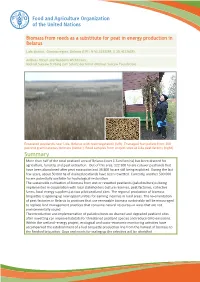
Biomass from reeds as a substitute for peat in energy production in Belarus Lida district, Grodno region, Belarus (LPF: N 53.8283389, E 25.4227639) Andreas Haberl and Wendelin Wichtmann, Michael Succow Stiftung zum Schutz der Natur (Michael Succow Foundation) ©FAO/Andreas Haberl ©FAO/Andreas Excavated peatlands near Lida, Belarus with reed vegetation (left). Envisaged fuel pellets from 100 percent graminaceous biomass (center). Reed samples from project sites at Lida peat factory (right). Summary More than half of the total peatland area of Belarus (over 1.5 million ha) has been drained for agriculture, forestry, and peat extraction. Out of this area, 122 200 ha are cutover peatlands that have been abandoned after peat excavation and 36 800 ha are still being exploited. During the last few years, about 50 000 ha of drained peatlands have been rewetted. Currently, another 500 000 ha are potentially available for hydrological restoration. The sustainable cultivation of biomass from wet or rewetted peatlands (paludiculture) is being implemented in cooperation with local stakeholders (nature reserves, peat factories, collective farms, local energy suppliers) at two pilot peatland sites. The regional production of biomass briquettes is opening up new opportunities for earning incomes in rural areas. The re–orientation of peat factories in Belarus to practices that use renewable biomass sustainably will be encouraged to replace land management practices that consume natural resources in ways that are not environmentally sound. The introduction and implementation of paludicultures on drained and degraded peatland sites after rewetting can improve habitats for threatened peatland species and reduce GHG emissions. Within the wetland–energy project, ecological and socio–economic monitoring activities have accompanied the establishment of a fuel briquette production line from the harvest of biomass to the finished briquettes. -
According to Chaim Weizmann's
Motal Pol. Motol, Bel. Моталь, [We] had our own house – one storey, with seven rooms and a kitchen some acres of land, chickens, two cows, a vegetable garden, a few – מאָטעלע .Yid fruit trees. So we had a supply of milk, and sometimes butter; we had fruit and vegetables in season; we had enough bread – which my mother baked herself; we had fish, and we had meat once a week – on the Sabbath. And there was always plenty of fresh air. Chaim Weizmann, Trial and Error. The Autobiography, Philadelphia 1949 Hebrew greeting ¶ Motal, the into the Slonim Province, then into the birthplace and childhood home of Lithuania Governorate, and from 1801, it Chaim Weizmann, the first president was made part of the Grodno Province of of Israel, is probably the only town in the Russian Empire. Belarus that has a sign with its name in Hebrew posted by the road leading out of The Jews of Motal ¶ In 1562, town. ¶ The earliest written mention of “a Jewish landlord and tax collector from Motal is found in the documents of the Kobryn Favish Yeskovich,” who leased Lithuanian Metrica from 1422, where the right to collect taxes on merchandise, it was referred to as a private estate in complained to Savostian Druzhylovitski the Principality of Pinsk. In 1520, it was that the ruler of the district did not allow the property of Prince Fyodor Ivanovich him to collect taxes in his town of Motal Yaroslavich, who later donated it to the and in the neighbouring villages. This Orthodox Church of the Assumption of document suggests that Jews collecting the Blessed Virgin Mary in Leszno. -

Mass Media in Belarus
Belarusian Association of Journalists (BAJ) MASS MEDIA IN BELARUS 2016 ANNUAL REPORT Minsk 2017 CONTENTS SITUATION IN THE SPHERE OF MASS MEDIA IN 2016 (OVERVIEW) ……………….…………………………………………….....…. 3 CHANGES IN LEGISLATION …………………………………………… 5 VIOLATIONS OF RIGHTS OF MASS MEDIA AND JOURNALISTS, CONFLICTS IN THE SPHERE OF MASS MEDIA ……………………………….................……...……....………………….. 8 Criminal cases ………………..…………………………………………………... 8 Other court cases (except for administrative prosecution) …….. 9 Detention of journalists, judicial administrative prosecution ….. 11 Physical attacks against journalists ……………………........................ 17 Seizure of equipment, damages, confiscation ………….……………. 19 Warnings of the Ministry of Information ………..……………………… 19 Restrictions on the free use of the Web ……………………………….. 20 Violations related to access to information ………….………………. 21 Violations during the elections to the House of Representatives of the National Assembly of the Republic of Belarus …................... 24 Economic policy in mass media field ………….…………………………. 25 Other forms of pressure and violation of rights of journalists and mass media ……………………………………………… 27 Mass-media in Belarus: 2016 SITUATION IN THE SPHERE OF MASS MEDIA IN 2016 (OVERVIEW) The main factor that influenced the media situation in Belarus in 2016 was the elections to the House of Representatives of the National Assembly of the Republic of Belarus. They took place in September 2016 against the backdrop of a worsening economic situation and a complex foreign policy environment. The Belarusian authorities sought to receive a positive assessment of the elections by international bodies, and as the election campaign approached and during its course, direct repression of journalists decreased. However, at the system level, the situation has not changed for the better, and the legislation in the field of media regulation has only become tougher. This shows the situational nature and volatility of some positive changes in the media sector in 2016. -
General Conclusions and Basic Tendencies 1. System of Human Rights Violations
REVIEW-CHRONICLE OF THE HUMAN RIGHTS VIOLATIONS IN BELARUS IN 2003 2 REVIEW-CHRONICLE OF THE HUMAN RIGHTS VIOLATIONS IN BELARUS IN 2003 INTRODUCTION: GENERAL CONCLUSIONS AND BASIC TENDENCIES 1. SYSTEM OF HUMAN RIGHTS VIOLATIONS The year 2003 was marked by deterioration of the human rights situation in Belarus. While the general human rights situation in the country did not improve, in its certain spheres it significantly changed for the worse. Disrespect for and regular violations of the basic constitutional civic rights became an unavoidable and permanent factor of the Belarusian reality. In 2003 the Belarusian authorities did not even hide their intention to maximally limit the freedom of speech, freedom of association, religious freedom, and human rights in general. These intentions of the ruling regime were declared publicly. It was a conscious and open choice of the state bodies constituting one of the strategic elements of their policy. This political process became most visible in formation and forced intrusion of state ideology upon the citizens. Even leaving aside the question of the ideology contents, the very existence of an ideology, compulsory for all citizens of the country, imposed through propaganda media and educational establishments, and fraught with punitive sanctions for any deviation from it, is a phenomenon, incompatible with the fundamental human right to have a personal opinion. Thus, the state policy of the ruling government aims to create ideological grounds for consistent undermining of civic freedoms in Belarus. The new ideology is introduced despite the Constitution of the Republic of Belarus which puts a direct ban on that. -

Review-Chronicle
REVIEW-CHRONICLE OF THE HUMAN RIGHTS VIOLATIONS IN BELARUS IN 1999 2 REVIEW-CHRONICLE OF THE HUMAN RIGHTS VIOLATIONS IN BELARUS IN 1999 INTRODUCTION: GENERAL CONCLUSIONS The year of 1999 was the last year of Alexander Lukashenka’s original mandate. In 1994 having used the machinery of democratic procedure he was elected president of the Republic of Belarus for five years term. But in 1996 A.Lukashenka conducted illegal, non-free and unfair referendum and by it prolonged his mandate to seven years. Constitutional Court’s judges and deputies of the Supreme Soviet that resisted to A.Lukashenka’s dictatorial intentions were dismissed. Thus provisions of the Constitution of the Republic of Belarus were broken. Attempt to conduct presidential elections done by the legitimate Supreme Soviet of the 13th convocation was supported by the most influential opposition parties and movements. But Belarusan authorities did their best to prevent opposition from succeeding in presidential elections and subjected people involved in election campaign to different kinds of repressions. Regime didn’t balk at anything in the struggle with its opponents. Detentions and arrests, persecutions of its organisers and participants, warnings, penalties and imprisonment followed every opposition-organised action… Yet the year of 1999 became a year of mass actions of protest of Belarusan people against a union with Russia imposed by the authorities to the people. In 1999 the OSCE Advisory and Monitoring Group in Belarus made an attempt to arrange talks between Belarusan authorities and opposition. This year will go down to history as a year when some of prominent politicians and fighters against the regime disappeared, when unprecedented number of criminal proceedings against opposition leaders and participants of mass actions of protest was instituted.. -

FEEFHS Journal Volume II 1994
FEEFHS Newsletter of the Federation of East European Family History Societies Val 2,No. 3 July 1994 ISSN 1077-1247, PERSI #EEFN A total of about 75 people registered for the convention, and many others assisted in various capacities. There were a few unexpected problems, of course, but altogether the meetings THE FIRST FEEFHS CONVENTION, provided a valuable service, enough so tbat at the end of MAYby John 14-16, C. Alleman 1994 convention it was tentatively decided that next year we will try to hold two conventions, in Calgary, Alberta, and Cleveland, Our first FEEFHS convention was successfully held as Ohio, in order to help serve the interests of people who have scheduled on May 14-16, 1994, at the Howard Johnson Hotel difficulty coming to Satt Lake City. in Saft Lake City. The program followed the plan published in our last issue of the Newsletter, for the most part, and we will not repeat it here in order to save space. Anyone who desires more information on the suhjects presented in the conference addresses is encouraged to write directly to the speakers at the addresses given there. THANK YOU, CONVENTION by Ed Brandt,SPEAKERS Program Chair The most importanl business of the convention was the installation of permanent officers. Charles M. Hall, Edward Many people attending the FEEFHS convention commented R. Brandt, and John D. Movius had been elected and were favorably on the quality of our convention speakers and their installed as president, Ist vice president, and 2nd vice presentations. I have heard from quite a few who could not president, respectively.