SUPERMAN: the AUCTION 97 Auction December 19, 2017 at 2:30 Pm Pst
Total Page:16
File Type:pdf, Size:1020Kb
Load more
Recommended publications
-
Myth, Metatext, Continuity and Cataclysm in Dc Comics’ Crisis on Infinite Earths
WORLDS WILL LIVE, WORLDS WILL DIE: MYTH, METATEXT, CONTINUITY AND CATACLYSM IN DC COMICS’ CRISIS ON INFINITE EARTHS Adam C. Murdough A Thesis Submitted to the Graduate College of Bowling Green State University in partial fulfillment of the requirements for the degree of MASTER OF ARTS August 2006 Committee: Angela Nelson, Advisor Marilyn Motz Jeremy Wallach ii ABSTRACT Angela Nelson, Advisor In 1985-86, DC Comics launched an extensive campaign to revamp and revise its most important superhero characters for a new era. In many cases, this involved streamlining, retouching, or completely overhauling the characters’ fictional back-stories, while similarly renovating the shared fictional context in which their adventures take place, “the DC Universe.” To accomplish this act of revisionist history, DC resorted to a text-based performative gesture, Crisis on Infinite Earths. This thesis analyzes the impact of this singular text and the phenomena it inspired on the comic-book industry and the DC Comics fan community. The first chapter explains the nature and importance of the convention of “continuity” (i.e., intertextual diegetic storytelling, unfolding progressively over time) in superhero comics, identifying superhero fans’ attachment to continuity as a source of reading pleasure and cultural expressivity as the key factor informing the creation of the Crisis on Infinite Earths text. The second chapter consists of an eschatological reading of the text itself, in which it is argued that Crisis on Infinite Earths combines self-reflexive metafiction with the ideologically inflected symbolic language of apocalypse myth to provide DC Comics fans with a textual "rite of transition," to win their acceptance for DC’s mid-1980s project of self- rehistoricization and renewal. -

Superman's Girl Friend, Lois Lane and the Represe
Research Space Journal article ‘Superman believes that a wife’s place is in the home’: Superman’s girl friend, Lois Lane and the representation of women Goodrum, M. Canterbury Christ Church University’s repository of research outputs http://create.canterbury.ac.uk Please cite this publication as follows: Goodrum, M. (2018) ‘Superman believes that a wife’s place is in the home’: Superman’s girl friend, Lois Lane and the representation of women. Gender & History, 30 (2). ISSN 1468-0424. Link to official URL (if available): https://doi.org/10.1111/1468-0424.12361 This version is made available in accordance with publishers’ policies. All material made available by CReaTE is protected by intellectual property law, including copyright law. Any use made of the contents should comply with the relevant law. Contact: create.library@canterbury.ac.uk ‘Superman believes that a wife’s place is in the home’: Superman’s Girl Friend, Lois Lane and the representation of women Michael Goodrum Superman’s Girl Friend, Lois Lane ran from 1958-1974 and stands as a microcosm of contemporary debates about women and their place in American society. The title itself suggests many of the topics about which women were concerned, or at least were supposed to concern them: the mediation of identity through heterosexual partnership, the pressure to marry and the simultaneous emphasis placed on individual achievement. Concerns about marriage and Lois’ ability to enter into it routinely provide the sole narrative dynamic for stories and Superman engages in different methods of avoiding the matrimonial schemes devised by Lois or her main romantic rival, Lana Lang. -
Crossmedia Adaptation and the Development of Continuity in the Dc Animated Universe
“INFINITE EARTHS”: CROSSMEDIA ADAPTATION AND THE DEVELOPMENT OF CONTINUITY IN THE DC ANIMATED UNIVERSE Alex Nader A Thesis Submitted to the Graduate College of Bowling Green State University in partial fulfillment of the requirements for the degree of MASTER OF ARTS May 2015 Committee: Jeff Brown, Advisor Becca Cragin © 2015 Alexander Nader All Rights Reserved iii ABSTRACT Jeff Brown, Advisor This thesis examines the process of adapting comic book properties into other visual media. I focus on the DC Animated Universe, the popular adaptation of DC Comics characters and concepts into all-ages programming. This adapted universe started with Batman: The Animated Series and comprised several shows on multiple networks, all of which fit into a shared universe based on their comic book counterparts. The adaptation of these properties is heavily reliant to intertextuality across DC Comics media. The shared universe developed within the television medium acted as an early example of comic book media adapting the idea of shared universes, a process that has been replicated with extreme financial success by DC and Marvel (in various stages of fruition). I address the process of adapting DC Comics properties in television, dividing it into “strict” or “loose” adaptations, as well as derivative adaptations that add new material to the comic book canon. This process was initially slow, exploding after the first series (Batman: The Animated Series) changed networks and Saturday morning cartoons flourished, allowing for more opportunities for producers to create content. References, crossover episodes, and the later series Justice League Unlimited allowed producers to utilize this shared universe to develop otherwise impossible adaptations that often became lasting additions to DC Comics publishing. -

Wonder Woman & Associates
ICONS © 2010, 2014 Steve Kenson; "1 used without permission Wonder Woman & Associates Here are some canonical Wonder Woman characters in ICONS. Conversation welcome, though I don’t promise to follow your suggestions. This is the Troia version of Donna Troy; goodness knows there have been others.! Bracers are done as Damage Resistance rather than Reflection because the latter requires a roll and they rarely miss with the bracers. More obscure abilities (like talking to animals) are left as stunts.! Wonder Woman, Donna Troy, Ares, and Giganta are good candidates for Innate Resistance as outlined in ICONS A-Z.! Acknowledgements All of these characters were created using the DC Adventures books as guides and sometimes I took the complications and turned them into qualities. My thanks to you people. I do not have permission to use these characters, but I acknowledge Warner Brothers/ DC as the owners of the copyright, and do not intend to infringe. ! Artwork is used without permission. I will give attribution if possible. Email corrections to jhmcmullen@yahoo.com.! • Wonder Woman is from Francis Bernardo’s DeviantArt page (http://kyomusha.deviantart.com).! • Wonder Girl is from the character sheet for Young Justice, so I believe it’s owned by Warner Brothers. ! • Troia is from Return of Donna Troy #4, drawn by Phil Jimenez, so owned by Warner Brothers/DC.! • Ares is by an unknown artist, but it looks like it might have been taken from the comic.! • Cheetah is in the style of Justice League Unlimited, so it might be owned by Warner Brothers. ! • Circe is drawn by Brian Hollingsworth on DeviantArt (http://beeboynyc.deviantart.com) but coloured by Dev20W (http:// dev20w.deviantart.com)! • I got Doctor Psycho from the Villains Wikia, but I don’t know who drew it. -
AKA Clark Kent) Middle Name Is Joseph
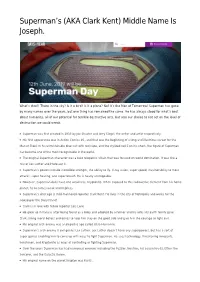
Superman’s (AKA Clark Kent) Middle Name Is Joseph. What’s that?! There in the sky? Is it a bird? Is it a plane? No! It’s the Man of Tomorrow! Superman has gone by many names over the years, but one thing has remained the same. He has always stood for what’s best about humanity, all of our potential for terrible destructive acts, but also our choice to not act on the level of destruction we could wreak. Superman was first created in 1933 by Joe Shuster and Jerry Siegel, the writer and artist respectively. His first appearance was in Action Comics #1, and that was the beginning of a long and illustrious career for the Man of Steel. In his unmistakable blue suit with red cape, and the stylized red S on his chest, the figure of Superman has become one of the most recognizable in the world. The original Superman character was a bald telepathic villain that was focused on world domination. It was like a mix of Lex Luthor and Professor X. Superman’s powers include incredible strength, the ability to fly. X-ray vision, super speed, invulnerability to most attacks, super hearing, and super breath. He is nearly unstoppable. However, Superman does have one weakness, Kryptonite. When exposed to this radioactive element from his home planet, he becomes weak and helpless. Superman’s alter ego is mild-mannered reporter Clark Kent. He lives in the city of Metropolis and works for the newspaper the Daily Planet. Clark is in love with fellow reporter Lois Lane. -

Arthur Suydam: “Heroes Are What We Aspire to Be”
Ro yThomas’’ BXa-Ttrta ilor od usinary Comiics Fanziine DARK NIGHTS & STEEL $6.95 IN THE GOLDEN & SILVER AGES In the USA No. 59 June 2006 SUYDAM • ADAMS • MOLDOFF SIEGEL • PLASTINO PLUS: MANNING • MATERA & MORE!!! Batman TM & ©2006 DC Comics Vol. 3, No. 59 / June 2006 ™ Editor Roy Thomas Associate Editors Bill Schelly Jim Amash Design & Layout Christopher Day Consulting Editor John Morrow FCA Editor P.C. Hamerlinck Comic Crypt Editor Michael T. Gilbert Editors Emeritus Jerry Bails (founder) Contents Ronn Foss, Biljo White, Mike Friedrich Writer/Editorial: Dark Nights & Steel . 2 Production Assistant Arthur Suydam: “Heroes Are What We Aspire To Be” . 3 Eric Nolen-Weathington Interview with the artist of Cholly and Flytrap and Marvel Zombies covers, by Renee Witterstaetter. Cover Painting “Maybe I Was Just Loyal” . 14 Arthur Suydam 1950s/60s Batman artist Shelly Moldoff tells Shel Dorf about Bob Kane & other phenomena. And Special Thanks to: “My Attitude Was, They’re Not Bosses, They’re Editors” . 25 Neal Adams Richard Martines Golden/Silver Age Superman artist Al Plastino talks to Jim Kealy & Eddy Zeno about his long Heidi Amash Fran Matera and illustrious career. Michael Ambrose Sheldon Moldoff Bill Bailey Frank Motler Jerry Siegel’s European Comics! . 36 Tim Barnes Brian K. Morris When Superman’s co-creator fought for truth, justice, and the European way—by Alberto Becattini. Dennis Beaulieu Karl Nelson Alberto Becattini Jerry Ordway “If You Can’t Improve Something 200%, Then Go With The Thing John Benson Jake Oster That You Have” . 40 Dominic Bongo Joe Petrilak Modern legend Neal Adams on the late 1960s at DC Comics. -
ALEX ROSS' Unrealized
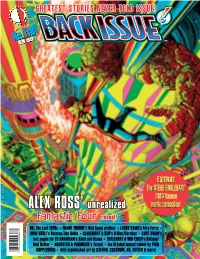
Fantastic Four TM & © Marvel Characters, Inc. All Rights Reserved. No.118 February 2020 $9.95 1 82658 00387 6 ALEX ROSS’ DC: TheLost1970s•FRANK THORNE’sRedSonjaprelims•LARRYHAMA’sFury Force• MIKE GRELL’sBatman/Jon Sable•CLAREMONT&SIM’sX-Men/CerebusCURT SWAN’s Mad Hatter• AUGUSTYN&PAROBECK’s Target•theill-fatedImpact rebootbyPAUL lost pagesfor EDHANNIGAN’sSkulland Bones•ENGLEHART&VON EEDEN’sBatman/ GREATEST STORIESNEVERTOLDISSUE! KUPPERBERG •with unpublished artbyCALNAN, COCKRUM, HA,NETZER &more! Fantastic Four Four Fantastic unrealized reboot! ™ Volume 1, Number 118 February 2020 EDITOR-IN-CHIEF Michael Eury Comics’ Bronze Age and Beyond! PUBLISHER John Morrow DESIGNER Rich Fowlks COVER ARTIST Alex Ross COVER DESIGNER Michael Kronenberg PROOFREADER Rob Smentek SPECIAL THANKS Brian Augustyn Alex Ross Mike W. Barr Jim Shooter Dewey Cassell Dave Sim Ed Catto Jim Simon GREATEST STORIES NEVER TOLD: Alex Ross and the Fantastic Four That Wasn’t . 2 Chris Claremont Anthony Snyder An exclusive interview with the comics visionary about his pop art Kirby homage Comic Book Artist Bryan Stroud Steve Englehart Roy Thomas ART GALLERY: Marvel Goes Day-Glo. 12 Tim Finn Frank Thorne Inspired by our cover feature, a collection of posters from the House of Psychedelic Ideas Paul Fricke J. C. Vaughn Mike Gold Trevor Von Eeden GREATEST STORIES NEVER TOLD: The “Lost” DC Stories of the 1970s . 15 Grand Comics John Wells From All-Out War to Zany, DC’s line was in a state of flux throughout the decade Database Mike Grell ROUGH STUFF: Unseen Sonja . 31 Larry Hama The Red Sonja prelims of Frank Thorne Ed Hannigan Jack C. Harris GREATEST STORIES NEVER TOLD: Cancelled Crossover Cavalcade . -

Why No Wonder Woman?
Why No Wonder Woman? A REPORT ON THE HISTORY OF WONDER WOMAN AND A CALL TO ACTION!! Created for Wonder Woman Fans Everywhere Introduction by Jacki Zehner with Report Written by Laura Moore April 15th, 2013 Wonder Woman - p. 2 April 15th, 2013 AN INTRODUCTION AND FRAMING “The destiny of the world is determined less by battles that are lost and won than by the stories it loves and believes in” – Harold Goddard. I believe in the story of Wonder Woman. I always have. Not the literal baby being made from clay story, but the metaphorical one. I believe in a story where a woman is the hero and not the victim. I believe in a story where a woman is strong and not weak. Where a woman can fall in love with a man, but she doesnʼt need a man. Where a woman can stand on her own two feet. And above all else, I believe in a story where a woman has superpowers that she uses to help others, and yes, I believe that a woman can help save the world. “Wonder Woman was created as a distinctly feminist role model whose mission was to bring the Amazon ideals of love, peace, and sexual equality to ʻa world torn by the hatred of men.ʼ”1 While the story of Wonder Woman began back in 1941, I did not discover her until much later, and my introduction didnʼt come at the hands of comic books. Instead, when I was a little girl I used to watch the television show starring Lynda Carter, and the animated television series, Super Friends. -

Department of Political Science Chair of Gender Politics Wonder Woman
Department of Political Science Chair of Gender Politics Wonder Woman and Captain Marvel as Representation of Women in Media Sara Mecatti Prof. Emiliana De Blasio Matr. 082252 SUPERVISOR CANDIDATE Academic Year 2018/2019 1 Index 1. History of Comic Books and Feminism 1.1 The Golden Age and the First Feminist Wave………………………………………………...…...3 1.2 The Early Feminist Second Wave and the Silver Age of Comic Books…………………………....5 1.3 Late Feminist Second Wave and the Bronze Age of Comic Books….……………………………. 9 1.4 The Third and Fourth Feminist Waves and the Modern Age of Comic Books…………...………11 2. Analysis of the Changes in Women’s Representation throughout the Ages of Comic Books…..........................................................................................................................................................15 2.1. Main Measures of Women’s Representation in Media………………………………………….15 2.2. Changing Gender Roles in Marvel Comic Books and Society from the Silver Age to the Modern Age……………………………………………………………………………………………………17 2.3. Letter Columns in DC Comics as a Measure of Female Representation………………………..23 2.3.1 DC Comics Letter Columns from 1960 to 1969………………………………………...26 2.3.2. Letter Columns from 1979 to 1979 ……………………………………………………27 2.3.3. Letter Columns from 1980 to 1989…………………………………………………….28 2.3.4. Letter Columns from 19090 to 1999…………………………………………………...29 2.4 Final Data Regarding Levels of Gender Equality in Comic Books………………………………31 3. Analyzing and Comparing Wonder Woman (2017) and Captain Marvel (2019) in a Framework of Media Representation of Female Superheroes…………………………………….33 3.1 Introduction…………………………….…………………………………………………………33 3.2. Wonder Woman…………………………………………………………………………………..34 3.2.1. Movie Summary………………………………………………………………………...34 3.2.2.Analysis of the Movie Based on the Seven Categories by Katherine J. -

Biblical Interpretation in the Age of Superheroes by Nicholaus Pumphrey
Biblical Interpretation in the Age of Superheroes By Nicholaus Pumphrey In 1938 Superman literally jumped off the pages of a comic book and into American culture. The world’s strongest and soon to be most famous superhero was created within the context of a nation suffering from the Great Depression and on the verge of entering a global war. How does this super-being impact American culture and does he influence how we read the Bible? Action Comics No. 1, 1938. Within five years, over 70 million people would be reading comic books about Superman or related to him. Superman’s debut in Action Comics #1 was followed by his appearance on radio, in cartoons, and eventually in movies and on television. While comic books have had ups and downs in sales, the superhero related medium has had an undeniable influence on Americans, child and adult alike. The concept of hero has shifted from a larger-than-life, flawed demi-god to a sci-fi, costumed character that can do no wrong. But biblical undertones remain inescapable. Scholars often point to his creators, Jerry Siegel and Joe Shuster, and their Jewish background as a sign that the Bible directly influenced Superman’s creation, and then influenced the readers. Superman’s origin narrative depicts parents of a dying civilization sending their child in a spaceship (a futuristic reed basket) only to grow up and become a savior of another world. The child is also uniquely strong and only stoppable by a single weakness. Siegel himself noted that Samson and other biblical figures played a prominent role in Superman’s development. -

Superman Ebook, Epub
SUPERMAN PDF, EPUB, EBOOK Jerry Siegel | 144 pages | 30 Jun 2009 | DC Comics | 9781401222581 | English | New York, NY, United States Superman PDF Book The next event occurs when Superman travels to Mars to help a group of astronauts battle Metalek, an alien machine bent on recreating its home world. He was voiced in all the incarnations of the Super Friends by Danny Dark. He is happily married with kids and good relations with everyone but his father, Jor-EL. American photographer Richard Avedon was best known for his work in the fashion world and for his minimalist, large-scale character-revealing portraits. As an adult, he moves to the bustling City of Tomorrow, Metropolis, becoming a field reporter for the Daily Planet newspaper, and donning the identity of Superman. Superwoman Earth 11 Justice Guild. James Denton All-Star Superman Superman then became accepted as a hero in both Metropolis and the world over. Raised by kindly farmers Jonathan and Martha Kent, young Clark discovers the source of his superhuman powers and moves to Metropolis to fight evil. Superman Earth -1 The Devastator. The next few days are not easy for Clark, as he is fired from the Daily Planet by an angry Perry, who felt betrayed that Clark kept such an important secret from him. Golden Age Superman is designated as an Earth-2 inhabitant. You must be a registered user to use the IMDb rating plugin. Filming on the series began in the fall. He tells Atom he is welcome to stay while Atom searches for the people he loves. -

AL PLASTINOPLASTINO His Era, Plastino Was the Last Surviving Penciler/Inker of Superman Comic Books
LAST SUPERMAN STANDING: THE STANDING: SUPERMAN LAST LAST SUPERMAN STANDING Alfred John Plastino might not be as famous as the creators of Nancy, Joe Palooka, Batman, and other classic daily and THE STORY Sunday newspaper strips, but he worked on many of them. And of ALAL PLASTINOPLASTINO his era, Plastino was the last surviving penciler/inker of Superman comic books. In these pages, the artist remembers both his struggles and triumphs in the world of cartooning and beyond. A near-century of history and insights shared by Al, his family, and contemporaries Allen Bellman, Nick Cardy, Joe Giella, and Carmine Infantino— along with successors Jon Bogdanove, Jerry Ordway, and Mark Waid —paint a layered portrait of Plastino’s life and career. From the author and designer team of Curt Swan: A Life In Comics. PLASTINO AL Foreword by Paul Levitz. STORY EDDY ZENO EDDY An illustrated biography EDDY ZENO Plastino cover.indd 1 8/19/14 2:26 PM LAST SUPERMAN STANDING THE STORY AL PLASTINO EDDY ZENO Plastino.indd 1 9/3/14 1:52 PM Contents Foreword By Paul Levitz .................................................................................................. 4 Introduction ...................................................................................................................... 6 Globs Of Clay, Flecks Of Paint ...................................................................................... 8 Harry “A” ............................................................................................................................ 16 The War