South African Crime Quarterly 57
Total Page:16
File Type:pdf, Size:1020Kb
Load more
Recommended publications
-

South·Africa in Transition
POLITICS OF HOPE AND TERROR: South ·Africa in Transition Report on Violence in South Africa by an American Friends Service Committee Study Team November 1992 The American Friends Service Committee's concern over Southern Africa has grown out of over 60 years of relationships since the first visit by a representative of the organization. In 1982 the AFSC Board of Directors approved the release of a full length book, Challenge and Hope, as a statement of its views on South Africa. Since 1977 the AFSC has had a national Southern Africa educational program in its Peace Education Division. AMERICAN FRIENDS SERVICE COMMITTEE 1501 Cherry Street Philadelphia, PA 19102 (215) 241-7000 AFSC REGIONAL OFFICES: Southeastern Region, Atlanta, Georgia 30303, 92 Piedmont Avenue, NE; Middle Atlantic Region, Baltimore, Maryland 21212, 4806 York Road; New England Region, Cambridge, Massachusetts 02140, 2161 Massachusetts Avenue; Great Lakes Region, Chicago, Illinois 60605, 59 E. Van Buren Street, Suite 1400; North Central Region, Des Moines, Iowa 50312, 4211 Grand Avenue; New York Metropolitan Region, New York, New York 10003, 15 Rutherford Place; Pacific Southwest Region, Pasadena, California 91103, 980 N. Fair Oaks Avenue; Pacific Mountain Region, San Francisco, California 94121,2160 Lake Street; Pacific Northwest Region, Seattle, Washington 98105, 814 N.E. 40th Street. CONTENTS II THE AFSC DELEGATION 1 PREFACE III POLITICS OF HOPE AND TERROR: South Africa in Transition 1 THE BASIC VIOLENCE 2 ANALYZING THE VIOLENCE 5 THE HIDDEN HAND 7 RETALIATION 9 POLICE INVESTIGATIONS 11 LESSONS FROM THE BOIPATONG MASSACRE 12 HOMELAND VIOLENCE IN CISKEI AND KWAZULU 13 HOMELAND LEADERS BUTHELEZI AND GQOZO 16 CONCLUSION 19 RECOMMENDATIONS 20 ACRONYMS 21 TEAM INTERVIEWS AND MEETINGS 22 THE AFSC DELEGATION TO SOUTH AFRICA The American Friends Service Committee's Board of Directors approved a proposal in June 1992 for a delegation to visit South Africa to study the escalating violence there. -

Opposition Party Mobilization in South Africa's Dominant
UNIVERSITY OF CALIFORNIA Los Angeles Eroding Dominance from Below: Opposition Party Mobilization in South Africa’s Dominant Party System A dissertation submitted in partial satisfaction of the requirements for the degree Doctor of Philosophy in Political Science by Safia Abukar Farole 2019 © Copyright by Safia Abukar Farole 2019 ABSTRACT OF THE DISSERTATION Eroding Dominance from Below: Opposition Party Mobilization in South Africa’s Dominant Party System by Safia Abukar Farole Doctor of Philosophy in Political Science University of California, Los Angeles, 2019 Professor Kathleen Bawn, Chair In countries ruled by a single party for a long period of time, how does political opposition to the ruling party grow? In this dissertation, I study the growth in support for the Democratic Alliance (DA) party, which is the largest opposition party in South Africa. South Africa is a case of democratic dominant party rule, a party system in which fair but uncompetitive elections are held. I argue that opposition party growth in dominant party systems is explained by the strategies that opposition parties adopt in local government and the factors that shape political competition in local politics. I argue that opposition parties can use time spent in local government to expand beyond their base by delivering services effectively and outperforming the ruling party. I also argue that performance in subnational political office helps opposition parties build a reputation for good governance, which is appealing to ruling party ii. supporters who are looking for an alternative. Finally, I argue that opposition parties use candidate nominations for local elections as a means to appeal to constituents that are vital to the ruling party’s coalition. -

Dozens More Held in Turkey Crackdown
INTERNATIONAL SATURDAY, AUGUST 20, 2016 S Africa opposition takes control of capital JOHANNESBURG: South Africa’s ruling ANC minority rule in 1994 that Pretoria is not head- ‘No More Suffering’ Msimanga started off in the DA’s marketing lost control of the capital Pretoria for the first ed by a mayor from the African National Msimanga vowed to end the patronage department, working his way up over the years. time since the end of apartheid two decades Congress (ANC). The DA topped the Aug 3 that he said had left the capital in the red. In an interview with local Afrikaans-language ago, as an opposition councillor was elected municipal election in the capital, taking 93 of “This city is technically bankrupt right now daily Beeld, Msimanga said when he never mayor yesterday. Solly Msimanga, 36, of the 214 council seats to the ANC’s 89. Nationally, because of greediness and because of peo- dreamed of becoming a mayor as he was liberal centre-right Democratic Alliance (DA), the party of Nelson Mandela suffered its worst ple who decided to put themselves first,” he growing up in Pretoria’s Atteridgeville town- was elected unopposed at a city council result in 22 years in the municipal vote, garner- said in a speech repeatedly drowned out by ship, one of the hotbeds of pre-election riots. meeting following nationwide municipal ing less than 54 percent of ballots cast - an chants and singing from ANC councilors. “No “The dream of becoming mayor was as far- ballots earlier this month. ANC councilors, eight percentage point drop from the last local more will our people suffer under the hands fetched as that of becoming an astronaut, so I aggrieved at their loss of power, heckled poll in 2011. -
National Assembly Written Reply
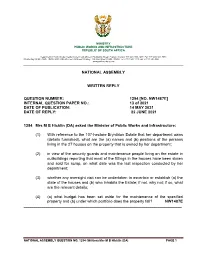
MINISTRY PUBLIC WORKS AND INFRASTRUCTURE REPUBLIC OF SOUTH AFRICA Department of Public Works l Central Government Offices l 256 Madiba Street l Pretoria l Contact: +27 (0)12 406 1627 l Fax: +27 (0)12 323 7573 Private Bag X9155 l CAPE TOWN, 8001 l RSA 4th Floor Parliament Building l 120 Plain Street l CAPE TOWN l Tel: +27 21 402 2219 Fax: +27 21 462 4592 www.publicworks.gov.za NATIONAL ASSEMBLY WRITTEN REPLY QUESTION NUMBER: 1294 [NO. NW1487E] INTERNAL QUESTION PAPER NO.: 13 of 2021 DATE OF PUBLICATION: 14 MAY 2021 DATE OF REPLY: 22 JUNE 2021 1294 Mrs M B Hicklin (DA) asked the Minister of Public Works and Infrastructure: (1) With reference to the 107-hectare Bryntirion Estate that her department owns (details furnished), what are the (a) names and (b) positions of the persons living in the 27 houses on the property that is owned by her department; (2) in view of the security guards and maintenance people living on the estate in outbuildings reporting that most of the fittings in the houses have been stolen and sold for scrap, on what date was the last inspection conducted by her department; (3) whether any oversight visit can be undertaken to ascertain or establish (a) the state of the houses and (b) who inhabits the Estate; if not, why not; if so, what are the relevant details; (4) (a) what budget has been set aside for the maintenance of the specified property and (b) under which portfolio does the property fall? NW1487E _______________________________________________________________________________ NATIONAL ASSEMBLY QUESTION NO. -

The Role of Cities in the Foreign Policy of Emerging Powers: the Cases of Bogotá, Colombia and Johannesburg, South Africa
THE ROLE OF CITIES IN THE FOREIGN POLICY OF EMERGING POWERS: THE CASES OF BOGOTÁ, COLOMBIA AND JOHANNESBURG, SOUTH AFRICA Town JERÓNIMO DELGADO CAICEDOCape of THESIS PRESENTEDUniversity FOR THE DEGREE OF DOCTOR OF PHILOSOPHY IN THE DEPARTMENT OF ENVIRONMENTAL AND GEOGRAPHICAL SCIENCE, FACULTY OF HUMANITIES, UNIVERSITY OF CAPE TOWN DECEMBER, 2017 The copyright of this thesis vests in the author. No quotation from it or information derived from it is to be published without full acknowledgementTown of the source. The thesis is to be used for private study or non- commercial research purposes only. Cape Published by the University ofof Cape Town (UCT) in terms of the non-exclusive license granted to UCT by the author. University DECLARATION I, Jerónimo Delgado Caicedo, declare that this thesis is my own unaided work. It is being submitted to the Degree of Doctor of Philosophy to the University of Cape Town. It has not been submitted before for any degree or examination to any other University. ………………………………… 11 December, 2017 ii ABSTRACT Cities are increasingly important actors in the current International System. Cities fall under the jurisdiction of States where they play a fundamental role in the making and consolidation of emerging powers. In today’s State-centred International System, cities are underexamined in the field of foreign policy, a domain that is exclusively that of national governments. Using the cases of Colombia (Bogotá) and South Africa (Johannesburg), this thesis draws from multilingual sources to examine the role of cities in the foreign policy of emerging powers of the Global South. An interdisciplinary approach indicates that, by drawing together debates across International Relations and Urban Studies literature, there is little to no place for the conceptual and operational cross pollination necessary to engage the increasing importance of cities in the emerging powers of the Global South. -

CALD Executive Mission to South Africa
CALD Executive Mission to South Africa Council of Asian Liberals and Democrats – Democratic Alliance Forging South-South Cooperation Among Political Parties 29 September - 5 October 2018 Saturday, 29 September 2018 Travel from Asia to Johannesburg (OR Tambo International Airport) Sunday, 30 September 2018 Variable Arrival and check-in at hotel Protea Hotel Marriott Johannesburg Wanderers Cnr. Corlett Drive & Rudd Road, Illovo 2196 South Africa T: +27 11 770 5500 F: +27 11 770 5555 E: phwand.res@proteahotels.com W: protea.marriott.com 13h30 Travel to Apartheid Museum 14h00 – 17h00 Apartheid Museum Visit 18h00 – 19h15 Welcome, introductions and programme overview With William Clayton and Kati Georgousaki With DA International Office Coordinator & FNF Programme Officer 19h15 – 21h00 Opening dinner Solly Msimanga, DA Gauteng Premier Candidate and With Executive Mayor of Tshwane 1 Monday, 1 October 2018 08h00 – 09h00 Breakfast and check-out of hotel 09h00 – 09h45 Travel to DA Campaign Headquarters Nkululeko House, Bruma, Johannesburg 09h45 – 10h15 Welcome and Introductions Nkululeko House, Bruma, Johannesburg 10h15 – 10h45 Tour of DA Campaign Headquarters Nkululeko House, Bruma, Johannesburg 10h45 – 11h30 The By-Elections Office With Gary van Wyk, DA Executive Director: By Elections and Political Activity Nkululeko House, Bruma, Johannesburg 11h30 – 12h00 Finger Food Snacks 12h00 – 12h45 Travel to Constitution Hill 12h45 – 15h00 Constitution Hill Visit 15h00 – 16h00 Travel to the Airport 16h00 – 17h00 Check-in 18h00 – 20h00 Flight to Cape -
12-Politcsweb-Going-Off-The-Rails
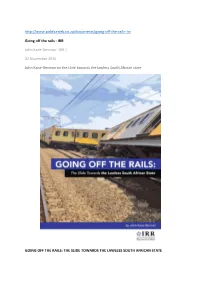
http://www.politicsweb.co.za/documents/going-off-the-rails--irr Going off the rails - IRR John Kane-Berman - IRR | 02 November 2016 John Kane-Berman on the slide towards the lawless South African state GOING OFF THE RAILS: THE SLIDE TOWARDS THE LAWLESS SOUTH AFRICAN STATE SETTING THE SCENE South Africa is widely recognised as a lawless country. It is also a country run by a government which has itself become increasingly lawless. This is so despite all the commitments to legality set out in the Constitution. Not only is the post–apartheid South Africa founded upon the principle of legality, but courts whose independence is guaranteed are vested with the power to ensure that these principles are upheld. Prosecuting authorities are enjoined to exercise their functions “without fear, favour, or prejudice”. The same duty is laid upon other institutions established by the Constitution, among them the public protector and the auditor general. Everyone is endowed with the right to “equal protection and benefit of the law”. We are all also entitled to “administrative action that is lawful, reasonable, and procedurally fair”. Unlike the old South Africa – no doubt because of it – the new Rechtsstaat was one where the rule of law would be supreme, power would be limited, and the courts would have the final say. This edifice, and these ideals, are under threat. Lawlessness on the part of the state and those who run it is on the increase. The culprits run from the president down to clerks of the court, from directors general to immigration officials, from municipal managers to prison warders, from police generals to police constables, from cabinet ministers to petty bureaucrats. -

Asmal Fatima 2015.Pdf (1.232Mb)
Demystifying the Muslimah: changing subjectivities, civic engagement and public participation of Muslim women in contemporary South Africa Fatima Asmal A dissertation submitted in fulfilment of the requirements for the degree of Master of Social Sciences (Masters) in the Programme of Historical Studies, School of Social Sciences, College of Humanities, University of KwaZulu-Natal, 2015 1 I, Fatima Asmal (941300984), hereby declare that this is my own work and that all sources that I have used have been acknowledged and referenced. No part of the dissertation has been submitted for any other degree. Any views expressed in the dissertation are those of the author and are in no way representative of those of the University of KwaZulu-Natal. The dissertation has not been presented to any other University for examination, either in the Republic of South Africa, or overseas. Signature: Date: 2 ABSTRACT Demystifying the Muslimah: changing subjectivities, civic engagement and public participation of Muslim women in contemporary South Africa This study interrogates the validity of generalisations about Muslim women. While Islam is undoubtedly important in the lives of most practising Muslim women, rather than regarding their actions and behaviours as governed by Islamic law, the study seeks to historicise their experiences through a life history approach of five women engaged in the civic life of their communities (however widely this may be defined) and in public participation in various ways. Using oral history as a methodology, it investigates what drew these women to civic participation; the nature of their participation in terms of the organisations they are members of and the activities they are involved in; the stimulus for civic engagement and public participation and their achievements in this regard as well as the impact of participation on their identities and subjectivities. -

MEDIA RELEASE PSA Calls for Decisive Actions by Newly-Appointed Ministers
MEDIA RELEASE PSA calls for decisive actions by newly-appointed Ministers DATE 31 May 2019 EMBARGO None ENQUIRIES communication@psa.co.za The Public Servants Association (PSA) welcomes the appointments of Cabinet Ministers by President Cyril Ramaphosa, sworn in at the Union Buildings on 30 May 2019. The non-politically affiliated Union, representing over 240 000 public-sector workers, is looking forward to progressive engagements with the leadership for a better Public Service. The Union, however, raised concerns about the operations of several key departments and indicated that it will engage with the relevant Ministers. The Department of Public Service and Administration is key to the well-being of the Public Service. The relationship between labour and the Ministry was starting to take positive form and with the appointment of Mr Senzo Mchunu as the new Minister, the PSA is looking forwards to building on the progress. The PSA is the majority Union at the Department of Home Affairs, another key department in service delivery. The PSA has experienced a hostile approach from the Department’s leadership in the past, which led to cases being heard in the Constitutional Court where the PSA was victorious in advancing workers’ rights. The PSA will be engaging with the new Minister, Dr Aaron Motsoaledi, to address outstanding matters. Health and safety continue to be a major issue in many government buildings with many not meeting the requirements of Occupational Health and Safety Act and posing danger to employees and the public. The PSA is an advocate for safe working conditions and unfortunately the employer has not been forthcoming in resolving the issues, regardless of judgements that found it guilty of not following procedure. -

National List
NATIONAL LIST 1 Otta Helen Maree 2 Mmoba Solomon Seshoka 3 Lindiwe Desire Mazibuko 4 Suhla James Masango 5 Joseph Job Mcgluwa 6 Andrew Grant Whitfield 7 Semakaleng Patricia Kopane 8 Gregory Allen Grootboom 9 Dion Travers George 10 David John Maynier 11 Desiree van der Walt 12 Gregory Rudy Krumbock 13 Tarnia Elena Baker 14 Leonard Jones Basson 15 Zisiwe Beauty Nosimo Balindlela 16 Annelie Lotriet 17 Dirk Jan Stubbe 18 Anchen Margaretha Dreyer 19 Phumzile Thelma Van Damme 20 Stevens Mokgalapa 21 Michael John Cardo 22 Stanford Makashule Gana 23 Mohammed Haniff Hoosen 24 Gavin Richard Davis 25 Kevin John Mileham 26 Natasha Wendy Anita Michael 27 Denise Robinson 28 Werner Horn 29 Ian Michael Ollis 30 Johanna Fredrika Terblanche 31 Hildegard Sonja Boshoff 32 Lance William Greyling 33 Glynnis Breytenbach 34 Robert Alfred Lees 35 Derrick America 36 James Robert Bourne Lorimer 37 Terri Stander 38 Evelyn Rayne Wilson 39 James Vos 40 Thomas Charles Ravenscroft Walters 41 Veronica van Dyk 42 Cameron MacKenzie 43 Tandeka Gqada 44 Dianne Kohler 45 Darren Bergman 46 Zelda Jongbloed 47 Annette Steyn 48 Sejamotopo Charles Motau 49 David Christie Ross 50 Archibold Mzuvukile Figlan 51 Michael Waters 52 John Henry Steenhuisen 53 Choloane David Matsepe 54 Santosh Vinita Kalyan 55 Hendrik Christiaan Crafford Kruger 56 Johanna Steenkamp 57 Annette Theresa Lovemore 58 Nomsa Innocencia Tarabella Marchesi 59 Karen De Kock 60 Heinrich Cyril Volmink 61 Michael Bagraim 62 Gordon Mackay 63 Erik Johannes Marais 64 Marius Helenis Redelinghuys 65 Lungiswa Veronica James -

South African Crime Quarterly, No 48
CQ Cover June 2014 7/10/14 3:27 PM Page 1 Reviewing 20 years of criminal justice in South Africa South A f r i c a n CRIME QUA RT E R LY No. 48 | June 2014 Previous issues Stacy Moreland analyses judgements in rape ISS Pretoria cases in the We s t e r n Cape, finding that Block C, Brooklyn Court p a t r i a rchal notions of gender still inform 361 Veale Street judgements in rape case. Heidi Barnes writes a New Muckleneuk case note on the Constitutional Court case Pretoria, South Africa F v Minister of Safety and Security. Alexander Tel: +27 12 346 9500 Hiropoulos and Jeremy Porter demonstrate how Fax:+27 12 460 0998 Geographic Information Systems can be used, pretoria@issafrica.org along with crime pattern theory, to analyse police crime data. Geoff Harris, Crispin Hemson ISS Addis Ababa & Sylvia Kaye report on a conference held in 5th Floor, Get House Building Durban in mid-2013 about measures to reduce Africa Avenue violence in schools; and Hema Harg o v a n Addis Ababa, Ethiopia reviews the latetest edition of Victimology in Tel: +251 11 515 6320 South Africa by Robert Peacock (ed). Fax: +251 11 515 6449 addisababa@issafrica.org Andrew Faull responds to Herrick and Charman ISS Dakar (SACQ 45), delving into the daily liquor policing 4th Floor, Immeuble Atryum in the Western Cape. He looks beyond policing Route de Ouakam for solutions to alcohol-related harms. Claudia Forester-Towne considers how race and gender Dakar, Senegal influence police reservists' views about their Tel: +221 33 860 3304/42 work. -

Mdluli Turns on Opponents in Battle for Top Job
Legalbrief | your legal news hub Thursday 23 September 2021 Mdluli turns on opponents in battle for top job National police crime intelligence chief Lieutenant-General Richard Mdluli is in a battle to eliminate rivals opposed to his planned ascension to National Police Commissioner, according to a report in The Times. It says the offensive - which it alleges involves the Presidency, the Police Ministry and the National Police Commissioner's office - has resulted in Mdluli fingering his bosses as co-conspirators in a campaign to discredit him. Those bosses are suspended police chief General Bheki Cele, Hawks head Lieutenant-General Anwa Dramat, National Crime Detection and Operational Services head Lieutenant-General Shadrack Lebeya and Gauteng Police Commissioner Lieutenant-General Mzwandile Petros. In the past month, Mdluli - a key figure in the inquest into the murder of his former lover's boyfriend - has narrowly escaped criminal prosecution for abuse of state resources, murder, defeating the ends of justice, fraud and corruption. He was then controversially reinstated to the powerful position of crime intelligence chief. In what the report describes as a strongly-worded letter to President Jacob Zuma, Police Minister Nathi Mthethwa and acting police chief Lieutenant-General Nhlanhla Mkhwanazi last week, Mdluli claimed senior police officers Cele, Dramat, Lebeya and Petros were openly campaigning to remove him. The letter has created major upheaval within the SAPS, with Mkhwanazi, who recently met Zuma to discuss the saga, fearing the outbreak of widespread panic 'as senior officers tear each other apart in war'. Petros yesterday blasted the letter and its author, demanding an immediate investigation.