Tibet Insight 1-15 October 2019
Total Page:16
File Type:pdf, Size:1020Kb
Load more
Recommended publications
-

2019 International Religious Freedom Report
CHINA (INCLUDES TIBET, XINJIANG, HONG KONG, AND MACAU) 2019 INTERNATIONAL RELIGIOUS FREEDOM REPORT Executive Summary Reports on Hong Kong, Macau, Tibet, and Xinjiang are appended at the end of this report. The constitution, which cites the leadership of the Chinese Communist Party and the guidance of Marxism-Leninism and Mao Zedong Thought, states that citizens have freedom of religious belief but limits protections for religious practice to “normal religious activities” and does not define “normal.” Despite Chairman Xi Jinping’s decree that all members of the Chinese Communist Party (CCP) must be “unyielding Marxist atheists,” the government continued to exercise control over religion and restrict the activities and personal freedom of religious adherents that it perceived as threatening state or CCP interests, according to religious groups, nongovernmental organizations (NGOs), and international media reports. The government recognizes five official religions – Buddhism, Taoism, Islam, Protestantism, and Catholicism. Only religious groups belonging to the five state- sanctioned “patriotic religious associations” representing these religions are permitted to register with the government and officially permitted to hold worship services. There continued to be reports of deaths in custody and that the government tortured, physically abused, arrested, detained, sentenced to prison, subjected to forced indoctrination in CCP ideology, or harassed adherents of both registered and unregistered religious groups for activities related to their religious beliefs and practices. There were several reports of individuals committing suicide in detention, or, according to sources, as a result of being threatened and surveilled. In December Pastor Wang Yi was tried in secret and sentenced to nine years in prison by a court in Chengdu, Sichuan Province, in connection to his peaceful advocacy for religious freedom. -

Ethnic Minorities in Custody
Ethnic Minorities In Custody Following is a list of prisoners from China's ethnic minority groups who are believed to be currently in custody for alleged political crimes. For space reasons, this list for the most part includes only those already convicted and sentenced to terms of imprisonment. It also does not include death sentences, which are normally carried out soon after sentencing unless an appeal is pending. The large majority of the offenses involve allegations of separatism or other state security crimes. Because of limited access to information, this list must be con- sidered incomplete and only an indication of the scale of the situation. In addition, there is conflicting information from different sources in some cases, including alternate spellings of names, and the information presented below represents a best guess on which informa- tion is more accurate. Sources: HRIC, Amnesty International, Congressional-Executive Commission on China, International Campaign for Tibet, Tibetan Centre for Human Rights and Democracy, Tibet Information Network, Southern Mongolia Information Center, Uyghur Human Rights Project, World Uyghur Congress, East Turkistan Information Center, Radio Free Asia, Human Rights Watch. INNER MONGOLIA AUTONOMOUS REGION DATE OF NAME DETENTION BACKGROUND SENTENCE OFFENSE PRISON Hada 10-Dec-95 An owner of Mongolian Academic 6-Dec-96, 15 years inciting separatism and No. 4 Prison of Inner Bookstore, as well as the founder espionage Mongolia, Chi Feng and editor-in-chief of The Voice of Southern Mongolia, Hada was arrested for publishing an under- ground journal and for founding and leading the Southern Mongolian Democracy Alliance (SMDA). Naguunbilig 7-Jun-05 Naguunbilig, a popular Mongolian Reportedly tried on practicing an evil cult, Inner Mongolia, No. -

Congressional Delegation Visits Dharamsala, Meets Dalai Lama
Congressional Delegation visits Dharamsala, meets Dalai Lama and Tibetan leadership https://www.savetibet.org/congressional-delegation-visits-dharamsala-meets-dalai-lama-and-tibetan-leadership/ April 6, 2018 A US Congressional Delegation composed of Rep. Ileana Ros-Lehtinen (R-FL) and Rep. Claudia Tenney (R-NY) and accompanied by staffers from the House Foreign Affairs Committee and the US Embassy in India concluded a three-day visit to Dharamsala, by meeting with His Holiness the Dalai Lama on the morning of April 6, 2018. The Dalai Lama welcomed the delegation and thanked the United States Congress and government for their decades-long support for the Tibetan cause. This support, he added, provides inspiration not only to the Tibetan people, but also for communities that are battling oppression all around the world. The Dalai Lama reaffirmed his commitment to the preservation of Tibetan culture and identity as they can provide benefit not only to Tibetans, but also to the entire world. Following the meeting, Representative Ros-Lehtinen expressed her feelings in a tweet saying, “Blessed to meet with His Holiness the Dalai Lama at his home in Dharamsala. It was great to listen to his wisdom, knowledge and compassion. I reaffirmed my support and that of the US Congress for the people of Tibet. Beijing should listen to him too!” The Congressional Delegation began their visit to Dharamsala on April 4, 2018 with a public meeting at the Central Tibetan Administration, where President Lobsang Sangay welcomed and thanked them and the United States Congress for support for the Tibetan people. Representative Ros-Lehtinen is the former Chairman of the House Foreign Affairs Committee, and the most senior Republican woman in Congress. -

2008 UPRISING in TIBET: CHRONOLOGY and ANALYSIS © 2008, Department of Information and International Relations, CTA First Edition, 1000 Copies ISBN: 978-93-80091-15-0
2008 UPRISING IN TIBET CHRONOLOGY AND ANALYSIS CONTENTS (Full contents here) Foreword List of Abbreviations 2008 Tibet Uprising: A Chronology 2008 Tibet Uprising: An Analysis Introduction Facts and Figures State Response to the Protests Reaction of the International Community Reaction of the Chinese People Causes Behind 2008 Tibet Uprising: Flawed Tibet Policies? Political and Cultural Protests in Tibet: 1950-1996 Conclusion Appendices Maps Glossary of Counties in Tibet 2008 UPRISING IN TIBET CHRONOLOGY AND ANALYSIS UN, EU & Human Rights Desk Department of Information and International Relations Central Tibetan Administration Dharamsala - 176215, HP, INDIA 2010 2008 UPRISING IN TIBET: CHRONOLOGY AND ANALYSIS © 2008, Department of Information and International Relations, CTA First Edition, 1000 copies ISBN: 978-93-80091-15-0 Acknowledgements: Norzin Dolma Editorial Consultants Jane Perkins (Chronology section) JoAnn Dionne (Analysis section) Other Contributions (Chronology section) Gabrielle Lafitte, Rebecca Nowark, Kunsang Dorje, Tsomo, Dhela, Pela, Freeman, Josh, Jean Cover photo courtesy Agence France-Presse (AFP) Published by: UN, EU & Human Rights Desk Department of Information and International Relations (DIIR) Central Tibetan Administration (CTA) Gangchen Kyishong Dharamsala - 176215, HP, INDIA Phone: +91-1892-222457,222510 Fax: +91-1892-224957 Email: diir@gov.tibet.net Website: www.tibet.net; www.tibet.com Printed at: Narthang Press DIIR, CTA Gangchen Kyishong Dharamsala - 176215, HP, INDIA ... for those who lost their lives, for -
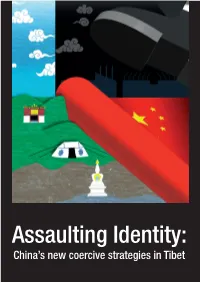
Assaulting Identity: China's New Coercive Strategies in Tibet
Assaulting Identity: China’s new coercive strategies in Tibet ABOUT Tibet Advocacy Coalition is a project established in 2013 by International Tibet Network, Tibet Justice Center and Students for a Free Tibet to develop coordinated strategies, monitoring tools, and reports to highlight the situation in Tibet at the United Nations Human Rights Council. The Coalition members are International Tibet Network Secretariat, Tibet Justice Center, Students for a Free Tibet, Tibetan Youth Association Europe and Tibet Initiative Deutschland, who work together with support and advice from Boston University’s Asylum & Human Rights Program. The Coalition also offers support to other Tibet groups engaging in UN mechanisms and strengthen the global Tibet movement’s advocacy work and lead an on-the-ground team of Tibet advocates. Cover illustration by Urgyen Wangchuk. http://www.urgyen.com 2 CONTENTS 1. EXECUTIVE SUMMARY .............................................................4 2. METHODOLOGY...................................................................6 3. BACKGROUND....................................................................8 4. SHAPING A NEW GENERATION FROM INFANCY ..........................................9 4.1. Kindergartens as new hubs for cultural re‑engineering and military‑style training ............10 4.2. Eroding Tibetan language instruction in kindergartens & nurseries........................12 4.3. Residential schools and “pairing” to monitor compliance of Tibetan students................14 4.4. “Patriotic education bases” -
Standards for Firefighters Rise As New Guidelines Take
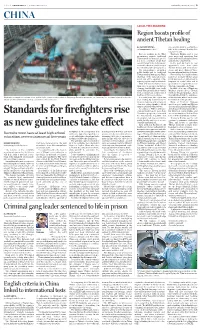
CHINA DAILY | HONG KONG EDITION Wednesday, January 16, 2019 | 5 CHINA LOCAL TWO SESSIONS Region boosts profile of ancient Tibetan healing By PALDEN NYIMA cine, and we want to contribute a and DAQIONG in Lhasa little to the country’s Healthy Chi na plan,” he said. Doctors working in the Tibet Tenshung Drakpa said it was autonomous region’s traditional great news and auspicious that Tibetan medicine hospitals are feel Lum medicinal bathing had been ing more confident about their added to the UNESCO list. careers thanks to the regional gov In the past 20 years, he has ernment’s efforts to boost recogni apprenticed more than 2,000 tion of traditional healing practices. Tibetan doctors and medical stu The region plans to strengthen dents, and more than 700 have public health and its traditional become independent practitioners. Tibetan medical heritage, Qi Zhala, Not only has the tradition been chairman of the regional govern passed on in many Tibetan areas ment, said at the opening of the but it has also been introduced to region’s people’s congress last week. hospitals in coastal cities and is With a written history of more gradually becoming known in non than 3,800 years and oral history Tibetan communities in China. of more than 10,000 years, tradi In 2004, after one of Tenshung tional Tibetan medicine is consid Drakpa’s papers about Tibetan ered an important component of medicine became popular, a book traditional Chinese medicine. was published with the assistance Firefighters suppress a blaze at an automobile component market in Guiyang, Guizhou province, on Tuesday. -
STP Written Statement
United Nations A/HRC/19/NGO/114 General Assembly Distr.: General 28 February 2012 English only Human Rights Council Nineteenth session Agenda item 3 Promotion and protection of all human rights, civil, political, economic, social and cultural rights, including the right to development Written statement* submitted by the Society for Threatened Peoples, a non-governmental organization in special consultative status The Secretary-General has received the following written statement which is circulated in accordance with Economic and Social Council resolution 1996/31. [13 February 2012] * This written statement is issued, unedited, in the language(s) received from the submitting non-governmental organization(s). GE.12-10867 A/HRC/19/NGO/114 Severe restrictions on religious freedom and freedom of expression in the Tibetan autonomous region and adjacent areas where Tibetans live The human rights situation in the Tibet Autonomous Region and adjacent areas where Tibetans live continues to remain a major concern. Spate of self-immolation protests since 2009 and demonstrations in the Tibet Autonomous Region and adjacent areas where Tibetans live defy the position of the Chinese government that the Tibetan Autonomous Region and adjacent areas where Tibetans live are stable. Arbitrary arrests, detentions and imprisonments have continued throughout the Tibetan Autonomous Region and adjacent areas where Tibetans live. Intensive patriotic re- education sessions pressuring the Buddhist monks and nuns to study communist ideologies and denounce their spiritual leader, the Dalai Lama have exacerbated rather than calmed the volatile situation. Tibetans are increasingly but peacefully showing their resistance to the continued suppression by the Chinese authorities. Kirti monastery in the Sichuan province, Nyitso monastery and Mamae Dechen Chokhorling nunnery, and Karma monastery are the four places where self-immolation protests took place. -

Tibet's “Intolerable” Monasteries
Tibet’s “Intolerable” Monasteries | Tibet Watch 2016 Tibet’s “Intolerable” Monasteries: The role of monasteries in Tibetan resistance since 1950 Thematic Report April 2016 -1- Tibet’s “Intolerable” Monasteries: The role of monasteries in Tibetan resistance since 1950 Copyright © 2016 Tibet Watch All rights reserved. Cover photo by Reuters Tibet Watch works to promote the human rights of the Tibetan people through monitoring, research and advocacy. We are a UK registered charity (no. 1114404) with an office in London and a field office in Dharamsala, India. We believe in the power of bearing witness, the power of truth. www.tibetwatch.org Contents Introduction ....................................................................................................................................................... 1 Background ........................................................................................................................................................ 4 Role of monasteries in Tibetan society ......................................................................................................... 4 China and Tibetan Buddhism since 1950 ...................................................................................................... 5 Current situation ........................................................................................................................................... 8 Labrang Tashikyil Monastery .......................................................................................................................... -

New Tibetan Exile President Congratulated by US Leaders, Interviewed
New Tibetan exile president congratulated by US leaders, interviewed http://www.savetibet.org/new-tibetan-exile-president-congratulated-by-us-leaders-interviewed May 26, 2021 In just a few hours, Penpa Tsering will swear in as the new president, or sikyong, of the Central Tibetan Administration. The CTA provides democratic governance for Tibetan exiles around the world. The Dalai Lama, the spiritual leader of the Tibetan people, will address the swearing-in ceremony virtually. Penpa won the election for sikyong last month after previously serving as speaker of the Tibetan Parliament-in-Exile and representative at the Office of Tibet in Washington, DC. The ceremony in Dharamsala, India will stream live at 12:25 am EDT on May 27, 9:25 pm PDT on May 26. Congratulations for Penpa—and expressions of support for the Tibetan exile community—have been rolling in from around the world. Earlier this month, US State Department spokesperson Ned Price tweeted: “The United States congratulates Penpa Tsering on his election as the Central Tibetan Administration's (CTA) next Sikyong. We look forward to working with him and the CTA to support the global Tibetan diaspora.” Penpa also received best wishes from the current sikyong, Lobsang Sangay, who delivered his farewell address today after 10 years as Tibetans’ exile political leader. In his remarks, Sangay discussed the growing belligerence of the Chinese government—which has illegally ruled Tibet for more than 60 years—as well as Tibetans’ success in gaining foreign support, including through the passage of the United States’ landmark Tibetan Policy and Support Act in 2020. -

Special Topic Paper: Tibet 2008-2009
Congressional-Executive Commission on China Special Topic Paper: Tibet 2008-2009 October 22, 2009 This Commission topic paper adds to and further develops information and analysis provided in Section V—Tibet of the Commission’s 2009 Annual Report, and incorporates the information and analysis contained therein. Congressional-Executive Commission on China Senator Byron L. Dorgan, Chairman Representative Sander M. Levin, Cochairman 243 Ford House Office Building | Washington, DC 20515 | 202-226-3766 | 202-226-3804 (FAX) www.cecc.gov Congressional-Executive Commission on China Special Topic Paper: Tibet 2008-2009 Table of Contents Findings ........................................................................................................................................................................1 Introduction: Tibetans Persist With Protest, Government Strengthens Unpopular Policies ...............................3 Government Shifts Toward More Aggressive International Policy on Tibet Issue ...............................................5 Beijing Think Tank Finds Chinese Government Policy Principally Responsible for the “3.14 Incident” ...................................................8 Status of Negotiations Between the Chinese Government and the Dalai Lama or His Representatives............13 The China-Dalai Lama Dialogue Stalls ..............................................................................................................................................................14 The Eighth Round of Dialogue, Handing Over -

ANNUAL REPORT 2014 ‘ the Tibet Fund Has Worked Closely with Our Central Tibetan Administration in Dharamsala to Understand the Priorities of the Tibetan Community
THE TIBET FUND ANNUAL REPORT 2014 ‘ The Tibet Fund has worked closely with our Central Tibetan Administration in Dharamsala to understand the priorities of the Tibetan Community. With the aid of The Tibet Fund, our people have built schools, homes for the elderly and other refugees in the settlements. The Tibet Fund has also enabled us to create programs essential to the preservation of our cultural heritage, the very seed of our civilization.’ His Holiness the 14th Dalai Lama The Tibet Fund works to preserve the distinct cultural The Tibet Fund’s work is guided by the following priorities: and national identity of the Tibetan people. Since 1981, under the patronage of His Holiness the Dalai Lama, The – Ensure that Tibetan culture and identity remain a strong Tibet Fund has been the primary funding organization for part of our global heritage health cv are, education, refugee rehabilitation, religious and cultural preservation, elder care and community and – Expand the resources needed to strengthen the growing economic development programs serving hundreds of Tibetan community in exile and prevent marginalization thousands of Tibetan refugees living in India, Nepal of Tibetans in Tibet and Bhutan. Our aim is to promote self-reliance and help sustain the – Enable individual donors to connect with Tibetan cohesiveness of the exile community. In Tibet, our support is children, monks, nuns and the elderly directed to education, emergency relief, healthcare and social enterprise programs that aid impoverished and marginalized – Raise awareness about the success and struggles of the Tibetans. Tibetan people to sustain their way of life, language and For more information please go to traditions www.tibetfund.org and visit the ‘About Us’ page for more information on our history and financial information and like us at www.facebook.com/tibetfund. -

Appendix III: Tibetan Political Detainees, 2013-2015
Appendix III: Tibetan Political Detainees, 2013-2015 Name Occupation County Prefecture Province Detention Sentence Sentence Date (yrs.) date Ade (m) Monk Sog (Suo) Nagchu (Naqu) Tibet AR 2014/03/28 On April 4, 2014, the March 28 detention of a Drilda monk, Ade, was reported in connection with the case of detained monks Lobsang Dargye and Lungtog Gyaltsen.1 Asang (m) Layperson Sog (Suo) Nagchu (Naqu) Tibet AR 2014/02/03 On February 2 or 3, 2014, authorities in Sog county reportedly took into custody seven Tibetan males ranging in age from 15 to 20: Tsesum Dorje (or Sisum Dorje), Lhagpa, Jamyang Gyatso, Dorje, Asang, Margong, and Jigme. They had used sand to spell out, “Tibet is an independent country,” or “May Tibet gain independence.” The detainees were reportedly held at the Suo County PSB Detention Center.2 Asong [Asung], 22 (m) Monk Barkham Ngaba (Aba) Tibetan Sichuan 2012/08/16 2.5 01/2013 (Ma’erkang) & Qiang AP Province On August 16, security officials detained Tsodun monks Thubwang Tenzin and Asong. Police may have suspected them of links to self-immolations by Tsodun monks Tenpa Dargyal and Chime Palden on March 30, 2012. In mid-January 2013, the Aba T&QAP Intermediate People’s Court reportedly sentenced on unknown charges monk Asong to 2 years and 6 months. Information is unavailable on the monks’ status or location.3 Atse (m) Monk, Chant Sog (Suo) Nagchu (Naqu) Tibet AR 2014/03/17 master On March 17, 2014, public security officials detained monks Tsangyang Gyatso, Tsewang, Atse, and Gyaltsen of Drilda Monastery, located near Chiduo (Trido) township, Suo (Sog) county, Naqu (Nagchu) county, Tibet Autonomous Region.