The Phylogenetic Position Species (Crassulaceae) Chloroplast
Total Page:16
File Type:pdf, Size:1020Kb
Load more
Recommended publications
-
Likely to Have Habitat Within Iras That ALLOW Road
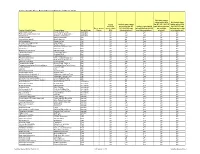
Item 3a - Sensitive Species National Master List By Region and Species Group Not likely to have habitat within IRAs Not likely to have Federal Likely to have habitat that DO NOT ALLOW habitat within IRAs Candidate within IRAs that DO Likely to have habitat road (re)construction that ALLOW road Forest Service Species Under NOT ALLOW road within IRAs that ALLOW but could be (re)construction but Species Scientific Name Common Name Species Group Region ESA (re)construction? road (re)construction? affected? could be affected? Bufo boreas boreas Boreal Western Toad Amphibian 1 No Yes Yes No No Plethodon vandykei idahoensis Coeur D'Alene Salamander Amphibian 1 No Yes Yes No No Rana pipiens Northern Leopard Frog Amphibian 1 No Yes Yes No No Accipiter gentilis Northern Goshawk Bird 1 No Yes Yes No No Ammodramus bairdii Baird's Sparrow Bird 1 No No Yes No No Anthus spragueii Sprague's Pipit Bird 1 No No Yes No No Centrocercus urophasianus Sage Grouse Bird 1 No Yes Yes No No Cygnus buccinator Trumpeter Swan Bird 1 No Yes Yes No No Falco peregrinus anatum American Peregrine Falcon Bird 1 No Yes Yes No No Gavia immer Common Loon Bird 1 No Yes Yes No No Histrionicus histrionicus Harlequin Duck Bird 1 No Yes Yes No No Lanius ludovicianus Loggerhead Shrike Bird 1 No Yes Yes No No Oreortyx pictus Mountain Quail Bird 1 No Yes Yes No No Otus flammeolus Flammulated Owl Bird 1 No Yes Yes No No Picoides albolarvatus White-Headed Woodpecker Bird 1 No Yes Yes No No Picoides arcticus Black-Backed Woodpecker Bird 1 No Yes Yes No No Speotyto cunicularia Burrowing -

Hylotelephium National Protocol: NP/HYL/1.Rev ______Botanical Taxon: Hylotelephium Telephium (L.) H
Hylotelephium National protocol: NP/HYL/1.rev ____________________________________________________________________ Botanical taxon: Hylotelephium telephium (L.) H. Ohba x H. spectabile (Boreau) H. Ohba (syn. Sedum telephium L. x S. spectabile Boreau) Common Name (when known): Sedum Date of preparation of NP: 28-08-2012 Date of revision of NP: 01-01-2020 NP revised by: W.A. Wietsma Sample to be examined: VEGETATIVE Number of growing cycles: 1 year Closing date for applications: 1/12 Submission date/period: 1/4 - 30/4 Seed/Plant Quantity: 24 young plants able to show all their characteristics during the first year of examination Special conditions sample: None Test station address: Naktuinbouw, Sotaweg 22, 2371 AA, Roelofarendsveen Name: Team Support Variety Testing Department E-mail: teamsupport@rasraad.nl List of grouping characteristics: NO, (if yes put as annex) Minimum number of plants in trial: Vegetative: 20 Seed: not appl. Minimum number of plants observed by measuring or counting: Vegetative: 1 Seed: not appl. Give description of when observations on the flower should take place: At full flowering Give description of when/where observations on the leaf should take place: At full flowering Give description of when/where the other observations should take place: At full flowering Test will take place: OUTDOOR Uniformity: A population standard of 1% with an acceptance probability of at least 95%. Number of Off-types allowed: one off-type allowed in a sample size of 24 Table of characteristics: PRESENT (see annex) (if present, please annex the table of characteristics and explanations) Literature: PRESENT (when present, please annex to this document) Page 1 of 3 Table of characteristics Hylotelephium 1. -

Sedum Society Newsletter(130) Pp
Open Research Online The Open University’s repository of research publications and other research outputs Kalanchoe arborescens - a Madagascan giant Journal Item How to cite: Walker, Colin (2019). Kalanchoe arborescens - a Madagascan giant. Sedum Society Newsletter(130) pp. 81–84. For guidance on citations see FAQs. c [not recorded] https://creativecommons.org/licenses/by-nc-nd/4.0/ Version: Version of Record Copyright and Moral Rights for the articles on this site are retained by the individual authors and/or other copyright owners. For more information on Open Research Online’s data policy on reuse of materials please consult the policies page. oro.open.ac.uk NUMBER 130 SEDUM SOCIETY NEWSLETTER JULY 2019 FRONT COVER Roy Mottram kindly supplied: “The Diet” copy of this Japanese herbal which is sharp and crisp (see page 97). “I counted the plates, and this copy is complete with 200 plates, in 8 parts, bound here in 2 vols. I checked for another Sedum but none are Established April 1987, now ending our present, so Maximowicz was basing his 32nd year. S. kagamontanum on this same plate, Subscriptions run from October to the following September. Anyone requesting translating the location as Mt. Kaga and to join after June, unless there is a special citing t.40 incorrectly. The "t.43" plate request, will receive his or her first number is also wrong. It is actually t.33 of Newsletter in October. If you do not the whole work, or Vol.2 t.8. The book is receive your copy by the 10th of April, July or October, or the 15th January, then bound back to front [by Western standards] please write to the editor: Ray as in all Japanese books of the day.” RM. -

NJ Native Plants - USDA
NJ Native Plants - USDA Scientific Name Common Name N/I Family Category National Wetland Indicator Status Thermopsis villosa Aaron's rod N Fabaceae Dicot Rubus depavitus Aberdeen dewberry N Rosaceae Dicot Artemisia absinthium absinthium I Asteraceae Dicot Aplectrum hyemale Adam and Eve N Orchidaceae Monocot FAC-, FACW Yucca filamentosa Adam's needle N Agavaceae Monocot Gentianella quinquefolia agueweed N Gentianaceae Dicot FAC, FACW- Rhamnus alnifolia alderleaf buckthorn N Rhamnaceae Dicot FACU, OBL Medicago sativa alfalfa I Fabaceae Dicot Ranunculus cymbalaria alkali buttercup N Ranunculaceae Dicot OBL Rubus allegheniensis Allegheny blackberry N Rosaceae Dicot UPL, FACW Hieracium paniculatum Allegheny hawkweed N Asteraceae Dicot Mimulus ringens Allegheny monkeyflower N Scrophulariaceae Dicot OBL Ranunculus allegheniensis Allegheny Mountain buttercup N Ranunculaceae Dicot FACU, FAC Prunus alleghaniensis Allegheny plum N Rosaceae Dicot UPL, NI Amelanchier laevis Allegheny serviceberry N Rosaceae Dicot Hylotelephium telephioides Allegheny stonecrop N Crassulaceae Dicot Adlumia fungosa allegheny vine N Fumariaceae Dicot Centaurea transalpina alpine knapweed N Asteraceae Dicot Potamogeton alpinus alpine pondweed N Potamogetonaceae Monocot OBL Viola labradorica alpine violet N Violaceae Dicot FAC Trifolium hybridum alsike clover I Fabaceae Dicot FACU-, FAC Cornus alternifolia alternateleaf dogwood N Cornaceae Dicot Strophostyles helvola amberique-bean N Fabaceae Dicot Puccinellia americana American alkaligrass N Poaceae Monocot Heuchera americana -
Abbotsford Water Efficient Plant List Minimum Soil Depth Botanical Name Common Name Type (Mm)
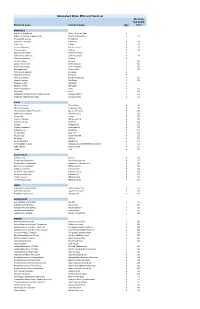
Abbotsford Water Efficient Plant List Minimum Soil Depth Botanical name Common name type (mm) ANNUALS Argemone grandifolia Statice/Sea Lavendar A Begonia x hybrida 'Dragon Wings' Dragon Wing begonia A 150 Bracteantha species Strawflower Calendula officinalis Calendula A 150 Coleus ssp. Coleus A 150 Cosmos bipinnatus Garden cosmos A 150 Cuphea llavea Cuphea A 150 Dyssocua tenuiloba Dahlberg Daisey A Eschscholzia californica California poppy A 150 Gazania spendens Gazania A Lantana camara Lantana A 150 Lobularia maritima Sweet alyssum A 150 Nigella damascena Love-in-the-mist A 150 Oesteopermum African daisy A 150 Pelargonium species Geranium A Portulaca oleracea Portulaca A Salvia guaranitica Anise-scented sage A 150 Scaevola aemula Fan flower A 150 Targetes erecta Marogold A Targetes erecta Marogold A Viola x wittrockiana Pansy A 150 Zinnia ssp. Zinnia A 150 Verbascum bombyciferum 'Arctic Summer' Broussa mullein A 150 Verbascum phlomoides 'Spica' Orange mullein A 150 BULBS Allium christophii Star of Persia B 150 Allium karataviense Turkestan onion B 150 Chionodoxa forbesii 'Pink Giant' Glory of the snow B 150 Colchicum autumnale Autumn crocus B 150 Crocus ssp. Crocus B 150 Eranthis hyemalis Winter aconite B 150 Erythronium ssp. Fawn lily B 150 Eucomis Pineapple lily B 150 Fritillaria meleagris Checkered lily B 150 Galanthus ssp. Snowdrop B 150 Iris reticulata Dwarf iris B 150 Muscari ssp. Grape hyacinth B 150 Narcissus Daffodil B 150 Nerine bowdenii Bowden lily B 150 Ornithogalum nutans Drooping Star of Bethlehem/Silverbells B 150 Scilla -
SFAN Early Detection V1.4
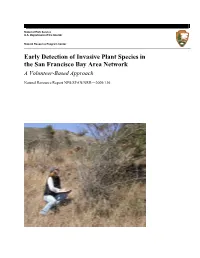
National Park Service U.S. Department of the Interior Natural Resource Program Center Early Detection of Invasive Plant Species in the San Francisco Bay Area Network A Volunteer-Based Approach Natural Resource Report NPS/SFAN/NRR—2009/136 ON THE COVER Golden Gate National Parks Conservancy employee Elizabeth Speith gathers data on an invasive Cotoneaster shrub. Photograph by: Andrea Williams, NPS. Early Detection of Invasive Plant Species in the San Francisco Bay Area Network A Volunteer-Based Approach Natural Resource Report NPS/SFAN/NRR—2009/136 Andrea Williams Marin Municipal Water District Sky Oaks Ranger Station 220 Nellen Avenue Corte Madera, CA 94925 Susan O'Neil Woodland Park Zoo 601 N 59th Seattle, WA 98103 Elizabeth Speith USGS NBII Pacific Basin Information Node Box 196 310 W Kaahumau Avenue Kahului, HI 96732 Jane Rodgers Socio-Cultural Group Lead Grand Canyon National Park PO Box 129 Grand Canyon, AZ 86023 August 2009 U.S. Department of the Interior National Park Service Natural Resource Program Center Fort Collins, Colorado The National Park Service, Natural Resource Program Center publishes a range of reports that address natural resource topics of interest and applicability to a broad audience in the National Park Service and others in natural resource management, including scientists, conservation and environmental constituencies, and the public. The Natural Resource Report Series is used to disseminate high-priority, current natural resource management information with managerial application. The series targets a general, diverse audience, and may contain NPS policy considerations or address sensitive issues of management applicability. All manuscripts in the series receive the appropriate level of peer review to ensure that the information is scientifically credible, technically accurate, appropriately written for the intended audience, and designed and published in a professional manner. -
Analysis of Morphological Characters and Rapds Fragments of Twelve Species of the Crassulaceae Family
ISSN 2007-3380 REVISTA BIO CIENCIAS h t t p : / / b i o c i e n c i a s . u a n . e d u . m x https://doi.org/10.15741/revbio.06.01.09 Original Article/Artículo Original Analysis of morphological characters and RAPDs fragments of twelve species of the Crassulaceae Family Análisis de caracteres morfológicos y fragmentos RAPDs de doce especies de la Familia Crassulaceae Andrade-Rodríguez, M.1, Rodríguez-Rojas, T. J.*1, Castillo-Gutiérrez, A.2, Villegas-Torres, O. G.1, Guillén-Sánchez, D.1. 1Universidad Autónoma del Estado de Morelos, Facultad de Ciencias Agropecuarias. Av. Universidad 1001, Cuernavaca, Morelos, C. P. 62210, México. 2Universidad Autónoma del Estado de Morelos, Escuela de Estudios Superiores de Xalostoc. Av. Nicolás Bravo s/n, Parque Industrial Cuautla, C.P. 62717 Xalostoc, Ayala, Morelos. México. Cite this paper/Como citar este artículo: Andrade-Rodríguez, M., Rodríguez-Rojas, T.J., Castillo- Gutiérrez, A., Villegas-Torres, O.G., Guillén-Sánchez, D. (2019). Analysis of morphological characters and Rapd fragments of twelve species of the Crassulaceae Family. Revista Bio Ciencias 6, e537. doi: https://doi. org/10.15741/revbio.06.01.09 A B S T R A C T R E S U M E N The Crassulaceae family is the most La familia Crassulaceae es la más representativa representative of Mexico due to the high endemism of most de México debido al alto endemismo de la mayoría de sus of its species and to its historical-cultural significance. They especies y por su significado histórico-cultural; son cotizadas are prized and valued on the international market, causing y valoradas en el mercado internacional, esto ha provocado an intense and illegal harvest and sacking of plants, fruits una intensa recolecta y saqueo de plantas, frutos y semillas and seeds, with the purpose of selling and recording them de manera ilegal, con fines de venta y registro en otros países. -

ALFABETISCHE TERMENLIJST Pagina 2 a a Z
ALFABETISCHE TERMENLIJST Pagina 2 A a z. alpha. A = afk. adenine: toegepast in schematische weergave vd. bouw van DNA en RNA. a. = afk. Lat. anno: in het jaar. a-, an- = voorvoegsel met de betekenis: niet, zonder. Å = ångstrom: verouderde lengteeenheid; 1 millimeter is gelijk aan 10 miljoen ångstrom; v. nm, afk. van nanometer. Aalwijn, Aalwee N. ZAfr. = Aloe spp. (Asphodelaceae), ook enkele aloë-achtige verwante soorten. Aaron's Beard N. = Opuntia leucotricha (Cactaceae). Aaron's Rod N. = Koningskaars: Verbascum thapsus (Scrophulariaceae). ABA z. abscisic acid. abaxial ADJ. = aan de vd. as verwijderde zijde, aan de onderzijde (ve. blad); syn. dorsal; ant. adaxial, ventral. abbreviate ADJ. = afgekort. ABC Islands N. = Aruba, Bonaire & Curaçao: de voormalig Ned. eilanden die, tov. de andere Kleine Antillen ver naar het Westen, voor de kust van Venezulela liggen; v. Leeward Islands, Windward Islands. aberrant ADJ. = afwijkend, niet normaal, ongewoon, iets verschilled vh. type; syn. abnormal. abiogenesis N. = veronderstelde ontwikkeling van levende organismen uit dood anorganisch materiaal. abiotic ADJ. = abiotisch: btr. factoren uit de niet-levende omgeving die het leven van planten en dieren beïnvloeden; bv. beschikbaar water, pH vd. bodem, kooldioxidegehalte vd. lucht en licht; v. biotic. abnormal ADJ. = ongewoon, abnormaal, afwijkend; v. aberrant. aboriginal ADJ. = oorspronkelijk, inheems; btr. plant die van nature in een gebied thuis hoort; syn. native, indigeneous; ant. exotic. aborted ADJ. = defect, onvruchtbaar, onvolledig ontwikkeld. abortion N. = het feit dat een orgaan of deel vd. plant zich niet ontwikkelt of in de volwassen plant niet meer aanwezig is. abortive ADJ. = al in een vroeg stadium onvolledig ontwikkeld. Abrojo Sp. N. = 1) Opuntia tunicata (Cactaceae) 2) ook O. -

Sedum (Rozchodník)
Sedum (Rozchodník) čeleď: Crassulaceae Kolem 6ti druhů roste i v České Republice. Patří mezi trvalky, většinou se jedná o sukulentní byliny, méně častěji polokeře nebo keře. Stonky mohou být vzpřímené nebo poléhavé. Stonky bývají větvené a hustě olistěné. Listy bývají střídavé, masité, celokrajné nebo zubaté. Květy mají 4 - 5 kališních i okvětních lístků a 8 - 10 tyčinek. Plodem je měchýřek. Jsou vhodné na pěstování ve skalkách. Existují vnitrodruhové taxony: - 'Bertram Anderson' - 'Black Beauty' - výška 40 - 50cm; růžovofialové listy - 'Briliant' - výška 50 - 70cm; ojíněné listy; růžové květy - 'Carl' - 'Elsies Gold' - výška i šířky 30cm; v mládí žlutozelené později zelené listy; růžové květy - 'Herbstfreude'/'Autumn Joy'/'Indian Chief' - výška 60cm; žedozelené listy; růžové květy v soukvětí o velikosti až 20cm - 'Iceberg' - výška 40 - 60cm; zelené ojíněné listy; bílé květy - 'Karfunkelstein' - výška 50cm; zelenorůžovofialové listy - 'Matrona' - výška 0,7 (i 1)m; načervenalé listy; světlerůžové květy - 'Oriental Dancer' - listy lesklé, červenofialové; květy růžové - 'Picolette' - listy sivočervenozelené; květy bleděrůžové - 'Purple Emperor' - výška 40 - 60cm; bronzovorůžovofialové listy; světlerůžové až červené květy - 'Red Cauli' - výška 50 - 70cm, šířka až 90cm; tmavězelené listy; soukvětí průměru 9cm z červených květů - 'Stardust' - výška 50 - 70cm; bílé nebo narůžovělé květy - 'Thunderhead' - listy tmavě; květy tmavě červenorůžové Vyhovuje jim sucho a hlinitopísčitá i suťovitá chudá půda a nutností je plné slunce. Množí se nejčastěji -
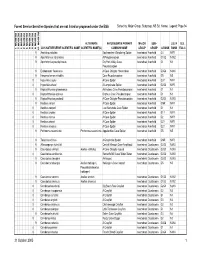
Sensitive Species That Are Not Listed Or Proposed Under the ESA Sorted By: Major Group, Subgroup, NS Sci
Forest Service Sensitive Species that are not listed or proposed under the ESA Sorted by: Major Group, Subgroup, NS Sci. Name; Legend: Page 94 REGION 10 REGION 1 REGION 2 REGION 3 REGION 4 REGION 5 REGION 6 REGION 8 REGION 9 ALTERNATE NATURESERVE PRIMARY MAJOR SUB- U.S. N U.S. 2005 NATURESERVE SCIENTIFIC NAME SCIENTIFIC NAME(S) COMMON NAME GROUP GROUP G RANK RANK ESA C 9 Anahita punctulata Southeastern Wandering Spider Invertebrate Arachnid G4 NNR 9 Apochthonius indianensis A Pseudoscorpion Invertebrate Arachnid G1G2 N1N2 9 Apochthonius paucispinosus Dry Fork Valley Cave Invertebrate Arachnid G1 N1 Pseudoscorpion 9 Erebomaster flavescens A Cave Obligate Harvestman Invertebrate Arachnid G3G4 N3N4 9 Hesperochernes mirabilis Cave Psuedoscorpion Invertebrate Arachnid G5 N5 8 Hypochilus coylei A Cave Spider Invertebrate Arachnid G3? NNR 8 Hypochilus sheari A Lampshade Spider Invertebrate Arachnid G2G3 NNR 9 Kleptochthonius griseomanus An Indiana Cave Pseudoscorpion Invertebrate Arachnid G1 N1 8 Kleptochthonius orpheus Orpheus Cave Pseudoscorpion Invertebrate Arachnid G1 N1 9 Kleptochthonius packardi A Cave Obligate Pseudoscorpion Invertebrate Arachnid G2G3 N2N3 9 Nesticus carteri A Cave Spider Invertebrate Arachnid GNR NNR 8 Nesticus cooperi Lost Nantahala Cave Spider Invertebrate Arachnid G1 N1 8 Nesticus crosbyi A Cave Spider Invertebrate Arachnid G1? NNR 8 Nesticus mimus A Cave Spider Invertebrate Arachnid G2 NNR 8 Nesticus sheari A Cave Spider Invertebrate Arachnid G2? NNR 8 Nesticus silvanus A Cave Spider Invertebrate Arachnid G2? NNR -

Rare, Threatened and Endangered Species of Oregon
Portland State University PDXScholar Institute for Natural Resources Publications Institute for Natural Resources - Portland 8-2016 Rare, Threatened and Endangered Species of Oregon James S. Kagan Portland State University Sue Vrilakas Portland State University, sue.vrilakas@pdx.edu John A. Christy Portland State University Eleanor P. Gaines Portland State University Lindsey Wise Portland State University See next page for additional authors Follow this and additional works at: https://pdxscholar.library.pdx.edu/naturalresources_pub Part of the Biodiversity Commons, Biology Commons, and the Zoology Commons Let us know how access to this document benefits ou.y Citation Details Oregon Biodiversity Information Center. 2016. Rare, Threatened and Endangered Species of Oregon. Institute for Natural Resources, Portland State University, Portland, Oregon. 130 pp. This Book is brought to you for free and open access. It has been accepted for inclusion in Institute for Natural Resources Publications by an authorized administrator of PDXScholar. Please contact us if we can make this document more accessible: pdxscholar@pdx.edu. Authors James S. Kagan, Sue Vrilakas, John A. Christy, Eleanor P. Gaines, Lindsey Wise, Cameron Pahl, and Kathy Howell This book is available at PDXScholar: https://pdxscholar.library.pdx.edu/naturalresources_pub/25 RARE, THREATENED AND ENDANGERED SPECIES OF OREGON OREGON BIODIVERSITY INFORMATION CENTER August 2016 Oregon Biodiversity Information Center Institute for Natural Resources Portland State University P.O. Box 751, -

Sempervivum * X (Hybrid); Var.( Variety); F
Sempervivum * x (hybrid); var.( variety); f. (form); G. (Group); ssp. (subspecies) # Botanical Name * Cultivar Description Sempervivum tectorum S. marmoreum 1 x 'Othello' pink and green 'Atropurpureum' 'Rubrifolia' also 'Silver Olympic';small rosettes, cobwebbed; 2 Sempervivum x 'Zilver Olympic' inner leaves green, outer pale red Sempervivum Syn. Jovibarba sobolifera; small bright green 3 subsp. arenarium globiferum leaves, chicks tiny red, round balls Sempervivum 4 'Robin' green inside, red outside of scales; cobweb arachnoideum green inner surface, almost all outer scale 5 Jovibarba hirta surface red 6 Sempervivum x 'Green Wheel' all green, scales circle growth 7 Sempervivum x 'Emerald Giant' Sempervivum 8 subsp. tomentosum 'Clarchen' open green with pink; very heavy webbing arachnoideum Sempervivum tectorum 9 x S. 'Lady Kelly' 'El Toro' red to pink with dark red stripes, khaki tips 'Hayling' 10 Sempervivum x 'Happy' red lower scale green tip 11 Sempervivum 'Red Heart' red base of scales at center only 12 Sempervivum x 'Hester' green with red tip (points); 3" 13 Sempervivum tectorum x 'Pacific Devils' Food' barn red/brown 14 Sempervivum 'Silver King' scales red at base, green at tips also sold as 'Donna Rose'; showy flowers; red 15 Sempervivum tectorum 'Donarrose' green tiny center with cobweb 16 Sempervivum x 'Excalibur' U.K.;red tips pointing upward and in, pale green 17 Sempervivum x 'Hey Hey' inner maroon leaves with green center and tips of 18 Sempervivum x 'Hopewell' leaves from U.K.;red/brown inner with green tips and 19 Sempervivum