Canadian Catalogue of Books | | R
Total Page:16
File Type:pdf, Size:1020Kb
Load more
Recommended publications
-
The Four Courts of Sir Lyman Duff
THE FOUR COURTS OF SIR LYMAN DUFF RICHARD GOSSE* Vancouver I. Introduction. Sir Lyman Poore Duff is the dominating figure in the Supreme Court of Canada's first hundred years. He sat on the court for more than one-third of those years, in the middle period, from 1906 to 1944, participating in nearly 2,000 judgments-and throughout that tenure he was commonly regarded as the court's most able judge. Appointed at forty-one, Duff has been the youngest person ever to have been elevated to the court. Twice his appointment was extended by special Acts of Parliament beyond the mandatory retirement age of seventy-five, a recogni- tion never accorded to any other Canadian judge. From 1933, he sat as Chief Justice, having twice previously-in 1918 and 1924 - almost succeeded to that post, although on those occasions he was not the senior judge. During World War 1, when Borden considered resigning over the conscription issue and recommending to the Governor General that an impartial national figure be called upon to form a government, the person foremost in his mind was Duff, although Sir Lyman had never been elected to public office. After Borden had found that he had the support to continue himself, Duff was invited to join the Cabinet but declined. Mackenzie King con- sidered recommending Duff for appointment as the first Canadian Governor General. Duff undertook several inquiries of national interest for the federal government, of particular significance being the 1931-32 Royal Commission on Transportation, of which he was chairman, and the 1942 investigation into the sending of Canadian troops to Hong Kong, in which he was the sole commissioner . -

Memorial of Elenor Hughes 1825
Memorial of Elenor Hughes 1825 Archives: Box 24 This Memorial is held by the Canadian Quaker Archives and Library in Newmarket, Ontario in Box 24. Sam Hughes came to Yonge Street from Pennsylvania with his parents Job Hughes and Elinor or Elenor Lee. This memorial is written by Samuel Hughes in honour of his mother. His sisters Amy (1887 – 1863) and Abigail (1780 - ?) married brothers Stephen Bowerman (1773 – 1857) and Judah Bowerman (1779 – 1868) respectively and settled in Bloomfield, Prince Edward County. All were Quakers. The Marion Cronk Fonds has several Hughes items including two journals by Sam Hughes. The finding aid for the fonds is available here on the web site of the Canadian Yearly Meeting Archives. See section 1-9 for the Hughes items. The transcription was coordinated by Jane Zavitz Bond, archivist for Canada Yearly Meeting, and fully transcribed by Sheila Havard with minor formatting changes for posting by Randy Saylor. The text was transcribed as written. Transcriber notes are in square brackets. The memoir has not been proof read. This transcription is made freely available and supports search, cut and paste. CFHA will officially grant linking privileges to organizations that support this free access. CFHA wishes to express its gratitude to those who worked on this project. Researchers are requested to cite the transcription when incorporating passages excerpted from this transcription. Please note that CFHA welcomes written comment, submissions and research related to the Canadian Quaker experience and legacy for publication consideration in The Meetinghouse newsletter or the Canadian Quaker History Journal. Please contact chair@cfha.info for additional details and see also the submission guidelines provided on the CFHA website. -

Healey's "From Quaker to Upper Canadian: Faith and Community Among Yonge Street Friends" - Book Review Thomas D
Quaker Studies Volume 12 | Issue 2 Article 10 2008 Healey's "From Quaker to Upper Canadian: Faith and Community among Yonge Street Friends" - Book Review Thomas D. Hamm Earlham College Follow this and additional works at: http://digitalcommons.georgefox.edu/quakerstudies Part of the Christian Denominations and Sects Commons, and the History of Christianity Commons Recommended Citation Hamm, Thomas D. (2008) "Healey's "From Quaker to Upper Canadian: Faith and Community among Yonge Street Friends" - Book Review," Quaker Studies: Vol. 12: Iss. 2, Article 10. Available at: http://digitalcommons.georgefox.edu/quakerstudies/vol12/iss2/10 This Article is brought to you for free and open access by Digital Commons @ George Fox University. It has been accepted for inclusion in Quaker Studies by an authorized administrator of Digital Commons @ George Fox University. For more information, please contact arolfe@georgefox.edu. BOOK REVIEWS 269 HEALEY, Robynne Rogers, From Quaker to Upper Canadian: Faith and Community among Yonge Street Friends, 1801-1850 (Montreal and Kingston: MeGill-Queen's University Press, 2006), pp. xxvi + 292, including maps, charts, tables and illustra tions. ISBN 9-78077-35313-69, Hardback, $75, £56. Robynne Rogers Healey has written one of the most useful and important studies of the evolution of a Quaker community ever published. Several historians, myself included, have ventured broad overviews of how and why Quakerism changed in the nineteenth century. But now we have a careful, incisive analysis of those changes at the local level. Healey's subject is Yonge Street Monthly Meeting in Ontario. Shortly after 1800, Friends from Vermont and Pennsylvania took advantage of generous land grants to settle north of what would become Toronto. -

David Willson's "Impressions of the Mind" and "Letters to the Jews"
DAVID WILLSON'S "IMPRESSIONS OF THE MIND" AND "LETTERS TO THE JEWS" Thomas M. F. Gerry Love hath no beginning nor ever will have an end. Love is the revealed will of God, and the saviour of nations. Love is the con- quering sword of God, the peace-maker of the world, the blessed of God. She bears his own image, and is forever. She ariseth in the east as the light of day. She is the bride of man, and the bride- groom of the soul. She binds together, and none can part those whom she hath joined together. She hath connected limb to limb, and joint to joint, since ever her name was known to the human mind. She is ever in the presence of God. She conceals her mind from those that disbelieve her name, till sorrow shall enable them to embrace her hand with a smile. She is the queen of the Deity ; as male and female, she is one with God.1 RLEADIN, G THESE WORDS of David Willson's, written and published in Upper Canada in 1835, one may be surprised, and perhaps mysti- fied, but certainly one must acknowledge the presence of an intriguingly unique voice from a Canadian pioneer settlement. Willson was a prolific writer of religious prose, poems, and hymns, whose works create a new dimension in our understand- ing of the early life and literature of Canada. Overshadowed in history by his friends William Lyon Mackenzie and Robert Baldwin, and actively ignored, even scorned, by church and state officers since John Strachan, Egerton Ryerson, and Stephen Grellet, Willson's endeavours, including the lovely Temple of Peace at Sharon, Ontario, and his musical achievements, are beginning to receive their rightful recognition. -

Ian Bushnell*
JUstice ivan rand and the roLe of a JUdge in the nation’s highest coUrt Ian Bushnell* INTRODUCTION What is the proper role for the judiciary in the governance of a country? This must be the most fundamental question when the work of judges is examined. It is a constitutional question. Naturally, the judicial role or, more specifically, the method of judicial decision-making, critically affects how lawyers function before the courts, i.e., what should be the content of the legal argument? What facts are needed? At an even more basic level, it affects the education that lawyers should experience. The present focus of attention is Ivan Cleveland Rand, a justice of the Supreme Court of Canada from 1943 until 1959 and widely reputed to be one of the greatest judges on that Court. His reputation is generally based on his method of decision-making, a method said to have been missing in the work of other judges of his time. The Rand legal method, based on his view of the judicial function, placed him in illustrious company. His work exemplified the traditional common law approach as seen in the works of classic writers and judges such as Sir Edward Coke, Sir Matthew Hale, Sir William Blackstone, and Lord Mansfield. And he was in company with modern jurists whose names command respect, Oliver Wendell Holmes, Jr., and Benjamin Cardozo, as well as a law professor of Rand at Harvard, Roscoe Pound. In his judicial decisions, addresses and other writings, he kept no secrets about his approach and his view of the judicial role. -
The Supremecourt History Of
The SupremeCourt of Canada History of the Institution JAMES G. SNELL and FREDERICK VAUGHAN The Osgoode Society 0 The Osgoode Society 1985 Printed in Canada ISBN 0-8020-34179 (cloth) Canadian Cataloguing in Publication Data Snell, James G. The Supreme Court of Canada lncludes bibliographical references and index. ISBN 0-802@34179 (bound). - ISBN 08020-3418-7 (pbk.) 1. Canada. Supreme Court - History. I. Vaughan, Frederick. 11. Osgoode Society. 111. Title. ~~8244.5661985 347.71'035 C85-398533-1 Picture credits: all pictures are from the Supreme Court photographic collection except the following: Duff - private collection of David R. Williams, Q.c.;Rand - Public Archives of Canada PA@~I; Laskin - Gilbert Studios, Toronto; Dickson - Michael Bedford, Ottawa. This book has been published with the help of a grant from the Social Science Federation of Canada, using funds provided by the Social Sciences and Humanities Research Council of Canada. THE SUPREME COURT OF CANADA History of the Institution Unknown and uncelebrated by the public, overshadowed and frequently overruled by the Privy Council, the Supreme Court of Canada before 1949 occupied a rather humble place in Canadian jurisprudence as an intermediate court of appeal. Today its name more accurately reflects its function: it is the court of ultimate appeal and the arbiter of Canada's constitutionalquestions. Appointment to its bench is the highest achieve- ment to which a member of the legal profession can aspire. This history traces the development of the Supreme Court of Canada from its establishment in the earliest days following Confederation, through itsattainment of independence from the Judicial Committeeof the Privy Council in 1949, to the adoption of the Constitution Act, 1982. -
Co Supreme Court of Canada
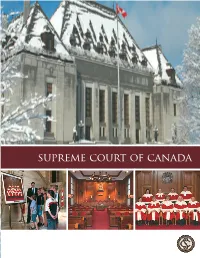
supreme court of canada of court supreme cour suprême du canada Philippe Landreville unless otherwise indicated otherwise unless Landreville Philippe by Photographs Ottawa, Ontario K1A 0J1 K1A Ontario Ottawa, 301 Wellington Street Wellington 301 Supreme Court of Canada of Court Supreme ISBN 978-1-100-21591-4 ISBN JU5-23/2013E-PDF No. Cat. ISBN 978-1-100-54456-4 ISBN Cat. No. JU5-23/2013 No. Cat. © Supreme Court of Canada (2013) Canada of Court Supreme © © Cour suprême du Canada (2013) No de cat. JU5-23/2013 ISBN 978-1-100-54456-4 No de cat. JU5-23/2013F-PDF ISBN 978-0-662-72037-9 Cour suprême du Canada 301, rue Wellington Ottawa (Ontario) K1A 0J1 Sauf indication contraire, les photographies sont de Philippe Landreville. SUPREME COURT OF CANADA rom the quill pen to the computer mouse, from unpublished unilingual decisions to Internet accessible bilingual judgments, from bulky paper files to virtual electronic documents, the Supreme Court of Canada has seen tremendous changes from the time of its inception and is now well anchored in the 21st century. Since its establishment in 1875, the Court has evolved from being a court of appeal whose decisions were subject to review by a higher authority in the United Kingdom to being the final court of appeal in Canada. The Supreme Court of Canada deals with cases that have a significant impact on Canadian society, and its judgments are read and respected by Canadians and by courts worldwide. This edition of Supreme Court of Canada marks the retirement of Madam Justice Marie Deschamps, followed by Fthe recent appointment of Mr. -

The Joint Stock Companies of the Home District and the Economic Roots of Deliberative Democracy in Upper Canada Albert Schrauwers
Document generated on 09/28/2021 3:06 p.m. Ontario History A Farmer's Alliance The Joint Stock Companies of the Home District and the Economic Roots of Deliberative Democracy in Upper Canada Albert Schrauwers Volume 99, Number 2, Fall 2007 Article abstract This article addresses the economic roots of the fight for democratic reform in URI: https://id.erudit.org/iderudit/1065739ar Upper Canada, and the role of a small religious sect, the Children of Peace, in DOI: https://doi.org/10.7202/1065739ar particular. The Children of Peace were critical players in a number of “joint stock companies” such as the Farmers’ Store House (a co-operative farm See table of contents produce marketing company) and the Bank of the People. Joint stock companies lacked a charter or limited liability for their shareholders, and this made them models of “responsible government.” These companies, and their Publisher(s) directors, helped found the democratic reform political union, the Canadian Alliance Society, and build its meeting place “Shepard’s Hall.” The Ontario Historical Society ISSN 0030-2953 (print) 2371-4654 (digital) Explore this journal Cite this article Schrauwers, A. (2007). A Farmer's Alliance: The Joint Stock Companies of the Home District and the Economic Roots of Deliberative Democracy in Upper Canada. Ontario History, 99(2), 190–219. https://doi.org/10.7202/1065739ar Copyright © The Ontario Historical Society, 2007 This document is protected by copyright law. Use of the services of Érudit (including reproduction) is subject to its terms and conditions, which can be viewed online. https://apropos.erudit.org/en/users/policy-on-use/ This article is disseminated and preserved by Érudit. -

YORK, UPPER CANADA MINUTES of TOWN MEETINGS and LISTS of INHABITANTS 1797-1823 Counal-0Fftce, Dec
~;./ ~ 7%, ~h4P,A#":J.;tf #;~ ~.... ~~"'h~' ~ytP~ kd!:rp~~ ~~/.,.ru~ ffl ~~ I'/~~ //?'/ -.-- Aj - "-..z:::>- .-!.......,. ?~ .,.~ 2fl 2.7 / / '2 ~ 2 2 j 2 ~ --i' j' ! .4' / 2 ~/ 2 - ./ / -- / / ! ~ ! 2 .J / / j / / .t .Y ./ 3 ,z / ./ / :I / / ".f !I Q j .2 Y 5'6' /:t./ YORK, UPPER CANADA MINUTES OF TOWN MEETINGS AND LISTS OF INHABITANTS 1797-1823 Counal-0fftce, Dec. 29, 1798. YONGE ST R E E T. OTICE is hereby given to all per. N fons fettled, or about to fettle on YO}lGE-STREE1~ and whofe locatio11s have not yet been confirmed by order of the PR ESIDENT in council, that before fllch locations can be confinncd it will be cx netted that the following CONDITIONS be COlllplicd with : First. That within Iwtlve mOllths fronl the tilnc they arc pcrrnittcd to occupy their rdpcClive lots, they do caufe to h2 erected thereon a good and fllfficicnt d "rcHing houfe, of at kall 16 feet by 20 in the clear, and do occupy the farne in }Jajim, orby a fubfiantial Tenant. Seco11d, THAT within the Elme period of tinlc, they do clear and fellce five acres, of their refpcClive lots, in a fubfiantial manner. Third, THAT within the fame period of time, they do open as much of the Y onge-Strcet road as lies between the front of their lots and the mid dle of faid road, amounting to one acre or thereabouts. .JOliN S~YALL, c. E. C. Conditions for settlement on Yonge Street, 1798. From the Broadside Collection, Canadian History Department, Metropolitan Toronto Library. YORK, UPPER CANADA MINUTES OF TOWN MEETINGS AND LISTS OF INHABITANTS 1797-1823 Edited by Christine Mosser Toronto: Metropolitan Toronto Library Board, 1984. -
The Court in Decline 1902-1918
4 The Court in Decline 1902-1918 During the first decade of the twentieth century, particularly in the early years, the Supreme Court of Canada experienced the heaviest turnover in the personnel on the bench in the history of the institution. Within less than two years (1901-3) five vacancies occurred. In May 1901 George King died, followed in January 1902 by John Gwynne. Late in 1902 Chief Justice Strong retired, and in 1903 two of the new appointees died. The instability caused by this turnover in personnel had serious consequences for the Court. In the ten years between 1901 and 1911, the Lauriergovemment had the greatest opportunity of any administration in Canadian history to shape thecharacter anddirection of thesupremecourt to theextent that it could be influenced by the quality of members of the bench. Sir Wilfrid Laurier and his ministers of justice appointed ten new puisne justices and two chief justices. Yet the early results were disappointing. The government’s selection criteria seemed mainly to reflect a mixture of such considerations as merit, political patronage, and the interests of the government rather than the Court. The tone of the appointments was set with the first. Some four and a half months after the death of Justice King, Sir Louis Davies was named to the Court. Replacing a maritimer, Davies was the only member in the history of the Court to come from Prince Edward Island. Bom in 1845 on the Island and educated there, he had received his legal haining at the Inner Temple in London: Davies was admitted to the provincial bar in The Court in Decline 83 1867 but soon turned to politics. -

Samuel Hughes: Child of Peace, Democrat, Socialist, Quaker Minister Albert Schrauwers 1 Other Than the Occasional Ironic Commen
Samuel Hughes: Child of Peace, Democrat, Socialist, Quaker Minister Albert Schrauwers1 Other than the occasional ironic commen- Holland Landing overlooking Hughes’s home tary on Quaker participation in the Rebellion across the Holland River valley in Hope of 1837, little has been written about Canadian (Sharon). Both men were prominent reform Quakers’ contributions to the development of politicians: Lount in Simcoe County (whose democratic governance in Upper Canada.2 Our seat was Holland Landing), and Hughes in collective fascination with revolutionary mo- York County. Both men were renowned for ments (and in this case, their failure), has ob- their charity; Hughes as an elder of the Chil- scured the important work of Friends in build- dren of Peace, and Lount among the immi- ing a strong culture of deliberative democracy, grants to Simcoe County.3 Both men sought to both within and outside their meeting houses. promote the Farmers’ Storehouse, Canada’s One of the most important of those early first farmers cooperative -- Hughes as its presi- friends, of whom almost nothing has been dent, and Lount, with Mackenzie and Gibson, written, is the Yonge Street Friend Samuel on the legislative committee to incorporate it in Hughes. Hughes and most of his family joined 1835. Both men were delegates to the planned the Children of Peace after the War of 1812. Constitutional Convention of 1837, which During the 1830s, he was to become the presi- formed the organizational framework for the dent of Canada’s first farmers’ cooperative (and Rebellion. mutual credit association), a prominent reform The common set of economic values, poli- politician, and a temperance advocate. -

History of Statute Revisions in the Provinces of Upper Canada, Canada and Ontario Ontario
Ontario: Revised Statutes 1950 History of Statute Revisions in the Provinces of Upper Canada, Canada and Ontario Ontario © Queen's Printer for Ontario, 1950 Follow this and additional works at: http://digitalcommons.osgoode.yorku.ca/rso Bibliographic Citation Repository Citation Ontario (1950) "History of Statute Revisions in the Provinces of Upper Canada, Canada and Ontario," Ontario: Revised Statutes: Vol. 1950: Iss. 5, Article 30. Available at: http://digitalcommons.osgoode.yorku.ca/rso/vol1950/iss5/30 This Appendix is brought to you for free and open access by the Statutes at Osgoode Digital Commons. It has been accepted for inclusion in Ontario: Revised Statutes by an authorized administrator of Osgoode Digital Commons. HISTORY OF STATUTE REVISIONS 265 History of Statute Revisions in the Provinces of Upper Canada, Canada and Ontario 1763 - 1791 The Treaty of Paris, 1763, ceded the French possessions in North America to Great Britain. On October 7th of that year a Royal procla- mation introduced the law of England, both civil e.id criminal, into the whole of the ceded territory', and formed the Eastern portion of it into the Province of Quebec. The Governor of the new colony received power and direction "so soon as the state and circumstances of the colony would admit thereof, to summon and call a General Assembly", but until this was done, the Governor and Council were invested with "authority to make such rules and regulations as should appear to be necessary' for the peace, order and good government of the Province". In 1774 the Quebec Act (14 Geo. Ill, c. 83, Imp.) was passed, by which French law was re-introduced in civil matters, and the limits of the Province of Quebec were enlarged, so as to include the whole of the territory afterwards formed into Upper Canada.