11-12 January 1941 15-16 January 1941
Total Page:16
File Type:pdf, Size:1020Kb
Load more
Recommended publications
-

World War II
World War II. – “The Blitz“ This information report describes the events of “The Blitz” during the Second World War in London. The attacks between 7th September 1940 and 10 th May 1941 are known as “The Blitz”. The report is based upon information from http://www.secondworldwar.co.uk/ , http://www.worldwar2database.com/ and http://en.wikipedia.org/wiki/The_Blitz . Prelude to the War in London The Second World War started on 1 st September 1939 with the German attack on Poland. The War in London began nearly one year later. On 24 th August 1940 the German Air Force flew an attack against Thames Haven, whereby some German bombers dropped bombs on London. At this time London was not officially a target of the German Air Force. As a return, the Royal Air Force attacked Berlin. On 5th September 1940 Hitler ordered his troops to attack London by day and by night. It was the beginning of the Second World War in London. Attack on Thames Haven in 1940 The Attacks First phase The first phase of the Second World War in London was from early September 1940 to mid November 1940. In this first phase of the Second World War Hitler achieved great military success. Hitler planned to destroy the Royal Air Force to achieve his goal of British invasion. His instruction of a sustainable bombing of London and other major cities like Birmingham and Manchester began towards the end of the Battle of Britain, which the British won. Hitler ordered the German Air Force to switch their attention from the Royal Air Force to urban centres of industrial and political significance. -

(June 1941) and the Development of the British Tactical Air Doctrine
Journal of Military and Strategic VOLUME 14, ISSUE 1, FALL 2011 Studies A Stepping Stone to Success: Operation Battleaxe (June 1941) and the Development of the British Tactical Air Doctrine Mike Bechthold On 16 February 1943 a meeting was held in Tripoli attended by senior American and British officers to discuss the various lessons learned during the Libyan campaign. The focus of the meeting was a presentation by General Bernard Montgomery. This "gospel according to Montgomery," as it was referred to by Air Chief Marshal Arthur Tedder, set out very clearly Monty's beliefs on how air power should be used to support the army.1 Among the tenets Montgomery articulated was his conviction of the importance of air power: "Any officer who aspires to hold high command in war must understand clearly certain principles regarding the use of air power." Montgomery also believed that flexibility was the greatest asset of air power. This allowed it to be applied as a "battle-winning factor of the first importance." As well, he fully endorsed the air force view of centralized control: "Nothing could be more fatal to successful results than to dissipate the air resource into small packets placed under the control of army formation commanders, with each packet working on its own plan. The soldier must not expect, or wish, to exercise direct command over air striking forces." Montgomery concluded his discussion by stating that it was of prime importance for the army and air 1 Arthur Tedder, With Prejudice: The war memoirs of Marshal of the Royal Air Force, Lord Tedder (London: Cassell, 1966), p. -

First Hand Accounts of December 7, 1941 in Pearl Harbor
First Hand Accounts of December 7, 1941 in Pearl Harbor William Brown East Carolina University Faculty Mentor: Wade Dudley East Carolina University ABSTRACT This project involves researching and writing a narrative combining the first-hand accounts of sail- ors in the United States Navy at Pearl Harbor, Hawaii on December 7, 1941. The goal of the project is to gather the personal accounts provided in oral histories and to synthesize those into a narrative describing the emotions of that morning. This has been accomplished by examining the oral histories provided by five men who graduated from the United States Naval Academy in 1941 and survived the Japanese attack. A sixth account is provided by Lt. Alexander B. Coxe, Jr., who was the executive officer aboard the U.S.S Breese. Each individual perspective provides a different angle to the horror that surrounded Pearl Harbor on December 7, 1941. The research highlights the raw emotions as the Japanese planes flew above and the destruction and death surrounding these men. n the morning of December 7, by documenting their memory of the at- O 1941, the naval and aerial forces of tack. Each of these men graduated from the Japanese Empire secretly attacked the the United States Naval Academy in 1941 United States Navy at the naval base of with the newly bestowed rank of Ensign, Pearl Harbor, Hawaii. For over two hours, except for Lt. Coxe. These men would two waves consisting of over three hundred begin their naval careers with the defin- Japanese aircraft destroyed the Pacific Fleet ing moment of Pearl Harbor. -
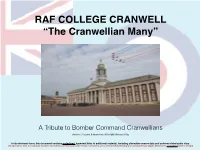
A Tribute to Bomber Command Cranwellians
RAF COLLEGE CRANWELL “The Cranwellian Many” A Tribute to Bomber Command Cranwellians Version 1.0 dated 9 November 2020 IBM Steward 6GE In its electronic form, this document contains underlined, hypertext links to additional material, including alternative source data and archived video/audio clips. [To open these links in a separate browser tab and thus not lose your place in this e-document, press control+click (Windows) or command+click (Apple Mac) on the underlined word or image] Bomber Command - the Cranwellian Contribution RAF Bomber Command was formed in 1936 when the RAF was restructured into four Commands, the other three being Fighter, Coastal and Training Commands. At that time, it was a commonly held view that the “bomber will always get through” and without the assistance of radar, yet to be developed, fighters would have insufficient time to assemble a counter attack against bomber raids. In certain quarters, it was postulated that strategic bombing could determine the outcome of a war. The reality was to prove different as reflected by Air Chief Marshal Sir Arthur Harris - interviewed here by Air Vice-Marshal Professor Tony Mason - at a tremendous cost to Bomber Command aircrew. Bomber Command suffered nearly 57,000 losses during World War II. Of those, our research suggests that 490 Cranwellians (75 flight cadets and 415 SFTS aircrew) were killed in action on Bomber Command ops; their squadron badges are depicted on the last page of this tribute. The totals are based on a thorough analysis of a Roll of Honour issued in the RAF College Journal of 2006, archived flight cadet and SFTS trainee records, the definitive International Bomber Command Centre (IBCC) database and inputs from IBCC historian Dr Robert Owen in “Our Story, Your History”, and the data contained in WR Chorley’s “Bomber Command Losses of the Second World War, Volume 9”. -

WHO's WHO in the WAR in EUROPE the War in Europe 7 CHARLES DE GAULLE
who’s Who in the War in Europe (National Archives and Records Administration, 342-FH-3A-20068.) POLITICAL LEADERS Allies FRANKLIN DELANO ROOSEVELT When World War II began, many Americans strongly opposed involvement in foreign conflicts. President Roosevelt maintained official USneutrality but supported measures like the Lend-Lease Act, which provided invaluable aid to countries battling Axis aggression. After Pearl Harbor and Germany’s declaration of war on the United States, Roosevelt rallied the country to fight the Axis powers as part of the Grand Alliance with Great Britain and the Soviet Union. (Image: Library of Congress, LC-USZ62-128765.) WINSTON CHURCHILL In the 1930s, Churchill fiercely opposed Westernappeasement of Nazi Germany. He became prime minister in May 1940 following a German blitzkrieg (lightning war) against Norway, Denmark, the Netherlands, Belgium, and France. He then played a pivotal role in building a global alliance to stop the German juggernaut. One of the greatest orators of the century, Churchill raised the spirits of his countrymen through the war’s darkest days as Germany threatened to invade Great Britain and unleashed a devastating nighttime bombing program on London and other major cities. (Image: Library of Congress, LC-USW33-019093-C.) JOSEPH STALIN Stalin rose through the ranks of the Communist Party to emerge as the absolute ruler of the Soviet Union. In the 1930s, he conducted a reign of terror against his political opponents, including much of the country’s top military leadership. His purge of Red Army generals suspected of being disloyal to him left his country desperately unprepared when Germany invaded in June 1941. -

SURVEY of CURRENT BUSINESS June 1941 Monthly Business Indicators, 1936-41 INDUSTRIAL PRODUCTION INCOME PAYMENTS * 160 (VOLUME, 1935-39 = 100) 1 10(1929 • L(30)
JUNE 1941 SURVEY OF RE S UNITED STATES DEPARTMENT OF COMMERCE BUREAU OF FOREIGN AND DOMESTIC COMMERCE VOLUME 21 NUMBER 6 The Code ©I Federal Regulations The National Archives of the United States Division ol the Federal Regisfei «ol« by the Superintendent of Documents, Washington, D. C. The Code of Federal Regulations, recently pub- lished by fhe Division of the Federal Register, ccniair^ all Ihi regulailons of genera) applicabiiii}r end legal ciiec?, as of June 1, 1938, promulgated by ovc-r 103 admirjsirative agencies ci the United States Government, The Code consists of 50 titles (analogous to the titles of ike United States Code) and a general index. It is bound in 15 volumes containing 17 books and is arranged in a systematic manner by chapters and parts to facilitate seaich and reference, Each volume sells for $2.25 excepting Volumes 7 and 14, which consist of two books each and are sold for $4i>0 a set. For further information, address: Major B. R. Kennedy, Director, Division of the Federal Register. UNITED STATES DEPARTMENT OF COMMERCE JESSE H. JONES, Secretary BUREAU OF FOREIGN AND DOMESTIC COMMERCE CARROLL L. WILSON, Director SURVEY OF CURRENT BUSINESS DIVISION OF RESEARCH AND STATISTICS CHARLES A. R. WARDWELL, Chief, Current Business Analysis Unit JOHN D. WILSON, In Charge, Survey of Current Business Volume 21 JUNE 1941 Number 6 CONTENTS Page Page The business situation 3 Figure 5.—Indexes of wholesale prices, January 2, 1937-May 24, Steel placed under limited priority status 4 1941 6 Consumption at record level 5 Figure 6.—Total freight-car loadings and loadings of the miscellane- Agricultural programs increase prices 6 ous and coal classes, January 7, 1939, through May 24, 1941 8 Growth in machine tool output. -

The First Americans the 1941 US Codebreaking Mission to Bletchley Park
United States Cryptologic History The First Americans The 1941 US Codebreaking Mission to Bletchley Park Special series | Volume 12 | 2016 Center for Cryptologic History David J. Sherman is Associate Director for Policy and Records at the National Security Agency. A graduate of Duke University, he holds a doctorate in Slavic Studies from Cornell University, where he taught for three years. He also is a graduate of the CAPSTONE General/Flag Officer Course at the National Defense University, the Intelligence Community Senior Leadership Program, and the Alexander S. Pushkin Institute of the Russian Language in Moscow. He has served as Associate Dean for Academic Programs at the National War College and while there taught courses on strategy, inter- national relations, and intelligence. Among his other government assignments include ones as NSA’s representative to the Office of the Secretary of Defense, as Director for Intelligence Programs at the National Security Council, and on the staff of the National Economic Council. This publication presents a historical perspective for informational and educational purposes, is the result of independent research, and does not necessarily reflect a position of NSA/CSS or any other US government entity. This publication is distributed free by the National Security Agency. If you would like additional copies, please email cchpubs@nsa.gov or write to: Center for Cryptologic History National Security Agency 9800 Savage Road, Suite 6886 Fort George G. Meade, MD 20755 Cover: (Top) Navy Department building, with Washington Monument in center distance, 1918 or 1919; (bottom) Bletchley Park mansion, headquarters of UK codebreaking, 1939 UNITED STATES CRYPTOLOGIC HISTORY The First Americans The 1941 US Codebreaking Mission to Bletchley Park David Sherman National Security Agency Center for Cryptologic History 2016 Second Printing Contents Foreword ................................................................................ -

Germany 1919-1941 U.S
U.S. MILITARY INTELLIGENCE REPORTS : GERMANY 1919-1941 U.S. MILITARY INTELLIGENCE REPORTS: GERMANY, 1919-1941 Edited by Dale Reynolds Guide Compiled by Robert Lester A Microfilm Project of UNIVERSITY PUBLICATIONS OF AMERICA, INC. 44 North Market Street • Frederick, MD 21701 Copyright© 1983 by University Publications of America, Inc. All rights reserved. ISBN 0-89093^26-6. Note on Sources The Documents in this Collection are from the National Archives and Record Service, Washington, D.C., Record Group #165. Mil- itary Intelligence Division Files: Germany. TABLE OF CONTENTS Red Index 1 Reel I 1 Reel II 6 Reel III 10 Reel IV 15 Reel V 18 Reel VI 22 Reel VII 25 Reel VIII 29 Reel IX 31 Reel X 33 Reel XI 33 Reel XII 34 Reel XIII 35 Reel XIV 38 Reel XV 39 Reel XVI 41 Reel XVII 43 Reel XVIII 45 Reel XIX 47 Reel XX 49 Reel XXI 52 Reel XXII 54 Reel XXIII 56 Reel XXIV 58 Reel XXV 61 Reel XXVI 63 Reel XXVII 65 Reel XXVIII 68 Subject Index 71 Dates to Remember February 3,1917 Severance of U.S. Diplomatic Relations with Germany; Declara- tion of War November 11,1918 Armistice December 1, 1918 U.S. Troops of the 3rd Army cross the Rhine and Occupy the Rhine Province July 2,1919 Departure of the U.S. 3rd Army; the U.S. Army of the Rhine Occupies Coblenz in the Rhine Province December 10, 1921 Presentation of Credentials of the U.S. Charge d'Affaires in Berlin April 22, 1922 Withdrawal of U.S. -

Pearl Harbor Revisited: U.S
United States Cryptologic History Cryptologic States United United States Cryptologic History Pearl Harbor Revisited: U.S. Navy Communications Intelligence 1924–1941 Pearl Harbor Revisited Harbor Pearl 2013 Series IV: World War II | Volume 6 n57370 Center for Cryptologic History This publication presents a historical perspective for informational and educational purposes, is the result of independent research, and does not necessarily reflect a position of NSA/CSS or any other U.S. government entity. This publication is distributed free by the National Security Agency. If you would like additional copies, please submit your request to: Center for Cryptologic History National Security Agency 9800 Savage Road, Suite 6886 Fort George G. Meade, MD 20755 Frederick D. Parker retired from NSA in 1984 after thirty-two years of service. Following his retirement, he worked as a reemployed annuitant and volunteer in the Center for Cryptologic His- tory. Mr. Parker served in the U.S. Marine Corps from 1943 to 1945 and from 1950 to 1952. He holds a B.S. from the Georgetown University School of Foreign Service. Cover: First Army photo of the bombing of Hawaii, 7 December 1941; the battleship USS Arizona in background is on fire and sinking. Signal Corps photo taken from Aeia Heights. Pearl Harbor Revisited: U.S. Navy Communications Intelligence 1924–1941 Frederick D. Parker Series IV: World War II | Volume 6 Third edition 2013 Contents Foreword ...................................................................... 5 Introduction ................................................................. -

The Battle for China
The Battle for China ESSAYS ON THE MILITARY HISTORY OF THE SINO-JAPANESE WAR OF 1937-1945 Edited by Mark Peattie, Edward J. Drea, and Hans van de Ven STANFORD UNIVERSITY PRESS STANFORD, CALIFORNIA There is no instance of a nation benefiting from prolonged warfare. Stanford University Press Stanford, California —Sunzi ©2.011 by the Board of Trustees of the Leland Stanford Junior University. All rights reserved. No part of this book may be reproduced or transmitted in any form or by any means, electronic or mechanical, including photocopying and recording, or in any information storage or retrieval system without the prior written permis- sion of Stanford University Press. Maps produced by David Rennie. Japan photographs reproduced with permission of AFLO/Mainichi Shimbun. Printed in the United States of America on acid-free, archival-quality paper Library of Congress Cataloging-in-Publication Data The battle for China : essays on the military history of the Sino-Japanese War of 1937-1945 / edited by Mark Peattie, Edward Drea, and Hans van de Ven. p. cm. Includes bibliographical references and index. ISBN 978-0-8047-6206-9 (cloth : alk. paper) i. Sino-Japanese War, 1937-1945—Campaigns—China, i. China— History, Military—1912-1949. 3. Japan—History, Military—1868-1945. I. Peattie, Mark R., 1930- II. Drea, Edward J., 1944- III. Van de Ven, Hans J. 05777.53.6337 2011 940.54*251—dczz 1010042047 Typeset by BookMatters in 10/12.5 Sabon W Chinese Operations in INDIA North Burma f \ Overview of Major Military Campaigns October 1943 - March 1945 during the Sino-Japanese War, i937-I945 • —'^ Chinese Offensives o> Japanese Strongpoints EDWARD J. -
Raf Bomber Command and No. 6 (Canadian) Group
ANGLO-CANADIAN WARTIME RELATIONS, 1939-1945: RAF BOMBER COMMAND AND NO. 6 (CANADIAN) GROUP By (£) WILLIAMS. CARTER, B.A., M.A. Submitted to the School of Graduate Studies in Partial Fulfilment of the Requirements for the Degree Doctor of Philosophy McMaster University April 1989 ANGLO-CANADIAN WARTIME RELATIONS, 1939-1945: RAF BOMBER COMMAND AND NO. 6 (CANADIAN) GROUP DOCTOR OF PHILOSOPHY (1989) McMASTER UNIVERSITY (History) Hamilton, Ontario TITLE: Anglo-Canadian Wartime Relations, 1939-1945: RAF Bomber Command and No. 6 (Canadian) Group AUTHOR: Williams. Carter, B.A. (York University) M.A. (McMaster University) SUPERVISOR: Professor John P. Campbell NUMBER OF PAGES: viii, 239 ii ABSTRACT In its broadest perspective the following thesis is a case study in Anglo-Canadian relations during the Second World War. The specific subject is the relationship between RAF Bomber Command and No. 6 (Canadian) Group, with emphasis on its political, operational (military), and social aspects. The Prologue describes the bombing raid on Dortmund of 6/7 October, 1944, and has two purposes. The first is to set the stage for the subsequent analysis of the Anglo Canadian relationship and to serve as a reminder of the underlying operational realities. The second is to show to what extent Canadian air power had grown during the war by highlighting the raid that was No. 6 Group's maximum effort of the bombing campaign. Chapter 1 deals with the political negotiations and problems associated with the creation of No. 6 Group on 25 October, 1942. The analysis begins with an account of how the Mackenzie King government placed all RCAF aircrew graduates of the British Commonwealth Air Training Plan at iii the disposal of the RAF and then had to negotiate for the right to concentrate RCAF aircrew overseas in their own squadrons and higher formations. -

Luftwaffe Victories Against Handley Page Halifax
Date Rank First Name Last name Staffel Unit Enemy Place 13.6.1941 Oblt. Paul Semrau 3. NJG 2 Halifax Finningley 24.6.1941 Oblt. Reinhold Eckardt Stab II. NJG 1 Halifax Buxtehude 30.6.1941 Ltn. Jakob Bender I. NJG 1 Halifax E. Tönning 30.6.1941 Oblt. Walter Fenske I. NJG 1 Halifax S. Garding 30.6.1941 Oblt. Walter Fenske I. NJG 1 Halifax SW Husum 30.6.1941 Ofw. Gerhard Herzog 2. NJG 1 Halifax SW Husum 9.7.1941 Ltn. August Geiger III. NJG 1 Halifax 10km S. Nijmegen 24.7.1941 Uffz. Helmut Baudach 1. JG 2 Halifax 27/3/7: 500m 24.7.1941 Oblt. Helmut Belser 2.Erg. JG 53 Halifax Pl.Qu. 27/3/4/14 West: 50m 24.7.1941 Uffz. Heinz Bross 2.Erg. JG 53 Halifax - 24.7.1941 Fw. Kurt Dols 2.Erg. JG 53 Halifax - 24.7.1941 Ofw. Franz Gawlick 2.Erg. JG 53 Halifax - 24.7.1941 Ofw. Franz Kaiser 2.Erg. JG 53 Halifax - 24.7.1941 Fw. Wolfgang Liedig 2. JG 2 Halifax - 24.7.1941 Fw. Harry Mayer 1. JG 2 Halifax La Rochelle 24.7.1941 Ofw. Gerhard Mund 2. JG 2 Halifax - 24.7.1941 Fw. Ernst Reckers 2.Erg. JG 53 Halifax - 24.7.1941 Ofw. Rudolf Täschner 1. JG 2 Halifax - 6.8.1941 Ltn. Hans-Joachim Redlich I. NJG 1 Halifax 5km NE St. Trond 8.8.1941 Ofw. Wilhelm Beier 3. NJG 2 Halifax 200km E. Withernsea [1424] 13.8.1941 Ltn. Hans Autenrieth 6.