Human Rights and Democracy: the 2013 Foreign & Commonwealth Office Report
Total Page:16
File Type:pdf, Size:1020Kb
Load more
Recommended publications
-

Download Download
ASEAS 11(1) 2018 Österreichische Zeitschrift für Südostasienwissenschaften Austrian Journal of South-East Asian Studies FOCUS THE POLITICAL ECONOMY OF NEW AUTHORITARIANISM ASEAS Österreichische Zeitschrift für Südostasienwissenschaften Austrian Journal of South-East Asian Studies ASEAS Österreichische Zeitschrift für Südostasienwissenschaften Austrian Journal of South-East Asian Studies The Austrian Journal of South-East Asian Studies (ASEAS) is an international, interdisciplinary, and open access social sciences journal covering a variety of topics (culture, economics, geography, politics, society) from both historical and contemporary perspectives. Topics are related to Southeast Asia, but are not restricted to the geographical region, when spatial and political borders of Southeast Asia are crossed or transcended, e.g., in the case of linguistics, diaspora groups, or forms of socio-cultural transfer. ASEAS publishes two focus issues per year and we welcome out-of-focus submissions at any time. The journal invites both established as well as young scholars to present research results and theoretical and methodical discussions, to report about on-going research projects or field studies, to publish conference reports, to conduct interviews with experts in the field, and to review relevant books. Articles can be submitted in German or English. MEDIENINHABERIN & HERAUSGEBERIN / PUBLISHER SEAS – Gesellschaft für Südostasienwissenschaften / Society for South-East Asian Studies ZVR-Zahl 786121796, Kreitnergasse 44/31, 1160 Wien, Austria GEGENSTAND / PURPOSE Der Verein SEAS bezweckt unter anderem die Förderung der Südostasienwissenschaften und der Bildung des wissenschaftlichen Nachwuchses, sowie des Stellenwertes und der Auseinandersetzung mit der Region Südostasien in Österreich und darüber hinaus. OFFENLEGUNG / DISCLOSURE (§ 25MEDG) Der Verein SEAS ist zu 100 Prozent Eigentümer von ASEAS. -

Capacity Building for Human Rights Defenders on Enforced Disappearance
Capacity Building for Human Rights Defenders on Enforced Disappearance Odhikar angladesh returned to democracy following the fall of an auto- cratic regime through a popular upsurge in 1990. Since then, three Bcredible elections were held successfully. However the growth of constitutional liberties still faces some challenges. Democracy or free and fair elections alone are not enough to protect the rights of the disadvantaged and vulnerable groups. Continued occur- rences of election violence, arbitrary arrests, custodial death, and torture by state and non-state actors hamper the enjoyment of civil and political rights, often with ominous consequences. he need for an independent and objec- tive human rights organization in safeguarding basic human rights, particu- larly civil and political rights of the people of Bangladesh was strongly felt. In 1994, a group of human rights activists underscored in a meeting the need to uphold the civil and political rights of the people of Bangladesh along with social, cultural and economic rights. Eventually, a decision was arrived at to form an organization in order to advance such rights. On 10 October 1994, Odhikar (a Bangla word that means rights) came into being with the aim of creating a wide monitoring and awareness raising system on the abuse of civil and political rights. Odhikar adopted the following principal objectives: to raise the aware- ness of human rights and its various abuses, on the one hand, and to create a vibrant democratic system through election monitoring on the other. he organization also performs policy advocacy to address the current human rights situation. By not establishing ield or branch oices, Odhikar instead trained more than ive hundred people all over the country to become hu- man rights defenders, who are relied upon for information outside Dhaka. -

UNA Mag July-Sep 2007.Qxp
NEWWORLD News and comment on the United Nations and UNA–UK On track or derailed? Progress towards the UN Millennium Development Goals PLUS: Justice not Vengeance It’s time to ditch the death penalty 2007 Review of UN Peace Operations Page 14 War and Democratic Accountability Page 20 UNITED NATIONS ASSOCIATION OF THE UK 3 Whitehall Court, London SW1A 2EL The UN Human Rights Council Page 22 www.una.org.uk Cartooning for Peace Page 35 £3.00 July–September 2007 Global Warming and the WI Page 38 UNA-UK CONTENTS Letter from the Executive Director 3 UNAUK Directory 4 UN: Miscellany 5 070707: the MDG Halfway Point 6 2007 Review of UN Peace Operations 14 UNAUK in Parliament 17 Annual Conference 2007 18 Waging War and Democratic Accountability 20 The UN Human Rights Council 22 It’s Time to Ditch the Death Penalty 26 The Oxford Handbook on the United Nations 29 Cartooning for Peace 35 UNA Westminster Pays Tribute to Peacekeepers 36 The Women’s Institute Tackles Waste 38 The Membership at Work 39 What’s On? 40 Books on the UN 41 Web Resources and Letters 42 Young Professionals Network 43 Newer World 46 MDGs Progress Chart 48 New World Subscription: is published by UNA-UK, 3 Whitehall Court, London SW1A 2EL Copies of New World are included in the membership fee for UNA-UK. www.una.org.uk Design: Advertisements: John Schwartz, john@thefrontline.net To advertise please call Veronica Lie on 020 7766 3451. The United Nations Association of Great Britain and Northern Ireland is ISSN: a company limited by guarantee (registered no. -

Download Book
84 823 65 Special thanks to the Independent Institute of Socio-Economic and Political Studies for assistance in getting access to archival data. The author also expresses sincere thanks to the International Consortium "EuroBelarus" and the Belarusian Association of Journalists for information support in preparing this book. Photos by ByMedia.Net and from family albums. Aliaksandr Tamkovich Contemporary History in Faces / Aliaksandr Tamkovich. — 2014. — ... pages. The book contains political essays about people who are well known in Belarus and abroad and who had the most direct relevance to the contemporary history of Belarus over the last 15 to 20 years. The author not only recalls some biographical data but also analyses the role of each of them in the development of Belarus. And there is another very important point. The articles collected in this book were written at different times, so today some changes can be introduced to dates, facts and opinions but the author did not do this INTENTIONALLY. People are not less interested in what we thought yesterday than in what we think today. Information and Op-Ed Publication 84 823 © Aliaksandr Tamkovich, 2014 AUTHOR’S PROLOGUE Probably, it is already known to many of those who talked to the author "on tape" but I will reiterate this idea. I have two encyclopedias on my bookshelves. One was published before 1995 when many people were not in the position yet to take their place in the contemporary history of Belarus. The other one was made recently. The fi rst book was very modest and the second book was printed on classy coated paper and richly decorated with photos. -
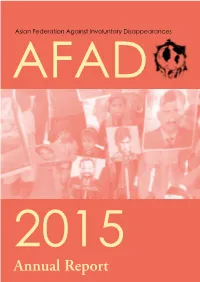
Annual Report Table of Contents
Asian Federation Against Involuntary Disappearances AFAD 2015 Annual Report Table of Contents I. AFAD’s Mission, Vision, Goals ..................................................................................................... 1 II. AFAD’s Work in 2014 ................................................................................................................. 2 1. Introduction ........................................................................................................................... 2 2. Programs and Services ............................................................................................................... 4 2.1 Campaign and Lobby ....................................................................................................... 5 2.1.1 Lobbying work at various levels ............................................................................. 5 2.1.2 Formation of National Coalitions Working on Enforced Disappearances .................................................................. 13 2.1. 3 Country Specific Campaigns................................................................................ 16 A. Country Specific Campaign on Laos ...................................................................... 16 B. Country Specific Campaign on the Philippines ..................................................... 20 C. Country Specific Campaign on Indonesia ............................................................. 28 2.1.4 Information Dissemination and Breaking Impunity ............................................. -

Amnesty International Report 2014/15 the State of the World's Human Rights
AMNESTY INTERNATIONAL OF THE WORLD’S HUMAN RIGHTS THE STATE REPORT 2014/15 AMNESTY INTERNATIONAL REPORT 2014/15 THE STATE OF THE WORLD’S HUMAN RIGHTS The Amnesty International Report 2014/15 documents the state of human rights in 160 countries and territories during 2014. Some key events from 2013 are also reported. While 2014 saw violent conflict and the failure of many governments to safeguard the rights and safety of civilians, significant progress was also witnessed in the safeguarding and securing of certain human rights. Key anniversaries, including the commemoration of the Bhopal gas leak in 1984 and the Rwanda genocide in 1994, as well as reflections on 30 years since the adoption of the UN Convention against Torture, reminded us that while leaps forward have been made, there is still work to be done to ensure justice for victims and survivors of grave abuses. AMNESTY INTERNATIONAL This report also celebrates those who stand up REPORT 2014/15 for human rights across the world, often in difficult and dangerous circumstances. It represents Amnesty International’s key concerns throughout 2014/15 the world, and is essential reading for policy- THE STATE OF THE WORLD’S makers, activists and anyone with an interest in human rights. HUMAN RIGHTS Work with us at amnesty.org AIR_2014/15_cover_final.indd All Pages 23/01/2015 15:04 AMNESTY INTERNATIONAL Amnesty International is a global movement of more than 7 million people who campaign for a world where human rights are enjoyed by all. Our vision is for every person to enjoy all the rights enshrined in the Universal Declaration of Human Rights and other international human rights standards. -
Annual Progress Report for 2011
¦ø−-ºö®-»ö´-»È¸´-²ñ©-ê½-−¾ Participatory Development Training Centre (PADETC) P.O.Box 2147 Vientiane Lao PDR.180 Nakham of Luang Prabang Road.Sikhot Vientiane.Tel & Fax (856-21) 219130 E-mail: padetc@padetc.org ANNUAL REPORT 2011 Name of the Project: Padetc 2009 - 2012 Project Number: LAO-501623-0006078 Report Period: January – December 2011 Date of Submission: April 2011 Logos of Donors who support this project: Oxfam Novib 1 TABLE OF CONTENT PAGE Section I: Analytical Summary ……………. .…………………………………………………...03 Section II: PADETC's programming……………………………………………………………..04 Section III: Principal risks and the milestones of risks mitigation for the reporting period…...…18 Section IV: Conclusion and Lesson learnt………………………………………………..............23 ANNEXES: - Annex 1- Interview of Management Committee - Annex 2 - Impact Assessment Report 2011 - Annex 2.1 - Field modeling report by Miki - Annex 2.2 - XIENGKHOUANG REPORT - Annex 3 - film script - Annex 4 - TOKYO TALK - Final - Annex 5 - API Invitation Letter Keynote Speaker Aj Sombat - Annex 5 - Walk the Talk - Annex 6 - API Keynote Speech - Annex 7 - Sombath Interview by API - Annex 8 - Wisdom Box Action Research - Annex 9 - LH Sharing of Village Mapping edit - Annex 10 - Lao debate - 07 Dec 2011 - Annex 11- Financial summary - Annex 12 - Operational Budget for the Next Project Year, including the Opening Balance 2 SECTION I ANALYTICAL SUMMARY With the policy focus on Foreign Direct Investment (FDI) led economic growth, Lao PDR has continued to record Gross Domestic Product (GDP) growth rates of 6-8 percent over the past five years, with 8.1 percent recorded in 2010. Foreign Direct Investment in hydropower, mining, commercial agriculture and timber have increased, as have revenues from tourism. -

Review–Chronicle
REVIEWCHRONICLE of the human rights violations in Belarus in 2005 Human Rights Center Viasna ReviewChronicle » of the Human Rights Violations in Belarus in 2005 VIASNA « Human Rights Center Minsk 2006 1 REVIEWCHRONICLE of the human rights violations in Belarus in 2005 » VIASNA « Human Rights Center 2 Human Rights Center Viasna, 2006 REVIEWCHRONICLE of the human rights violations in Belarus in 2005 INTRODUCTION: main trends and generalizations The year of 2005 was marked by a considerable aggravation of the general situation in the field of human rights in Belarus. It was not only political rights » that were violated but social, economic and cultural rights as well. These viola- tions are constant and conditioned by the authoritys voluntary policy, with Lu- kashenka at its head. At the same time, human rights violations are not merely VIASNA a side-effect of the authoritarian state control; they are deliberately used as a « means of eradicating political opponents and creating an atmosphere of intimi- dation in the society. The negative dynamics is characterized by the growth of the number of victims of human rights violations and discrimination. Under these circums- tances, with a high level of latent violations and concealed facts, with great obstacles to human rights activity and overall fear in the society, the growth points to drastic stiffening of the regimes methods. Apart from the growing number of registered violations, one should men- Human Rights Center tion the increase of their new forms, caused in most cases by the development of the state oppressive machine, the expansion of legal restrictions and ad- ministrative control over social life and individuals. -

State of the World's Minorities and Indigenous Peoples 2013
Focus on health minority rights group international State of the World’s Minorities and Indigenous Peoples 2013 Events of 2012 State of theWorld’s Minorities and Indigenous Peoples 20131 Events of 2012 Front cover: A Dalit woman who works as a Community Public Health Promoter in Nepal. Jane Beesley/Oxfam GB. Inside front cover: Indigenous patient and doctor at Klinik Kalvary, a community health clinic in Papua, Indonesia. Klinik Kalvary. Inside back cover: Roma child at a community centre in Slovakia. Bjoern Steinz/Panos Acknowledgements Support our work Minority Rights Group International (MRG) Donate at www.minorityrights.org/donate gratefully acknowledges the support of all organizations MRG relies on the generous support of institutions and individuals who gave financial and other assistance and individuals to help us secure the rights of to this publication, including CAFOD, the European minorities and indigenous peoples around the Union and the Finnish Ministry of Foreign Affairs. world. All donations received contribute directly to our projects with minorities and indigenous peoples. © Minority Rights Group International, September 2013. All rights reserved. Subscribe to our publications at www.minorityrights.org/publications Material from this publication may be reproduced Another valuable way to support us is to subscribe for teaching or for other non-commercial purposes. to our publications, which offer a compelling No part of it may be reproduced in any form for analysis of minority and indigenous issues and commercial purposes without the prior express original research. We also offer specialist training permission of the copyright holders. materials and guides on international human rights instruments and accessing international bodies. -

Human Rights & Democracy the 2016 Foreign & Commonwealth Office
Human Rights & Democracy Cp 104 The 2018 Foreign & Commonwealth Office Report Human Rights & Democracy The 2018 Foreign & Commonwealth Office Report Presented to Parliament by the Secretary of State for Foreign and Commonwealth Affairs by Command of Her Majesty June 2019 Cp 104 Human Rights and Democracy: The 2018 Foreign & Commonwealth Office Report © Crown copyright 2019 This publication is licensed under the terms of the Open Government Licence v3.0 except where otherwise stated. To view this licence, visit nationalarchives.gov.uk/doc/open-government-licence/version/3 Where we have identified any third party copyright information you will need to obtain permission from the copyright holders concerned. This publication is available at www.gov.uk/fco/human-rights-report Any enquiries regarding this publication should be sent to us at Communications Team, WH1.165, Multilateral Policy Directorate, Foreign and Commonwealth Office, King Charles Street, London SW1A 2AH ISBN 978-1-5286-1205-0 CCS0519142502 06/19 Printed on paper containing 75% recycled fibre content minimum Printed in the UK by the APS Group on behalf of the Controller of Her Majesty’s Stationery Office Designed in-house by the FCO Communication Directorate Cover image: Young Bangladeshi woman with candle (Getty Images) Human Rights and Democracy: The 2018 Foreign & Commonwealth Office Report Contents Preface by Foreign Secretary Jeremy Hunt ................................................................................. iv Foreword by Minister for Human Rights, Lord (Tariq) Ahmad of Wimbledon, the Prime Minister’s Special Envoy on Freedom of Religion or Belief, and Special Representative on Preventing Sexual Violence in Conflict ........................................................................................ v CHAPTER 1: Human Rights and Democracy Priority Themes ..................................................... -

SITUATION of HUMAN RIGHTS in BELARUS in 2014
Human Rights Centre “Viasna” SITUATION OF HUMAN RIGHTS in BELARUS in 2014 REVIEW-CHRONICLE Minsk, 2015 SITUATION OF HUMAN RIGHTS IN BELARUS in 2014 REVIEW-CHRONICLE Author and compiler: Tatsiana Reviaka Editor and author of the foreword: Valiantsin Stefanovich The edition was prepared on the basis of reviews of human rights violations in Belarus published every month in 2014. Each of the monthly reviews includes an analysis of the most important events infl uencing the observance of human rights and outlines the most eloquent and characteristic facts of human rights abuses registered over the described period. The review was prepared on the basis of personal appeals of victims of human rights abuses and the facts which were either registered by human rights activists or reported by open informational sources. The book features photos from the archive of the Human Rights Center “Viasna”, as well as from publications on the websites of Radio Free Europe/ Radio Liberty Belarus service, the Nasha Niva newspaper, tv.lrytas.lt, baj.by, gazetaby.com, and taken by Franak Viachorka and Siarhei Hudzilin. Human Rights Situation in 2014: Trends and Evaluation The situation of human rights during 2014 remained consistently poor with a tendency to deterioration at the end of the year. Human rights violations were of both systemic and systematic nature: basic civil and political rights were extremely restricted, there were no systemic changes in the fi eld of human rights (at the legislative level and (or) at the level of practices). The only positive development during the year was the early release of Ales Bialiatski, Chairman of the Human Rights Centre “Viasna” and Vice-President of the International Federation for Human Rights. -

Review-Chronicle of Human Rights Violations in Belarus in 2008
1 Human Rights Center ‘Viasna’ Review-Chronicle of human rights violations in Belarus in 2008 Minsk 2009 2 Прага вясны Review-Chronicle of human rights violations in Belarus in 2008 The book was prepared on the basis of the short reviews of the human rights situation in Belarus for each month of 2008. It begins with the gener- al analysis of the civil and political situation in the country for the reporting time. The book describes important events and the reaction of the internation- al community to them. Then there are presented some concrete facts of hu- man rights violations by which one can trace back a certain history of struggle of representatives of the Belarusian democratic community for human rights and fundamental freedoms. Among the main violations there are politically motivated criminal and administrative persecution, trampling upon the free- dom of expression, prohibition of peaceful assemblies and denial of the right to association. The book includes photos from the web resources photo.bymedia.net, nn.by, charter97.org, spring96.org. ISBN 15-26496-006-P 3 Contents Review-Chronicle of Human Rights Violations in Belarus in January 2008 ....................................................................................6 Administrative punishment of participants of peaceful protest actions ......... 8 Politically motivated criminal cases .................................................................. 9 Torture and other kinds of violent and inhuman treatment .......................... 11 Freedom of expression and the right