Jan Baptist Weenix: the Paintings
Total Page:16
File Type:pdf, Size:1020Kb
Load more
Recommended publications
-
Art from the Ancient Mediterranean and Europe Before 1850 Gallery 15
Art from the Ancient Mediterranean and Europe before 1850 Gallery 15 QUESTIONS? Contact us at acklandlearn@unc.edu ACKLAND ART MUSEUM The University of North Carolina at Chapel Hill 101 S. Columbia Street Chapel Hill, NC 27514 Phone: 919-966-5736 MUSEUM HOURS Wed - Sat 10 a.m. - 5 p.m. Sun 1 - 5 p.m. Closed Mondays & Tuesdays. Closed July 4th, Thanksgiving, Christmas Eve, Christmas Day, & New Year’s Day. 1 Domenichino Italian, 1581 – 1641 Landscape with Fishermen, Hunters, and Washerwomen, c. 1604 oil on canvas Ackland Fund, 66.18.1 About the Art • Italian art criticism of this period describes the concept of “variety,” in which paintings include multiple kinds of everything. Here we see people of all ages, nude and clothed, performing varied activities in numerous poses, all in a setting that includes different bodies of water, types of architecture, land forms, and animals. • Wealthy Roman patrons liked landscapes like this one, combining natural and human-made elements in an orderly structure. Rather than emphasizing the vast distance between foreground and horizon with a sweeping view, Domenichino placed boundaries between the foreground (the shoreline), middle ground (architecture), and distance. Viewers can then experience the scene’s depth in a more measured way. • For many years, scholars thought this was a copy of a painting by Domenichino, but recently it has been argued that it is an original. The argument is based on careful comparison of many of the picture’s stylistic characteristics, and on the presence of so many figures in complex poses. At this point in Domenichino’s career he wanted more commissions for narrative scenes and knew he needed to demonstrate his skill in depicting human action. -
Evolution and Ambition in the Career of Jan Lievens (1607-1674)
ABSTRACT Title: EVOLUTION AND AMBITION IN THE CAREER OF JAN LIEVENS (1607-1674) Lloyd DeWitt, Ph.D., 2006 Directed By: Prof. Arthur K. Wheelock, Jr. Department of Art History and Archaeology The Dutch artist Jan Lievens (1607-1674) was viewed by his contemporaries as one of the most important artists of his age. Ambitious and self-confident, Lievens assimilated leading trends from Haarlem, Utrecht and Antwerp into a bold and monumental style that he refined during the late 1620s through close artistic interaction with Rembrandt van Rijn in Leiden, climaxing in a competition for a court commission. Lievens’s early Job on the Dung Heap and Raising of Lazarus demonstrate his careful adaptation of style and iconography to both theological and political conditions of his time. This much-discussed phase of Lievens’s life came to an end in 1631when Rembrandt left Leiden. Around 1631-1632 Lievens was transformed by his encounter with Anthony van Dyck, and his ambition to be a court artist led him to follow Van Dyck to London in the spring of 1632. His output of independent works in London was modest and entirely connected to Van Dyck and the English court, thus Lievens almost certainly worked in Van Dyck’s studio. In 1635, Lievens moved to Antwerp and returned to history painting, executing commissions for the Jesuits, and he also broadened his artistic vocabulary by mastering woodcut prints and landscape paintings. After a short and successful stay in Leiden in 1639, Lievens moved to Amsterdam permanently in 1644, and from 1648 until the end of his career was engaged in a string of important and prestigious civic and princely commissions in which he continued to demonstrate his aptitude for adapting to and assimilating the most current style of his day to his own somber monumentality. -

The Dutch School of Painting
Cornell University Library The original of tiiis book is in the Cornell University Library. There are no known copyright restrictions in the United States on the use of the text. http://www.archive.org/details/cu31924073798336 CORNELL UNIVERSITY LIBRARY 924 073 798 336 THE FINE-ART LIBRARY. EDITED BY JOHN C. L. SPARKES, Principal of the National Art Training School, South Kensington - Museum, THE Dutch School Painting. ye rl ENRY HA YARD. TRANSLATED HV G. POWELL. CASSELL & COMPANY, Limited: LONDON, PARIS, NEW YORK ,C- MELBOURNE. 1885. CONTENTS. -•o*— ClIAr. I'AGE I. Dutch Painting : Its Origin and Character . i II. The First Period i8 III. The Period of Transition 41 IV. The Grand Ki'ocii 61 V. Historical and Portrait Painters ... 68 VI. Painters of Genre, Interiors, Conversations, Societies, and Popular and Rustic Scenes . 117 VI [. Landscape Painters 190 VIII. Marine Painters 249 IX. Painters of Still Life 259 X. The Decline ... 274 The Dutch School of Painting. CHAPTER I. DUTCH PAINTING : ITS ORIGIN AND CHARACTER. The artistic energy of a great nation is not a mere accident, of which we can neither determine the cause nor foresee the result. It is, on the contrary, the resultant of the genius and character of the people ; the reflection of the social conditions under which it was called into being ; and the product of the civilisation to which it owes its birth. All the force and activity of a race appear to be concentrated in its Art ; enterprise aids its growth ; appreciation ensures its development ; and as Art is always grandest when national prosperity is at its height, so it is pre-eminently by its Art that we can estimate the capabilities of a people. -

Northern Italianate Landscape Painters
Northern Italianate Landscape Painters ... Northern artists had long spent time in Italy – hence the work of Pieter de Kempeneer (1503-1580) (Room 9) and Frans Floris (1516-1570) in the sixteenth century, who drew their inspiration from the Antique and contemporary masters. Landscape painters Paul Bril (1554-1626) and Adam Elsheimer (1574/78-1610/20) (Room 10), settled there from the end of the sixteenth century and were to influence the Italian school profoundly. However, from around 1620, the Northern Diaspora gave rise to a novel way of representing the towns and countryside of Italy. Cornelis van Poelenburgh (1595/96-1667) went to Rome in 1617 and around 1623 was among the founder members of the Bentvueghels “birds of a feather”, an association of mutual support for Northern artists, goldsmiths and “art lovers” – not only Flemish and Dutch, but Room also Germans and even a few French. He painted shepherds in the ruins and plains of Latium where the harsh light creates strong shadows. Around 1625, the Dutch painter Pieter van Berchem Laer (1599-1642 ?), nicknamed Il Bamboccio, invented the bambocciate, a different take on Caravaggesque scenes of realism showing moments of contemporary Italian low-life in ... the open air and bringing a modern feel to the subject matter. The bambocciate met with considerable success. Flemish and From these two trends – pastoral landscapes suffused with light, and racy at times Dutch Painting vulgar scenes of daily life – was to develop a whole chapter in European painting, dominated by Northern artists but also marked by Italians such as Michelangelo Cerquozzi (1602-1660) and French painters like Sébastien Bourdon (1616-1671). -

Masters of Mobility Cultural Exchange Between the Netherlands and Germany in the Long 17Th Century
Masters of Mobility Cultural Exchange between the Netherlands and Germany in the Long 17th Century 8-9 October 2017: International two-day symposium on the occasion of the 75th anniversary of Horst Gerson’s publication Ausbreitung und Nachwirkung der holländischen Malerei des 17. Jahrhunderts Sunday 8 October, 2017: Rijksmuseum, Amsterdam 09.00 - 09.30 Registration and Coffee INTRODUCTION 09.30 - 09.35 Taco Dibbits, Welcome 09.35 - 09.45 Gregor Weber, Introduction 09.45 - 10.05 Rieke van Leeuwen, Presentation of Gerson Digital: Germany and Visualization of 'Masters of Mobility' 10.05 - 10.25 Th. DaCosta Kaufmann, Gerson's Ausbreitung and its Meaning for the Study of Netherlandish Art in the International Context 10.25 - 10.45 Johannes Müller, Later-generation Migrants and their Impact on Cultural Transfer between Germany and the Low Countries 10.45 - 11.00 Discussion 11.00 -11.25 Coffee NETWORKS OF NETHERLANDISH-GERMAN CULTURAL EXCHANGE 11.25 - 11.30 Chair, Introduction to Section 11.30 - 11.50 Katharina Schmidt-Loske and Kurt Wettengl, Flemish Artists in Frankfurt around 1600 11.50 - 12.10 Amanda Herrin, Working Together - Apart: Collaborative Printmaking across Religious Conflict 12.10 - 12.30 Berit Wagner, The Art Dealer Family of Caymox, as Mediators of Flemish Artworks around 1600 12.30 - 12.40 Discussion 12.40 - 13.45 Lunch COURT ARTISTS FROM THE LOW COUNTRIES IN GERMANY 13.45 - 13.50 Chair, Introduction to Section 13.50 - 14.10 Marten Jan Bok, Court Artists from the Low Countries in Germany 14.10 - 14.30 Gero Seelig, Dutch and Flemish artists in Mecklenburg in the 16th and 17th centuries 14.30 - 14.50 Frits Scholten, The Legacy of Johan Gregor van der Schardt in Nuremberg 14.50 - 15.10 Gabri van Tussenbroek, Dutch Architects, Engineers and Entrepreneurs in Berlin and Brandenburg (1648-1688) 15.10 - 15.20 Discussion 15.20 - 15.40 Tea 15.40 - 16.00 Anna Koldeweij, German Relations of the Still-life Painter Rachel Ruysch (1664-1750). -
Open Access Version Via Utrecht University Repository
Philosopher on the throne Stanisław August’s predilection for Netherlandish art in the context of his self-fashioning as an Enlightened monarch Magdalena Grądzka Philosopher on the throne Magdalena Grądzka Philosopher on the throne Stanisław August’s predilection for Netherlandish art in the context of his self-fashioning as an Enlightened monarch Magdalena Grądzka 3930424 March 2018 Master Thesis Art History of the Low Countries in its European Context University of Utrecht Prof. dr. M.A. Weststeijn Prof. dr. E. Manikowska 1 Philosopher on the throne Magdalena Grądzka Index Introduction p. 4 Historiography and research motivation p. 4 Theoretical framework p. 12 Research question p. 15 Chapters summary and methodology p. 15 1. The collection of Stanisław August 1.1. Introduction p. 18 1.1.1. Catalogues p. 19 1.1.2. Residences p. 22 1.2. Netherlandish painting in the collection in general p. 26 1.2.1. General remarks p. 26 1.2.2. Genres p. 28 1.2.3. Netherlandish painting in the collection per stylistic schools p. 30 1.2.3.1. The circle of Rubens and Van Dyck p. 30 1.2.3.2. The circle of Rembrandt p. 33 1.2.3.3. Italianate landscapists p. 41 1.2.3.4. Fijnschilders p. 44 1.2.3.5. Other Netherlandish artists p. 47 1.3. Other painting schools in the collection p. 52 1.3.1. Paintings by court painters in Warsaw p. 52 1.3.2. Italian paintings p. 53 1.3.3. French paintings p. 54 1.3.4. German paintings p. -

Dutch and Flemish Art in Russia
Dutch & Flemish art in Russia Dutch and Flemish art in Russia CODART & Foundation for Cultural Inventory (Stichting Cultuur Inventarisatie) Amsterdam Editors: LIA GORTER, Foundation for Cultural Inventory GARY SCHWARTZ, CODART BERNARD VERMET, Foundation for Cultural Inventory Editorial organization: MARIJCKE VAN DONGEN-MATHLENER, Foundation for Cultural Inventory WIETSKE DONKERSLOOT, CODART English-language editing: JENNIFER KILIAN KATHY KIST This publication proceeds from the CODART TWEE congress in Amsterdam, 14-16 March 1999, organized by CODART, the international council for curators of Dutch and Flemish art, in cooperation with the Foundation for Cultural Inventory (Stichting Cultuur Inventarisatie). The contents of this volume are available for quotation for appropriate purposes, with acknowledgment of author and source. © 2005 CODART & Foundation for Cultural Inventory Contents 7 Introduction EGBERT HAVERKAMP-BEGEMANN 10 Late 19th-century private collections in Moscow and their fate between 1918 and 1924 MARINA SENENKO 42 Prince Paul Viazemsky and his Gothic Hall XENIA EGOROVA 56 Dutch and Flemish old master drawings in the Hermitage: a brief history of the collection ALEXEI LARIONOV 82 The perception of Rembrandt and his work in Russia IRINA SOKOLOVA 112 Dutch and Flemish paintings in Russian provincial museums: history and highlights VADIM SADKOV 120 Russian collections of Dutch and Flemish art in art history in the west RUDI EKKART 128 Epilogue 129 Bibliography of Russian collection catalogues of Dutch and Flemish art MARIJCKE VAN DONGEN-MATHLENER & BERNARD VERMET Introduction EGBERT HAVERKAMP-BEGEMANN CODART brings together museum curators from different institutions with different experiences and different interests. The organisation aims to foster discussions and an exchange of information and ideas, so that professional colleagues have an opportunity to learn from each other, an opportunity they often lack. -

Art Appreciation Meeting 11-01-18
Art Appreciation Meeting 11-01-18 Painting 1 (Elaine Evans). John Collier (1850 – 1934): ‘Lady Godiva’ (1897). Herbert Art Gallery and Museum, Coventry. (Public Domain) Elaine talked about the history of the Herbert Art Gallery and Museum, named after Sir Alfred Herbert (1866 – 1957) an English industrialist and museum benefactor. The foundation stone of the Art Gallery and Museum was laid in 1954 and the Gallery has had a recent extension, including Archives storage and a Café. Lady Godiva was an 11th Century noblewoman, who is mentioned in the Domesday Survey. She owned land in her own right. She was just, fair, pious, proud, in strong contrast to her husband, The Earl Leofric who was a tyrant who levied an oppressive tax on his people. Elaine told the story of Lady Godiva’s ride through Coventry, naked, to shame her unpopular husband. In 1949 a statue of her was erected in Coventry. Collier was a member of the Pre-Raphaelite Brotherhood and the painting measures 4’8” x 6’. There are many paintings of Lady Godiva in the gallery. There is a sense of rich colour and heightened brush strokes in this painting. Among the many details in this painting are the richly ornamented horse cloth and the ornate column behind Lady Godiva. There is also an anomaly on the building to the right, which is not in keeping with period. Links: John Collier Lady Godiva, Herbert Art Gallery and Museum. Painting 2 (Anne Williams) Jan Asselijn (1610 - 1652). ‘The Threatened Swan’ (1650, oil) Rijksmuseum, Amsterdam. Asselijn was a Dutch Golden Age painter and this painting is in the same gallery as 'The Night Watch' by Rembrandt. -
Observing Protest from a Place
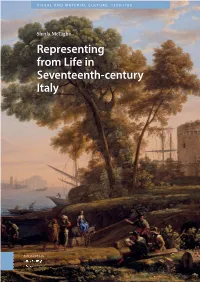
VISUAL AND MATERIAL CULTURE, 13001700 Sheila McTighe Representing from LifeLife inin Seventeenth-century Italy FOR PRIVATE AND NON-COMMERCIAL USE AMSTERDAM UNIVERSITY PRESS Representing from Life in Seventeenth-century Italy FOR PRIVATE AND NON-COMMERCIAL USE AMSTERDAM UNIVERSITY PRESS Visual and Material Culture, 1300–1700 A forum for innovative research on the role of images and objects in the late me- dieval and early modern periods, Visual and Material Culture, 1300–1700 publishes monographs and essay collections that combine rigorous investigation with critical inquiry to present new narratives on a wide range of topics, from traditional arts to seemingly ordinary things. Recognizing the fluidity of images, objects, and ideas, this series fosters cross-cultural as well as multi-disciplinary exploration. We consider proposals from across the spectrum of analytic approaches and methodologies. Series Editor Dr. Allison Levy, an art historian, has written and/or edited three scholarly books, and she has been the recipient of numerous grants and awards, from the Nation- al Endowment for the Humanities, the American Association of University Wom- en, the Getty Research Institute, the Dumbarton Oaks Research Library of Harvard University, the Whiting Foundation and the Bogliasco Foundation, among others. www.allisonlevy.com. FOR PRIVATE AND NON-COMMERCIAL USE AMSTERDAM UNIVERSITY PRESS Representing from Life in Seventeenth- century Italy Sheila McTighe Amsterdam University Press FOR PRIVATE AND NON-COMMERCIAL USE AMSTERDAM UNIVERSITY PRESS Cover illustration: Claude Lorrain. An artist studying from nature. 1639. Oil on canvas. Cincinnati Art Museum, Ohio, USA / Gift of Mary Hanna / Bridgeman Images. Cover design: Coördesign, Leiden Lay-out: Newgen/Konvertus isbn 978 94 6298 328 1 e-isbn 978 90 4853 326 8 doi 10.5117/ 9789462983281 nur 685 © S. -

A Catalogue of the Paintings at Doughty House, Richmond, & Elsewhere in the Collection of Sir Frederick Cook, Bt., Visconde
A CATALOGUE OF THE PAINTINGS IN THE COLLECTION of SIR FREDERICK COOK, BT. A CATALOGUE OF THE PAINTINGS AT DOUGHTY HOUSE RICHMOND AND ELSEWHERE IN THE COLLECTION OF SIR FREDERICK COOK BT VISCONDE DE MONSERRATE Edited by HERBERT COOK, M.A., F.S.A. VOLUME I ITALIAN SCHOOLS By DR TANCRED BORENIUS LONDON • WILLIAM HEINEMANN A CATALOGUE OFTHE PAINTINGS AT DOUGHTY HOUSE RICHMOND ELSEWHERE IN THE COLLECTION OF SIR FREDERICK COOK BT VISCONDE DE MONSERRATE EDITED BY HERBERT COOK, M.A., F.S.A. HON. MEMBER OF THE ROYAL ACADEMY OF MILAN VOLUME II DUTCH AND FLEMISH SCHOOLS By J. O. KRONIG LONDON WILLIAM HEINEMANN M DCCCC XIV PREFATORY NOTE THE second volume of the Cook colledtion is devoted to the Dutch and Flemish Schools. The art of the so-called School of the Early Netherlands is reserved for the third volume, which will also contain the English, French, German and Spanish se&ions. In the present volume 190 Dutch and Flemish piitures are recorded, and of these 100 are illustrated either on photogravure plates or by collotype process. The former are executed by the Rembrandt Photogravure Co., of 36 Basinghall Street, E.C.; the latter are the work of Messrs Knighton & Cutts, of Red Lion Court, Fleet Street, E.C. As in the previous volume, single photographs can be obtained either from Signor Domenico Anderson, of Rome, or from Mr W. E. Gray, of 92 Queen’s Road, Bays- water; the register number for ordering is always quoted whenever the photograph exists. The text has been entrusted to Mr J. -

The Prophet Elijah and the Widow of Zarephath C
National Gallery of Art NATIONAL GALLERY OF ART ONLINE EDITIONS Dutch Paintings of the Seventeenth Century Cornelis van Poelenburch Dutch, 1594/1595 - 1667 The Prophet Elijah and the Widow of Zarephath c. 1630 oil on panel overall: 35.6 x 47 cm (14 x 18 1/2 in.) framed: 51.1 x 62.1 x 5.1 cm (20 1/8 x 24 7/16 x 2 in.) Gift of Joseph F. McCrindle in honor of John Thomas Rowe, Jr. 2004.101.2 ENTRY The Prophet Elijah and the Widow of Zarephath illustrates the passage in 1 Kings 17:8–24 that recounts how the Lord led the prophet Elijah to Zarephath, where he met a widow and her son gathering sticks.[1] Elijah asked the widow for some water and bread, and although she was destitute because of the draught that had plagued the land for more than three years, she used her last bit of flour and oil to cook for him. Elijah then blessed her and her child and assured them that their supplies of flour and oil would never be diminished. Shortly thereafter the widow's son died, and Elijah prayed that the Lord would return the child to life. The Lord heard Elijah's prayer and returned the boy's soul to his body. This Old Testament story was often interpreted as exemplifying the power of faith to achieve miracles. It also portends New Testament accounts of Christ’s crucifixion and resurrection. The way the widow's son clutches a large bundle of sticks anticipates Christ’s carrying of the cross on the way to Golgotha, and because the boy was brought back from the dead, he was also seen as alluding to the resurrected Christ.[2] Significantly, when this painting appeared at auction in Paris in 1752, it was sold as a pendant to a painting by Poelenburch of Abraham and Isaac, another Old Testament story that was considered to embody the power of faith and to prefigure Christ’s death and resurrection.[3] In Poelenburch’s painting the meeting of the prophet, shown wrapped in a red robe, and the widow, who kneels before him, occurs near the end of the day under cerulean blue skies. -

305 BOEKBESPREKINGEN/BOEK REVIEWS Ronald Forsyth Millen
BOEKBESPREKINGEN/BOEK REVIEWS Ronald Forsyth Millen and Robert Erich Wolf, Heroic Deedsand sequently, they see in Mercury's pose a metaphor of fate thrusting Mystic Figures: A New Readingof Rubens' Life of Maria de' Medici, 'the freight of future responsibility on a girl as yet unwarned of Princeton University Press, 1989.1 griefs to come, of dilemmas and burdens to be resolved only through this gift of peacemaking and peacekeeping.' Likewise, in This book broadens and deepens in several ways our understand- The Death of Henryi v and the Proclamationo/?lhe the picture ing of Rubens's series of twenty-four paintings depicting the life which contains the peripeteia of the story and which is given the of Maria de' Medici, executed for the Grand Gallery of the Queen greatest visual prominence both through its double size and its Mother's new Luxembourg Palace between i 6 z and The position alone at the end of the gallery, Millen and Wolf fix their authors assume that every aspect of each picture is pregnant with attention on the Caduceus held by Mercury, one of the group of meaning and consequently organize their chapters as a sequence Olympians in the upper background who admit the apothcosized of exhaustive picture-by-picture analyses. They argue that the King among their number. Their analysis separates the attribute series as a whole and each picture is an intricate revision of histo- from the god and places the Caduceus - as emblem of peace - at a ry, constructed to reflect and justify the life and actions of the convergence of diagonals.In the authors' eyes the Caduceus be- Queen Mother from the vantage point of her policies and senti- comes the visual and symbolic center of the whole series, but this ments current at the inception of the project late in 1 6zi and view strikes me as exaggerated and contrived.