Nominal Classification in Michif by Olivia Nathene Sammons A
Total Page:16
File Type:pdf, Size:1020Kb
Load more
Recommended publications
-

Fact Sheets French, Arabic, Simplified and Traditional Chinese, Somali, Spanish
Translated COVID-19 Resources – September 24, 2020 Page 1 of 4 COVID-19 Resources Available in Multiple Languages Please note that not all resources will be appropriate for the local context. Government of Canada (all webpages available in French) Awareness resources are available in the following languages: Arabic, Bengali, Simplified or Traditional Chinese, Cree, Dene, Farsi, German, Greek, Gujarati, Hindi, Innu-Aimun, Inuinnaqtun, Inuktitut (Nunavik), Italian, Korean, Michif, Mikmaq, Ojibwe Eastern and Western, Oji-Cree, Polish, Portuguese, Punjabi, Romanian, Russian, Somali, Spanish, Tagalog, Tamil, Ukrainian, Urdu, Vietnamese Relevant Resources (selected) Languages About COVID-19 All Reduce the spread of COVID-19: Wash All your hands infographic How to care for a child with COVID-19 at All home: Advice for caregivers Physical distancing: How to slow the All except Bengali, Romanian or spread of COVID-19 Vietnamese COVID-19: How to safely use a non- All except Bengali, Traditional Chinese, medical mask or face covering (poster) Greek, Gujarati, Polish, Romanian, Urdu or Vietnamese How to quarantine (self-isolate) at home All except Bengali, Traditional Chinese, when you may have been exposed and Greek, Gujarati, Polish, Romanian, Urdu have no symptoms or Vietnamese Government of Ontario (all webpages available in French) Relevant Resources Languages COVID-19: Reopening schools and child French, Simplified and Traditional care Chinese, Farsi, Greek, Gujarati, Hindi, Italian, Korean, Polish Punjabi, Spanish, Tamil, Ukrainian, Urdu 519-822-2715 -
Indigenous Languages
INDIGENOUS LANGUAGES PRE-TEACH/PRE-ACTIVITY Have students look at the Indigenous languages and/or language groups that are displayed on the map. Discuss where this data came from (the 2016 census) and what biases or problems this data may have, such as the fear of self-identifying based on historical reasons or current gaps in data. Take some time to look at how censuses are performed, who participates in them, and what they can learn from the data that is and is not collected. Refer to the online and poster map of Indigenous Languages in Canada featured in the 2017 November/December issue of Canadian Geographic, and explore how students feel about the number of speakers each language has and what the current data means for the people who speak each language. Additionally, look at the language families listed and the names of each language used by the federal government in collecting this data. Discuss with students why these may not be the correct names and how they can help in the reconciliation process by using the correct language names. LEARNING OUTCOMES: • Students will learn about the number and • Students will learn about the importance of diversity of languages and language groups language and the ties it has to culture. spoken by Indigenous Peoples in Canada. • Students will become engaged in learning a • Students will learn that Indigenous Peoples local Indigenous language. in Canada speak many languages and that some languages are endangered. INDIGENOUS LANGUAGES Foundational knowledge and perspectives FIRST NATIONS “One of the first acts of colonization and settlement “Our languages are central to our ceremonies, our rela- is to name the newly ‘discovered’ land in the lan- tionships to our lands, the animals, to each other, our guage of the colonizers or the ‘discoverers.’ This is understandings, of our worlds, including the natural done despite the fact that there are already names world, our stories and our laws.” for these places that were given by the original in- habitants. -
Obviation in Michif Deborah Weaver
University of North Dakota UND Scholarly Commons Theses and Dissertations Theses, Dissertations, and Senior Projects 8-1-1982 Obviation in Michif Deborah Weaver Follow this and additional works at: https://commons.und.edu/theses Recommended Citation Weaver, Deborah, "Obviation in Michif" (1982). Theses and Dissertations. 672. https://commons.und.edu/theses/672 This Thesis is brought to you for free and open access by the Theses, Dissertations, and Senior Projects at UND Scholarly Commons. It has been accepted for inclusion in Theses and Dissertations by an authorized administrator of UND Scholarly Commons. For more information, please contact zeineb.yousif@library.und.edu. OBVIATION IN MICHIF by Deborah Weaver Bachelor of Science, Wheaton College, 1976 A Thesis Submitted to the Graduate Faculty of the University of North Dakota in partial fulfillment of the requirements for the degree of Master of Arts Grand Forks, North Dakota August 1982 -s J 1 I This thesis submitted by Deborah Weaver in partial ful fillment of the requirements for the Degree of Master of Arts from the University of North Dakota is hereby approved by the Faculty Advisory Committee under whom the work has been done. This thesis meets the standards for appearance and con forms to the style and format requirements of the Graduate School of the University of North Dakota, and is hereby ap proved . ( I W k i 11 Title OBVIATION IN MICHIF Department Linguistics Degree Master of Arts In presenting this thesis in partial fulfillment of the requirements for a graduate degree from the Uni versity of North Dakota, I agree that the Library of this University shall make it freely available for in spection. -
Fpcc-Newsletter-Spring-Summer-2014
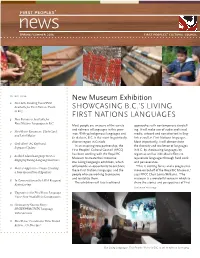
first peoples’ news spring /summer 2014 first peoples’ cultural council IN THIS ISSUE New Museum Exhibition 2 New Arts Funding from FPCC Available for First Nations Youth SHOWCASING B.C.’S LIVING in B.C. FIRST NATIONS LANGUAGES 3 New Resources Available for First Nations Languages in B.C. Most people are unaware of the variety approaches with contemporary storytell- and richness of languages in this prov- ing. It will make use of audio and visual 4 FirstVoices Resources: Flash Card ince. With 34 Indigenous languages and media, artwork and narrative text in Eng- and Label Maker 61 dialects, B.C. is the most linguistically lish as well as First Nations languages. diverse region in Canada. Most importantly, it will demonstrate 4 Geek Alert! PC Keyboard In an inspiring new partnership, the the diversity and resilience of languages Software Update First Peoples’ Cultural Council (FPCC) in B.C. by showcasing languages by has been working with the Royal BC region as well as individual efforts to 5 Seabird Island Language Nests is Museum to create the innovative rejuvenate languages through hard work Engaging Young Language Learners Our Living Languages exhibition, which and perseverance. will provide an opportunity to celebrate “This is exciting for us and a progressive 6 Mentor-Apprentice Teams Creating these First Nations languages and the move on behalf of the Royal BC Museum,” a New Generation of Speakers people who are working to preserve says FPCC Chair Lorna Williams. “The and revitalize them. museum is a wonderful venue in which to 8 In Conversation with AADA Recipient The exhibition will fuse traditional share the stories and perspectives of First Kevin Loring Continued next page… 9 Upgrades to the FirstVoices Language Tutor Now Available to Communities 10 Community Success Story: SECWEPEMCTSÍN Language Tutor Lessons 11 FirstVoices Coordinator Peter Brand Retires…Or Does He? Our Living Languages: First Peoples' Voices in B.C. -
LANGUAGES of the LAND a RESOURCE MANUAL for ABORIGINAL LANGUAGE ACTIVISTS
LANGUAGES of THE LAND A RESOURCE MANUAL FOR ABORIGINAL LANGUAGE ACTIVISTS Prepared by: Crosscurrent Associates, Hay River Prepared for: NWT Literacy Council, Yellowknife TABLE OF CONTENTS Introductory Remarks - NWT Literacy Council . 2 Definitions . 3 Using the Manual . 4 Statements by Aboriginal Language Activists . 5 Things You Need to Know . 9 The Importance of Language . 9 Language Shift. 10 Community Mobilization . 11 Language Assessment. 11 The Status of Aboriginal Languages in the NWT. 13 Chipewyan . 14 Cree . 15 Dogrib . 16 Gwich'in. 17 Inuvialuktun . 18 South Slavey . 19 North Slavey . 20 Aboriginal Language Rights . 21 Taking Action . 23 An Overview of Aboriginal Language Strategies . 23 A Four-Step Approach to Language Retention . 28 Forming a Core Group . 29 Strategic Planning. 30 Setting Realistic Language Goals . 30 Strategic Approaches . 31 Strategic Planning Steps and Questions. 34 Building Community Support and Alliances . 36 Overcoming Common Language Myths . 37 Managing and Coordinating Language Activities . 40 Aboriginal Language Resources . 41 Funding . 41 Language Resources / Agencies . 43 Bibliography . 48 NWT Literacy Council Languages of the Land 1 LANGUAGES of THE LAND A RESOURCE MANUAL FOR ABORIGINAL LANGUAGE ACTIVISTS We gratefully acknowledge the financial assistance received from the Government of the Northwest Territories, Department of Education, Culture and Employment Copyright: NWT Literacy Council, Yellowknife, 1999 Although this manual is copyrighted by the NWT Literacy Council, non-profit organizations have permission to use it for language retention and revitalization purposes. Office of the Languages Commissioner of the Northwest Territories Cover Photo: Ingrid Kritch, Gwich’in Social and Cultural Institute INTRODUCTORY REMARKS - NWT LITERACY COUNCIL The NWT Literacy Council is a territorial-wide organization that supports and promotes literacy in all official languages of the NWT. -
THE USE of INDIGENOUS LANGUAGES in PROCEEDINGS of the HOUSE of COMMONS and COMMITTEES Report of the Standing Committee on Procedure and House Affairs
THE USE OF INDIGENOUS LANGUAGES IN PROCEEDINGS OF THE HOUSE OF COMMONS AND COMMITTEES Report of the Standing Committee on Procedure and House Affairs The Honourable Larry Bagnell, Chair JUNE 2018 42nd PARLIAMENT, 1st SESSION Published under the authority of the Speaker of the House of Commons SPEAKER’S PERMISSION The proceedings of the House of Commons and its Committees are hereby made available to provide greater public access. The parliamentary privilege of the House of Commons to control the publication and broadcast of the proceedings of the House of Commons and its Committees is nonetheless reserved. All copyrights therein are also reserved. Reproduction of the proceedings of the House of Commons and its Committees, in whole or in part and in any medium, is hereby permitted provided that the reproduction is accurate and is not presented as official. This permission does not extend to reproduction, distribution or use for commercial purpose of financial gain. Reproduction or use outside this permission or without authorization may be treated as copyright infringement in accordance with the Copyright Act. Authorization may be obtained on written application to the Office of the Speaker of the House of Commons. Reproduction in accordance with this permission does not constitute publication under the authority of the House of Commons. The absolute privilege that applies to the proceedings of the House of Commons does not extend to these permitted reproductions. Where a reproduction includes briefs to a Standing Committee of the House of Commons, authorization for reproduction may be required from the authors in accordance with the Copyright Act. -
Aboriginal Languages and Selected Vitality Indicators in 2011
Catalogue no. 89-655-X— No. 001 ISBN 978-1-100-24855-4 Aboriginal Languages and Selected Vitality Indicators in 2011 by Stéphanie Langlois and Annie Turner Release date: October 16, 2014 How to obtain more information For information about this product or the wide range of services and data available from Statistics Canada, visit our website, www.statcan.gc.ca. You can also contact us by email at infostats@statcan.gc.ca, telephone, from Monday to Friday, 8:30 a.m. to 4:30 p.m., at the following toll-free numbers: • Statistical Information Service 1-800-263-1136 • National telecommunications device for the hearing impaired 1-800-363-7629 • Fax line 1-877-287-4369 Depository Services Program • Inquiries line 1-800-635-7943 • Fax line 1-800-565-7757 To access this product This product, Catalogue no. 89-655-X, is available free in electronic format. To obtain a single issue, visit our website, www.statcan.gc.ca, and browse by “Key resource” > “Publications.” Standards of service to the public Statistics Canada is committed to serving its clients in a prompt, reliable and courteous manner. To this end, Statistics Canada has developed standards of service that its employees observe. To obtain a copy of these service standards, please contact Statistics Canada toll-free at 1-800-263-1136. The service standards are also published on www.statcan.gc.ca under “About us” > “The agency” > “Providing services to Canadians.” Standard symbols Published by authority of the Minister responsible for Statistics Canada The following symbols are used in Statistics Canada publications: . -

Native American Languages, Indigenous Languages of the Native Peoples of North, Middle, and South America
Native American Languages, indigenous languages of the native peoples of North, Middle, and South America. The precise number of languages originally spoken cannot be known, since many disappeared before they were documented. In North America, around 300 distinct, mutually unintelligible languages were spoken when Europeans arrived. Of those, 187 survive today, but few will continue far into the 21st century, since children are no longer learning the vast majority of these. In Middle America (Mexico and Central America) about 300 languages have been identified, of which about 140 are still spoken. South American languages have been the least studied. Around 1500 languages are known to have been spoken, but only about 350 are still in use. These, too are disappearing rapidly. Classification A major task facing scholars of Native American languages is their classification into language families. (A language family consists of all languages that have evolved from a single ancestral language, as English, German, French, Russian, Greek, Armenian, Hindi, and others have all evolved from Proto-Indo-European.) Because of the vast number of languages spoken in the Americas, and the gaps in our information about many of them, the task of classifying these languages is a challenging one. In 1891, Major John Wesley Powell proposed that the languages of North America constituted 58 independent families, mainly on the basis of superficial vocabulary resemblances. At the same time Daniel Brinton posited 80 families for South America. These two schemes form the basis of subsequent classifications. In 1929 Edward Sapir tentatively proposed grouping these families into superstocks, 6 in North America and 15 in Middle America. -

Spirit Bear: Fishing for Knowledge, Catching Dreams Based on a True Story
Spirit Bear: Fishing for Knowledge, Catching Dreams Based on a True Story LakE BEArbine Dream Chipewyan: Nati Michif – Prairie: Pawatamihk Nipissing Dialect – Nishinaabemwin: Bwaajgan Innu – Montagnais: Paumu Innu – QC: Puamun Blackfoot: Papokan Quechua (Peru): Musquy Noray House Dialect – Cree: Pawahmowin Algonquin: Wejibaabandam Saulteaux: Pawatan Mushkego (Swampy) Cree: obwamowin Māori: Moemoea Anishinaabemowin: Bawajigan Carrier: Wahlelh Inuktitut: Sinakturtuq Dene: Nats’e’te Dream Chipewyan: Nati Michif – Prairie: Pawatamihk Nipissing Dialect – Nishinaabemwin: Bwaajgan Innu – Montagnais: Paumu Innu – QC: Puamun Blackfoot: Papokan Quechua (Peru): Musquy Noray House Dialect – Cree: Pawahmowin Algonquin: Wejibaabandam Saulteaux: Pawatan Mushkego (Swampy) Cree: obwamowin Māori: Moemoea Anishinaabemowin: Bawajigan Carrier: Wahlelh Inuktitut: Sinakturtuq Dene: Nats’e’te Dream Chipewyan: Nati Michif – Prairie: Pawatamihk Nipissing Dialect – Nishinaabemwin: Bwaajgan Innu – Montagnais: Paumu Innu – QC: Puamun Blackfoot: Papokan Quechua (Peru): Musquy Noray House Dialect – Cree: Pawahmowin Algonquin: Wejibaabandam Saulteaux: Pawatan Mushkego (Swampy) Cree: obwamowin Māori: Moemoea Anishinaabemowin: Bawajigan Carrier: Wahlelh Inuktitut: Sinakturtuq Dene: Nats’e’te Dream Chipewyan: Nati Michif – Prairie: Pawatamihk Nipissing Dialect – Nishinaabemwin: Bwaajgan Innu – Montagnais: Paumu Innu – QC: Puamun Blackfoot: Papokan Quechua (Peru): Musquy Noray House Dialect – Cree: Pawahmowin Algonquin: Wejibaabandam Saulteaux: Pawatan Mushkego (Swampy) -

Nominal Contact in Michif. by Carrie Gillon and Nicole Rosen , with Verna De - Montigny
806 LANGUAGE, VOLUME 9 5, NUMBER 4 (201 9) Corbett, Greville G. 2009. Canonical inflection classes. Selected proceedings of the 6th Décembrettes , ed. by Fabio Montermini, Gilles Boyé, and Jessie Tseng, 1–11. Online: http://www.lingref.com/cpp/decemb /6/paper2231.pdf . Dahl, Östen . 2004. The growth and maintenance of linguistic complexity . Amsterdam: John Benjamins. Harley, Heidi. 2008. When is a syncretism more than a syncretism? Impoverishment, metasyncretism, and underspecification. Phi theory: Phi-features across modules and interfaces , ed. by Daniel Harbour, David Adger, and Susana Béjar, 251–94. Oxford: Oxford University Press. Parker, Jeff, and Andrea D. Sims. 2020. Irregularity, paradigmatic layers, and the complexity of inflection class systems: A study of Russian nouns. Morphological complexities , ed. by Peter Arkadiev and Francesco Gardani. Oxford: Oxford University Press, to appear. Sagot, Benoît, and Géraldine Walther. 2011 . Non-canonical inflection: Data, formalisation and com - plexity measures. SFCM 2011: The second workshop on Systems and Frameworks for Computational Morphology , ed. by Cerstin Mahlow and Michael Piotrowski, 23–45. Berlin: Springer. Stump, Gregory T . 2016. Inflectional paradigms: Content and form at the syntax-morphology interface . Cambridge: Cambridge University Press. Zwicky, Arnold M. 1992. Some choices in the theory of morphology. Formal grammar: Theory and imple - mentation , ed. by Robert Levine, 327–71. Oxford: Oxford University Press. Department of Linguistics 1712 Neil Avenue Columbus, OH 43210 [sims.120@osu.edu] Nominal contact in Michif. By Carrie Gillon and Nicole Rosen , with Verna De - montigny . (Oxford studies of endangered languages.) Oxford: Oxford University Press, 2018. Pp. xxii, 202. ISBN 9780198795339. $88 (Hb). Reviewed by Sarah G. -

Oji-Cree Medical Dictionary a Handbook for Health Care Providers
Oji-Cree Medical Dictionary A Handbook for Health Care Providers Consultants: Clara Beardy, Muskrat Dam, ON Emily Gregg, Kasabonika, ON Joan Kakegamic, Sandy Lake, ON Margaret Lawson, McDowell / Weagamow, ON Ruby Morris, Big Trout Lake, ON Jerry Sawanas, Sandy Lake, ON Amelia Sturgeon, Wapekeka, ON Joan Winter, Webique, ON Published by the Sioux Lookout Meno Ya Win Health Centre 1 Oji-Cree Medical Dictionary Coordinator: Patricia Ningewance Nadeau Illustrator: Don Ningewance Formatting: Reimer Communications Copyright © 2011 by: Sioux Lookout Meno Ya Win Health Centre First printing: 2011 All rights reserved. No part of this book may be used or reproduced in any manner whatsoever without written permission except in the case of brief quotations embodied in critical articles and reviews. For order inquiries, contact Sioux Lookout Meno Ya Win Health Centre at (807) 737-3030. ISBN 978 – 0 – 9867961 – 1 - 1 The cover image of the 8-pointed star, which has such powerful meaning for First Nations peoples, is embedded in the floor pattern of the central gathering space at Sioux Lookout Meno Ya Win Health Centre. Image courtesy of Stantec Architecture Ltd. in association with Douglas Cardinal Architect Inc. 2 Acknowledgements Funding for this medical dictionary project largely came from the Aboriginal Health Transition Fund provided through the Ministry of Health and Long Term Care with the Local Health Integration Network as a contributor. The Sweetgrass First Nations Language Council Inc. also provided funding in the beginning but due to our -
Curriculum and Resources for First Nations Language Programs in BC First Nations Schools
Curriculum and Resources for First Nations Language Programs in BC First Nations Schools Resource Directory Curriculum and Resources for First Nations Language Programs in BC First Nations Schools Resource Directory: Table of Contents and Section Descriptions 1. Linguistic Resources Academic linguistics articles, reference materials, and online language resources for each BC First Nations language. 2. Language-Specific Resources Practical teaching resources and curriculum identified for each BC First Nations language. 3. Adaptable Resources General curriculum and teaching resources which can be adapted for teaching BC First Nations languages: books, curriculum documents, online and multimedia resources. Includes copies of many documents in PDF format. 4. Language Revitalization Resources This section includes general resources on language revitalization, as well as resources on awakening languages, teaching methods for language revitalization, materials and activities for language teaching, assessing the state of a language, envisioning and planning a language program, teacher training, curriculum design, language acquisition, and the role of technology in language revitalization. 5. Language Teaching Journals A list of journals relevant to teachers of BC First Nations languages. 6. Further Education This section highlights opportunities for further education, training, certification, and professional development. It includes a list of conferences and workshops relevant to BC First Nations language teachers, and a spreadsheet of post‐ secondary programs relevant to Aboriginal Education and Teacher Training - in BC, across Canada, in the USA, and around the world. 7. Funding This section includes a list of funding sources for Indigenous language revitalization programs, as well as a list of scholarships and bursaries available for Aboriginal students and students in the field of Education, in BC, across Canada, and at specific institutions.