Damrak 69, Amsterdam in 1912
Total Page:16
File Type:pdf, Size:1020Kb
Load more
Recommended publications
-
Gaudenz Freuler 19 2 Spinello Di Luca Spinelli, Call
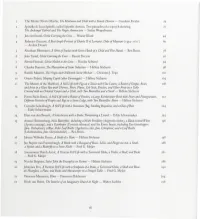
1 The Monte Oliveto Master, The Madonna and Child with a Female Devotee — Gaudenz Freuler 19 2 Spinello di Luca Spinelli, called Spinello Aretino, Two pinnacles of a triptych showing 27 The Archangel Gabriel and The Virgin Annunciate — Stefan Weppelmann 3 Jan van Scorel, Christ Carrying the Cross — Wouter Kloek 44 4 Federico Zuccaro, A Bust-length Portrait of Charles II of Lorraine, Duke ofMayenne (1554-1611) 60 — Andrea Donati 5 Abraham Bloemaert, A Sheet of Studies with Seven Heads of a Child and Five Hands — Ben Broos 78 6 Jean Tassel, Christ Carrying the Cross — Benoit Decron 92 7 Ferrau Fenzoni, Christ Nailed to the Cross — Nicolas Schwed 94 8 Charles Poerson, The Martyrdom of Saint Sebastian — Helene Secherre 98 9 Rutilio Manetti, The Virgin and Child with Saint Michael — Christina J. Tripi 102 10 Orazio Fidani, Sleeping Cupid (after Caravaggio) — Helene Secherre 104 11 The Master of the Hartford, A Still Life with Figs on a Tazza with Vine Leaves, a Basket of Grapes, Roses, 108 and Irises in a Glass Vase with Cherries, Pears, Plums, Cob Nuts, Peaches, and Other Fruit on a Table Covered with an Oriental Carpet and a Cloth, with Two Butterflies and a Snail — Helene Secherre 12 Pietro Paolo Bonzi, A Still Life with a Basket of Peaches, a Large Earthenware Bowl with Pears and Pomegranates, 112 Different Varieties of Grapes and Figs on a Stone Ledge, with Two Butterflies Above — Helene Secherre 13 Cornelis Lelienbergh, A Still Life with a Stoneware Jug, Smoking Requisites, and a Glass of Beer 124 — Eddy Schavemaker 14 Elias van den Broeck, A Sottobosco with a Snake Threatening a Lizard — Eddy Schavemaker 154 15 Antoni Henstenburg, Nine Butterflies, including a Niobe Fritillary (Argynnis niobe), a Black-veined White 156 (Aporia crateagi), and a Gatekeeper (Pyronia tithonus) and Six Exotic Insects, including Two Grasshoppers (Jam. -
FOLLOWER of OSIAS BEERT I (Circa 1605-1630) Almonds
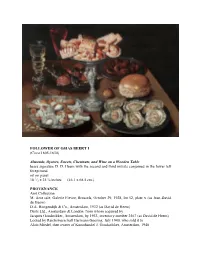
FOLLOWER OF OSIAS BEERT I (Circa 1605-1630) Almonds, Oysters, Sweets, Chestnuts, and Wine on a Wooden Table bears signature D. D. Heem with the second and third initials conjoined in the lower left foreground oil on panel 1 18 /8 x 25 ¾ inches (46.1 x 68.5 cm.) PROVENANCE Arot Collection M. Arot sale, Galerie Fievez, Brussels, October 29, 1928, lot 52, plate X (as Jean-David de Heem) D.A. Hoogendijk & Co., Amsterdam, 1932 (as David de Heem) Duits Ltd., Amsterdam & London, from whom acquired by Jacques Goudstikker, Amsterdam, by 1933, inventory number 2567 (as David de Heem) Looted by Reichsmarschall Hermann Goering, July 1940, who sold it to Alois Miedel, then owner of Kunsthandel J. Goudstikker, Amsterdam, 1940 Kunsthandel J. Goudstikker-Miedel sale, Hans W. Lange, Berlin, December 3-4, 1940, lot 23, plate 20 (attribution changed by Walther Bernt to Osias Beert II) Anonymous sale, Kunsthaus Lempertz, Cologne, May 22-27, 1957, lot 1182, illustrated (as Osias Beert II) Gemälde-Galerie Abels, Cologne, 1957 Kunsthandlung Julius Böhler, Munich, until December 1957 (as Osias Beert) where purchased by Kunsthandel P. de Boer, Amsterdam (as Osias Beert) who sold it to F. Thornton, Antwerp, February 1958 Private Collection, The Hague, by 1969 Private Collection, France Anonymous sale, Christie’s, London, December 2, 2008, lot 23 (as Follower of Osias Beert I) Anonymous sale, Christie’s, London, October 28, 2009, lot 50 (as Follower of Osias Beert I) Restituted to Marei von Saher, heir to Jacques Goudstikker, March 2012 “Collection of Jacques Goudstikker sale,” Christie’s, New York, June 3, 2015, lot 50 (as Circle of Osias Beert I) EXHIBITED Amsterdam, D.A. -
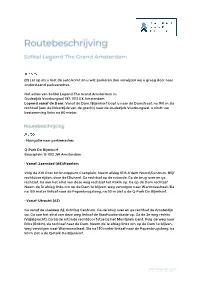
De Routebeschrijving in Deze Link
(!!) Let op als u met de auto komt en u wilt parkeren dan verwijzen we u graag door naar onderstaand parkeeradres. Het adres van Sofitel Legend The Grand Amsterdam is: Oudezijds Voorburgwal 197, 1012 EX Amsterdam Lopend vanaf de Dam: Vanaf de Dam/ Bijenkorf loopt u naar de Damstraat, na 160 m sla rechtsaf (aan de linkerzijde van de gracht) naar de Oudezijds Voorburgwal, u vindt uw bestemming links na 80 meter. · Navigatie naar parkeeradres Q-Park De Bijenkorf Beursplein 15 1012 JW Amsterdam · Vanaf: Zaanstad (A8)/Haarlem Volg de A10 Oost tot knooppunt Coenplein. Neem afslag S116 A’dam Noord/Centrum. Blijf rechtdoor rijden, door de IJtunnel. Ga rechtsaf op de rotonde. Ga de brug over en ga rechtsaf. Ga aan het eind van deze weg rechtsaf het Rokin op. Ga op de Dam rechtsaf. Neem de 1e afslag links om op de Dam te blijven, weg vervolgen naar Warmoesstraat. Sla na 130 meter linksaf naar de Papenbrugsteeg, na 50 m ziet u de Q-Park De Bijenkorf. · Vanaf: Utrecht (A2) Ga vanaf de snelweg A2, richting Centrum. Ga de brug over en ga rechtsaf de Amsteldijk op. Ga aan het eind van deze weg linksaf de Stadhouderskade op. Ga de 2e weg rechts (Vijzelgracht). Ga bij de rotonde rechtdoor tot je bij het Muntplein bent. Volg de weg naar links (Rokin), sla rechtsaf naar de Dam. Neem de 1e afslag links om op de Dam te blijven, weg vervolgen naar Warmoesstraat. Sla na 130 meter linksaf naar de Papenbrugsteeg, na 50 m ziet u de Q-Park De Bijenkorf. -

Un Univers Intime Paintings in the Frits Lugt Collection 1St March - 27 Th May 2012
Institut Centre culturel 121 rue de Lille - 75007 Paris Néerlandais des Pays-Bas www.institutneerlandais.com UN UNIVERS INTIME PAINTINGS IN THE FRITS LUGT COLLECTION 1ST MARCH - 27 TH MAY 2012 MAI 2012 Pieter Jansz. Saenredam (Assendelft 1597 - 1665 Haarlem) Choir of the Church of St Bavo in Haarlem, Seen from the Christmas Chapel , 1636 UN UNIVERS Paintings in the Frits INTIME Lugt Collection Press Release The paintings of the Frits Lugt Collection - topographical view of a village in the Netherlands. Fondation Custodia leave their home for the The same goes for the landscape with trees by Jan Institut Néerlandais, displaying for the first time Lievens, a companion of Rembrandt in his early the full scope of the collection! years, of whom very few painted landscapes are known. The exhibition Un Univers intime offers a rare Again, the peaceful expanse of water in the View of a opportunity to view this outstanding collection of Canal with Sailing Boats and a Windmill is an exception pictures (Berchem, Saenredam, Maes, Teniers, in the career of Ludolf Backhuysen, painter of Guardi, Largillière, Isabey, Bonington...), expanded tempestuous seascapes. in the past two years with another hundred works. The intimate interiors of Hôtel Turgot, home to the Frits Lugt Collection, do indeed keep many treasures which remain a secret to the public. The exhibition presents this collection which was created gradually, with great passion and discernment, over nearly a century, in a selection of 115 paintings, including masterpieces of the Dutch Golden Age, together with Flemish, Italian, French and Danish paintings. DUTCH OF NOTE Fig. -

Hoe Oud Is Het Damrak Als Kade Langs De Amstel?
hoe oud is het Damrak? hoe oud is het Damrak? de ontstaansgeschiedenis van het Damrak als kade langs de Amstel 1 hoe oud is het Damrak? “Eerst zijn rond 1380 achter de westelijke woningen in de War- moesstraat pakhuizen gezet, die met hun pui in het Damrak kwa- men te staan. En kort na 1400 aan de overkant tussen de Nieu- wendijk en het water een rij woningen met hun voordeuren aan de kade van het Damrak.[….] Als stadsstraat met huizen en be- drijven is het Damrak in 1413 dus eigenlijk niet veel ouder dan twintig jaar”. Deze zinsneden in een artikel van Peter-Paul de Baar (Ons Amster- dam 2013, blz. 10-13) was aanleiding tot de opmerking van een van mijn lezers dat het in het jaartallen-overzicht op deze site ge- noemde jaartal 1531 er toch wel flink naast zat. Ik wil hem en ook u hieronder uit de doeken doen dat de Amstelmonding in minimaal drie fasen smaller is gemaakt door plempen van stroken nieuwe oever en dat pas na de tweede fase de brede en openbaar toegan- kelijke kade ontstond waar huizen met hun voorgevel aan stonden. te duiken. In de zomer van 1972 hadden opgravingen plaats, waar- Dat was de door de stedelijke overheid ondernomen demping van bij al snel Henk Zantkuijl geraadpleegd werd om de houtconstruc- de westelijke Amsteloever in de periode 1530-’31. Dat kan met ties te duiden. Archivaris Dudok van Heel op zijn beurt speurde enige stelligheid beweerd worden door diepgravend (letterlijk!) in de archieven naar akten betreffende dit pand, ’t Claverblat, en onderzoek door archeologen, een historisch bouwkundige en een naburige panden. -
Simonis & Buunk
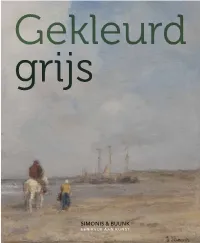
2019 / 2020 Gekleurd Gekleurd Gekleurd grijs grijs SIMONIS & BUUNK SIMONIS & BUUNK EEN KEUR AAN KUNST cover Haagse School_2019_bs.indd 1 06-11-19 16:00 Gekleurd grijs Verkooptentoonstelling Haagse School zaterdag 30 november 2019 t/m zaterdag 4 januari 2020 Dinsdag t/m zaterdag van 11-17 uur en op afspraak open zondagen: 1, 15 en 29 december van 11-17 uur Een collectie schilderijen en aquarellen van de Haagse School. Voor prijzen en foto’s met lijst: simonisbuunk.nl SIMONIS & BUUNK EEN KEUR AAN KUNST 19e eeuw Notaris Fischerstraat 30 20e eeuw Notaris Fischerstraat 19 Fischerhuis Notaris Fischerstraat 27 Buiten exposities om geopend dinsdag t/m zaterdag 11-17 uur en op afspraak Notaris Fischerstraat 30, 6711 BD Ede +31 (0) 318 652888 info@simonisbuunk.nl www.simonisbuunk.nl cover Haagse School_2019_bs.indd 2 06-11-19 16:00 Predicaat ‘meesterlijk’ Frank Buunk Als ik aan de Haagse School denk dan komt het jaar trouwe halfjaarlijkse bezoeken aan zijn goede vriend 1976 in mijn herinnering, toen ik voor het eerst over Scheen thuis kwam. de vloer kwam bij Rien Simonis als aanbidder van Kunsthandelaar Pieter Scheen, samensteller van de zijn oudste dochter Mariëtte. Al snel raakte ik ook ‘Rode Scheen’, was toen een begrip in kunstkringen. geboeid door de anekdotes uit de kunstwereld die In zijn kunsthandel aan de Zeestraat 50, recht mijn aanstaande schoonvader in geuren en kleuren tegenover het Panorama Mesdag, presenteerde hij kon vertellen. Pieter Scheen passeerde vaak de revue vanaf de jaren 50 schilderijen uit de Romantische in de sterke verhalen waarmee schoonvader na zijn School en de Haagse School. -

Chrono- and Archaeostratigraphy and Development of the River Amstel: Results of the North/South Underground Line Excavations, Amsterdam, the Netherlands
Netherlands Journal of Geosciences — Geologie en Mijnbouw |94 – 4 | 333–352 | 2015 doi:10.1017/njg.2014.38 Chrono- and archaeostratigraphy and development of the River Amstel: results of the North/South underground line excavations, Amsterdam, the Netherlands P. Kranendonk1,S.J.Kluiving2,3,4,∗ & S.R. Troelstra5,6 1 Office for Monuments & Archaeology (Bureau Monumenten en Archeologie), Amsterdam 2 GEO-LOGICAL Earth Scientific Research & Consultancy, Delft 3 VU University, Faculty of Humanities, Department of Archaeology, Classics and Ancient Studies, Amsterdam 4 VU University, Faculty of Earth & Life Sciences, Amsterdam 5 VU University, Faculty of Earth & Life Sciences, Earth & Climate Cluster, Amsterdam 6 NCB Naturalis, Leiden ∗ Corresponding author. Email: s.j.kluiving@vu.nl Manuscript received: 28 May 2014, accepted: 2 November 2014 Abstract Since 2003 extensive archaeological research has been conducted in Amsterdam, the Netherlands, connected with the initial phase of the new underground system (Noord/Zuidlijn). Research has mainly focused on two locations, Damrak and Rokin, in the centre of Medieval Amsterdam. Both sites are situated around the (former) River Amstel, which is of vital importance for the origin and development of the city of Amsterdam. Information on the Holocene evolution of the river, however, is relatively sparse. This project has provided new evidence combining archaeological and geological data, and allowed the reconstruction of six consecutive landscape phases associated with the development of the River Amstel. The course of the present-day Amstel is the result of a complex interaction of processes that started with an early prehistoric tidal gully within the Wormer Member of the Naaldwijk Formation, including Late Neolithic (2400–2000 BC) occupation debris in its fill that was subsequently eroded. -

Naar Een Betere Verkeerscirculatie in De Nieuwmarktbuurt
WERKGROEP VERKEER naar een betere verkeerscirculatie in de nieuwmarktbuurt In de zomer van 2014 heeft de Werkgroep Verkeer van de Bewonersraad Nieuwmarkt-Groot Waterloo het initiatief genomen om een plan te ontwerpen ter verbetering van de verkeersomstandigheden in de ruime Nieuwmarktbuurt. Het plan is bestemd voor het bestuur van Amsterdam en het Stadsdeel Amsterdam en bestaat uit de volgende onderdelen: 1. een kaart met de afbakening van het aandachtsgebied; 2. de aanleidingen en drijfveren; 3. een inventarisatie van de belangrijkste problemen; 4. een inventarisatie van de gebruikte sluiproutes, met kaart; 5. de gestelde doelen; 6. aannames; 7. een aantal scenario’s waarmee de Werkgroep Verkeer de problemen wil oplossen, die al dan niet in combinatie met elkaar kunnen worden toegepast, eventueel samen met 8. een concreet scenario om luchtvervuiling terug te dringen in de gehele binnenstad; 9. conclusies en aanbevelingen; 10. bijlagen. De Werkgroep Verkeer handelt in opdracht van de Bewonersraad en staat onder voorzitterschap van Peter Paschenegger. De leden zijn: Nico Beuk, Ilco Braam, Ben van Duin, Cliff van Dijk, Mariken de Goede, Manu Hartsuyker, Guido Pouw, Evert van Voskuilen en Jet Willers. Veel dank is de Werkgroep Verkeer verschuldigd voor de hulp en adviezen van de ambtenaren Wies Daamen, Auke-Jan Drenth en Eefke van Lier. In deze notitie wordt verwezen naar het begrip ‘Buurtparkeren’. Met toestemming van de initiatief- groep Buurtparkeren.nu hebben wij de tekst van dit initiatief als bijlage opgenomen in deze notitie, ter verduidelijking van dit begrip. Voor verdere informatie hierover verwijzen wij naar www.buurtparkeren.nu. De Werkgroep Verkeer is ook de opsteller van een notitie over de problemen die het taxiverkeer in de buurt veroorzaakt (Taxistandplaatsen Nieuwmarkt, voorstellen tot verbetering, mei 2015). -

George Hendrik Breitner (1857-1923) Was Among the Most Successful Dutch Painters of the Nineteenth Century
George Hendrik Breitner (1857-1923) was among the most successful Dutch painters of the nineteenth century. Well known for his paintings of city scenes, a series of young women dressed in kimonos, cavalrymen and horses, Breitner also depicted cats in his sketches, paintings, and photo- graphs. Breitner was a cat lover: cats were always roaming around in his house and in his studio. This book contains a selection of his sketches and photographs of cats. George Hendrik Breitner Born in Rotterdam in 1857, George Hendrik Breitner began his studies at the Academy of Art, The Hague, in 1876. There he met painters of the Hague School who, influenced by the French Barbizon painters, preferred realism to romanticism. Soon known for his ability to paint horses, Breitner was hired by Hendrik Willem Mesdag in 1881 to paint the horses in his renowned panorama painting of Scheveningen, which can still be visited today in a specially built rotund gallery in The Hague. A year later Breitner befriended Vincent van Gogh, with whom he often went sketching in and around The Hague. Attracted by its vibrant artistic and cultural life spurred by a revival of economic growth, Breitner moved to Amsterdam in 1886. Here Breitner captured the city’s street life in many of his paintings. Horses remained an important subject for the artist, but he soon replaced his caval- ry horses with those pulling carts and trams. He often took his sketchbook on his walks through the town and, from around 1890, he would also take his Kodak camera out with him to capture scenes that would find their way into his paintings. -

Andreas Schelfhout Onsterfelijk Schoon De Landschappen Van Andreas Schelfhout (1787-1870) En Zijn Leerlingen SIMONIS&BUUNK KUNSTHANDEL
SIMONIS &BUUNK EEN KEUR AAN KUNST IJsgezichten Zomerlandschappen Strandgezichten Marines Andreas Schelfhout Onsterfelijk schoon De landschappen van Andreas Schelfhout (1787-1870) en zijn leerlingen SIMONIS&BUUNK KUNSTHANDEL Andreas Schelfhout Onsterfelijk schoon De landschappen van Andreas Schelfhout (1787-1870) en zijn leerlingen Andreas ‘Andries’ Schelfhout Den Haag 1787-1870 Jonge terriër op kussen, paneel 32,1 x 27,3 cm, gesigneerd en gedateerd ’47. Herkomst: veiling Frederik Muller & Cie., Amsterdam. Omslag: Andreas ‘Andries’ Schelfhout Schaatsvolk en trekslede op een bevroren vaart (detail) zie pag. 13 Andreas ‘Andries’ Schelfhout Winterlandschap met sprokkelaarster en boer in een punter Andreas ‘Andries’ Schelfhout Een vroege winter Den Haag 1787-1870 Winterlandschap met sprokkelaarster en boer in In het begin van zijn loopbaan schilderde Schelfhout reeds in de eerste werken zijn een punter, paneel 51 x 73 cm, en exposeerde Andreas Schelfhout zelden eigenheid. Zo zijn de figuren, belangrijk als gesigneerd en te dateren ca. 1815. het onderwerp waardoor hij zo beroemd verhalend element, in Schelfhouts land- geworden is: wintertaferelen. Tijdgenoten schappen vanaf het begin kleiner in aantal en critici waren aanvankelijk namelijk meer dan in 17e-eeuwse (winter)voorstellingen, gecharmeerd van zijn zomerlandschappen. waardoor de grootsheid van landschap en Bovenstaande winter is geschilderd wolkenluchten benadrukt wordt. Slechts omstreeks 1815, het jaar waarin Schelfhout twee keer eerder verwierven wij een zo zijn vierjarige opleiding tot kunstschilder vroeg wintergezicht van Schelfhout, in bij de Haagse toneeldecorateur J.H.A.A. 1987 en 1998. Onze ‘ontdekking’ van een Breckenheijmer afsloot. Hoewel de invloed vroege winter in 1998 was een van de van 17e-eeuwse landschappen op zijn gelukkigste ‘wapenfeiten’ uit ons bestaan vroege schilderijen onmiskenbaar is toont (pag. -

Pride of Place: Dutch Cityscapes in the Golden Age
Updated Wednesday, January 28, 2009 | 3:12:10 PM Last updated Wednesday, January 28, 2009 Updated Wednesday, January 28, 2009 | 3:12:10 PM National Gallery of Art, Press Office 202.842.6353 fax: 202.789.3044 National Gallery of Art, Press Office 202.842.6353 fax: 202.789.3044 Pride of Place: Dutch Cityscapes in the Golden Age - Important: The images displayed on this page are for reference only and are not to be reproduced in any media. To obtain images and permissions for print or digital reproduction please provide your name, press affiliation and all other information as required(*) utilizing the order form at the end of this page. Digital images will be sent via e-mail. Please include a brief description of the kind of press coverage planned and your phone number so that we may contact you. Usage: Images are provided exclusively to the press, and only for purposes of publicity for the duration of the exhibition at the National Gallery of Art. All published images must be accompanied by the credit line provided and with copyright information, as noted. Cat. No. 1 / File Name: 246-045.jpg Title Section Raw Cat. No. 1 / File Name: 246-045.jpg Jan Beerstraten Jan Beerstraten The Old Town Hall of Amsterdam on Fire in 1652, c. 1652-1655 The Old Town Hall of Amsterdam on Fire in 1652, c. 1652-1655 oil on panel; 89 x 121.8 cm (35 1/16 x 47 15/16 in.) oil on panel; 89 x 121.8 cm (35 1/16 x 47 15/16 in.) Amsterdams Historisch Museum Amsterdams Historisch Museum Cat. -

BARTHOLOMEUS JOHANNES VAN HOVE (The Hague 1790 – the Hague 1880)
BARTHOLOMEUS JOHANNES VAN HOVE (The Hague 1790 – The Hague 1880) De Grote Houtpoort, Haarlem signed on the boat in the lower right B. VAN HOVE oil on panel 1 19 /8 x 26 inches (48.6 x 66 cm.) PROVENANCE Lady V. Braithwaite Lady V. Braithwaite, Eighteenth and Nineteenth Century Paintings and Drawings, Sotheby’s, London, May 17, 1967, lot 90, where bought by M. Newman, Ltd., London Frost & Reed Ltd., London Vixseboxse Art Galleries, Inc., Cleveland Heights, Ohio Private Collection, Ohio, until 2015 LITERATURE The Connoisseur, volume 166, September 1967, p. XLIV, in an advertisement for M. Newman, Ltd., London, reproduced E. Bénézit, “Bartholomeus-Johannes van Hove” in Dictionnaire des Peintres, Sculpteurs, Dessinateurs et Graveurs, volume 5, Libraire Gründ, Paris, 1976, p. 634 In a large panel, under radiant skies, the old fortifications of Haarlem abut the Spaarne River. The Grote Houtpoort rises majestically in the foreground, dominating the scene with its weathervane reaching to the composition’s edge. The Kalistoren Tower, used for the storage of gunpowder, is in the middle with the Kleine Houtpoort visible in the distance. Built in 1570, the Grote Houtpoort was at the end of the Grote Houtstraat, one of the main roads from the Grote Markt that led outside the city walls. Beyond the gate lay the wooded area, called the Haarlemmerwoud. The temperature is mild, over the arched bridge of the Grote Houtpoort, residents contentedly stroll, conversed or stop to admire the view. Below boatmen propel their craft across glass-like waters with shimmering reflections and floating swans. The sense of well-being pervades this orderly view of the city’s great landmarks that dominate its skyline.