Mt. Paektu and Contemporary Sino-Korean Relations
Total Page:16
File Type:pdf, Size:1020Kb
Load more
Recommended publications
-

Thousands of Feet on the Ground Are a Challenge in Changbai Mountain, China by Leah Eskelin
Refuge Notebook • Vol. 16, No. 41 • October 24, 2014 Thousands of feet on the ground are a challenge in Changbai Mountain, China by Leah Eskelin tional Nature Reserve, with a focus on wildland fire management and visitor services in protected areas. Changbai Mountain straddles the China-North Korea border and has been held in almost sacred es- teem by both nations for centuries. It is this adula- tion that has protected the landscape from develop- ment over the years, until it became officially pro- tected within a 200,000 hectare reserve in 1960. How- ever, now, with a growing middle class and increas- ingly easy tourist travel to the region (the Changbais- han airport opened in 2008), human pressures on the area’s natural resources are mounting. Illegal hunting, plant and mushroom gathering, and the simple recre- ational activities of law-abiding visitors are all taking their toll on the land. Lake Tianchi, the awe-inspiring crater lake atop Mount Baekdu, can be viewed from two vantage points. We visited the North Approach on a Saturday, along with 10,000 other visitors. The experience is in- tense. First, in a vehicle driven by Changbai Moun- tain staff, you travel up the mountain from the forest of yew, Korean pine and birch at the base through 30 hairpin turns onto the tundra, and finally to the sum- mit of gray rock. At an elevation of 6,257 feet, there The North Approach to Lake Tianchi sees over 10,000 vis- is a chill to the air that solicits rental parkas in the itors on weekend days (credit: Matt Conner/USFWS). -

Nationalism and Ethnic Identity in the Sino-Korean Border Region of Yanbian, 1945–1950
View metadata, citation and similar papers at core.ac.uk brought to you by CORE provided by White Rose Research Online promoting access to White Rose research papers Universities of Leeds, Sheffield and York http://eprints.whiterose.ac.uk/ White Rose Research Online URL for this paper: http://eprints.whiterose.ac.uk/76459/ Paper: Cathcart, AJ (2010) Nationalism and Ethnic Identity in the Sino-Korean Border Region of Yanbian, 1945–1950. Korean Studies, 34. 25 - 53 (28). White Rose Research Online eprints@whiterose.ac.uk Nationalism and Ethnic Identity in the Sino-Korean Border Region of Yanbian, 1945–1950 Adam Cathcart This article chronicles the evolution of ethnic politics in the Yanbian region, focus- ing on the Chinese Korean communist leader Chu To˘k-hae during the Chinese civil war and the early Korean War. Chu’s advocacy of Chinese nationality for ethnic Koreans is juxtaposed with his cooperation with North Korea, conflict over North Korean refugees, and examinations of the Yanbian region’s role between the People’s Republic of China and the Democratic People’s Republic of Korea. The ‘‘Resist America and Aid Korea’’ movement provides the most dramatic example of how Chu and ethnic Koreans in Yanbian expressed a uniquely tinged Chinese nationalism while continuing to lend support to North Korea. The article thereby aims to contribute to the regional history of Northeast Asia, add texture to debates on Chinese and Korean nationalism in that region, and reveal new aspects of Chinese Korean agency in the earliest years of Chinese Communist Party control. In the immense outpouring of scholarship that examines the Korean experience from 1945 to 1950, the role of Chinese Koreans, or Choso˘njok, in Yanbian during those years has received relatively little attention. -

Notizen 1312.Indd
27 Feature II Franz Eckert und „seine“ Nationalhymnen. Eine Einführung1 von Prof. Dr. Hermann Gottschewski und Prof. Dr. Kyungboon Lee Der preußische Militärmusiker Franz Eckert2, geboren 1852, wurde 1879 als Musiklehrer nach Japan berufen, wo er kurz vor seinem 27. Geburtstag eintraf. Er war dort bis 1899 in ver- schiedenen Positionen tätig, insbesondere als musikalischer Mentor der Marinekapelle. Für mehrere Jahre unterrichtete er auch an der To- yama Armeeschule, außerdem an der Musik- akademie Tokyo und nicht zuletzt an der Musi- kabteilung des Kaiserhofes. In die Zeit seines Wirkens in Japan fällt der Japanisch-Chinesi- sche Krieg, in dem die Militärmusik einen sehr großen Einfluss auf den öffentlichen Musikge- schmack gewann. Von der musikhistorischen Forschung wird dieser Einfluss als einer der wesentlichen Faktoren für die Durchsetzung der westlichen Musik in der modernen japani- schen Musikkultur gesehen. Abb. 1: Aus dem Nachruf Eckert von 1926, in: Mitteilungen der Deutschen Gesellschaft 1899 kehrte Eckert zunächst nach Deutschland für Natur- und Völkerkunde Ostasiens, zurück, aber nach einer kurzen Interimszeit in Band XXI. Dieser Nachruf fehlt in dem Berlin erhielt er einen Ruf an den koreanischen Nachdruck der Mitteilungen von 1965. 1 Dieses Feature geht auf 2 Vorträge zurück, die von den Autoren am 18.9.2013 in der OAG gehalten wurden. 2 Die bisher eingehendste Forschung zu Eckerts Biographie ist von Nakamura Rihei: Yōgaku Dōnyūsha no Kiseki ‒ Nihon Kindai Yōgaku-shi Josetsu (Die Spuren der Einführer westlicher Musik ‒ Eine Einführung in die Geschichte westlicher Musik in der japanischen Moderne), Tōsui Shobō 1993, S. 235- 363. Die grundlegendste Forschung zu Eckerts koreanischen Jahren ist von Namgung Yoyŏl: Gaehwagi ŭi Hanguk-ŭmak ‒ Franz Eckert rŭl jungsim-ŭro (Die koreanische Musik der Aufklärungszeit, insbesondere über Franz Eckert), Seoul: Segwang Ŭmak Chulpanja, 1987. -

This Is Northeast China Report Categories: Market Development Reports Approved By: Roseanne Freese Prepared By: Roseanne Freese
THIS REPORT CONTAINS ASSESSMENTS OF COMMODITY AND TRADE ISSUES MADE BY USDA STAFF AND NOT NECESSARILY STATEMENTS OF OFFICIAL U.S. GOVERNMENT POLICY Voluntary - Public Date: 12/30/2016 GAIN Report Number: SH0002 China - Peoples Republic of Post: Shenyang This is Northeast China Report Categories: Market Development Reports Approved By: Roseanne Freese Prepared By: Roseanne Freese Report Highlights: Home to winter sports, ski resorts, and ancient Manchurian towns, Dongbei or Northeastern China is home to 110 million people. With a down-home friendliness resonant of the U.S. Midwest, Dongbei’s denizens are the largest buyer of U.S. soybeans and are China’s largest consumers of beef and lamb. Dongbei companies, processors and distributors are looking for U.S. products. Dongbei importers are seeking consumer-ready products such as red wine, sports beverages, and chocolate. Processors and distributors are looking for U.S. hardwoods, potato starch, and aquatic products. Liaoning Province is also set to open China’s seventh free trade zone in 2018. If selling to Dongbei interests you, read on! General Information: This report provides trends, statistics, and recommendations for selling to Northeast China, a market of 110 million people. 1 This is Northeast China: Come See and Come Sell! Home to winter sports, ski resorts, and ancient Manchurian towns, Dongbei or Northeastern China is home to 110 million people. With a down-home friendliness resonant of the U.S. Midwest, Dongbei’s denizens are the largest buyer of U.S. soybeans and are China’s largest consumers of beef and lamb. Dongbei companies, processors and distributors are looking for U.S. -

Japanese Rule Over Rural Manchukuo: Strategies and Policies
JAPANESE RULE OVER RURAL MANCHUKUO: STRATEGIES AND POLICIES A THESIS SUBMITTED FOR THE DEGREE OF DOCTOR OF PHILOSOPHY OF THE AUSTRALIAN NATIONAL UNIVERSITY MO TIAN September 2015 DECLARATION I, Mo Tian, declare that, except where otherwise acknowledged or noted, this thesis is entirely my own work. Mo Tian iii ACKNOWLEDGEMENTS This study is the outcome of a frustrating intellectual trajectory. It started as an enquiry into the political ideology of Manchukuo, but later on switched its direction to the examination of the political institutions of Manchukuo, and finally landed on the area of Japanese rule over rural Manchukuo. On the path towards completing this thesis, I have incurred debts to many individuals and institutions. This thesis would have never been possible without their assistance and support. First, I would like to thank my family for carrying me through this PhD journey. I dedicate this thesis to my mother Huang Wei. Her unceasing love has supported me in various ways. I dedicate this thesis to my father Tian Shubin who died prematurely in 2001. He was a great father who taught me to pursue excellence and to become a man of integrity. I dedicate this thesis to my grandfather Huang Kexuan who grew up in Manchuria under the Japanese rule. In my early childhood, he strongly cultivated my genuine interest in Japan. His stories of the various aspects of the Japanese rule in Manchuria are the sources of inspiration for my work on Manchuria. My mentors and colleagues in Australia have greatly facilitated the process of my writing. The three members of my examination panel have been tremendously helpful for my thesis writing. -

Eighth United Nations Conference on the Standardization of Geographical Names Berlin, 27 August-5 September 2002 Item 16 (A) of the Provisional Agenda*
EICONF.94INF.68 26 August 2002 Original : English Eighth United Nations Conference on the Standardization of Geographical Names Berlin, 27 August-5 September 2002 Item 16 (a) of the provisional agenda* WRITING SYSTEMS: ROMANIZATION New Romanization System of Korean (Submitted by Republic of Korea**) *E/CONF.94/1 ** Prepared by Ki. Suk Lee, Republic of Korea The Revised Romanization of Korean Korean Ministry of Culture & Tourism, following Ministry proclamation No. 2000-8 of 7 July 2000, revised and adopted new guidelines for romanization of Korean. The following contents include 1) basic principles, 2) summary, 3) special provisions, and 4) examples. 1. Basic Principles of Romanization (1) Romanization is based on standard Korean pronunciation. (2) Symbols other than Roman letters are avoided to the greatest extent possible. 2. Summary of the Romanization System (1) Vowels are transcribed as follows: simple vowels \ -1 ’- -r -1 1 H 41 4 71 a eo o u eu/i ae e oe wi * diphthongs Note 1 : 4 is transcribed as ui, even when pronounced as 1 . Note 2 : Long vowels are not reflected in Romanization. (2) Consonants are transcribed as follows: plosives( stops) lll?cCCEtlütl~ - affricates - fricatives xmz AMS i ii ch s ss h * nasals - liquids Note 1 : The sounds 1,E, and tl are transcribed respectively as g, d, and b when they appear before a vowel; they are transcribed as k, t, and p when followed by another consonant or fonn the final sound of a word. (They are I'lomanized as pronunciation in [ 1.) e.g. 701 Gumi %Z Yeongdong q ",c Baegarn f?&4 Okcheon 3q Hapdeok Hobeop Q W[O! c1 Wolgot 5g;i[p!!] beotkkot 2pJ[ Eb C] Hanbat Note 2 : ;I is transcnbed as r when followed by a vowel, and as I when followed by a consonant or when appearing at the end of a word. -
Scenario-Based Pyroclastic Density Current Invasion Maps at Poorly Known Volcanoes: a Case Study from Changbaishan (China/North Korea)
applied sciences Article Scenario-Based Pyroclastic Density Current Invasion Maps at Poorly Known Volcanoes: A Case Study from Changbaishan (China/North Korea) Anna Maria Lombardi 1, Pierdomenico Del Gaudio 1, Zhengfu Guo 2, Maoliang Zhang 2,3, Guoming Liu 4,5, Vincenzo Sepe 1 , Jiaqi Liu 2 and Guido Ventura 1,* 1 Istituto Nazionale di Geofisica e Vulcanologia, 00143 Roma, Italy; annmaria.lombardi@ingv.it (A.M.L.); piero.delgaudio@ingv.it (P.D.G.); vincenzo.sepe@ingv.it (V.S.) 2 Key Laboratory of Cenozoic Geology and Environment, Institute of Geology and Geophysics, Chinese Academy of Sciences, Beijing 100029, China; zfguo@mail.iggcas.ac.cn (Z.G.); mzhang@tju.edu.cn (M.Z.); liujq@mail.igcas.ac.cn (J.L.) 3 Institute of Surface-Earth System Science, Tianjin University, Tianjin 300072, China 4 Earthquake Administration of Jilin Province, Changchun 130022, China; cbslgm@126.com 5 Changbaishan Volcano Observatory, Antu 133613, China * Correspondence: guido.ventura@ingv.it Received: 6 March 2020; Accepted: 7 April 2020; Published: 10 April 2020 Featured Application: Volcanic hazard evaluation, Urban Planning. Abstract: Changbaishan volcano (China/North Korea; last eruption in 1903 AD) was responsible for a Volcanic Explosivity Index (VEI) 7 eruption in 946 AD. Approximately 186,000 people live around Changbaishan and 2,000,000 tourists/year visit the volcano. An unrest occurred between 2002 and 2006. Despite the relevant hazard, the eruptive history is poorly known, a condition common to many volcanoes worldwide. Here, we investigate the extension of the areas potentially affected by pyroclastic density currents (PDCs) in case of future eruptions following a scenario-based approach. -
LCSH Section H
H (The sound) H.P. 15 (Bomber) Giha (African people) [P235.5] USE Handley Page V/1500 (Bomber) Ikiha (African people) BT Consonants H.P. 42 (Transport plane) Kiha (African people) Phonetics USE Handley Page H.P. 42 (Transport plane) Waha (African people) H-2 locus H.P. 80 (Jet bomber) BT Ethnology—Tanzania UF H-2 system USE Victor (Jet bomber) Hāʾ (The Arabic letter) BT Immunogenetics H.P. 115 (Supersonic plane) BT Arabic alphabet H 2 regions (Astrophysics) USE Handley Page 115 (Supersonic plane) HA 132 Site (Niederzier, Germany) USE H II regions (Astrophysics) H.P.11 (Bomber) USE Hambach 132 Site (Niederzier, Germany) H-2 system USE Handley Page Type O (Bomber) HA 500 Site (Niederzier, Germany) USE H-2 locus H.P.12 (Bomber) USE Hambach 500 Site (Niederzier, Germany) H-8 (Computer) USE Handley Page Type O (Bomber) HA 512 Site (Niederzier, Germany) USE Heathkit H-8 (Computer) H.P.50 (Bomber) USE Hambach 512 Site (Niederzier, Germany) H-19 (Military transport helicopter) USE Handley Page Heyford (Bomber) HA 516 Site (Niederzier, Germany) USE Chickasaw (Military transport helicopter) H.P. Sutton House (McCook, Neb.) USE Hambach 516 Site (Niederzier, Germany) H-34 Choctaw (Military transport helicopter) USE Sutton House (McCook, Neb.) Ha-erh-pin chih Tʻung-chiang kung lu (China) USE Choctaw (Military transport helicopter) H.R. 10 plans USE Ha Tʻung kung lu (China) H-43 (Military transport helicopter) (Not Subd Geog) USE Keogh plans Ha family (Not Subd Geog) UF Huskie (Military transport helicopter) H.R.D. motorcycle Here are entered works on families with the Kaman H-43 Huskie (Military transport USE Vincent H.R.D. -
4 Days Tour for Changbai Mountains (Reference Tours at Conference Rate)
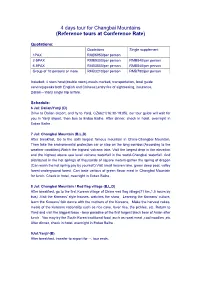
4 days tour for Changbai Mountains (Reference tours at Conference Rate) Quotations: Quotations Single supplement 1PAX RMB6950/per person 2-5PAX RMB5300/per person RMB840/per person 6-9PAX RMB3850/per person RMB840/per person Group of 10 persons or more RMB3210/per person RMB780/per person Included: 4 stars hotel(double room),meals marked, transportation, local guide service(speaks both English and Chinese),entry fee of sightseeing, insurance, Dalian—Yianji single trip airfare. Schedule: 6 Jul: Dalian/Yanji (D) Drive to Dalian airport, and fly to Yanji, CZ6621(16:30-19:05), our tour guide will wait for you in Yanji airport, then bus to Erdao Baihe. After dinner, check in hotel, overnight in Erdao Baihe . 7 Jul: Changbai Mountain (B,L,D) After breakfast, Go to the sixth largest famous mountain in China-Changbai Mountain. Then take the environmental protection car or step on the long corridor.(According to the weather condition).Watch the highest volcano lake. Visit the largest drop in the elevation and the highest above sea level volcano waterfall in the world-Changbai waterfall. And distributed in the hot springs of thousands of square meters-gather the spring of dragon (Can wash the hot spring pay by yourself).Visit small heaven lake, green deep pool, valley forest-underground forest. Can taste various of green flavor meal in Changbai Mountain for lunch. Check in hotel, overnight in Erdao Baihe . 8 Jul: Changbai Mountain / Red flag village (B,L,D) After breakfast, go to the first Korean village of China -red flag village(71 km,1.5 hours by bus) .Visit the Koreans’ style houses, watches the show。Learning the Koreans' culture, learn the Koreans' folk dance with the mothers of the Koreans,Make the harvest cakes, meals of the Koreans nationality such as rice cake, laver rice, the pickles, etc. -
Resolution Template
FILE NO. 201098 RESOLUTION NO. 456-20 1 [Korean Chuseok Day - October 1, 2020] 2 3 Resolution recognizing October 1, 2020, as Korean Chuseok Day and honoring the 4 Korean Center, Inc. for its contributions to the Korean American community in the City 5 and County of San Francisco. 6 7 WHEREAS, Korean Chuseok Day, otherwise known as Korean Thanksgiving, is a 8 harvest festival celebrated at the autumn equinox of the Lunar Calendar and is one of the 9 most important and widely celebrated holidays in the Korean culture; and 10 WHEREAS, Korean Americans have contributed immeasurably to the culture and 11 history of this city, state, and country; and 12 WHEREAS, Korean Americans are the fifth largest Asian American ethnic group in the 13 United States, with a population of over 1.8 million and more than 500,000 in California alone; 14 and 15 WHEREAS, In the San Francisco Bay Area, Korean Americans are the sixth largest 16 Asian population with approximately 90,000 residents; and 17 WHEREAS, San Francisco has been a principal port of entry for Korean immigrants 18 since the early 1900s and more recently since the repeal of restrictive immigration quotas in 19 1965; and 20 WHEREAS, San Francisco has been a center of political activism and cultural 21 importance for Korean Americans the late 19th century; and 22 WHEREAS, In 1883, Bobingsa, the first Korean diplomatic delegation dispatched to the 23 United States, led by Prince Min Young-lk, had San Francisco as its first destination where the 24 delegation stayed at the Palace Hotel located on -

A Brief History of the Sino-Korean Border from the 18Th to the 20Th Century
A BRIEF HISTORY OF THE SINO-KOREAN BORDER FROM THE 18TH TO THE 20TH CENTURY Larisa Zabrovskaya ABSTRACT This article studies the long history of formation of the Sino-Korean border. The Amnok and Tuman rivers were considered the frontier between Qing China and Korea. The establishment of a neutral zone at the beginning of the 18th century further strengthened the border. Disagreements between Qing China and Korea arose from the 1870s when the Qing authorities became aware of Korean settlements on the left side of the Tuman river. Russian in- terest in the region sharpened Chinese anxiety. Two treaties signed in the early 20th century, between China and Korea and China and Japan, recog- nised these settlements, known as Jiandao (Kor.: Kando), as a part of Qing Chinese territory. After 1949 the exact demarcation of the frontier became an issue of dispute between the People’s Republic of China (PRC) and the Dem- ocratic People’s Republic of Korea (DPRK), in which the North Korean view appears to have prevailed. Freedom of passage across the border itself since the 1950s has reflected the varying political and economic conditions within both states. The frontier dispute between the PRC and the DPRK seems to have been settled, but issues arising from this dispute, such as the Korean population residing in the Chinese northeast, that have led to tensions in the past, have not yet been solved. 1 THE EARLY FRONTIER In the 17th century, before the Manzhou conquest of China, the fron- tier between Korea and Manchuria marked on Chinese maps followed a line along the Changbaishan ridge to the northeast of the peninsula, embracing Mt Paektu (Ch.: Baitoushan) to the north, and at its west- erly end following the line of fortification known as the Willow Pali- sade, which was somewhat to the north of the eastern end of the Great Wall of China. -

Damian Harper, Piera Chen, Chung Wah Chow, Megan Eaves, David Eimer, Tienlon Ho, Robert Kelly, Shawn Low, Emily Matchar, Bradley
©Lonely Planet Publications Pty Ltd China H‰ilóngjiƒng p331 Jílín p320 B›ij¸ng p54 Liáoníng X¸njiƒng Inner Mongolia p302 p792 p866 Tiƒnj¸n & Héb›i p127 Níngxià Shƒnx¸ p346 ShƒndŸng p855 p151 Jiƒngs¥ Q¸ngh†i Shaanxi p231 p880 Gƒnsù Hénán Tibet (Sh†nx¸) p408 p823 p366 „nhu¸ Shàngh†i p897 Húb›i p388 p186 SìchuƒnChóngqìng p428 p770 Jiƒngx¸ Zhèjiƒng p717 Húnán p258 GuìzhŸu p464 p442 p630 Fújiàn Yúnnán Gu†ngdŸng p281 p652 Gu†ngx¸ p603 p550 Hong Kong p489 H†inán Macau p587 p528 THIS EDITION WRITTEN AND RESEARCHED BY Damian Harper, Piera Chen, Chung Wah Chow, Megan Eaves, David Eimer, Tienlon Ho, Robert Kelly, Shawn Low, Emily Matchar, Bradley Mayhew, Daniel McCrohan, Dai Min, Phillip Tang PLAN YOUR TRIP ON THE ROAD Welcome to China . 6 BĚIJĪNG . 54 ZHÈJIĀNG . 258 China Map . 8 Around Běijīng . 114 Hángzhōu . 260 . China’s Top 30 . 10 The Great Wall 114 Wūzhèn . 272 Ming Tombs . 114 Xīn’ānjiāng . 274 Need to Know . 26 Chuāndǐxià . 115 Pǔtuóshān . 276 First Time . 28 Marco Polo Bridge & Wǎnpíng Town . 116 If You Like… . 30 FÚJIÀN . 281 Xiàmén . 283 Month by Month . 33 THE GREAT WALL . .. 117 Gǔlàng Yǔ . 289 Itineraries . 37 Great Wall History . 117 Fújiàn Tǔlóu . 291 Off the Beaten Track . 44 Visiting the Wall . 118 Quánzhōu . 294 Mùtiányù . 118 Regions at a Glance . 46 Fúzhōu . .298 Gǔběikǒu . 119 Wǔyí Shān . 299 Jiànkòu . 120 Zhuàngdàokǒu . 121 LIÁONÍNG . 302 Jīnshānlǐng . 122 Shěnyáng . 304 Bādálǐng . 123 Dàlián . 308 K-KING PHOTOGRAPHY MEDIA CO. LTD / GETTY IMAGES © IMAGES GETTY / LTD CO. MEDIA PHOTOGRAPHY K-KING Dāndōng .