The Eucharist in Medieval Canon Law Thomas M
Total Page:16
File Type:pdf, Size:1020Kb
Load more
Recommended publications
-

Tables of Contemporary Chronology, from the Creation to A. D. 1825
: TABLES OP CONTEMPORARY CHUONOLOGY. FROM THE CREATION, TO A. D. 1825. \> IN SEVEN PARTS. "Remember the days of old—consider the years of many generations." 3lorttatttt PUBLISHED BY SHIRLEY & HYDE. 1629. : : DISTRICT OF MAItfE, TO WIT DISTRICT CLERKS OFFICE. BE IT REMEMBERED, That on the first day of June, A. D. 1829, and in the fifty-third year of the Independence of the United States of America, Messrs. Shiraey tt Hyde, of said District, have deposited in this office, the title of a book, the right whereof they claim as proprietors, in the words following, to wit Tables of Contemporary Chronology, from the Creation, to A.D. 1825. In seven parts. "Remember the days of old—consider the years of many generations." In conformity to the act of the Congress of the United States, entitled " An Act for the encouragement of learning, by securing the copies of maps, charts, and books, to the authors and proprietors of such copies, during the times therein mentioned ;" and also to an act, entitled "An Act supplementary to an act, entitled An Act for the encouragement of learning, by securing the copies of maps, charts and books, to the authors and proprietors of such copies, during the times therein mentioned ; and for extending the benefits thereof to the arts of designing, engraving, and etching historical and other prints." J. MUSSEV, Clerk of the District of Maine. A true copy as of record, Attest. J MUSSEY. Clerk D. C. of Maine — TO THE PUBLIC. The compiler of these Tables has long considered a work of this sort a desideratum. -

The Thirteenth Century
1 SHORT HISTORY OF THE ORDER OF THE SERVANTS OF MARY V. Benassi - O. J. Diaz - F. M. Faustini Chapter I THE THIRTEENTH CENTURY From the origins of the Order (ca. 1233) to its approval (1304) The approval of the Order. In the year 1233... Florence in the first half of the thirteenth century. The beginnings at Cafaggio and the retreat to Monte Senario. From Monte Senario into the world. The generalate of St. Philip Benizi. Servite life in the Florentine priory of St. Mary of Cafaggio in the years 1286 to 1289. The approval of the Order On 11 February 1304, the Dominican Pope Benedict XI, then in the first year of his pontificate, sent a bull, beginning with the words Dum levamus, from his palace of the Lateran in Rome to the prior general and all priors and friars of the Order of the Servants of Saint Mary. With this, he gave approval to the Rule and Constitutions they professed, and thus to the Order of the Servants of Saint Mary which had originated in Florence some seventy years previously. For the Servants of Saint Mary a long period of waiting had come to an end, and a new era of development began for the young religious institute which had come to take its place among the existing religious orders. The bull, or pontifical letter, of Pope Benedict XI does not say anything about the origins of the Order; it merely recognizes that Servites follow the Rule of St. Augustine and legislation common to other orders embracing the same Rule. -

The Physician Who Became Pope
The Linacre Quarterly Volume 28 | Number 1 Article 4 February 1961 The hP ysician Who Became Pope William M. Crawford Follow this and additional works at: http://epublications.marquette.edu/lnq Recommended Citation Crawford, William M. (1961) "The hP ysician Who Became Pope," The Linacre Quarterly: Vol. 28 : No. 1 , Article 4. Available at: http://epublications.marquette.edu/lnq/vol28/iss1/4 :iUMMARY proper understanding and preci The foregoing comments repre ation of those fundament norms sent nothing more than a standard will make it possible to erceive synopsis of current theological the total significance of ti practi teaching on the question of ectopic cal conclusion expressed Direc- The Physician pregnancy. Emphasis has been tive 20: placed on the basic moral prin In extrauterine pregnancy tl affected part of the mother (e.g., ar. vary or ciples on which that teaching de fallopian tube) may be rem. ed, even Who Became Pope pends, in the hope that certain though the life of the fetus thus in misconceptions of our position may directly terminated, provided e opera· tion cannot be postponed with . notably thereby be corrected. Only a increasing the danger to the , ther. WILLIAM M. CRAWFORD, M.D. Fort Worth, Texas branches of philosophical learning, By MODERN standards, the transformation of a successful it was not abnormal for Petrus to practicing physician into a pope is pass from the logic of Aristotle almost unthinkable. Yet this is pre and the Arabian philosophers to cisely what happened in the thir medicine. teenth century when the renowned During the middle of the thir Petrus Hispanus exchanged his teenth century Petrus was a teach scalpel for the papal ring and keys er of medicine at Siena when the to become Pope John XXI. -

The Manuscript Vat. Lat. 2463: Some Considerations About a Medieval Medical Volume of Galvanus De Levanto
The manuscript Vat. lat. 2463: some considerations about a medieval medical volume of Galvanus de Levanto by Luca Salvatelli In nomine Domini Nostri Ihesu Christi Amen. Thesaurus corporalis prelatorum Ecclesiae dei et magnatum fidelium Galvani Ianuansis de Levanto umbrae medici1 contra nocumento digestionis stomaci […]. Written in red ink, these are the first words of the medical codex MS Vat. lat. 2463 #reser$ed in the Vatical %ibrary. Meas&rin' 265 x 165 mm, it is a refined small man&script of 116 $ell&m lea$es (ff. *V [I+** #aper, ***+*V membr.2], 116, *- [pa#er])", that dates to the first half of the 14th century (1340-1343). *t has a do&ble col&mn of writin' (171x130mm, interspace 15mm), penned by an *talian littera textualis, in what is #robably 1olognese handwriting. 2he $ol&me is com#rised of fo&r medical works of 3al$an&s *an&ansis de %e$anto, listed accordin' to the index on f. *r index at f. **r, which was written in a ele'ant formal writin' at the end of 16th century 4 a) Thesaurus corporalis praelatorum ecclesiae dei et magnatum fidelium (ff. 1r+!5$., b) Remedium solutivum contra catarrum ad eosdem praelatos et principes (ff. 69r+05$., c) Paleofilon curativus languoris articolorum ad Ven(erabilem) Archiep(iscopum)Ramen (ff. 79r-110r., d) Salutare carisma ex Sacra Scriptura (ff. 110r-114r). 2he frontes#ice on f. 1r contains an ill&minated panel (71x121mm), with a dedicatory scene on a 'old back'ro&nd. *t shows a tons&red doctor, who offers an o#en $ol&me to the pope on his throne. -

The Christian Ethics of Dante's Purgatory
MEDIUM ÆVUM, VOL. LXXXIII, No. 2, pp. 266–287 © SSMLL, 2014 THE CHRISTIAN ETHICS OF DANTE’S PURGATORY It might appear straightforward, on a first reading, that Dante’s Purgatory represents a penitential journey guided by Christian ethics to God. For most of the poem’s history, indeed, Purgatory has been read broadly in this way. In the second half of the twentieth century, however, a parallel interpretation emerged. Influenced by Dante’s dualistic theory of man’s two ethical goals (one temporal and one eternal), many scholars have argued that Purgatory represents a secular journey guided by philosophical principles to a temporal happiness. This article presents three major counter-arguments to the secular reading of Purgatory, a reading proposed most powerfully in recent scholarship by John A. Scott’s monograph Dante’s Political Purgatory.1 First, it proposes a new way to read the poem as informed by Dante’s dualistic theory which does not entail a forced reading of Purgatory in overly political terms. Secondly, it demonstrates how Dante forged his vision of Purgatory through two areas of distinctively Christian theory and practice which had risen to particular prominence in the thirteenth century: the newly crystallized doctrine of Purgatory and the tradition of the seven capital vices (or deadly sins) in penitential ethics.2 Thirdly, it argues that the region embodies an explicit reorientation from natural to supernatural ethics, from pagan to Christian exempla, and from this world to the heavenly city. Where Scott has argued for a ‘political -
![Landlord Comp] His Tenants Are Squatte](https://docslib.b-cdn.net/cover/7255/landlord-comp-his-tenants-are-squatte-1077255.webp)
Landlord Comp] His Tenants Are Squatte
i • . 4*. n ^tfLkaisdas#**fi''' I Now incorporating Neto 3*. .-<; .«i"-.' VOLUME 1(» NO. 18 Landlord comp] his tenants are squatte Commissioner Duke Holt O'Mara said that theja Bj MARY ELIZABETH DUVFV described] the apartment as has no responsibilitibili y to ''over-utilized," and recommen- the security deposit until the I ed to Marks that he contact the is formally terminated. Coope SUMMIT — The Rent Cow Substandard Housing Board or who has relet the apartment as < mission motioned to dismiss the request an eviction notice from Nov. 1, is due the October rent| \'; complaint brought before the the County Courthouse, He told from the previous tenant. board at last Wednesday night's the landlord, "You have obvious Holt said that in cases such; meeting by Marian Jackson rights for eviction." this the estate can receive the difi against her landlord Frank Marks Marks said, "I don't want ference between the rent due < that he had not given her ade- more money for the apartment, I the landlord and the security} quate notice to quit her apart- just want to get in there to begin deposit. ment and insufficient time to work." locate a new dwelling. Tenants from 390 Morrir In another matter before the Avenue, Phil Schneider and Johp. Jackson* who did not show at commission, landlord Drucilla the meeting, had made a written Gallager, who had spent the pait Cooper wrote to seek their advice two days in County Court battl- request to be allowed to pay a in how to proceed in securing one rent increase to allow her addi- ing their rent increase, were also month's rent due tq her and at the meeting. -

The Medieval Origins of the Financial Revolution: Usury, Rentes, and Negotiability Author(S): John H
The Medieval Origins of the Financial Revolution: Usury, Rentes, and Negotiability Author(s): John H. Munro Source: The International History Review, Vol. 25, No. 3 (Sep., 2003), pp. 505-562 Published by: The International History Review Stable URL: http://www.jstor.org/stable/40109398 Accessed: 19/04/2010 14:25 Your use of the JSTOR archive indicates your acceptance of JSTOR's Terms and Conditions of Use, available at http://www.jstor.org/page/info/about/policies/terms.jsp. JSTOR's Terms and Conditions of Use provides, in part, that unless you have obtained prior permission, you may not download an entire issue of a journal or multiple copies of articles, and you may use content in the JSTOR archive only for your personal, non-commercial use. Please contact the publisher regarding any further use of this work. Publisher contact information may be obtained at http://www.jstor.org/action/showPublisher?publisherCode=ihr. Each copy of any part of a JSTOR transmission must contain the same copyright notice that appears on the screen or printed page of such transmission. JSTOR is a not-for-profit service that helps scholars, researchers, and students discover, use, and build upon a wide range of content in a trusted digital archive. We use information technology and tools to increase productivity and facilitate new forms of scholarship. For more information about JSTOR, please contact support@jstor.org. The International History Review is collaborating with JSTOR to digitize, preserve and extend access to The International History Review. http://www.jstor.org JOHN H. MUNRO The Medieval Origins of the Financial Revolution: Usury, Rentes,and Negotiability Hamilton observed many years ago that a 'national debt is one of the very few important economic phenomena without roots in the Ancient World'.1 The first evidence for organized public debts is to be found in towns of twelfth-century Italy. -

Roman Canon Law in the Medieval English Church: Stubbs Vs
Michigan Law Review Volume 72 Issue 4 1974 Roman Canon Law in the Medieval English Church: Stubbs vs. Maitland Re-examined After 75 Years in the Light of Some Records from the Church Courts Charles Donahue Jr. University of Michigan Law School Follow this and additional works at: https://repository.law.umich.edu/mlr Part of the Legal History Commons, and the Religion Law Commons Recommended Citation Charles Donahue Jr., Roman Canon Law in the Medieval English Church: Stubbs vs. Maitland Re-examined After 75 Years in the Light of Some Records from the Church Courts, 72 MICH. L. REV. 647 (1974). Available at: https://repository.law.umich.edu/mlr/vol72/iss4/2 This Article is brought to you for free and open access by the Michigan Law Review at University of Michigan Law School Scholarship Repository. It has been accepted for inclusion in Michigan Law Review by an authorized editor of University of Michigan Law School Scholarship Repository. For more information, please contact mlaw.repository@umich.edu. ROMAN CANON LAW IN THE MEDIEVAL ENGLISH CHURCH: STUBBS VS. MAITLAND RE-EXAMINED AFTER 75 YEARS IN THE LIGHT OF SOME RECORDS FROM THE CHURCH COURTSf Charles Donahue, Jr.* I. INTRODUCTION HE Right Reverend William Stubbs, D.D. (1825-1901), was the T Anglican Bishop of Oxford, sometime Regius Professor of Modem History at Oxford, and a scholar of considerable repute.1 His Constitutional History of England2 was, until quite recently, the standard work in the field, and his editions of texts for the Rolls Series3 leave no doubt that he spent long hours ·with basic source material. -
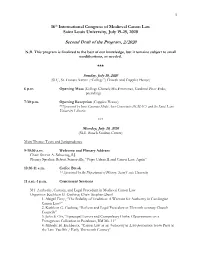
Second Draft of the Program, 2/2020
1 16 th International Congress of Medieval Canon Law Saint Louis University, July 19-25, 2020 Second Draft of the Program, 2/2020 N.B. This program is finalized to the best of our knowledge, but it remains subject to small modifications, as needed. *** Sunday, July 19, 2020 (SLU, St. Francis Xavier (“College”) Church and Cupples House) 6 p.m. Opening Mass (College Church; His Eminence, Cardinal Péter Erdö, presiding) 7:30 p.m. Opening Reception (Cupples House) ** Sponsored by Iuris Canonici Medii Aevi Consociatio (ICMAC) and the Saint Louis University Libraries *** Monday, July 20, 2020 (SLU, Busch Student Center) Main Theme: Texts and Jurisprudence 9-10:30 a.m. Welcome and Plenary Address Chair: Steven A. Schoenig, S.J. Plenary Speaker: Robert Somerville, “Pope Urban II and Canon Law, Again” 10:30-11 a.m. Coffee Break ** Sponsored by the Department of History, Saint Louis University 11 a.m.-1 p.m. Concurrent Sessions M1 Authority, Custom, and Legal Precedent in Medieval Canon Law Organizer: Kathleen G. Cushing; Chair: Stephan Dusil 1. Abigail Firey, “The Stability of Tradition: A Warrant for Authority in Carolingian Canon Law?” 2. Kathleen G. Cushing, “Reform and Legal Precedent in Eleventh-century Church Councils” 3. John S. Ott, “Episcopal Letters and Compulsory Oaths: Observations on a Farraginous Collection in Bordeaux, BM Ms. 11” 4. Melodie H. Eichbauer, “Canon Law as an Authority in Libri penitentiales from Paris in the Late Twelfth / Early Thirteenth Century” 2 M2 Emotions and Psychology in Canon Law Chair: John Burden 1. Jeffrey Ryan Barnett, “The Emotions of Killing in Gratian’s Causa 23” 2. -

Tables C Ononoev
D IS T R IC T O F M AIN E , T o W IT ’ D IS TR IC T CLER K S OF F ICE . E T 8 fift - t - h I RE MEMBE ED fi J A D . 1 29 and t he o f t e R , That on the rst day of une, , in the y hird year of Independence ' - B U a of I E 5L D of i ui ct e i n a k - ht M . SH RL Y HY s D s a e ffi l nited St tes America, essrs E, aid , h v d posited this o ce, the tit e of boo , the rig w e m o w l w to wi t hereof th y clai as propriet rs, in the ords fo lo ing, " ‘3 Q p x r ‘ T ontem eat t D 1 89 52 S a “ e — C ora i o A . R m m s i ables of p Chronology , from the Cr on, . In even p rts e ber the days of old con der ” the years of many gener ons . o act o U a i for e o a e In c nformity to the of the C ngress of the nited St tes, ent tled An Act the nc ur g ment of learning , by securing the a a k t o t he o and o e o of o n m e m o a nd a o copies of m ps , ch rts, and boo s , auth rs pr pri t rs such c pies , duri g the ti s therein enti ned ls “ t o t e e a t o a n ac t e e for e o a m n of lea o e o f an act, enti led An Act suppl m nt ry , nti tl d An Act the nc ur ge e t rning , by securing the c pi s a a o k a o and o et o e n t he m o a nd for te t he m ps, ch rts and b o s, to the uth rs pr pri rs of such copi s , duri g t i es therein menti ned ex nding ” efi s t hereof t o a and o a nd o e . -

Dante's Hidden
Dominican Scholar Graduate Master's Theses, Capstones, and Culminating Projects Student Scholarship 5-2016 Dante’s Hidden Sin - Wrath: How Dante Vindictively Used The Inferno Against Contemporaries Michael J. Rupers Dominican University of California https://doi.org/10.33015/dominican.edu/2016.hum.01 Survey: Let us know how this paper benefits you. Recommended Citation Rupers, Michael J., "Dante’s Hidden Sin - Wrath: How Dante Vindictively Used The Inferno Against Contemporaries" (2016). Graduate Master's Theses, Capstones, and Culminating Projects. 214. https://doi.org/10.33015/dominican.edu/2016.hum.01 This Master's Thesis is brought to you for free and open access by the Student Scholarship at Dominican Scholar. It has been accepted for inclusion in Graduate Master's Theses, Capstones, and Culminating Projects by an authorized administrator of Dominican Scholar. For more information, please contact michael.pujals@dominican.edu. Dante’s Hidden Sin: Wrath How Dante Vindictively Used The Inferno Against Contemporaries by Michael Rupers A culminating thesis submitted to the faculty of Dominican University of California in partial fulfillment of the requirements for the degree of Master of Arts in Humanities San Rafael, California May 2016 This thesis, written under the direction of the candidate’s thesis advisor and approved by the department chair, has been presented to and accepted by the Department of Humanities in partial fulfillment of the requirements for the degree of Master of Arts. The content and research presented in this work represent the work of the candidate alone. Michael Rupers May 2016 Candidate Joan Baranow, Ph.D. May 2016 MAH Program Director Sister Aaron Winkelman, Ph.D., Professor Emerita (English) May 2016 Thesis Advisor Leslie Ross, Ph.D., Professor (Art History) May 2016 Secondary Thesis Advisor "II Copyright @ 2016 by Michael Rupers All Rights Reserved "III Table of Contents Introduction: Contemporaries of Dante in The Inferno ……………….……… 1 Pope Celestine V ………………………………………………………………. -

Next Meeting October 1, 2020
THE PATRIOT Knights of Columbus, Fourth Degree Bishop Wendelin J. Nold Assembly No. 2084 October 2020 Craig Guth, Faithful Navigator MEETING: Monthly - 1st Thursday- 7:30 PM 10026 Sagedowne Ln Father Eugene Heyck Council # 8960 Hall Houston, TX 77089 2320 Hatfield Road Telephone: (713)-248-1831 Pearland, TX 77581 Email: craigw007@comcast.net Mike Melancon, Faithful Comptroller NEXT MEETINGS: October 1, 2020 2934 Metcalf November 5, 2020 Houston, TX, 77017 December 6, 2020 Telephone: (713) 302-9518 Email: mamelancon@sbcglobal.net Next Meeting October 1, 2020 Faithful Navigator At our next meeting on October 1, 2020, we will require masks and practice social distancing. Usually this would have been a Ladies social night while we had our meeting, but with this Covid virus concern, and talking to some of the Officers of our Assembly, it was decided to err on the side of caution and cancel the Ladies event. The Assembly will discuss at the October meeting, how we will proceed with our November Memorial Meeting and the December Christmas Party. Like the rest of you, I can’t wait until this pandemic has passed, but it appears it is going to be with us for a long time. Our Assembly has had no activity this past month of September. Please follow the health rules the Doctors are advocating. Our Arch-Diocese Shepard, Cardinal DiNardo has excused practicing Catholics from attending Mass in person at church. Churches have set up websites for Mass and information going on in their parishes. Hope everyone is following the guidelines set to stop the spread of this dreaded disease.