Pagan Statuettes in Late Antique Corinth 91
Total Page:16
File Type:pdf, Size:1020Kb
Load more
Recommended publications
-
Annual Meeting Issue 2003 Final Revision
Program of the Seventy-Second Annual Meeting of the American Association of Physical Anthropologists to be held at The Tempe Mission Palms Hotel Tempe, Arizona April 23 to April 26, 2003 AAPA Scientific Program Committee: John H. Relethford Chair and Program Editor James Calcagno William L. Jungers Lyle Konigsberg Lorena Madrigal Karen Rosenberg Theodore G. Schurr Lynette Leidy Sievert Dawnie Wolfe Steadman Karen B. Strier Edward Hagen, Computer Programming Charles A. Lockwood, Cover Photo Local Arrangements Committee: Leanne T. Nash (Chair) Brenda J. Baker Kaye E. Reed Charles A. Lockwood Robert C. Williams Melissa K. Schaefer (student) Stephanie Meredith (student) and many other student volunteers 2 Message from the Program Committee Chair The 2003 AAPA meeting, our seventy- obtain abstracts and determine when and second annual meeting, will be held at the where specific posters and papers will be Tempe Mission Palms Hotel in Tempe, Ari- presented. zona. There will be 682 podium and poster As in the past, we will meet in conjunc- presentations in 55 sessions, with a total of tion with a number of affiliated groups in- almost 1,300 authors participating. These cluding the American Association of Anthro- numbers mark our largest meeting ever. The pological Genetics, the American Der- program includes nine podium symposia and matoglyphics Association, the Dental An- three poster symposia on a variety of topics: thropology Association, the Human Biology 3D methods, atelines, baboon life history, Association, the Paleoanthropology Society, behavior genetics, biomedical anthropology, the Paleopathology Association, and the dental variation, hominid environments, Primate Biology and Behavior Interest primate conservation, primate zoonoses, Group. -

Ethiopian Calendar from Wikipedia, the Free Encyclopedia
Ethiopian calendar From Wikipedia, the free encyclopedia The Ethiopian calendar (Amharic: የኢትዮጵያ ዘመን አቆጣጠር?; yä'Ityoṗṗya zämän aḳoṭaṭär) is the principal calendar used in Ethiopia and also serves as the liturgical year for Christians in Eritrea and Ethiopia belonging to the Orthodox Tewahedo Churches, Eastern Catholic Churches and Coptic Orthodox Church of Alexandria. It is a solar calendar which in turn derives from the Egyptian Calendar, but like the Julian Calendar, it adds a leap day every four years without exception, and begins the year on August 29th or August 30th in the Julian Calendar. A gap of 7–8 years between the Ethiopian and Gregorian Calendars results from an alternate calculation in determining the date of the Annunciation. Like the Coptic calendar, the Ethiopic calendar has 12 months of 30 days plus 5 or 6 epagomenal days, which comprise a thirteenth month. The Ethiopian months begin on the same days as those of the Coptic calendar, but their names are in Ge'ez. The 6th epagomenal day is added every 4 years, without exception, on August 29 of the Julian calendar, 6 months before the corresponding Julian leap day. Thus the first day of the Ethiopian year, 1 Mäskäräm, for years between 1900 and 2099 (inclusive), is usually September 11 (Gregorian). It, however, falls on September 12 in years before the Gregorian leap year. In the Gregorian Calendar Year 2015; the Ethiopian Calendar Year 2008 began on the 12th September (rather than the 11th of September) on account of this additional epagomenal day occurring every 4 years. Contents 1 New Year's Day 2 Eras 2.1 Era of Martyrs 2.2 Anno Mundi according to Panodoros 2.3 Anno Mundi according to Anianos 3 Leap year cycle 4 Months 5 References 6 Sources 7 External links New Year's Day Enkutatash is the word for the Ethiopian New Year in Amharic, the official language of Ethiopia, while it is called Ri'se Awde Amet ("Head Anniversary") in Ge'ez, the term preferred by the Ethiopian Orthodox Tewahedo Church. -

Extracts on Eggs, Nymphs and Adult Red Spider Mites, Tetranychus Spp. (Acari: Tetranychidae) on Tomatoes
African Journal of Agricultural Research Vol.8(8), pp. 695-700, 8 March, 2013 Available online at http://www.academicjournals.org/AJAR DOI: 10.5897/AJAR12.2143 ISSN 1991-637X ©2013 Academic Journals Full Length Research Paper Efficacy of Syringa (Melia Azedarach L.) extracts on eggs, nymphs and adult red spider mites, Tetranychus spp. (Acari: Tetranychidae) on tomatoes Mwandila N. J. K.1, J. Olivier1*, D. Munthali2 and D. Visser3 1Department of Environmental Sciences, University of South Africa (UNISA), Florida 1710, South Africa. 2Department of Crop Science and Production, Botswana College of Agriculture, Private Bag 0027, Gaborone, Botswana. 3ARC-Roodeplaat Vegetable and Ornamental Plant Institute (VOPI), Private Bag X293, Pretoria 0001, South Africa. Accepted 18 February, 2013 This study evaluated the effect of Syringa (Melia azedarach) fruit and seed extracts (SSE) on red spider mite (Tetranychus spp.) eggs, nymphs and adults. Bioassay investigations were carried at the Vegetable and Ornamental Plant Institute (VOPI) outside Pretoria in South Africa using different concentrations (0.1, 1, 10, 20, 50, 75 and 100%) of SSE. Mortalities were measured at 24, 48 and 72 h after treatment and compared to the effects of the synthetic acaricides: Abamectin, chlorfenapyr and protenofos. A completely randomized design (CRD) was used with 12 treatments. Analysis of variance (ANOVA) was used to test for effects of treatments. Differences in treatment means were identified using Fisher’s protected t-test least significant difference (LSD) at the 1% level of significance. Data were analysed using the statistical program GenStat (2003). The result of the analyses revealed that the efficacy of SSE and commercial synthetic acaricides increased with exposure time. -

'Jaws'. In: Hunter, IQ and Melia, Matthew, (Eds.) the 'Jaws' Book : New Perspectives on the Classic Summer Blockbuster
This is the accepted manuscript version of Melia, Matthew [Author] (2020) Relocating the western in 'Jaws'. In: Hunter, IQ and Melia, Matthew, (eds.) The 'Jaws' book : new perspectives on the classic summer blockbuster. London, U.K. For more details see: https://www.bloomsbury.com/uk/the-jaws-book-9781501347528/ 12 Relocating the Western in Jaws Matthew Melia Introduction During the Jaws 40th Anniversary Symposium1 Carl Gottlieb, the film’s screenwriter, refuted the suggestion that Jaws was a ‘Revisionist’ or ‘Post’ Western, and claimed that the influence of the Western genre had not entered the screenwriting or production processes. Yet the Western is such a ubiquitous presence in American visual culture that its narratives, tropes, style and forms can be broadly transposed across a variety of non-Western genre films, including Jaws. Star Wars (1977), for instance, a film with which Jaws shares a similar intermedial cultural position between the Hollywood Renaissance and the New Blockbuster, was a ‘Western movie set in Outer Space’.2 Matthew Carter has noted the ubiquitous presence of the frontier mythos in US popular culture and how contemporary ‘film scholars have recently taken account of the “migration” of the themes of frontier mythology from the Western into numerous other Hollywood genres’.3 This chapter will not claim that Jaws is a Western, but that the Western is a distinct yet largely unrecognised part of its extensive cross-generic hybridity. Gottlieb has admitted the influence of the ‘Sensorama’ pictures of proto-exploitation auteur William Castle (the shocking appearance of Ben Gardner’s head is testament to this) as well as The Thing from Another World (1951),4 while Spielberg suggested that they were simply trying to make a Roger Corman picture.5 Critical writing on Jaws has tended to exclude the Western from the film’s generic DNA. -

The Homes People Lived In
THE WORLD OF THE EARLY CHURCH A P T E H R C 2 The Homes People Lived in So, the early Christians lived in cities. But what It seems that architectural styles were pretty kind of homes did they live in? This question is limited in the ancient world. The two dominant not only interesting – after all, you only have to housing designs are generally referred to as turn on the television to see how fascinated we the domus and the insula. The domus was a villa- are by people’s homes – it is also essential for style house, usually constructed over one or understanding their world. This is because the two storeys around a central courtyard. The places where the first Christians lived were also the insula was a block of apartments, usually with places where they worked (for the most part) and shop-fronts at street level and multi-room living met for worship and learning. So understanding spaces on the floors above, getting smaller and their physical location is crucial for gaining insight more basic as they went up. into their daily lives and social relationships. We will examine these two housing styles It used to be thought that the few rich in the in some detail before looking at what the Roman empire lived in large, spacious, well- physical remains from the cities that have been appointed villas while the poor masses huddled substantially excavated tell us about the precise together in overcrowded, badly constructed nature of living arrangements in the empire. apartment blocks, often with a whole family in The results of these studies are both fascinating a single room. -

E. GILOT and P. C. CAPRON 6510 B.C. 2480 ± 85 Lv-458. Rraakman
Louvain Natural Radiocarbon Measurements XI Item Type Article; text Authors Gilot, E.; Capron, P. C. Citation Gilot, E., & Capron, P. C. (1971). Louvain natural radiocarbon measurements XI. Radiocarbon, 13(2), 358-362. DOI 10.1017/S0033822200008481 Publisher American Journal of Science Journal Radiocarbon Rights Copyright © The American Journal of Science Download date 27/09/2021 00:11:48 Item License http://rightsstatements.org/vocab/InC/1.0/ Version Final published version Link to Item http://hdl.handle.net/10150/651597 [RADIOCARBON, VOL. 13, No. 2, 1971, P. 358-362] LOUVAIN NATURAL RADIOCARBON MEASUREMENTS XI E. GILOT and P. C. CAPRON Department of Nuclear Chemistry, University of Louvain, Louvain, Belgium The following list comprises selected measurements obtained by counting methane at 3 atm pressure in a 0.6 L stainless steel counter. Sample preparation, counting procedure, and calculation method are described in previous lists. Dates are reported in terms of the Libby half- life. The quoted errors are the experimental standard deviations includ- ing uncertainty on samples and standards. Descriptions and comments are based on information supplied by the submitters. Thanks are extended to F. Frix for routine sample preparation and counting, and G. Michotte for electronics maintenance. Financial support is provided by the Fonds de la Recherche Fondamentale Collective, Brussels. SAMPLE DESCRIPTIONS I. GEOLOGIC SAMPLES Les Laubies series, France Peat from Les Laubies (44° 28' N Lat, 3° 39' E Long), Dept. of Lozere, France, alt 1380 m. Holocene peat bog, 135 cm thick, on granitic substratum. Coll. 1969 by A. Pons and J. L. de Beaulieu; subm, by A. -

The Monopteros in the Athenian Agora
THE MONOPTEROS IN THE ATHENIAN AGORA (PLATE 88) O SCAR Broneerhas a monopterosat Ancient Isthmia. So do we at the Athenian Agora.' His is middle Roman in date with few architectural remains. So is ours. He, however, has coins which depict his building and he knows, from Pau- sanias, that it was built for the hero Palaimon.2 We, unfortunately, have no such coins and are not even certain of the function of our building. We must be content merely to label it a monopteros, a term defined by Vitruvius in The Ten Books on Architecture, IV, 8, 1: Fiunt autem aedes rotundae, e quibus caliaemonopteroe sine cella columnatae constituuntur.,aliae peripteroe dicuntur. The round building at the Athenian Agora was unearthed during excavations in 1936 to the west of the northern end of the Stoa of Attalos (Fig. 1). Further excavations were carried on in the campaigns of 1951-1954. The structure has been dated to the Antonine period, mid-second century after Christ,' and was apparently built some twenty years later than the large Hadrianic Basilica which was recently found to its north.4 The lifespan of the building was comparatively short in that it was demolished either during or soon after the Herulian invasion of A.D. 267.5 1 I want to thank Professor Homer A. Thompson for his interest, suggestions and generous help in doing this study and for his permission to publish the material from the Athenian Agora which is used in this article. Anastasia N. Dinsmoor helped greatly in correcting the manuscript and in the library work. -

Melia-Ebrochure.Pdf
SOHNA - THE BEST OF SUBURBIA AND THE CITY Sohna or South Gurgaon is an Idyllic retreat with sulphur water Springs , Scenic Lake and a charming bird scantury, just a stone throw away. South of Gurgaon offers you the luxury of living in a chaos-free environment – while enjoying Gurgaon's best amenities at an affordable price compared to Gurgaon. South of Gurgaon is well connected to Gurgaon and the National Capital by the National Highway 248A which will also soon be revamped to a 6 Lane highway. The areas around the Gurgaon Sohna highway is set to emerge as the next axis of industrial and commercial development like Manesar. The Haryana State Industrial & Infrastructure Development Corporation (HSIIDC) has acquired about 1,700 acres of land in Roz Ka Meo, nearly 26 km from Gurgaon, to establish a new industrial township on the lines of IMT Manesar. It will be well connected by the in-progress KMP (Kundli-Manesar-Palwal) and DMIC (Delhi Mumbai Industrial Corridor). Coming to localized connectivity, Sohna has a proposed 60 meter wide sector road that connects 5 sectors of Sohna. It will also have a 2 km elevated road between Vatika City and Badshahpur. South of Gurgaon, is also rapidly accessible from Udyog Vihar, Cyber City, IFFCO Chowk, Rajeev Chowk, NH8, Subhash Chowk and Hero Honda Chowk. Infrastructure South of Gurgaon has many other important facilities already in place – like banks, ATMs, shops for daily needs, nearby – all of which make living here extremely convenient. Hospitals like Medanta, Artemis, Paras, Fortis, Max, etc. are also located within 25-30 minutes. -
CALENDRICAL CALCULATIONS the Ultimate Edition an Invaluable
Cambridge University Press 978-1-107-05762-3 — Calendrical Calculations 4th Edition Frontmatter More Information CALENDRICAL CALCULATIONS The Ultimate Edition An invaluable resource for working programmers, as well as a fount of useful algorithmic tools for computer scientists, astronomers, and other calendar enthu- siasts, the Ultimate Edition updates and expands the previous edition to achieve more accurate results and present new calendar variants. The book now includes algorithmic descriptions of nearly forty calendars: the Gregorian, ISO, Icelandic, Egyptian, Armenian, Julian, Coptic, Ethiopic, Akan, Islamic (arithmetic and astro- nomical forms), Saudi Arabian, Persian (arithmetic and astronomical), Bahá’í (arithmetic and astronomical), French Revolutionary (arithmetic and astronomical), Babylonian, Hebrew (arithmetic and astronomical), Samaritan, Mayan (long count, haab, and tzolkin), Aztec (xihuitl and tonalpohualli), Balinese Pawukon, Chinese, Japanese, Korean, Vietnamese, Hindu (old arithmetic and medieval astronomical, both solar and lunisolar), and Tibetan Phug-lugs. It also includes information on major holidays and on different methods of keeping time. The necessary astronom- ical functions have been rewritten to produce more accurate results and to include calculations of moonrise and moonset. The authors frame the calendars of the world in a completely algorithmic form, allowing easy conversion among these calendars and the determination of secular and religious holidays. Lisp code for all the algorithms is available in machine- readable form. Edward M. Reingold is Professor of Computer Science at the Illinois Institute of Technology. Nachum Dershowitz is Professor of Computational Logic and Chair of Computer Science at Tel Aviv University. © in this web service Cambridge University Press www.cambridge.org Cambridge University Press 978-1-107-05762-3 — Calendrical Calculations 4th Edition Frontmatter More Information About the Authors Edward M. -

Organized Collective Burial in the Port Cities of Roman Italy
excerpt REFLECTIONS: HARBOUR CITY DEATHSCAPES IN ROMAN ITALY AND BEYOND EDITED BY NIELS BARGFELDT & JANE HJARL PETERSEN EDIZIONI QUASAR ROMA MMXX excerpt Analecta Romana Instituti Danici – Supplementum LIII Accademia di Danimarca, via Omero, 18, I – 00197, Rome © 2020 Edizioni Quasar di Severino Tognon srl, Roma ISBN 978-88-5491-014-0 The book has been published with financial support from The Carlsberg Foundation Cover: Sarcophagus with harbour scene, marble, third century CE, allegedly from Ostia, IN.no 1299. Ny Carlsberg Glyptotek, Copenhagen. Reproduced with permission from the Ny Carlsberg Glyptotek, Copenhagen. Whilst every effort has been made to locate copyright holders, the publisher would be grateful to hear from any person(s) not here acknowledged Print in Italy by Arti Grafiche CDC srl – Città di Castello (PG) excerpt Contents Preface ...........................................................................7 Introduction ......................................................................9 Contributors .. ...................................................................13 DORIAN BORBONUS, Organized Collective Burial in the Port Cities of Roman Italy ..............15 EMANUELA BORGIA, Foreigners from the Eastern Mediterranean at Ostia, Portus, and Puteoli in the Imperial Period: A Reconsideration of the Matter through an Analysis of Funerary Inscriptions ......................................................................39 DAVID NOY, Electa mihi domus est Ostia felix: The Burial and Commemoration of Migrants at Ostia -
Lecture Slides: Panhellenic Athens I: Delphi
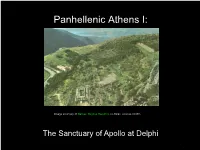
Panhellenic Athens I: Image courtesy of Nathan Hughes Hamilton on flickr. License CC BY. The Sanctuary of Apollo at Delphi 1 © 2003 Ancient World Mapping Center. Released under CC BY-NC 3.0. 2 Image courtesy of BillBl on flickr. License CC BY. Image courtesy of Lucas on flickr. License CC BY. 3 Image courtesy of Verity Cridland on flickr. License CC BY. Navel of the Earth Delphi Museum 4 Sanctuary of Apollo Image by P. de la Coste-Messelière. This image is in the public domain. Source: Wikimedia Commons. 5 Treasury of the Sicyonians Image courtesy of Lauren Jankowski on flickr. License CC BY. The Caledonian Boar Metopes of the archaic monopteros, 560 BC? 6 Image courtesy of Lauren Jankowski on flickr. License CC BY. Europa and the Bull Metopes of the archaic monopteros, 560 BC? 7 Siphnian Treasury – East Pediment Image courtesy of greekgeek on flickr. License CC BY-NC-SA. Apollo and Herakles dispute over the Delphic tripod 8 Siphnian Treasury Image courtesy of greekgeek on flickr. License CC BY-NC-SA. North Frieze - Gigantomachy 9 Siphnian Treasury – North Frieze Image courtesy of Richard Mortel on flickr. License CC BY-NC-SA. One of Dionysos’ lions attacks a Giant 10 Siphnian Treasury – North Frieze Apollo and Artemis Image courtesy of greekgeek on flickr. License CC BY-NC-SA. 11 Image courtesy of Richard Mortel on flickr. License CC BY-NC-SA. Aphrodite and Athena battle Giants 12 The Treasury of the Athenians Inscription on south face of platform: "The Athenians [dedicated this] to Apollo as first fruits from the Persians at the Battle of Marathon" Image courtesy of Mikael Vejdemo Johansson on flickr. -

A Comparative Study of Ancient Greek City Walls in North-Western Black Sea During the Classical and Hellenistic Times
INTERNATIONAL HELLENIC UNIVERSITY SCHOOL OF HUMANITIES MA IN BLACK SEA CULTURAL STUDIES A comparative study of ancient Greek city walls in North-Western Black Sea during the Classical and Hellenistic times Thessaloniki, 2011 Supervisor’s name: Professor Akamatis Ioannis Student’s name: Fantsoudi Fotini Id number:2201100018 Abstract Greek presence in the North Western Black Sea Coast is a fact proven by literary texts, epigraphical data and extensive archaeological remains. The latter in particular are the most indicative for the presence of walls in the area and through their craftsmanship and techniques being used one can closely relate these defensive structures to the walls in Asia Minor and the Greek mainland. The area examined in this paper, lies from ancient Apollonia Pontica on the Bulgarian coast and clockwise to Kerch Peninsula.When establishing in these places, Greeks created emporeia which later on turned into powerful city states. However, in the early years of colonization no walls existed as Greeks were starting from zero and the construction of walls needed large funds. This seems to be one of the reasons for the absence of walls of the Archaic period to which lack comprehensive fieldwork must be added. This is also the reason why the Archaic period is not examined, but rather the Classical and Hellenistic until the Roman conquest. The aim of Greeks when situating the Black Sea was to permanently relocate and to become autonomous from their mother cities. In order to be so, colonizers had to create cities similar to their motherlands. More specifically, they had to build public buildings, among which walls in order to prevent themselves from the indigenous tribes lurking to chase away the strangers from their land.