Palaeontological Heritage of North West
Total Page:16
File Type:pdf, Size:1020Kb
Load more
Recommended publications
-
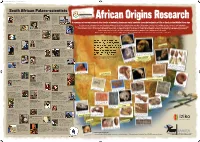
South African Palaeo-Scientists the Names Listed Below Are Just Some of South Africa’S Excellent Researchers Who Are Working Towards Understanding Our African Origins
2010 African Origins Research MAP_Layout 1 2010/04/15 11:02 AM Page 1 South African Palaeo-scientists The names listed below are just some of South Africa’s excellent researchers who are working towards understanding our African origins. UNIVERSITY OF CAPE TOWN (UCT) Dr Thalassa Matthews analyses the Dr Job Kibii focuses PALAEOBIOLOGICAL RESEARCH thousands of tiny teeth and bones of fossil on how fossil hominid Professor Anusuya Chinsamy-Turan is one microfauna to reconstruct palaeoenviron- and non-hominid of only a few specialists in the world who mental and climatic changes on the west faunal communities coast over the last 5 million years. changed over time and African Origins Research studies the microscopic structure of bones of dinosaurs, pterosaurs and mammal-like uses this to reconstruct reptiles in order to interpret various aspects ALBANY MUSEUM, past palaeoenviron- of the biology of extinct animals. GRAHAMSTOWN ments and palaeo- A summary of current research into fossils of animals, plants and early hominids from the beginning of life on Earth to the Middle Stone Age PERMIAN AGE PLANTS ecology. THE HOFMEYR SKULL Dr Rose Prevec studies the “No other country in the world can boast the oldest evidence of life on Earth extending back more than 3 billion years, the oldest multi-cellular animals, the oldest land-living plants, Professor Alan Morris described the Glossopteris flora of South Africa (the PAST HUMAN BEHAVIOUR Hofmeyer skull, a prehistoric, fossilized ancient forests that formed our coal Professor Chris Henshilwood directs the most distant ancestors of dinosaurs, the most complete record of the more than 80 million year ancestry of mammals, and, together with several other African countries, a most remarkable human skull about 36 000 years old deposits) and their end-Permian excavations at Blombos Cave where that corroborates genetic evidence that extinction. -

South Africa's Coalfields — a 2014 Perspective
International Journal of Coal Geology 132 (2014) 170–254 Contents lists available at ScienceDirect International Journal of Coal Geology journal homepage: www.elsevier.com/locate/ijcoalgeo South Africa's coalfields — A 2014 perspective P. John Hancox a,⁎,AnnetteE.Götzb,c a University of the Witwatersrand, School of Geosciences and Evolutionary Studies Institute, Private Bag 3, 2050 Wits, South Africa b University of Pretoria, Department of Geology, Private Bag X20, Hatfield, 0028 Pretoria, South Africa c Kazan Federal University, 18 Kremlyovskaya St., Kazan 420008, Republic of Tatarstan, Russian Federation article info abstract Article history: For well over a century and a half coal has played a vital role in South Africa's economy and currently bituminous Received 7 April 2014 coal is the primary energy source for domestic electricity generation, as well as being the feedstock for the Received in revised form 22 June 2014 production of a substantial percentage of the country's liquid fuels. It furthermore provides a considerable source Accepted 22 June 2014 of foreign revenue from exports. Available online 28 June 2014 Based on geographic considerations, and variations in the sedimentation, origin, formation, distribution and quality of the coals, 19 coalfields are generally recognised in South Africa. This paper provides an updated review Keywords: Gondwana coal of their exploration and exploitation histories, general geology, coal seam nomenclature and coal qualities. With- Permian in the various coalfields autocyclic variability is the norm rather than the exception, whereas allocyclic variability Triassic is much less so, and allows for the correlation of genetically related sequences. During the mid-Jurassic break up Coalfield of Gondwana most of the coal-bearing successions were intruded by dolerite. -

Sequence Stratigraphic Development of the Neoarchean Transvaal Carbonate Platform, Kaapvaal Craton, South Africa Dawn Y
DAWN Y. SUMNER AND NICOLAS J. BEUKES 11 Sequence Stratigraphic Development of the Neoarchean Transvaal carbonate platform, Kaapvaal Craton, South Africa Dawn Y. Sumner Department of Geology, University of California 1 Shields Ave, Davis, CA 95616 USA e-mail: sumner@geology.ucdavis.edu Nicolas J. Beukes Department of Geology, University of Johannesburg P.O. Box 524, Auckland Park, 2000 South Africa e-mail: njb@na.rau.ac.za © 2006 March Geological Society of South Africa ABSTRACT The ~2.67 to ~2.46 Ga lower Transvaal Supergroup, South Africa, consists of a mixed siliciclastic-carbonate ramp that grades upward into an extensive carbonate platform, overlain by deep subtidal banded iron-formation. It is composed of 14 third-order sequences that develop from a mixed siliciclastic-carbonate ramp to a steepened margin followed by a rimmed margin that separated lagoonal environments from the open ocean. Drowning of the platform coincided with deposition of banded iron-formation across the Kaapvaal Craton. The geometry and stacking of these sequences are consistent with more recent patterns of carbonate accumulation, demonstrating that Neoarchean carbonate accumulation responded to subsidence, sea level change, and carbonate production similarly to Proterozoic and Phanerozoic platforms. The similarity of carbonate platform geometry through time, even with significant changes in dominant biota, demonstrates that rimmed margins are localized primarily by physiochemical conditions rather than growth dynamics of specific organisms. Stratigraphic patterns during deposition of the Schmidtsdrift and Campbellrand-Malmani subgroups are most consistent with variable thinning of the Kaapvaal Craton during extrusion of the ~2.7 Ga Ventersdorp lavas. Although depositional patterns are consistent with rifting of the western margin of the Kaapvaal Craton during this time, a rift-to-drift transition is not required to explain subsidence. -
Alternative Model for the Derivation of Gold in the Witwatersrand Supergroup
J. geol. Soc. London, Vol. 141, 1984, pp. 263-272, 3 figs., 3 tables. Printed in Northern Ireland. Alternative model for the derivation of gold in the Witwatersrand Supergroup Thomas 0. Reimer SUMMARY: Present models of the derivation of the gold in the Witwatersrand conglomerates of South Africa as detrital grains directly from primary deposits in a source area consisting mainly of Archaean schist belts meets with a volume problem. Witwatersrand deposits have yielded about 923 kg/km2 Au compared to about 65 kg/km* Au in the richest known schist belts. Differences in the extent of mining activities cannot account for these differences in yield. Gold fineness, grain size, and morphology of the gold particles are also difficult to reconcile with a purely detrital derivation. Data on the mobility of gold in the hydrosphere and in the weatheringcycle are used to erect a model which predicts that mostof the gold in the Witwatersrand conglomerates was derived from a source area in trace amounts in a ‘dissolved’ form and precipitated at or close to the edge of the depositional basin, possibly under organic influences. Subsequent sedimentary reworking and metamorphiddiagenetic remobilization led to the formation of the complex association of minerals observed now in the conglomerates. Since the dawn of civilization an estimatedtotal of data irreconcilable with the ‘mechanical’ model of about 65 000 tons of gold has been produced. Of this derivation of the Witwatersrand gold. Atthe same about 55% has beenderived fromthe auriferous time an alternative model for the processes which led conglomerates of the early Proterozoic Witwatersrand tothe spectacularconcentration of gold in these Supergroup (2.3-2.7 Ga.). -
The Systematic Position of the Enigmatic Thyreophoran Dinosaur Paranthodon Africanus, and the Use of Basal Exemplifiers in Phyl
1 The systematic position of the enigmatic thyreophoran dinosaur Paranthodon africanus, 2 and the use of basal exemplifiers in phylogenetic analysis 3 4 Thomas J. Raven1,2 ,3 and Susannah C. R. Maidment2 ,3 5 61Department of Earth Science & Engineering, Imperial College London, UK 72School of Environment & Technology, University of Brighton, UK 8 3Department of Earth Sciences, Natural History Museum, London, UK 9 10Corresponding author: Thomas J. Raven 11 12Email address: tom.raven13@imperial.ac.uk 13 14 15 16 17 18 19 20 21ABSTRACT 22 23The first African dinosaur to be discovered, Paranthodon africanus was found in 1845 in the 24Lower Cretaceous of South Africa. Taxonomically assigned to numerous groups since discovery, 25in 1981 it was described as a stegosaur, a group of armoured ornithischian dinosaurs 26characterised by bizarre plates and spines extending from the neck to the tail. This assignment 27that has been subsequently accepted. The type material consists of a premaxilla, maxilla, a nasal, 28and a vertebra, and contains no synapomorphies of Stegosauria. Several features of the maxilla 29and dentition are reminiscent of Ankylosauria, the sister-taxon to Stegosauria, and the premaxilla 30appears superficially similar to that of some ornithopods. The vertebral material has never been 31described, and since the last description of the specimen, there have been numerous discoveries 32of thyreophoran material potentially pertinent to establishing the taxonomic assignment of the 33specimen. An investigation of the taxonomic and systematic position of Paranthodon is therefore 34warranted. This study provides a detailed re-description, including the first description of the 35vertebra. Numerous phylogenetic analyses demonstrate that the systematic position of 36Paranthodon is highly labile and subject to change depending on which exemplifier for the clade 37Stegosauria is used. -
Joint Geological Survey/University of Cape Town MARINE GEOSCIENCE UNIT TECHNICAL ^REPORT NO. 13 PROGRESS REPORTS for the YEARS 1
Joint Geological Survey/University of Cape Town MARINE GEOSCIENCE UNIT TECHNICAL ^REPORT NO. 13 PROGRESS REPORTS FOR THE YEARS 1981-1982 Marine Geoscience Group Department of Geology University of Cape Town December 1982 NGU-Tfc—Kh JOINT GEOLOGICAL SURVEY/UNIVERSITY OF CAPE TOWN MARINE GEOSCIENCE UNIT TECHNICAL REPORT NO. 13 PROGRESS REPORTS FOR THE YEARS 1981-1982 Marine Geoscience Group Department of Geology University of Cape Town December 1982 The Joint Geological Survey/University of Cape Town Marine Geoscience Unit is jointly funded by the two parent organizations to promote marine geoscientific activity in South Africa. The Geological Survey Director, Mr L.N.J. Engelbrecht, and the University Research Committee are thanked for their continued generous financial and technical support for this work. The Unit was established in 1975 by the amalgamation of the Marine Geology Programme (funded by SANCOR until 1972) and the Marine Geophysical Unit. Financial ?nd technical assistance from the South African National Committee for Oceanographic Research, and the National Research Institute for Oceanology (Stellenbosch) are also gratefully acknowledged. It is the policy of the Geological Survey and the University of Cape Town that the data obtained may be presented in the form of theses for higher degrees and that completed projects shall be published without delay in appropriate media. The data and conclusions contained in this report are made available for the information of the international scientific community with tl~e request that they be not published in any manner without written permission. CONTENTS Page INTRODUCTION by R.V.Dingle i PRELIMINARY REPORT ON THE BATHYMETRY OF PART OF 1 THE TRANSKEI BASIN by S.H. -

Key Trends in the Resource Sustainability of Platinum Group Elements
Ore Geology Reviews 46 (2012) 106–117 Contents lists available at SciVerse ScienceDirect Ore Geology Reviews journal homepage: www.elsevier.com/locate/oregeorev Key trends in the resource sustainability of platinum group elements Gavin M. Mudd ⁎ Environmental Engineering, Department of Civil Engineering, Monash University, Clayton, 3800, Melbourne, Australia article info abstract Article history: Platinum group elements (PGEs) are increasingly used in a variety of environmentally-related technologies, Received 6 November 2011 such as chemical process catalysts, catalytic converters for vehicle exhaust control, hydrogen fuel cells, Received in revised form 3 February 2012 electronic components, and a variety of specialty medical uses, amongst others — almost all of which have Accepted 3 February 2012 strong expected growth to meet environmental and technological challenges this century. Economic Available online 11 February 2012 geologists have been arguing on the case of abundant geologic resources of PGEs for some time while others still raise concerns about long-term supply — yet there remains no detailed analysis of formally reported Keywords: Platinum group elements (PGEs) mineral resources and key trends in the PGEs sector. This paper presents such a detailed review of the Economic mineral resources PGEs sector, including detailed mine production statistics and mineral resources by principal ore types, pro- Mineral resource sustainability viding an authoritative case study on the resource sustainability for a group of elements which are uniquely Bushveld Complex concentrated in a select few regions of the earth. The methodology, compiled data sets and trends provide Great Dyke strong assurance on the contribution that PGEs can make to the key sustainability and technology challenges – Noril'sk Talnakh of the 21st century such as energy and pollution control. -
Open Kosei.Pdf
The Pennsylvania State University The Graduate School Department of Geosciences GEOCHEMISTRY OF ARCHEAN–PALEOPROTEROZOIC BLACK SHALES: THE EARLY EVOLUTION OF THE ATMOSPHERE, OCEANS, AND BIOSPHERE A Thesis in Geosciences by Kosei Yamaguchi Copyright 2002 Kosei Yamaguchi Submitted in Partial Fulfillment of the Requirements for the Degree of Doctor of Philosophy May 2002 We approve the thesis of Kosei Yamaguchi Date of Signature ____________________________________ _______________________ Hiroshi Ohmoto Professor of Geochemistry Thesis Advisor Chair of Committee ____________________________________ _______________________ Michael A. Arthur Professor of Geosciences ____________________________________ _______________________ Lee R. Kump Professor of Geosciences ____________________________________ _______________________ Raymond G. Najjar Associate Professor of Meteorology ____________________________________ _______________________ Peter Deines Professor of Geochemistry Associate Head for Graduate Program and Research in Geosciences iii ABSTRACT When did the Earth's surface environment become oxic? The timing and mechanism of the rise of atmospheric pO2 level in the early Precambrian have been long debated but no consensus has been reached. The oxygenation of the atmosphere and oceans has significant impacts on the evolution of the biosphere and the geochemical cycles of redox-sensitive elements. In order to constrain the evolution of the atmosphere, oceans, biosphere, and geochemical cycles of elements, a systematic and multidisciplinary -

Palaeontological Heritage of the Free State
SAHRA PALAEOTECHNICAL REPORT PALAEONTOLOGICAL HERITAGE OF THE FREE STATE Brandwag Rock Golden Gate Highlands National Park. Photograpgh: Gideon Groenewald Dr Gideon Groenewald Cell: (082) 339-9202 David Groenewald Cell: (083) 469-4696 Logistical Support: Sue Groenewald Cell: (082) 339 9202 PO Box 360, Clarens, 9707 (1davidgroenewald@gmail.com) (Copyright: March 2014) GENERAL INTRODUCTION The core purpose of this SAHRA palaeotechnical report (PTR) is to briefly but comprehensively document the palaeontological heritage resources in South Africa in an accessible and useful format. Following the request by SAHRA, the report is presented in the form of two sections. The first section outlines the general geological history of South Africa and the second section provides a more detailed, geological history of the Free State, Gauteng, North West, Limpopo and Mpumalanga Provinces with specific reference to the palaeontological sensitivity of geological formations and their importance to the development of life through 3600 million years of time in Earth history. The first section summarises the geological history of South Africa and gives a very brief description of the six major events that shaped the Earth over time. The known and predicted fossil heritage within all the major fossiliferous stratigraphic units (formations, groups etc) that crop out in South Africa are presented on a map that relates directly to the composite geological map of South Africa where mapping was done on a 1:250 000 scale. The palaeontological sensitivity of geological units was allocated sensitivity ratings on a five point scale: very high sensitivity, high sensitivity, moderate sensitivity, low sensitivity and very low sensitivity (Table 1). -

Gold in South Africa by P.R
J. S. Afr. Inst. Min. Metaff., vol. 86, no. 8 Aug. 1986. pp. 273-316. Gold in South Africa by P.R. JANISCH* SYNOPSIS This paper reviews the sources, production, and technology of gold in South Africa. First of all it details the geographical distribution of gold-bearing materials, together with the mineralogy and distribution of gold within those materials. It goes on to the geological origins, and to the discovery and early exploitation, of the gold deposits. The laws relating to the mining and disposal of the metal are explained, after which an outline is given of gold exploration, processing, and refining. The economics of gold production are discussed briefly, and it is concluded that, although present expertise in the financial and technological aspects of a gold-mining venture have largely reduced the risks involved, one severe risk remains: that the rate of cost inflation will not be matched by the rate of escalation in the gold price. SAMEV A TTING Hierdie referaat gee 'n oorsig oor die bronne, produksie en tegnologie van goud in Suid-Afrika. Eerstens verstrek dit besonderhede van die geografiese verspreiding van goudhoudende materiale tesame met die mineralogie en verspreiding van goud in daardie materiale. Daarna behandel dit die geologiese oorsprong, en vervolgens die ont- dekking en vroee ontginning van die goudafsettings. Die wette in verband met die ontginning van en beskikking oor die metaal word verduidelik, waarna goudeksplorasie, -verwerking en -raffinering in hooftrekke behandel word. Die ekonomie van goudproduksie word kortliks bespreek en die gevolgtrekking word gemaak dat hoewel die huidige kundigheid wat betref die finansiele en tegnologiese aspekte van 'n goudmynonderneming die risiko's daaraan verbonde baie verminder het, daar nog een emstige risiko oorbly, naamlik dat die eskalasiekoers van die goudprys nie met die inflasiekoers van die koste sal tred hou nie. -

South Africa's Coalfields – a 2014 Perspective
South Africa's coalfields – a 2014 perspective 1Hancox, P. John and 2,3Götz, Annette E. 1University of the Witwatersrand, School of Geosciences, Private Bag 3, 2050 Wits, South Africa; hancox@cciconline.com 2University of Pretoria, Department of Geology, Private Bag X20, Hatfield, 0028 Pretoria, South Africa; annette.goetz@up.ac.za 3Kazan Federal University, 18 Kremlyovskaya St., Kazan 420008, Republic of Tatarstan, Russian Federation Highlights • South Africa’s Coalfields are presented. • The role of Gondwanan coals as palaeoclimate archives is stated. • Future research fields include palynology, sequence stratigraphy, basin fill. Abstract For well over a century and a half coal has played a vital role in South Africa’s economy and currently bituminous coal is the primary energy source for domestic electricity generation, as well as being the feedstock for the production of a substantial percentage of the country’s liquid fuels. It furthermore provides a considerable source of foreign revenue from exports. Based on geographic considerations, and variations in the sedimentation, origin, formation, distribution and quality of the coals, 19 coalfields are generally recognised in South Africa. This paper provides an updated review of their exploration and exploitation histories, general geology, and coal seam nomenclature and coal qualities. Within the various coalfields autocyclic variability is the norm rather than the exception, whereas allocyclic variability is much less so, and allows for the correlation of genetically related sequences. During the mid-Jurassic break up of Gondwana most of the coals bearing successions were intruded by dolerite. These intrusions are important as they may cause devolatilisation and burning of the coal, create structural disturbances and related seam correlation problems, and difficulties in mining operations. -

Buffelsbank Feasibility Study
ESKOM THYSPUNT TRANSMISSION LINE INTEGRATION PROJECT EIA: GEO-TECHNICAL SPECIALIST REPORT Prepared for SiVEST By Dr Johan Hattingh Carlo Fourie December 2010 TABLE OF CONTENTS EXECUTIVE SUMMARY .............................................................................................................. 4 GLOSSARY OF TERMS .............................................................................................................. 6 1. TERMS OF REFERENCE ................................................................................................... 7 2. GEOLOGY ...................................................................................................................... 7 2.1 GAMTOOS GROUP ................................................................................................... 8 2.1.1 LIME BANK FORMATION ...................................................................................... 8 2.1.2 KLEINRIVIER FORMATION ................................................................................... 8 2.1.3 KAAN FORMATION ............................................................................................. 10 2.1.4 VAN STADENS FORMATION ................................................................................ 10 2.2 CAPE SUPERGROUP ................................................................................................ 10 2.2.1 TABLE MOUNTAIN GROUP .................................................................................. 10 2.2.1.1 SARDINIA BAY FORMATION .........................................................................