14Th International Exhibition
Total Page:16
File Type:pdf, Size:1020Kb
Load more
Recommended publications
-

Leiden, a City Worth Exploring
Dit document wordt u aangeboden door: XXXXXXXXXXXXXXXXXXXXXXXXXXXXXXXX XXXXXXXXXXXXXXXXXXXXXXXXXXXXXXXX XXXXXXXXXXXXXXXXXXXXXXXXXXXXXXXX klik hier voor meer artikelen Leiden, a city worth exploring ‘Seeing is believing’. With this saying in mind, soon becomes obvious when a number of the partici- Leiden Marketing organized the inspirational pants in the weekend is picked up from their hotel by means of battery-powered Tuk-Tuks. The participants weekend ‘Discover the convention city of were dropped off at the Academy building of the Leiden Leiden’. So, late September, more than 20 University for a visit to the Hortus Botanicus Leiden. meeting planners and event organizers from This Hortus dates back to 1590 and this means that it is all over the country came to see with their the oldest Hortus of the Netherlands. Apart from a huge variety of plants that can be admired in various gardens own eyes what Leiden has to offer with regard and hothouses, the site also includes some buildings to corporate events. suited for a corporate meeting, such as the ‘Tuinkamer’ (garden hall) with the Cycas terrace, grand café Clusius Photography Hielco Kuipers with its Curator’s terrace and the Orangery. In grand café Clusius, which can also be leased on an exclu- uring the inspirational weekend a number of sive basis, the food and drinks are provided by caterer Leiden Marketing’s partners is given the op- Vermaat. He uses mainly biological ingredients and Dportunity to present themselves to a dedicated herbs from the gardens. The Orangery from 1744 is group of interested organizers of corporate meetings where the entire group is welcomed by Martijn Bulthuis, and events. -
2007 Vol. 10, Issue 1
Department of Botany & the U.S. National Herbarium TheThe PlantPlant PressPress New Series - Vol. 10 - No. 1 January-March 2007 Botany Profile Taking Aim at the GSPC Targets By Gary A. Krupnick and W. John Kress n 2002, the Convention on Biologi- are the contributions that the Department The data and images of more than cal Diversity (CBD), a global treaty has made towards achieving the 16 targets 95,000 type specimens of algae, Isigned by 188 countries addressing since the Strategy’s inception in 2002. lichens, bryophytes, ferns, gymno- the conservation and sustainable use of sperms and angiosperms are available on biological diversity, adopted the Global Understanding and Documenting Plant USNH’s Type Specimen Register at Strategy for Plant Conservation (GSPC), Diversity <http://ravenel.si.edu/botany/types/>. A the first CBD document that defines Target 1: A widely accessible working multi-DVD set containing images of specific targets for conserving plant list of known plant species, as a step 89,000 vascular type specimens from diversity. The 16 targets are grouped towards a complete world flora USNH has been produced and distrib- under five major headings: (a) under- uted to institutions around the world. In standing and documenting plant diversity; One of the Department’s core mis- addition, data from 778,054 specimen (b) conserving plant diversity; (c) using sions is to discover and describe plant life records have been inventoried in the plant diversity sustainably; (d) promoting in marine and terrestrial environments. EMu catalogue software. education and awareness about plant Thus, one primary objective is to conduct In addition, USNH is a partner in diversity; and (e) building capacity for field work in poorly known areas of high producing the Global Working Check- the conservation of plant diversity. -

Toeristisch Bezoek Aan Leiden in 2010 En Motivering Toeristisch Gebied Leiden)
B&W.nr. 11.0872, d.d. 13 september 2011 Onderwerp Herijking toeristisch gebied a.g.v. de wijziging in winkeltijdenwet per 01.01.2011 Besluiten: 1. de notitie ‘Herijking toeristisch gebied gemeente Leiden’ voor inspraak vast te stellen, waarin drie beleidsvarianten voor het toeristisch gebied – in de zin van de winkeltijdenwet – worden overwogen: a. de binnenstad en het stationsdistrict (handhaving huidige situatie) b. geheel Leiden (uitbreiding), c. geen (afschaffen van de huidige situatie), 2. de verslaglegging van de raadpleging van stadspartners over dit onderwerp vast te stellen, 3. in afwijking van artikel 7 van de Inspraakverordening de termijn van de inspraak te stellen op vier weken, ingaande de maandag, volgende op de besluitdatum van dit besluit; Perssamenvatting: De winkeltijdenwet uit 1996 is gewijzigd per 1 januari 2011. Op grond van die wijziging, zijn gemeenten, die een toeristisch gebied in de zin van de winkeltijdenwet hebben aangewezen, verplicht die aanwijzing te herijken. De gemeente moet onderbouwen waarom de gemeente daadwerkelijk toeristisch is. De toeristische aantrekkingskracht dient autonoom en substantieel te zijn. De wet geeft aan welke verplichte (belangen)afweging gemaakt moet worden: a. werkgelegenheid en economische bedrijvigheid in de gemeente, waaronder mede wordt begrepen het belang van winkeliers met weinig of geen personeel en van winkelpersoneel; b. de zondagsrust in de gemeente; c. de leefbaarheid, de veiligheid en de openbare orde in de gemeente. In de Notitie ‘Herijking toeristisch gebied gemeente Leiden’ wordt deze afweging gemaakt. Deze notitie wordt voor inspraak vastgesteld. Na verwerking van de inspraakreacties zal het college van Burgemeester en wethouders de raad voorstellen uit de drie beleidsvarianten met bijbehorende varianten winkeltijdenverordeningen, er één te kiezen. -

The Exotic World of Carolus Clusius 1526-1609 and a Reconstruction of the Clusius Garden
The Netherlandish humanist Carolus Clusius (Arras 1526- Leiden 1609) is one of the most important European the exotic botanists of the sixteenth century. He is the author of innovative, internationally famous botanical publications, the exotic worldof he introduced exotic plants such as the tulip and potato world of in the Low Countries, and he was advisor of princes and aristocrats in various European countries, professor and director of the Hortus botanicus in Leiden, and central figure in a vast European network of exchanges. Carolus On 4 April 2009 Leiden University, Leiden University Library, The Hortus botanicus and the Scaliger Institute 1526-1609 commemorate the quatercentenary of Clusius’ death with an exhibition The Exotic World of Carolus Clusius 1526-1609 and a reconstruction of the Clusius Garden. Clusius carolus clusius scaliger instituut clusius all3.indd 1 16-03-2009 10:38:21 binnenwerk.qxp 16-3-2009 11:11 Pagina 1 Kleine publicaties van de Leidse Universiteitsbibliotheek Nr. 80 binnenwerk.qxp 16-3-2009 11:12 Pagina 2 binnenwerk.qxp 16-3-2009 11:12 Pagina 3 The Exotic World of Carolus Clusius (1526-1609) Catalogue of an exhibition on the quatercentenary of Clusius’ death, 4 April 2009 Edited by Kasper van Ommen With an introductory essay by Florike Egmond LEIDEN UNIVERSITY LIBRARY LEIDEN 2009 binnenwerk.qxp 16-3-2009 11:12 Pagina 4 ISSN 0921-9293, volume 80 This publication was made possible through generous grants from the Clusiusstichting, Clusius Project, Hortus botanicus and The Scaliger Institute, Leiden. Web version: https://disc.leidenuniv.nl/view/exh.jsp?id=exhubl002 Cover: Jacob de Monte (attributed), Portrait of Carolus Clusius at the age of 59. -

Plant Life of Western Australia
INTRODUCTION The characteristic features of the vegetation of Australia I. General Physiography At present the animals and plants of Australia are isolated from the rest of the world, except by way of the Torres Straits to New Guinea and southeast Asia. Even here adverse climatic conditions restrict or make it impossible for migration. Over a long period this isolation has meant that even what was common to the floras of the southern Asiatic Archipelago and Australia has become restricted to small areas. This resulted in an ever increasing divergence. As a consequence, Australia is a true island continent, with its own peculiar flora and fauna. As in southern Africa, Australia is largely an extensive plateau, although at a lower elevation. As in Africa too, the plateau increases gradually in height towards the east, culminating in a high ridge from which the land then drops steeply to a narrow coastal plain crossed by short rivers. On the west coast the plateau is only 00-00 m in height but there is usually an abrupt descent to the narrow coastal region. The plateau drops towards the center, and the major rivers flow into this depression. Fed from the high eastern margin of the plateau, these rivers run through low rainfall areas to the sea. While the tropical northern region is characterized by a wet summer and dry win- ter, the actual amount of rain is determined by additional factors. On the mountainous east coast the rainfall is high, while it diminishes with surprising rapidity towards the interior. Thus in New South Wales, the yearly rainfall at the edge of the plateau and the adjacent coast often reaches over 100 cm. -
Skunk Cabbage Guide
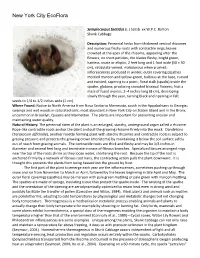
New York City EcoFlora Symplocarpus foetidus (L.) Salisb. ex W.P.C. Barton Skunk Cabbage Description: Perennial herbs from thickened vertical rhizomes and numerous fleshy roots with contractile rings; leaves crowded at the apex of the rhizome, appearing after the flowers, on short petioles, the blades fleshy, bright green, hairless, ovate or elliptic, 2 feet long and 1 foot wide (50 × 30 cm), reticulate veined, malodorous when crushed; inflorescences produced in winter; outer covering (spathe) mottled maroon and yellow-green, bulbous at the base, curved and twisted, tapering to a point; floral stalk (spadix) inside the spathe, globose, producing crowded bisexual flowers; fruit a mass of fused ovaries, 2–4 inches long (8 cm), developing slowly through the year, turning black and ripening in fall; seeds to 1/4 to 1/2 inches wide (1 cm). Where Found: Native to North America from Nova Scotia to Minnesota, south in the Appalachians to Georgia; swamps and wet woods in saturated soils; most abundant in New York City on Staten Island and in the Bronx, uncommon in Brooklyn, Queens and Manhattan. The plants are important for preventing erosion and maintaining water quality. Natural History: The perennial stem of the plant is an enlarged, starchy, underground organ called a rhizome. Rope-like contractile roots anchor the plant and pull the growing rhizome firmly into the muck. Dandelions (Taraxacum officinale), another rosette forming plant with starchy rhizomes and contractile roots is subject to grazing pressure and protects the growing crown (meristems) by maintaining it below the soil surface safely out of reach from grazing animals. -
(Ebenaceae) by Evaluating Short Sequence Region of Plastid Rbcl Gene
POJ 7(2):102-107 (2014) ISSN:1836-3644 Nucleotide based validation of the endangered plant Diospyros mespiliformis (Ebenaceae) by evaluating short sequence region of plastid rbcL gene Abdullah Alaklabi1, Ibrahim A. Arif 2,3, Sameera O. Bafeel4, Ahmad H. Alfarhan2,3, Anis Ahamed2,3, Jacob Thomas2 and Mohammad A. Bakir2,3* 1Department of Biology, College of Arts and Science, Al-Baha University (BU), Baljurashi, Saudi Arabia 2Department of Botany and Microbiology, College of Science, King Saud University (KSU), Riyadh, Saudi Arabia 3Saudi Biological Society and Prince Sultan Research Chair for Environment and Wildlife, King Saud University 4Department of Biology, King Abdulaziz University (KAU), Jeddah, Saudi Arabia *Corresponding author. Email: mbakir@ksu.edu.sa Abstract Diospyros mespiliformis (Hochst. ex A.DC.; Ebenaceae) is a large deciduous medicinal plant. This plant species is currently listed as endangered in Saudi Arabia. Molecular identification of this plant species based on short sequence regions (571 and 664 bp) of plastid rbcL (ribulose-1, 5-biphosphate carboxylase) gene was investigated in this study. The endangered plant specimens were collected from Al-Baha, Saudi Arabia (GPS coordinate: 19.8543987, 41.3059349). Phylogenetic tree inferred from the rbcL gene sequences showed that this species is very closely related with D. brandisiana. Close relationship was also observed among D. bejaudii, D. Philippinensis and D. releyi (≥99.7% sequence homology). The partial rbcL gene sequence region (571 bp) that was amplified by rbcL primer-pair rbcLaF-rbcLaR failed to discriminate D. mespiliformis from the closely related plant species, D. brandisiana. In contrast, primer-pair rbcL1F-rbcL724R yielded longer amplicon, discriminated the species from D. -
Hortus Atelier by Anita Walsmit Sachs Offers a 5 Days Course Botanical Drawing and Painting 2016 in Co-Operation With
21 Hortus atelier by Anita Walsmit Sachs offers a 5 days course botanical drawing and painting 2016 in co-operation with Rapenburg 73, 2311 GJ T. 0031 71 5 27 72 49 M. 0031 6 24 12 48 91 The Hortus botanicus Leiden is the oldest botanical garden in the Netherlands and located in the historical centre of Leiden. Behind the academy building of the Leiden University you will discover a green oasis with a large collection of plants native to South-east and East Asia, Southern Europe and South Africa. The Hortus is a haven within the city centre, a historical monument and a meeting place full of character. People come here to relax, enjoy the seasons or to learn more about the diversity of the plant kingdom. In 1590 the Hortus was founded by the University of Leiden. In 1594 Carolus Clusius (1526-1609) turned it into a medicinal herb garden. But Clusius introduced the tulip and many other plants like tobacco and potato the Hortus. These flowers and plants became known throughout Western Europe Many famous international scientists such as Clusius, Boerhaave, Linnaeus and Einstein were connected to the Hortus botanicus in Leiden. In the 19th century the German physician Philipp Franz von Siebold (1796-1866) brought hundreds of plant species with him from Japan to the Netherlands and 15 of these original introductions can still be found in the Hortus today. 21 The purpose of a botanical illustration is primarily a scientific accurate drawing, the artistic input is reflected in the sensitivity in which the subject is displayed and in the composition. -
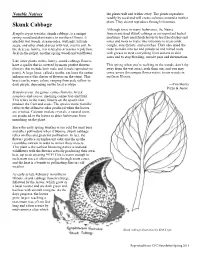
Skunk Cabbage
Notable Natives the plants wilt and wither away. The plants reproduce readily by seed and will create colonies around a mother plant. They do not reproduce through rhizomes. Skunk Cabbage Although toxic to many herbivores, the Native Symplocarpus foetidus, skunk cabbage, is a unique Americans used skunk cabbage as an important herbal spring woodland plant native to northern Illinois. It medicine. They used fresh leaves to treat headaches and inhabits wet woods, stream-sides, wetlands, hillside sores and roots to make into infusions to treat colds, seeps, and other shaded areas with wet, mucky soil. In coughs, sore throats, and earaches. They also dried the the Araceae family, it is related to Arisaema triphyllum, roots to make into tea and powdered and mixed roots Jack-in-the-pulpit, another spring woodland wildflower. with grease to treat everything from asthma to skin sores and to stop bleeding, muscle pain and rheumatism. Like other plants in this family, skunk cabbage flowers have a spadix that is covered by many perfect flowers This spring when you’re walking in the woods, don’t shy (flowers that include both male and female reproductive away from the wet areas; seek them out, and you may parts). A large bract, called a spathe, encloses the entire come across this unique flower native to our woods in inflorescence (the cluster of flowers on the stem). This northern Illinois. bract can be many colors, ranging from pale yellow to dark purple, depending on the local ecotype. —Tim Moritz Pizzo & Assoc. Symplocarpus, the genus, comes from the Greek symploce and carpos, meaning connection and fruit. -
Pennisetum Setaceum) on Water Availability and Productivity of Canopy Trees Within a Tropical Dry Forest in Hawaii
Functional Ecology 2008, 22, 1008–1017 doi: 10.1111/j.1365-2435.2008.01471.x TheBlackwell Publishing Ltd impact of an invasive African bunchgrass (Pennisetum setaceum) on water availability and productivity of canopy trees within a tropical dry forest in Hawaii S. Cordell1* and D. R. Sandquist2 1Institute of Pacific Islands Forestry, USDA Forest Service, Hilo, HI, USA; and 2Department of Biological Science, California State University, Fullerton, CA, USA Summary 1. Tropical dry forests are among the Earth’s most threatened ecosystems. On the Island of Hawaii the African bunchgrass Pennisetum setaceum (fountain grass) dominates the understorey of the few remaining fragments of native dry forests and is contributing to the degradation of this once diverse ecosystem. In this study, we examined the impacts of Pennisetum on water use and productivity of the dominant native canopy tree, Diospyros sandwicensis. 2. Over a 3-year period, measurements were made on tree growth rates, and physiological and morphological responses of the most common dry forest native tree, D. sandwicensis, growing with an understorey dominated by Pennisetum, and on trees growing in plots maintained free of grasses. 3. Analysis of stable oxygen isotope ratios indicated that trees growing in the absence of Pennisetum used a higher proportion of water from shallow soil sources. They also sustained higher mid-day water potentials, especially during drier periods. At the leaf level, no significant differences were found in gas exchange measurements between Diospyros trees growing with or without Pennisetum. However, trees growing without Pennisetum had 30% lower leaf mass per unit area and 40% higher diameter growth than trees growing with Pennisetum. -

Waxes and Triterpene Acids from Lagerstroemia Loudonii Fruit
NU Science Journal 2013; 10(2): 33 - 43 Waxes and Triterpene acids from Lagerstroemia loudonii fruit Ketkan Sirimethawong, Chanitsara Sriwattanawarunyoo, Vijitr Udeye and Surat Boonphong* Department of Chemistry, Faculty of Science, Naresuan University, Phitsanulok, 65000 Thailand. *Corresponding author. E-mail: suratb@nu.ac.th ABSTRACT Dichloromethane crude extracts from the Lagerstroemia loudonii fruit were purified by column chromatography and the isolated compounds were identified by spectroscopic methods, particularly by extensive Nuclear Magnetic Resonance (NMR) techniques. The isolated compounds were waxes, oleanane-type triterpene acid; oleanolic acid (OA) and ursan-type triterpene acid; ursolic acid (UA). This is the first report on the isolation of waxes and isomeric triterpene acids as OA and UA from this plant. Key words: Lagerstroemia loudonii, oleanolic acid, ursolic acid, waxes INTRODUCTION Lagerstroemia loudonii (Lythraceae) is a tropical plant mainly distributed in the northern part of Thailand. This genus has 18 species found in mixed forest (Smitinand, 2001). Some species are used for a local Thai herbal medicine such as L. floribunda and L. loudonii barks are used for treating diarrhea, while L. speciosa leaf is used for diuretic and diabetes. The wide range of pharmaceutical activity of L. speciosa has been studied, for example, control level in total hepatic lipid contents in genetically diabetic mice (type II, KK-Ay) (Suzuki et al., 1999), reduce blood pressure, lower blood glucose levels, antivirus, antifungal, antibacterial, anticancer (Punyaprabhasara, 2000) and antidiabetic activity in humans (Judy et al., 2003). Boonphong et al. reported that dichloromethane and methanol extracts from L. loudonii have antioxidant, anti-TB and anti-malarial activities. -
Notes on Persimmons, Kakis, Date Plums, and Chapotes by STEPHEN A
Notes on Persimmons, Kakis, Date Plums, and Chapotes by STEPHEN A. SPONGBERG The genus Diospyros is not at present an important genus of orna- mental woody plants in North America, and while native persimmons once were valuable fruits in the eastern United States, the fruits pro- duced by Diospyros species no longer are important food items in the American home. In the countries of eastern Asia at least two species of Diospyros are among the most common trees encountered in door- yard gardens and orchards, where they are cultivated for their edible fruits as well as for other uses and for their ornamental beauty. J. J. Rein, a German traveler and author, wrote in 1889 that Diospyros kaki Linnaeus f. was "undeniably the most widely distributed, most important, and most beautiful fruit-tree in Japan, Corea, and North- ern China." And in Japan, where D. kaki is second in importance as an orchard crop only to citrus fruit, the kaki often is referred to as the national fruit (Childers, 1972). The rarity with which species of Diospyros are found in cultivation in cool-temperate North America is partially due to the fact that most are native to regions of tropical and subtropical climate and are not hardy in areas of temperate climate. A member of the Ebenaceae or Ebony Family, the genus contains upwards of 400 species that occur Stephen A. Spongberg is a horticultural taxonomist at the Arnold Arbore- tum. He participated in the Arboretum’s collecting trip to Japan and Korea in the fall of 1977, an experience which intensifted his interest in persim- mons.