Centenary (Madagascar) | International Encyclopedia of The
Total Page:16
File Type:pdf, Size:1020Kb
Load more
Recommended publications
-

World Bank Document
1 PID THE WORLwDBANX GROUP ANVorld Free of Poyorty ?lhfoShop Public Disclosure Authorized 'Me Woddl Iank Report No AB84 Initial Project Information Document (PID) Project Name MADAGASCAR-MG-TRANSPORT INFRASTRUCTURE fNVESTMENT PROJECT Region Africa Regional Office Sector Roads and highways (82%); Ports; waterways and shipping(l4%); Aviation (4%) Project ID P082806 Supplemental Project Public Disclosure Authorized Borrower(s) REPUBLIC OF MADAGASCAR Implementing Agency MINISTRY OF TRANSPORT AND MINISTRY OF PUBLIC WORKS Address Program Executive Secretariat Address' Vice Premier Office of Economic Programs, Ministry of Transport, Public Works and Regional Planning, Antananarivo, Madagascar Contact Person Jean Berchmans Rakotomaniraka Tel. 261 33 11 159 42 Fax. Email rjb_sepst@dts mg Environment Category A Date PID Prepared May 15, 2003 Auth Appr/Negs Date September 10, 2003 Bank Approval Date November 13, 2003 1. Country and Sector Background Public Disclosure Authorized The transport sector plays a key role in Madagascar's growth and poverty alleviation strategy. Increased foreign investment, development of the country's eco-tourism and mining potential, and growth in agricultural output all depend on the efficiency of transport services and the availability of appropriate transport infrastructure. Unfortunately, three decades (1970-2000) of inappropriate sector policies have led to a serious deterioration of the country's transport infrastructure. It is estimated that during that period the country lost on average about 1000 kilometers -
PLAGUE OUTBREAK Madagascar External Situation Report 06
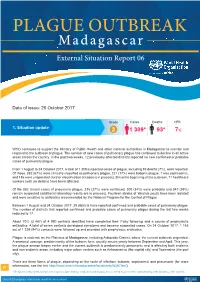
PLAGUE OUTBREAK Madagascar External Situation Report 06 Date of issue: 26 October 2017 ....................... ....................... ....................... Grade Cases Deaths CFR 1. Situation update 2 1 309* 93* 7% WHO continues to support the Ministry of Public Health and other national authorities in Madagascar to monitor and respond to the outbreak of plague. The number of new cases of pulmonary plague has continued to decline in all active areas across the country. In the past two weeks, 12 previously affected districts reported no new confirmed or probable cases of pulmonary plague. From 1 August to 24 October 2017, a total of 1 309 suspected cases of plague, including 93 deaths (7%), were reported. Of these, 882 (67%) were clinically classified as pulmonary plague, 221 (17%) were bubonic plague, 1 was septicaemic, and 186 were unspecified (further classification of cases is in process). Since the beginning of the outbreak, 71 healthcare workers (with no deaths) have been affected. Of the 882 clinical cases of pneumonic plague, 235 (27%) were confirmed, 300 (34%) were probable and 347 (39%) remain suspected (additional laboratory results are in process). Fourteen strains of Yersinia pestis have been isolated and were sensitive to antibiotics recommended by the National Program for the Control of Plague. Between 1 August and 24 October 2017, 29 districts have reported confirmed and probable cases of pulmonary plague. The number of districts that reported confirmed and probable cases of pulmonary plague during the last two weeks reduced to 17. About 70% (3 467) of 4 990 contacts identified have completed their 7-day follow-up and a course of prophylactic antibiotics. -
Lessons Learnt from the 2017/2018 Plague Outbreak in Madagascar
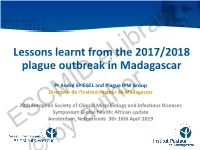
Lessons learnt from the 2017/2018 plague outbreak in Madagascar Pr André SPIEGEL and Plague IPM Group Directeur de l’Institut Pasteur de Madagascar 29th European Society of Clinical Microbiology and Infectious Diseases Symposium Global health: African update ESCMIDAmsterdam, Netherlands eLibrary 3th-16th April 2019 © by author Plague Y pestis / rodents / fleas and… humans Rodents Humans and Secondary fleas Pneumonic form Yersinia Person to person transmission pestis Possible evolution to Flea Bubonic form Infected rodent ESCMID eLibrary 2 © by author Plague in Madagascar 1898 : introduction of the Plague in Madagascar (Toamasina) • 1898 : Toamasina epidemic • 24 november 1898 : 1th cas • 1921 : Antananarivo • Following the construction railways • Spread in Madagascar • Endemic to the present day ESCMID eLibrary 3 © by author Plague in Madagascar Rural / seasonal / bubonic • Endemic area • Rural areas of the Central highlands • Natural foci of plague • Altitude > 800 m ESCMID eLibrary 4 © by author Plague in Madagascar Rural / seasonal / bubonic : Reservoirs and Vectors (1) (1) (2) Urban coast Rural area C C (1) B B A A B B (2) Urban highland ESCMID(1) (2) eLibrary(1) A : Rattus rattus (1) : Xenopsylla cheopis B : Rattus norvegicus (2) : Synopsyllus fonquerniei 5 C : Suncus©murinus by author Plague in Madagascar Rural / seasonal / bubonic • Seasonal : October to April • Cases • 500 / year • Bubonic form predominant > 85% notified cases (1998 – 2016) 1998 - 2016 ESCMID eLibrary 6 (Andrianaivoarimanana© V et al,by EID 2019,25,220 -228)author -

Les Monuments Aux Morts De La Grande Guerre Dans Le Nord-Pas-De-Calais
MOSAÏQUE, revue de jeunes chercheurs en SHS – Lille Nord de France – Belgique – n° 14, décembre 2014 Matthias MEIRLAEN Témoins de mémoires spécifiques : les monuments aux morts de la Grande Guerre dans le Nord-Pas-de-Calais Notice Biographique Matthias Meirlaen est docteur de l’université de Louvain (KU Leuven, Belgique), avec un travail portant sur l’émergence de l’enseignement de l’histoire dans les Pays-Bas méridionaux aux XVIIIe et XIXe siècles. Actuellement, il est Post-doctorant à l’Institut de Recherches Historiques du SePtentrion (IRHiS) de l’Université Lille 3 (France). Il y conduit un Projet de recherches intitulé « Retracer la Grande Guerre » sous la direction d’Élise Julien. Dans son contenu, le Projet ambitionne de s’attarder sur l’ensemble des phénomènes de la mémoire de la Première Guerre mondiale dans la région Nord-Pas-de-Calais. Résumé Dans l’entre-deux-guerres, un vaste mouvement commémoratif se développe. Presque chaque commune de France commémore alors ses morts tombés Pendant la Grande Guerre. Dans la majorité des communes, les manifestations en l’honneur des morts se déroulent autour de monuments érigés Pour l’occasion. cet article examine les représentations Portées Par les monuments communaux de la Première Guerre mondiale dans la région Nord-Pas-de-Calais. Cette région constitue du Point de vue de la guerre un esPace charnière spécifique. APrès les batailles d’octobre 1914, elle est partagée pour quatre années en trois zones distinctes : une zone de front, une zone occupée et une zone libre. L’article cherche à voir si les rePrésentations Portées Par les monuments aux morts de l’entre-deux- guerres diffèrent dans les trois secteurs concernés. -

The Case of Madagascar
water Article Environmental Factors and the Microbial Quality of Urban Drinking Water in a Low-Income Country: The Case of Madagascar Alexandra Bastaraud 1, Jean Marius Rakotondramanga 2, Jackson Mahazosaotra 1, Noror Ravaonindrina 1 and Ronan Jambou 3,* 1 Food Hygiene and Environment Laboratory, Institut Pasteur of Madagascar, 101 Antananarivo, Madagascar; abastaraud@pasteur.mg (A.B.); mjackson@pasteur.mg (J.M.); nravaoni@pasteur.mg (N.R.) 2 Epidemiology Department Institut Pasteur of Madagascar, 101 Antananarivo, Madagascar; rjmarius@pasteur.mg 3 Parasites and Vectors Insects Department, Institut Pasteur, 75015 Paris, France * Correspondence: rjambou@pasteur.fr; Tel.: +225-77-92-32-04 Received: 25 July 2018; Accepted: 9 October 2018; Published: 15 October 2018 Abstract: Access to piped water is often limited to urban areas in low-income countries, and the microbiological quality of drinking water varies due to technical and environmental constraints. To analyse the parameters that modulate the contamination of these systems, this study examines 16 years of microbial quality data for water supplied in 32 urban areas of Madagascar. A discriminant statistical approach and agglomerative hierarchical clusters were applied to environmental and climatic data. The microbial contamination varied between sites from 3.3 to 17.5%, and 78% of the supply systems showed large variations between years or months. Agglomerative hierarchical clusters (AHCs) revealed four supply system profiles that share a similar bacteriological evolution. Heavy rainfall and dry periods sustained increasing contamination, as reflected in levels of spores of sulphite-reducing clostridia (SSRC) and/or total coliforms (TC). SSRC were dominant in three profiles, with faecal indicator bacteria (FIB) dominant in the other. -

11Th Indian Ocean Ports and Shipping 2017
Conférence Bilingue Avec Follow us on: Traduction Anglais-Français French to English Bilingual Conference Translation Hotel Carlton, Antananarivo, Madagascar Associate Members Wednesday 22 and Thursday 23 March 2017 Hosted By Organised By Sponsored By • Technical Site Visit • 30 International Exhibition Stands • 35 International Conference Speakers • 300 Conference Delegates • Networking Welcome Reception • Networking Welcome Dinner • Special Offer: Conference Delegate Registration for Shipping Lines; Port Authorities And Terminal Operating Companies at only €795! Save €500! • FREE Conference Delegate Registration for Shippers/Beneficial Cargo Owners (BCOs) KEY SPEAKERS.... PLUS MANY MORE! HIGHLIGHTED TOPICS 1. Christian Eddy Avellin • Indian Ocean economic transformations and trade outlook for 2017: Opportunities and challenges Director General, Port of Toamasina (SPAT), Madagascar from a regional and global perspective 2. Rachid Baho Chief Executive Officer, Madagascar International Container Terminal Services Limited • The Port of Toamasina and its future prospects (MICTSL), Madagascar • Creating value for Eastern and Southern Africa ports: Roles of hinterland countries 3. Philippe Murcia Strategic approach in increasing container handling capacity in Eastern Africa Founder, Ocean Company Consulting, Advisor, ENAC Group, Expert in Maritime Economics, • UNECA (United Nations Economic Commission for Africa), Madagascar • Port investment and expansion opportunities around the Indian Ocean region: Current 4. Nishal Sooredoo developments -
Variable Name
Data codebook for a Round 5 Afrobarometer survey in 34 African countries Prepared by: Chunho Park Michigan State University July 2015 University of Cape Town (UCT) Center for Democratic Development (CDD-Ghana) Michigan State University (MSU) Centre for Social Science Research 14 W. Airport Residential Area Department of Political Science Private Bag, Rondebosch, 7701, South Africa P.O. Box 404, Legon-Accra, Ghana East Lansing, Michigan 48824 27 21 650 3827•fax: 27 21 650 4657 233 21 776 142•fax: 233 21 763 028 517 353 3377•fax: 517 432 1091 Mattes (robert.mattes@uct.ac.za) Gyimah-Boadi (cdd@ghana.com) Bratton (mbratton@msu.edu) Copyright Afrobarometer Table of Contents Page number Variable descriptives 3-71 Appendix 1: Sample characteristics 72 Appendix 2: List of country abbreviations and country-specific codes 73 Appendix 3: Technical Information Forms for each country survey 74-107 Copyright Afrobarometer 2 Question Number: COUNTRY_ALPHA Question: Country Variable Label: Country in alphabetical order Values: 1-35 Value Labels: 1=Algeria, 2=Benin, 3=Botswana, 4=Burkina Faso, 5=Burundi, 6=Cameroon, 7=Cape Verde, 8=Cote d’Ivoire, 9=Egypt, 11=Ghana, 12=Guinea, 13=Kenya, 14=Lesotho, 15=Liberia, 16=Madagascar, 17=Malawi, 18=Mali, 19=Mauritius, 20=Morocco, 21=Mozambique, 22=Namibia, 23=Niger, 24=Nigeria, 25=Senegal, 26=Sierra Leone, 27=South Africa, 28=Sudan, 29=Swaziland, 30=Tanzania, 31=Togo, 32=Tunisia, 33=Uganda, 34=Zambia, 35=Zimbabwe Note: Answered by interviewer Question Number: RESPNO Question: Respondent number Variable Label: Respondent -

Guide Des Sources Sur La Première Guerre Mondiale Aux A.D
GUIDE DES SOURCES SUR LA PREMIERE GUERRE MONDIALE AUX ARCHIVES DEPARTEMENTALES DE LA SOMME ARCHIVES DEPARTEMENTALES DE LA SOMME AMIENS — OCTOBRE 2015 Illustration de couverture : carte de correspondance militaire (détail), cote 99 R 330935. Date de dernière mise à jour du guide : 13 octobre 2015. 2 Table des matières abrégée Une table des matières détaillée figure à la fin du guide. INTRODUCTION.......................................................................................................................... 5 GUIDE........................................................................................................................................ 10 K - LOIS, ORDONNANCES, ARRETES ................................................................................................ 12 3 K - Recueil des actes administratifs de la préfecture de la Somme (impr.) .................................... 12 4 K - Arrêtés du préfet (registres)....................................................................................................... 12 M - ADMINISTRATION GENERALE ET ECONOMIE ........................................................................... 13 1 M - Administration generale du département.................................................................................. 13 2 M - Personnel de la préfecture, sous-préfectures et services annexes.......................................... 25 3 M - Plébisistes et élections............................................................................................................. -

Gabrielle Petit
GABRIELLE PETIT i ii GABRIELLE PETIT THE DEATH AND LIFE OF A FEMALE SPY IN THE FIRST WORLD WAR S o p h i e D e S c h a e p d r i j v e r Bloomsbury Academic An imprint of Bloomsbury Publishing Plc iii Bloomsbury Academic An imprint of Bloomsbury Publishing Plc 50 Bedford Square 1385 Broadway London New York WC1B 3DP NY 10018 UK USA www.bloomsbury.com BLOOMSBURY and the Diana logo are trademarks of Bloomsbury Publishing Plc First published 2015 © Sophie De Schaepdrijver, 2015 Sophie De Schaepdrijver has asserted her right under the Copyright, Designs and Patents Act, 1988, to be identifi ed as Author of this work. All rights reserved. No part of this publication may be reproduced or transmitted in any form or by any means, electronic or mechanical, including photocopying, recording, or any information storage or retrieval system, without prior permission in writing from the publishers. No responsibility for loss caused to any individual or organization acting on or refraining from action as a result of the material in this publication can be accepted by Bloomsbury or the author. British Library Cataloguing- in-Publication Data A catalogue record for this book is available from the British Library. ISBN: HB: 978-1-4725-9087-9 PB: 978-1-4725-9086-2 ePDF: 978-1-4725-9088-6 ePub: 978-1-4725-9089-3 Library of Congress Cataloging- in-Publication Data Schaepdrijver, Sophie de. Gabrielle Petit : the death and life of a female spy in the First World War / Sophie De Schaepdrijver. -

Fombandrazana Vezo: Ethnic Identity and Subsistence
FOMBANDRAZANA VEZO: ETHNIC IDENTITY AND SUBSISTENCE STRATEGIES AMONG COASTAL FISHERS OF WESTERN MADAGASCAR by EARL FURMAN SANDERS (Under the Direction of THEODORE GRAGSON) ABSTRACT The complex dynamic among coastal peoples of western Madagascar involves spread of cultural elements due to extensive seasonal migrations, tribes and ethnic groups merging into progressively broader ethnic groups, distinctions based on interethnic and intra-ethnic boundaries, and lumping of peoples with remotely similar subsistence patterns which has perpetuated ethnonym vagaries. This study analyzes the cultural bases of the Vezo, a group of marine fishers inhabiting the west coast of Madagascar, with the intent of presenting a clearer image of what is entailed within the ethnonym, Vezo, both with respect to subsistence strategies and cultural identity. Three broad areas of inquiry, ethnohistory, ecological niche as understood from the Eltonian definition, and geographical scope inform the field research. Access to these areas leans heavily on oral histories, which in turn is greatly facilitated by intensive participant observation and work in the native language. The analysis shows that the Vezo constitute a distinct ethnic group composed of diverse named patrilineal descent groups. This ethnic group is defined by common origins and a shared sense of common history, which along with the origins of the taboos are maintained within their oral histories. Within the ethnonym, Vezo, there are subsistence as well as other cultural distinctions, most notably the taboos. These distinctions are the bases of the ethnic boundaries separating those who belong to the Vezo cultural group and others who are referred to as Vezo (Vezom-potake and Vezo-loatse) due to geographical disposition. -

The Search for Knowledge Among the Seventh-Day Adventists in the Area of Maroantsetra, Madagascar
1 The search for knowledge among the Seventh-day Adventists in the area of Maroantsetra, Madagascar Eva Salome Keller London School of Economics and Political Science Doctor of Philosophy 2002 UMI Number: U615598 All rights reserved INFORMATION TO ALL USERS The quality of this reproduction is dependent upon the quality of the copy submitted. In the unlikely event that the author did not send a complete manuscript and there are missing pages, these will be noted. Also, if material had to be removed, a note will indicate the deletion. Dissertation Publishing UMI U615598 Published by ProQuest LLC 2014. Copyright in the Dissertation held by the Author. Microform Edition © ProQuest LLC. All rights reserved. This work is protected against unauthorized copying under Title 17, United States Code. ProQuest LLC 789 East Eisenhower Parkway P.O. Box 1346 Ann Arbor, Ml 48106-1346 "Th c I S£- S F 7?6>7 ‘•4 2 Abstract The thesis is an ethnographic inquiry into the nature of Seventh-day Adventism in Maroantsetra, a small town on the northeast coast of Madagascar, and Sahameloka, a nearby village. The Seventh-day Adventists in Maroantsetra and Sahameloka do not participate in traditional practices through which local people communicate with their ancestors, because they consider such practices to be the work of the devil. This is highly significant in the context of Madagascar and causes serious tension between Adventist and non-Adventist kin. The thesis examines whether the members of the church form a discrete community, but finds that they remain firmly embedded in existing kinship networks despite the difficulties involved. -

Revival After the Great War Rebuild, Remember, Repair, Reform
Revival after the Great War Rebuild, Remember, Repair, Reform Edited by Luc Verpoest, Leen Engelen, Rajesh Heynickx, Jan Schmidt, Pieter Uyttenhove, and Pieter Verstraete LEUVEN UNIVERSITY PRESS Published with the support of the KU Leuven Fund for Fair Open Access, the City of Leuven and LUCA School of Arts Published in 2020 by Leuven University Press / Presses Universitaires de Louvain / Universitaire Pers Leuven. Minderbroedersstraat 4, B-3000 Leuven (Belgium). © 2020 Selection and editorial matter: Luc Verpoest, Leen Engelen, Rajesh Heynickx, Jan Schmidt, Pieter Uyttenhove, and Pieter Verstraete © 2020 Individual chapters: The respective authors This book is published under a Creative Commons Attribution Non-Commercial Non- Derivative 4.0 International Licence. The license allows you to share, copy, distribute, and transmit the work for personal and non-commercial use providing author and publisher attribution is clearly stated. Attribution should include the following information: Luc Verpoest, Leen Engelen, Rajesh Heynickx, Jan Schmidt, Pieter Uyttenhove, and Pieter Verstraete (eds.). Revival after the Great War: Rebuild, Remember, Repair, Reform. Leuven, Leuven University Press. (CC BY-NC-ND 4.0) Further details about Creative Commons licenses are available at http://creativecommons.org/licenses/ ISBN 978 94 6270 250 9 (Paperback) ISBN 978 94 6166 354 2 (ePDF) ISBN 978 94 6166 355 9 (ePUB) https://doi.org/10.11116/9789461663542 D/2020/1869/60 NUR: 648 Layout: Friedemann Vervoort Cover design: Anton Lecock Cover illustration: A family