Florida Field Naturalist Published by the Florida Ornithological Society
Total Page:16
File Type:pdf, Size:1020Kb
Load more
Recommended publications
-

Castle Green Bird List
GREEN CASTLE ESTATE Bird List Birds seen on recent tours during November – April | In one week we can expect around 120 species. E=Endemic | ES=Endemic Subspecies | I=Introduced Some of the species below are very unusual however they have been included for completeness. Jamaica has recorded over 300 species and the birds below are the most frequently encountered, however we cannot guarantee what we will or will not see, that’s birding! West Indian Whistling-Duck Lesser Yellowlegs Greater Antillean Elaenia (ES) Blue-winged Teal Whimbrel Jamaican Pewee (E) Northern Shoveler Ruddy Turnstone Sad Flycatcher (E) Ring-necked Duck Red Knot Rufous-tailed Flycatcher (E) Lesser Scaup Sanderling Stolid Flycatcher (ES) Masked Duck Semipalmated Sandpiper Gray Kingbird Ruddy Duck Western Sandpiper Loggerhead Kingbird (ES) Least Grebe Least Sandpiper Jamaican Becard (E) Pied-billed Grebe White-rumped Sandpiper Jamaican Vireo (E) White-tailed Tropicbird Baird's Sandpiper Blue Mountain Vireo (E) Magnificent Frigatebird Stilt Sandpiper Black-whiskered Vireo Brown Booby Short-billed Dowitcher Jamaican Crow (E) Brown Pelican Laughing Gull Caribbean Martin American Bittern Least Tern Tree Swallow Least Bittern Gull-billed Tern Northern Rough-winged Swallow Great Blue Heron Caspian Tern Cave Swallow (ES) Great Egret Royal Tern Barn Swallow Snowy Egret Sandwich Tern Rufous-throated Solitaire (ES) Little Blue Heron Rock Pigeon (I) White-eyed Thrush (E) Tricolored Heron White-crowned Pigeon White-chinned Thrush (E) Reddish Egret Plain Pigeon (ES) Gray Catbird Cattle -

Birding Oxley Creek Common Brisbane, Australia
Birding Oxley Creek Common Brisbane, Australia Hugh Possingham and Mat Gilfedder – January 2011 h.possingham@uq.edu.au www.ecology.uq.edu.au 3379 9388 (h) Other photos, records and comments contributed by: Cathy Gilfedder, Mike Bennett, David Niland, Mark Roberts, Pete Kyne, Conrad Hoskin, Chris Sanderson, Angela Wardell-Johnson, Denis Mollison. This guide provides information about the birds, and how to bird on, Oxley Creek Common. This is a public park (access restricted to the yellow parts of the map, page 6). Over 185 species have been recorded on Oxley Creek Common in the last 83 years, making it one of the best birding spots in Brisbane. This guide is complimented by a full annotated list of the species seen in, or from, the Common. How to get there Oxley Creek Common is in the suburb of Rocklea and is well signposted from Sherwood Road. If approaching from the east (Ipswich Road side), pass the Rocklea Markets and turn left before the bridge crossing Oxley Creek. If approaching from the west (Sherwood side) turn right about 100 m after the bridge over Oxley Creek. The gate is always open. Amenities The main development at Oxley Creek Common is the Red Shed, which is beside the car park (plenty of space). The Red Shed has toilets (composting), water, covered seating, and BBQ facilities. The toilets close about 8pm and open very early. The paths are flat, wide and easy to walk or cycle. When to arrive The diversity of waterbirds is a feature of the Common and these can be good at any time of the day. -

Ducks, Geese, and Swans of the World: Sources Cited
University of Nebraska - Lincoln DigitalCommons@University of Nebraska - Lincoln Ducks, Geese, and Swans of the World by Paul A. Johnsgard Papers in the Biological Sciences 2010 Ducks, Geese, and Swans of the World: Sources Cited Paul A. Johnsgard University of Nebraska-Lincoln, pajohnsgard@gmail.com Follow this and additional works at: https://digitalcommons.unl.edu/biosciducksgeeseswans Part of the Ornithology Commons Johnsgard, Paul A., "Ducks, Geese, and Swans of the World: Sources Cited" (2010). Ducks, Geese, and Swans of the World by Paul A. Johnsgard. 17. https://digitalcommons.unl.edu/biosciducksgeeseswans/17 This Article is brought to you for free and open access by the Papers in the Biological Sciences at DigitalCommons@University of Nebraska - Lincoln. It has been accepted for inclusion in Ducks, Geese, and Swans of the World by Paul A. Johnsgard by an authorized administrator of DigitalCommons@University of Nebraska - Lincoln. Sources Cited Alder, L. P. 1963. The calls and displays of African and In Bellrose, F. C. 1976. Ducks, geese and swans of North dian pygmy geese. In Wildfowl Trust, 14th Annual America. 2d ed. Harrisburg, Pa.: Stackpole. Report, pp. 174-75. Bellrose, F. c., & Hawkins, A. S. 1947. Duck weights in Il Ali, S. 1960. The pink-headed duck Rhodonessa caryo linois. Auk 64:422-30. phyllacea (Latham). Wildfowl Trust, 11th Annual Re Bengtson, S. A. 1966a. [Observation on the sexual be port, pp. 55-60. havior of the common scoter, Melanitta nigra, on the Ali, S., & Ripley, D. 1968. Handbook of the birds of India breeding grounds, with special reference to courting and Pakistan, together with those of Nepal, Sikkim, parties.] Var Fagelvarld 25:202-26. -

Understanding the Motivations for Keeping Wild Birds in the Semi-Arid
de Oliveira et al. Journal of Ethnobiology and Ethnomedicine (2018) 14:41 https://doi.org/10.1186/s13002-018-0243-6 RESEARCH Open Access Understanding the motivations for keeping wild birds in the semi-arid region of Brazil Wallisson Sylas Luna de Oliveira1* , Sérgio de Faria Lopes2 and Rômulo Romeu Nóbrega Alves1,2 Abstract Background: Birds are kept as pets around the world, and bird-keeping is an ancient and widespread practice, constituting one of the main reasons for the decline of some species. In the semi-arid region of Brazil, this practice is very common and continues despite being designated as illegal in recent decades. This study aimed to identify the species and families of songbirds used as pets in the semi-arid region of Brazil, characterize the maintenance of the exploited species in captivity, and evaluate the sociocultural context associated with this practice. Methods: Data were collected from a total of 62 wild bird-keepers in the study area through interviews using semi- structured forms and informal conversations. Results: A total of 34 bird species are bred as pets in the study area. Thraupidae was the most represented family in this study followed by Icteridae, and together, these families accounted for 61.7% of the local specimens. As reported by the respondents, birds are acquired by capturing them in rural areas or through local and regional markets. The number of species identified by the respondents did not differ according to respondent income, educational level, or age (p > 0.05). Maintaining these birds in cages includes some care, such as providing feed, medicine, and in some cases, training to improve their song or to learn songs from other species. -

A 2010 Supplement to Ducks, Geese, and Swans of the World
University of Nebraska - Lincoln DigitalCommons@University of Nebraska - Lincoln Ducks, Geese, and Swans of the World by Paul A. Johnsgard Papers in the Biological Sciences 2010 The World’s Waterfowl in the 21st Century: A 2010 Supplement to Ducks, Geese, and Swans of the World Paul A. Johnsgard University of Nebraska-Lincoln, pajohnsgard@gmail.com Follow this and additional works at: https://digitalcommons.unl.edu/biosciducksgeeseswans Part of the Ornithology Commons Johnsgard, Paul A., "The World’s Waterfowl in the 21st Century: A 2010 Supplement to Ducks, Geese, and Swans of the World" (2010). Ducks, Geese, and Swans of the World by Paul A. Johnsgard. 20. https://digitalcommons.unl.edu/biosciducksgeeseswans/20 This Article is brought to you for free and open access by the Papers in the Biological Sciences at DigitalCommons@University of Nebraska - Lincoln. It has been accepted for inclusion in Ducks, Geese, and Swans of the World by Paul A. Johnsgard by an authorized administrator of DigitalCommons@University of Nebraska - Lincoln. The World’s Waterfowl in the 21st Century: A 200 Supplement to Ducks, Geese, and Swans of the World Paul A. Johnsgard Pages xvii–xxiii: recent taxonomic changes, I have revised sev- Introduction to the Family Anatidae eral of the range maps to conform with more current information. For these updates I have Since the 978 publication of my Ducks, Geese relied largely on Kear (2005). and Swans of the World hundreds if not thou- Other important waterfowl books published sands of publications on the Anatidae have since 978 and covering the entire waterfowl appeared, making a comprehensive literature family include an identification guide to the supplement and text updating impossible. -

The Crimson Finch
PUBLISHED FOR BIRD LOVERS BY BIRD LOVERS life Aviarywww.aviarylife.com.au Issue 04/2015 $12.45 Incl. GST Australia The Red Strawberry Finch Crimson Finch Black-capped Lory One Week in Brazil The Red-breasted Goose ISSN 1832-3405 White-browed Woodswallow The Crimson Finch A Striking Little Aussie! Text by Glenn Johnson Photos by Julian Robinson www.flickr.com/photos/ozjulian/ Barbara Harris www.flickr.com/photos/12539790@N00/ Jon Irvine www.flickr.com/photos/33820263@N07/ and Aviarylife. Introduction he Crimson Finch Neochmia phaeton has Talways been one of the rarer Australian finches in captivity, and even more so since the white- the mid-late 1980’s, when the previously legal bellied. The trapping of wild finches in Australia was crown is dark prohibited across all states. They unfortunately brown, the back and have a bad reputation for being aggressive, wings are paler brown washed with red, the tail and this together with the fact that they is long, scarlet on top and black underneath. are reasonably expensive in comparison to The cheeks along with the entire under parts are many other finches, could well be a couple deep crimson, the flanks are spotted white, and of the main reasons as to why they are not so the centre of the belly is black in the nominate commonly kept. race and white for N. p. evangelinae, and the Description beak is red. Hens are duller, with black beaks. They are an elegant bird, generally standing There are two types of Crimson Finches, the very upright on the perch, and range from 120- black-bellied, which is the nominate form and 140mm in length. -
Brood Parasitism in a Host Generalist, the Shiny Cowbird: I
BROOD PARASITISM IN A HOST GENERALIST, THE SHINY COWBIRD: I. THE QUALITY OF DIFFERENT SPECIES AS HOSTS PAUL MASON 1 Departmentof Zoology,University of Texas,Austin, Texas 78712 USA ASSTRACT.--TheShiny Cowbird (Molothrusbonariensis) of South America, Panama, and the West Indies is an obligate brood parasiteknown to have used 176 speciesof birds as hosts. This study documentswide variability in the quality of real and potential hostsin terms of responseto eggs, nestling diet, and nest survivorship. The eggs of the parasiteare either spotted or immaculate in eastern Argentina and neighboring parts of Uruguay and Brazil. Most speciesaccept both morphs of cowbird eggs,two reject both morphs, and one (Chalk- browed Mockingbird, Mimus saturninus)rejects immaculate eggs but acceptsspotted ones. No species,via its rejection behavior, protectsthe Shiny Cowbird from competition with a potentialcompetitor, the sympatricScreaming Cowbird (M. rufoaxillaris).Cross-fostering ex- periments and natural-history observationsindicate that nestling cowbirds require a diet composedof animal protein. Becausemost passerinesprovide their nestlingswith suchfood, host selectionis little restricted by diet. Species-specificnest survivorship, adjustedto ap- propriatevalues of Shiny Cowbird life-history variables,varied by over an order of mag- nitude. Shiny Cowbirds peck host eggs.This density-dependentsource of mortality lowers the survivorshipof nestsof preferred hostsand createsnatural selectionfor greater gener- alization. Host quality is sensitive to the natural-history attributes of each host speciesand to the behavior of cowbirds at nests.Received 4 June1984, accepted26 June1985. VARIATIONin resourcequality can have great parasitized176 species(Friedmann et al. 1977). ecologicaland evolutionary consequences.Ob- The Shiny Cowbird is sympatric with a poten- ligate brood parasites never build nests but tial competitor, the ScreamingCowbird (M. -

Breeding Biology of the Magpie Goose
BREEDING BIOLOGY OF THE MAGPIE GOOSE Paul A. Johnsgard Summary A B r e e d in g pair of Magpie Geese was studied at the Wildfowl Trust during one breeding season and part of a second. Nest-building was performed by both sexes and was done in the typical anatid fashion of passing material back over the shoulders. Nests were built on land of sticks and green vegetation. Two copulations were observed, both of which occurred on the nest, and precopulatory as well as postcopulatory behaviour appears to differ greatly from the typical anatid patterns. Eggs were laid at approximate day-and-a-half intervals, and the nest was guarded by both sexes. Incubation was also performed by both sexes, with the male normally sitting during the night. A simple nest-relief ceremony is present. The eggs hatched after 28 to 30 days, and the goslings left the nest the morning after hatching. Unlike all other Anatidae so far studied, the goslings, in addition to foraging independently, are fed directly by their parents and a special whistling begging call associated with a gaping posture is present. It is suggested that the bright bill colouration and unusual cinnamon-coloured heads of downy Magpie Geese are also related to this parental feeding. The parents constructed a “ brood nest ” of herbaceous vegetation that the goslings rested and slept on, which is also unique among the Anatidae. Family bonds are strong, and a rudimentary form of “ triumph ceremony ” is present. Development of the young and moulting sequences of downy, juvenal, and immature plumages are described ; the presence of separate juvenal and immature plumages which are distinct from the adult plumage is apparently unique. -
Wildlife Management Program for the Magpie Goose (Anseranas Semipalmata) in the Northern Territory of Australia 2020-2030 Consultation Draft
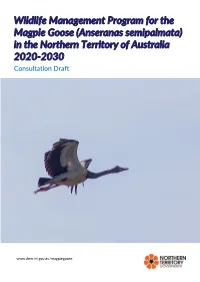
Wildlife Management Program for the Magpie Goose (Anseranas semipalmata) in the Northern Territory of Australia 2020-2030 Consultation Draft www.denr.nt.gov.au/magpiegoose Wildlife Management Program for the Magpie Goose (Anseranas Document title semipalmata) in the Northern Territory of Australia 2020-2030 Department of Department of Environment and Natural Resources Environment and Po Box 496, Palmerston NT 0831 Natural Resources Telephone 08 8995 5099 Email: wildlife.use@nt.gov.au Web: www.denr.nt.gov.au Approved by Date approved Document review 5 years or earlier as required TRM number BD2019/0017 Version Date Author Changes made 1.0 27 September 2019 Tim Clancy Format version 1 Acronyms / Full form / Definitions Terms Aboriginal Harvest carried out by Aboriginal people in accordance with Section 122 of the traditional harvest Territory Parks and Wildlife Conservation Act 1976. B Billion CDU Charles Darwin University CITES Convention on International Trade in Endangered Species DENR Department of Environment and Natural Resources DPIR Department of Primary Industry and Resources DTSC Department of Tourism, Sport and Culture EPBC Act Environment Protection and Biodiversity Conservation Act 1999 IUCN The International Union for Conservation of Nature K Carrying capacity or maximum population the habitat can sustain when conditions close to optimal NAIWB National Avian Influenza Wild Bird Steering Group NLC Northern Land Council Non-Aboriginal Harvest carried out by either Aboriginal or non-Aboriginal people in accordance harvest with -

Trinidad & Tobago 2018 Species List
Trinidad Tobago Leader: Ernesto Carman Eagle-Eye Tours Nov 29 - Dec 9, 2018 Bird Species Seen/ Common Name Scientific Name Heard TINAMOUS 1 Little Tinamou Crypturellus soui H GUANS, CHACHALACAS, AND CURASSOWS 2 Trinidad Piping-Guan Aburria pipile S 3 Rufous-vented Chachalaca Ortalis ruficauda S FLAMINGOS 4 American Flamingo Phoenicopterus ruber S TROPICBIRDS 5 Red-billed Tropicbird Phaethon aethereus S FRIGATEBIRDS 6 Magnificent Frigatebird Fregata magnificens S BOOBIES AND GANNETS 7 Brown Booby Sula leucogaster S 8 Red-footed Booby Sula sula S CORMORANTS AND SHAGS 9 Neotropic Cormorant Phalacrocorax brasilianus S ANHINGAS 10 Anhinga Anhinga anhinga S PELICANS 11 Brown Pelican Pelecanus occidentalis S HERONS, EGRETS, AND BITTERNS 12 Pinnated Bittern Botaurus pinnatus S 13 Great Egret Ardea alba S 14 Little Egret Egretta garzetta S 15 Snowy Egret Egretta thula S 16 Little Blue Heron Egretta caerulea S 17 Tricolored Heron Egretta tricolor S 18 Cattle Egret Bubulcus ibis S 19 Green Heron Butorides virescens S 20 Striated Heron Butorides striata S 21 Black-crowned Night-Heron Nycticorax nycticorax S 22 Yellow-crowned Night-Heron Nyctanassa violacea S 23 Boat-billed Heron Cochlearius cochlearius S IBISES AND SPOONBILLS 24 Scarlet Ibis Eudocimus ruber S NEW WORLD VULTURES Page 1 of 8 www.eagle-eye.com Trinidad Tobago Leader: Ernesto Carman Eagle-Eye Tours Nov 29 - Dec 9, 2018 Bird Species Seen/ Common Name Scientific Name Heard 25 Black Vulture Coragyps atratus S 26 Turkey Vulture Cathartes aura S OSPREY 27 Osprey Pandion haliaetus S HAWKS, -

SAFFRON FINCH Sicalis Flaveola Naturalized (Non-Native) Resident, Recently Established S.F
SAFFRON FINCH Sicalis flaveola naturalized (non-native) resident, recently established S.f. flaveola Saffron Finches are native to S America and have been successfully introduced to Panama, Jamaica, Puerto Rico, and on O'ahu and Hawai'i I in the Southeastern Hawaiian Islands (Long 1981, Lever 1987, Ridgely and Tudor 1989, AOU 1998). Populations on both islands have been established since introduction in the mid 1960s, whereas additional observations on Kaua'i, Maui, and Lana'i in the 1990s-2010s appear to be from local releases rather than natural dispersal from other islands, and we consider these as yet-to-be established populations in 2016. On O'ahu, Saffron Finches were first reported from the w. slopes of Diamond Head in the fall of 1965 (E 26:54). Throughout 1966 a pair was observed in Kapiolani Park (E 26:90, 26:111, 27: 64), and numbers in this vicinity increased during the 1970s, peaking at 22 individuals on the Honolulu Christmas Bird Count 17 Dec 1972 (E 33:79). They also showed up at Bellows Field in Dec 1972 (E 33:79), then at Manoa Valley up to Lyon Arboretum in 1975-1976 (e.g., E 36:155, 37:47), and spreading toward Peal Harbor in Jan 1975, nesting there by 1977 (E 35:146, 38:37). However, populations declined in these areas by the early 1980s (Graph), prompting HAS (1986) to state that they were no longer on the island, although continued sporadic observations (e.g., E 47:42, 48:31, 48:114) indicated that they were persisting in small numbers. -
21 Sep 2018 Lists of Victims and Hosts of the Parasitic
version: 21 Sep 2018 Lists of victims and hosts of the parasitic cowbirds (Molothrus). Peter E. Lowther, Field Museum Brood parasitism is an awkward term to describe an interaction between two species in which, as in predator-prey relationships, one species gains at the expense of the other. Brood parasites "prey" upon parental care. Victimized species usually have reduced breeding success, partly because of the additional cost of caring for alien eggs and young, and partly because of the behavior of brood parasites (both adults and young) which may directly and adversely affect the survival of the victim's own eggs or young. About 1% of all bird species, among 7 families, are brood parasites. The 5 species of brood parasitic “cowbirds” are currently all treated as members of the genus Molothrus. Host selection is an active process. Not all species co-occurring with brood parasites are equally likely to be selected nor are they of equal quality as hosts. Rather, to varying degrees, brood parasites are specialized for certain categories of hosts. Brood parasites may rely on a single host species to rear their young or may distribute their eggs among many species, seemingly without regard to any characteristics of potential hosts. Lists of species are not the best means to describe interactions between a brood parasitic species and its hosts. Such lists do not necessarily reflect the taxonomy used by the brood parasites themselves nor do they accurately reflect the complex interactions within bird communities (see Ortega 1998: 183-184). Host lists do, however, offer some insight into the process of host selection and do emphasize the wide variety of features than can impact on host selection.