Editorial Society for the Conservation of Reef Fish
Total Page:16
File Type:pdf, Size:1020Kb
Load more
Recommended publications
-
Appendix 4: Background Materials Provided to Participants Prior to the Workshop
Appendix 4: Background materials provided to participants prior to the workshop. Coral reef fin fish spawning closures f. Camouflage grouper (Epinephelus polyphekadion) Risk assessment workshop g. Flowery cod (Epinephelus fuscoguttatus) h. Greasy rockcod (Epinephelus tauvina) 12 – 13 May 2009 i. Spanish flag (stripey;Lutjanus carponotatus) 9am – 5pm Russell 1 & 2 j. Tuskfish Choerodon( spp.) Berkley’s On Ann Closures targeting coral trout afford some protection Rendezvous Hotel Brisbane to other coral reef fin fish species, although the magnitude of this effect is speculative. The imperative 255 Ann Street, Brisbane to explicitly consider other species rests on judgments concerning • the importance of each species to each sector, • the importance of each sector, and • the capacity of existing controls other than spawning closures to provide adequate protection. These judgments are a central theme of the workshop. Background An initial task for the workshop is identification of candidate alternatives. Any closure regime This workshop will explore candidate alternatives for implemented beyond 2008 needs to provide adequate spawning closures to be applied 2009 – 2013. protection for spawning coral reef fin fish species, The Fisheries (Coral Reef Fin Fish) Management Plan within a constraint that the impost on commercial 2003 introduced three nine-day spawning closures and recreational (including charter) fishing is no for coral reef fin fish on the Great Barrier Reef (GBR). greater than for the period 2004 – 2008. ReefMAC The closures applied to the new moon periods in has recommended a five year package comprising two October, November and December for the years years (2009-2010) of no spawning closures followed 2004-2008. -
Fish Spawning Aggregations
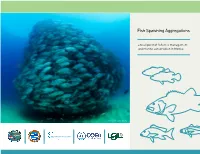
Fish Spawning Aggregations a focal point of fisheries management and marine conservation in Mexico Photo: Octavio Aburto Authorship Brad Erisman – Coastal Fisheries Research Program, University of Texas Marine Science Institute, 750 Channel View Drive, Port Aransas, TX 78373 William Heyman – LGL Ecological Research Associates, Inc., 4103 S. Texas Avenue, Bryan TX 77802 Stuart Fulton – Comunidad y Biodiversidad, Isla del Peruano 215, Lomas de Miramar, Guaymas, Sonora, Mexico Timothy Rowell – Gulf of California Marine Program, Scripps Institution of Oceanography, 9500 Gilman Drive, La Jolla, CA 92037 Illustrations – Larry Allen and Madeline Wukusick Graphic Design – Madeline Wukusick | www.communique.design Photography – Octavio Aburto, Richard Barnden, Douglas David Seifert, Walt Stearns, Cristina Limonta, Alfredo Barroso Citation – Erisman, B., W.D. Heyman, S. Fulton, and T.Rowell 2018. Fish spawning aggregations: a focal point of fisheries management and marine conservation in Mexico. Gulf of California Marine Program, La Jolla, CA. 24 p. Email Contact: Brad Erisman, berisman@utexas.edu Fish Spawning Aggregations // 2 Contents > Introduction .................................................................................................................................................................. 4 > What are fish spawning aggregations (FSAs)? ............................................................................................................ 5 > What kinds of fishes form FSAs? ................................................................................................................................ -
RNA Detection Technology for Applications in Marine Science: Microbes to Fish Robert Michael Ulrich University of South Florida, Bobmiu@Aol.Com
University of South Florida Scholar Commons Graduate Theses and Dissertations Graduate School 6-25-2014 RNA Detection Technology for Applications in Marine Science: Microbes to Fish Robert Michael Ulrich University of South Florida, bobmiu@aol.com Follow this and additional works at: https://scholarcommons.usf.edu/etd Part of the Biology Commons, and the Molecular Biology Commons Scholar Commons Citation Ulrich, Robert Michael, "RNA Detection Technology for Applications in Marine Science: Microbes to Fish" (2014). Graduate Theses and Dissertations. https://scholarcommons.usf.edu/etd/5321 This Dissertation is brought to you for free and open access by the Graduate School at Scholar Commons. It has been accepted for inclusion in Graduate Theses and Dissertations by an authorized administrator of Scholar Commons. For more information, please contact scholarcommons@usf.edu. RNA Detection Technology for Applications in Marine Science: Microbes to Fish by Robert M. Ulrich A dissertation submitted in partial fulfillment of the requirements for the degree of Doctor of Philosophy College of Marine Science University of South Florida Major Professor: John H. Paul, Ph.D. Valerie J. Harwood, Ph.D. Mya Breitbart, Ph.D. Christopher D. Stallings, Ph.D. David E. John, Ph.D. Date of Approval June 25, 2014 Keywords: NASBA, grouper, Karenia mikimotoi, Enterococcus Copyright © 2014, Robert M. Ulrich DEDICATION This dissertation is dedicated to my fiancée, Dr. Shannon McQuaig for inspiring my return to graduate school and her continued support over the last four years. On no other porch in our little town have there been more impactful scientific discussions, nor more words of encouragement. ACKNOWLEDGMENTS I gratefully acknowledge the many people who have encouraged and advised me throughout my graduate studies. -
Download Book (PDF)
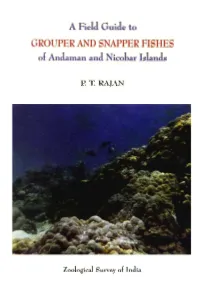
e · ~ e t · aI ' A Field Guide to Grouper and Snapper Fishes of Andaman and Nicobar Islands (Family: SERRANIDAE, Subfamily: EPINEPHELINAE and Family: LUTJANIDAE) P. T. RAJAN Andaman & Nicobar Regional Station Zoological Survey of India Haddo, Port Blair - 744102 Edited by the Director, Zoological Survey of India, Kolkata Zoological Survey of India Kolkata CITATION Rajan, P. T. 2001. Afield guide to Grouper and Snapper Fishes of Andaman and Nicobar Islands. (Published - Director, Z.5.1.) Published : December, 2001 ISBN 81-85874-40-9 Front cover: Roving Coral Grouper (Plectropomus pessuliferus) Back cover : A School of Blue banded Snapper (Lutjanus lcasmira) © Government of India, 2001 ALL RIGHTS RESERVED • No part of this publication may be reproduced, stored in a retrieval system or transmitted, in any form or by any means, electronic, mechanical, photocopying, recording or otherwise without the prior permission of the publisher. • This book is sold subject to the condition that it shall not, by way of trade, be lent, re-sold, hired out or otherwise disposed of without the publisher'S consent, in any form of binding or cover other than that in which it is published. • The correct price of this publication is the price printed on this page. Any revised price indicated by a rubber stamp or by a sticker or by any other means is incorrect and should be unacceptable. PRICE Indian Rs. 400.00 Foreign $ 25; £ 20 Published at the Publication Division by the Director, Zoological Survey of India, 234/4, AJe Bose Road, 2nd MSO Building, (13th Floor), Nizam Palace, Calcutta-700 020 after laser typesetting by Computech Graphics, Calcutta 700019 and printed at Power Printers, New Delhi - 110002. -

Diet Composition of Juvenile Black Grouper (Mycteroperca Bonaci) from Coastal Nursery Areas of the Yucatán Peninsula, Mexico
BULLETIN OF MARINE SCIENCE, 77(3): 441–452, 2005 NOTE DIET COMPOSITION OF JUVENILE BLACK GROUPER (MYCTEROPERCA BONACI) FROM COASTAL NURSERY AREAS OF THE YUCATÁN PENINSULA, MEXICO Thierry Brulé, Enrique Puerto-Novelo, Esperanza Pérez-Díaz, and Ximena Renán-Galindo Groupers (Epinephelinae, Epinephelini) are top-level predators that influence the trophic web of coral reef ecosystems (Parrish, 1987; Heemstra and Randall, 1993; Sluka et al., 2001). They are demersal mesocarnivores and stalk and ambush preda- tors that sit and wait for larger moving prey such as fish and mobile invertebrates (Cailliet et al., 1986). Groupers contribute to the ecological balance of complex tropi- cal hard-bottom communities (Sluka et al., 1994), and thus large changes in their populations may significantly alter other community components (Parrish, 1987). The black grouper (Mycteroperca bonaci Poey, 1860) is an important commercial and recreational fin fish resource in the western Atlantic region (Bullock and Smith, 1991; Heemstra and Randall, 1993). The southern Gulf of Mexico grouper fishery is currently considered to be deteriorated and M. bonaci, along with red grouper (Epinephelus morio Valenciennes, 1828) and gag (Mycteroperca microlepis Goode and Bean, 1880), is one of the most heavily exploited fish species in this region (Co- lás-Marrufo et al., 1998; SEMARNAP, 2000). Currently, M. bonaci is considered a threatened species (Morris et al., 2000; IUCN, 2003) and has been classified as vul- nerable in U.S. waters because male biomass in the Atlantic dropped from 20% in 1982 to 6% in 1995 (Musick et al., 2000). The black grouper is usually found on irregular bottoms such as coral reefs, drop- off walls, and rocky ledges, at depths from 10 to 100 m (Roe, 1977; Manooch and Mason, 1987; Bullock and Smith, 1991; Heemstra and Randall, 1993). -
V a Tion & Management of Reef Fish Sp a Wning Aggrega Tions
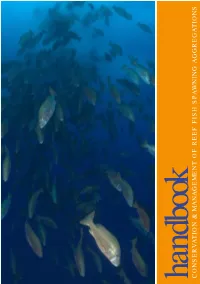
handbook CONSERVATION & MANAGEMENT OF REEF FISH SPAWNING AGGREGATIONS A Handbook for the Conservation & Management of Reef Fish Spawning Aggregations © Seapics.com Without the Land and the Sea, and their Bounties, the People and their Traditional Ways would be Poor and without Cultural Identity Fijian Proverb Why a Handbook? 1 What are Spawning Aggregations? 2 How to Identify Spawning Aggregations 2 Species that Aggregate to Spawn 2 Contents Places Where Aggregations Form 9 Concern for Spawning Aggregations 10 Importance for Fish and Fishermen 10 Trends in Exploited Aggregations 12 Managing & Conserving Spawning Aggregations 13 Research and Monitoring 13 Management Options 15 What is SCRFA? 16 How can SCRFA Help? 16 SCRFA Work to Date 17 Useful References 18 SCRFA Board of Directors 20 Since 2000, scientists, fishery managers, conservationists and politicians have become increasingly aware, not only that many commercially important coral reef fish species aggregate to spawn (reproduce) but also that these important reproductive gatherings are particularly susceptible to fishing. In extreme cases, when fishing pressure is high, aggregations can dwindle and even cease to form, sometimes within just a few years. Whether or not they will recover and what the long-term effects on the fish population(s) might be of such declines are not yet known. We do know, however, that healthy aggregations tend to be associated with healthy fisheries. It is, therefore, important to understand and better protect this critical part of the life cycle of aggregating species to ensure that they continue to yield food and support livelihoods. Why a Handbook? As fishing technology improved in the second half of the twentieth century, engines came to replace sails and oars, the cash economy developed rapidly, and human populations and demand for seafood grew, the pressures on reef fishes for food, and especially for money, increased enormously. -
Evidence of Sexual Transition in Leopard Grouper (Mycteroperca Rosacea )
Ovarian development of M. rosacea in captivity Hidrobiológica 2010, 20 (3): 213-221213 Evidence of sexual transition in Leopard Grouper (Mycteroperca rosacea) individuals held in captivity Evidencia de transición sexual en individuos de cabrilla sardinera (Mycteroperca rosacea) mantenidos en cautiverio Margarita Kiewek-Martínez, Vicente Gracia-López and Carmen Rodríguez-Jaramillo Centro de Investigaciones Biológicas del Noroeste (CIBNOR), Mar Bermejo 195, Col. Playa Palo Sta. Rita, La Paz B.C.S. 23090, México e-mail: vinny@cibnor.mx Kiewek-Martínez, M., V. Gracia-López and C. Rodríguez-Jaramillo. 2010. Evidence of sexual transition in Leopard Grouper (Mycteroperca rosacea) individuals held in captivity. Hidrobiológica 20 (3): 213-221. ABSTRACT This study describes histological observations of the gonads of 12 captive leopard grouper, M. rosacea maintained in captivity. Monthly gonad samples during February to April 2003, were obtained by catheterization and analyzed to determine sex and degree of ovarian development. Oocytes were classified into 5 stages of development and the fre- quencies were obtained to describe the oocyte distribution in the ovary. Two fish that were females in February were in a bisexual stage in March and functional males in April. The transitional stage was observed during the reproductive season and included degeneration of primary oocytes and proliferation of spermatogonia. Key words: Gonad development, leopard grouper, captivity. RESUMEN Este estudio describe las observaciones histológicas del desarrollo gonadal de 12 individuos de la cabrilla sardinera, en condiciones de cautiverio. De febrero a abril del 2003 se obtuvieron muestras mensuales de la gónada mediante un catéter flexible, las cuales fueron analizadas para determinar el sexo del organismo y el estadio de desarrollo gonadal. -
PP-4. Monitoring of Fish Supply to Resorts and Setting up of an Ecolabel Certification
PP-4. Monitoring of Fish Supply to Resorts and Setting up of an Ecolabel Certification 1) Report on Survey on Reef Fish Landings to Tourist Resorts 2) Guidelines on Best Fishing and Fish Handling Practices 3) Overview of reef fish sampling in K. Dhiffushi – Nov-Dec 2016 REPORT ON SURVEY ON REEF FISH LANDINGS TO TOURIST RESORTS May 2016 Muawin YOOSUF, Ministry of Fisheries and Agriculture with the technical assistance of Bernard ADRIEN, MASPLAN This survey was carried out as part of a Pilot Project under the Project for the Formulation of Master Plan for Sustainable Fisheries (MASPLAN), a technical cooperation project of the Japan International Cooperation Agency (JICA). All pictures taken by Bernard Adrien. REPORT ON SURVEY ON REEF FISH LANDINGS TO RESORTS – MAY 2016 1 Table of Contents 1 INTRODUCTION .................................................................................................................................3 2 METHOD ..............................................................................................................................................4 3 RESULTS & ANALYSIS .....................................................................................................................5 3.1 Estimates on reef fish production ..................................................................................................5 Estimate of Annual Reef Fish Landings to Resorts from the present survey ................................5 Comparison on Annual Reef Fish Landings to Resorts with previous surveys ............................5 -

Valuable but Vulnerable: Over-Fishing and Under-Management Continue to Threaten Groupers So What Now?
See discussions, stats, and author profiles for this publication at: https://www.researchgate.net/publication/339934856 Valuable but vulnerable: Over-fishing and under-management continue to threaten groupers so what now? Article in Marine Policy · June 2020 DOI: 10.1016/j.marpol.2020.103909 CITATIONS READS 15 845 17 authors, including: João Pedro Barreiros Alfonso Aguilar-Perera University of the Azores - Faculty of Agrarian and Environmental Sciences Universidad Autónoma de Yucatán -México 215 PUBLICATIONS 2,177 CITATIONS 94 PUBLICATIONS 1,085 CITATIONS SEE PROFILE SEE PROFILE Pedro Afonso Brad E. Erisman IMAR Institute of Marine Research / OKEANOS NOAA / NMFS Southwest Fisheries Science Center 152 PUBLICATIONS 2,700 CITATIONS 170 PUBLICATIONS 2,569 CITATIONS SEE PROFILE SEE PROFILE Some of the authors of this publication are also working on these related projects: Comparative assessments of vocalizations in Indo-Pacific groupers View project Study on the reef fishes of the south India View project All content following this page was uploaded by Matthew Thomas Craig on 25 March 2020. The user has requested enhancement of the downloaded file. Marine Policy 116 (2020) 103909 Contents lists available at ScienceDirect Marine Policy journal homepage: http://www.elsevier.com/locate/marpol Full length article Valuable but vulnerable: Over-fishing and under-management continue to threaten groupers so what now? Yvonne J. Sadovy de Mitcheson a,b, Christi Linardich c, Joao~ Pedro Barreiros d, Gina M. Ralph c, Alfonso Aguilar-Perera e, Pedro Afonso f,g,h, Brad E. Erisman i, David A. Pollard j, Sean T. Fennessy k, Athila A. Bertoncini l,m, Rekha J. -
Coral Reef Fin Fish Spawning Closures Risk Assessment and Decision Support Report on Outcomes from a Workshop Held 12–13 May 2009
Queensland Primary Industries and Fisheries Coral reef fin fish spawning closures Risk assessment and decision support Report on outcomes from a workshop held 12–13 May 2009 Terry Walshe Australian Centre of Excellence for Risk Analysis University of Melbourne and Stephanie Slade Queensland Primary Industries and Fisheries Coral reef fin fish spawning closures 1 On 26 March 2009, the Department of Primary Industries and Fisheries was amalgamated with other government departments to form the Department of Employment, Economic Development and Innovation. © The State of Queensland, Department of Employment, Economic Development and Innovation, 2009. Except as permitted by the Copyright Act 1968, no part of the work may in any form or by any electronic, mechanical, photocopying, recording, or any other means be reproduced, stored in a retrieval system or be broadcast or transmitted without the prior written permission of the Department of Employment, Economic Development and Innovation. The information contained herein is subject to change without notice. The copyright owner shall not be liable for technical or other errors or omissions contained herein. The reader/user accepts all risks and responsibility for losses, damages, costs and other consequences resulting directly or indirectly from using this information. Enquiries about reproduction, including downloading or printing the web version, should be directed to ipcu@deedi.qld.gov.au or telephone +61 7 3225 1398. Acknowledgments We thank all those who attended the workshop. Tracy Rout -

Xchel G. MORENO-SÁNCHEZ1, Pilar PEREZ-ROJO1, Marina S
ACTA ICHTHYOLOGICA ET PISCATORIA (2019) 49 (1): 9–22 DOI: 10.3750/AIEP/02321 FEEDING HABITS OF THE LEOPARD GROUPER, MYCTEROPERCA ROSACEA (ACTINOPTERYGII: PERCIFORMES: EPINEPHELIDAE), IN THE CENTRAL GULF OF CALIFORNIA, BCS, MEXICO Xchel G. MORENO-SÁNCHEZ1, Pilar PEREZ-ROJO1, Marina S. IRIGOYEN-ARREDONDO1, Emigdio MARIN- ENRÍQUEZ2, Leonardo A. ABITIA-CÁRDENAS1*, and Ofelia ESCOBAR-SANCHEZ2 1Instituto Politecnico Nacional, Centro Interdisciplinario de Ciencias Marinas (CICIMAR-IPN), Departamento de Pesquerías y Biología Marina La Paz, BCS, Mexico 2CONACYT-Universidad Autónoma de Sinaloa-Facultad de Ciencias del Mar (CONACYT UAS-FACIMAR) Mazatlán, SIN, Mexico Moreno-Sánchez X.G., Perez-Rojo P., Irigoyen-Arredondo M.S., Marin- Enríquez E., Abitia-Cárdenas L.A., Escobar-Sanchez O. 2019. Feeding habits of the leopard grouper, Mycteroperca rosacea (Actinopterygii: Perciformes: Epinephelidae), in the central Gulf of California, BCS, Mexico. Acta Ichthyol. Piscat. 49 (1): 9–22. Background. The leopard grouper, Mycteroperca rosacea (Streets, 1877), is endemic to north-western Mexico and has high commercial value. Although facts of its basic biology are known, information on its trophic ecology, in particular, is scarce. The objective of the presently reported study was to characterize the feeding habits of M. rosacea through the analysis of stomach contents, and to determine possible variations linked to sex (male or female), size (small, medium, or large), or season (spring, summer, autumn, or winter), in order to understand the trophic role that this species plays in the ecosystem where it is found. Materials and methods. Fish were captured monthly, from March 2014 to May 2015 by spearfishing in Santa Rosalía, BCS, Mexico. Percentages by the number, by weight, and frequency of appearance of each food category, the index of relative importance (%IRI), and prey-specific index of relative importance (%PSIRI) were used to determine the importance of each prey item in the leopard grouper diet. -

(<I>Epinephelus Polyphekadion</I>) and Brown Marbled Grouper
BULLETIN OF MARINE SCIENCE, 83(2): 415–431, 2008 CORAL REEF PAPER DYNAMICS OF CAMOUFLAGE (EPINEPHELUS POLYPHEKADION) AND BROWN MARBLED GROUPER (EPINEPHELUS FUSCOGUTTATUS) SPAWNING AGGREGATIONS AT A REMOTE REEF SITE, SEYCHELLES Jan Robinson, Riaz Aumeeruddy, Tove Lund Jörgensen, and Marcus C. Öhman ABSTRACT Aggregations of camouflage, Epinephelus polyphekadion (Bleeker, 1849), and brown marbled grouper, Epinephelus fuscoguttatus (Forsskål, 1775), were found to overlap spatially and temporally at a reef pass site located in the outer island group of the archipelagic Seychelles. Over three spawning seasons, we investigated the spatial and temporal dynamics of aggregations using a combination of underwater visual census (UVC) surveys and trends in reproductive parameters, notably gona- dosomatic index. Interannual variation in aggregation formation was evident for both species, but was more variable in camouflage grouper. Aggregations lasted be- tween 2–3 wks, with peak abundances attained a few days prior to the new moon, soon after which aggregations quickly dispersed. Spawning within aggregations was confirmed using direct (observations of hydrated oocytes) and indirect (gonadoso- matic indices, behavior, color changes) signs. Spawning seasons were estimated at between 2 and 3-mo long, occurring between November and February, with inter- annual variation in onset and termination. Tagged camouflage grouper exhibited site fidelity on scales of weeks to months, and one individual returned to the aggre- gation the following year. The aggregations are known to fishers and are commer- cially exploited. Fisher knowledge was found to be a reliable source of information for locating aggregations. Many reef fish species form aggregations at specific times and places for the pur- pose of reproduction (Domeier and Colin, 1997).