COMMEN NAME SCIENTIFIC NAME FAMILY Polka Dot Plant Hypoestes
Total Page:16
File Type:pdf, Size:1020Kb
Load more
Recommended publications
-

Phylogenetic Relationships Among the Mangrove Species of Acanthaceae Found in Indian Sundarban, As Revealed by RAPD Analysis
Available online a t www.pelagiaresearchlibrary.com Pelagia Research Library Advances in Applied Science Research, 2015, 6(3):179-184 ISSN: 0976-8610 CODEN (USA): AASRFC Phylogenetic relationships among the mangrove species of Acanthaceae found in Indian Sundarban, as revealed by RAPD analysis Surya Shekhar Das 1, Swati Das (Sur) 2 and Parthadeb Ghosh* 1Department of Botany, Bolpur College, Birbhum, West Bengal, India 2Department of Botany, Nabadwip Vidyasagar College, Nadia, West Bengal, India _____________________________________________________________________________________________ ABSTRACT RAPD markers were successfully used to identify and differentiate all the five species of Acanthaceae found in the mangrove forest of Indian Sundarban, to assess the extent of interspecific genetic diversity among them, to reveal their molecular phylogeny and to throw some light on the systematic position of Avicennia. The dendrogram reveals that the five species under study exhibits an overall similarity of 60.7%. Avicennia alba and A. officinalis (cluster C1) have very close relationship between them and share a common node in the dendrogram at a 73.3% level of similarity. Avicennia marina and Acanthus ilicifolius (cluster C2) also have close relationship between them as evident by a common node in the dendrogram at 71.8% level of similarity. Acanthus volubilis showed 68.1% similarity with cluster C1 and 60.7% similarity with cluster C2. Our study also supported the view of placing Avicennia under Acanthaceae. Regarding the relative position of Avicennia within Acanthaceae, it was shown to be very close to Acanthoideae. In comparison to other species, A. marina showed most genetic variability, suggesting utilization of this species over others for breeding programme and as source material in in situ conservation programmes. -

Hoya New Volume
HOYA NEW Oh There it is ! American Samoa, trees dripping with Hoyas 1 A pdf publication devoted to the Genus Hoya ISSN 2329-7336 Volume 2 Issue 4 July 2014 Editor: Dale Kloppenburg Contents When a species is collected from the wild, I feel it is wise to identify it, propagate it and name it. In this way it will eventually get it into commercial channels, be distributed to all those interested in this genus and thus be preserved. If in the future the species is lost through natural causes or forest destruction it will still be here on earth in your collection. Corrections: Vol. 2 – 2 May 2014, Katherine Challis at IPNI has pointed out that “stemma” is a singular neuter III so the endings on the two following Eriostemma species should be (corrected) as follows. Eriostemma davaoense Kloppenburg. Eriostemma suluense Kloppenburg. The following new species are presented in PDF format with ISSN number. 1. Eriostemma guppyi Kloppenburg 2. Eriostemma smarense Kloppenburg 3. Hoya lagunaensis Kloppenburg 4. Hoya amoena subsp. bogorensis T. Green & Kloppenburg 5. Dischidia tonsuensis T. Green & Kloppenburg NOTE: please see the Website publication of these species at “www.rare- hoyas.com”. Go to end and click on “publication” to access new species publications. 2 Eriostemma guppyi Kloppenburg ISSN 2329-7336 Type description: H. Guppyi, Oliv. in Guppy, 'Solomon Islands,' p. 298 ex Hook. In Icones Plantarum 23 (1892) 2247, ramulis ultiimis parce hirtellis deinde glabratis foliis petiolatis coriaceis late ellipticis breviter acuminatis cuspidutisve basi late rotundatis subcordatisve supra glabris v. fere glabris subtus plus minus hirtellis 1-costatis nervis lateralibus primiariis subtus utrinque 7-9, umbellis pedunculatis pedunculis pedicellisque glabris, calycis parvi corollae tubo 2-4-plo brevioris carnosuli 5-partiti lobis ovatis obtusis ciliolatis, corollae rotatae lobis patentibus ovatis v. -

Acanthaceae), a New Chinese Endemic Genus Segregated from Justicia (Acanthaceae)
Plant Diversity xxx (2016) 1e10 Contents lists available at ScienceDirect Plant Diversity journal homepage: http://www.keaipublishing.com/en/journals/plant-diversity/ http://journal.kib.ac.cn Wuacanthus (Acanthaceae), a new Chinese endemic genus segregated from Justicia (Acanthaceae) * Yunfei Deng a, , Chunming Gao b, Nianhe Xia a, Hua Peng c a Key Laboratory of Plant Resources Conservation and Sustainable Utilization, South China Botanical Garden, Chinese Academy of Sciences, Guangzhou, 510650, People's Republic of China b Shandong Provincial Engineering and Technology Research Center for Wild Plant Resources Development and Application of Yellow River Delta, Facultyof Life Science, Binzhou University, Binzhou, 256603, Shandong, People's Republic of China c Key Laboratory for Plant Diversity and Biogeography of East Asia, Kunming Institute of Botany, Chinese Academy of Sciences, Kunming, 650201, People's Republic of China article info abstract Article history: A new genus, Wuacanthus Y.F. Deng, N.H. Xia & H. Peng (Acanthaceae), is described from the Hengduan Received 30 September 2016 Mountains, China. Wuacanthus is based on Wuacanthus microdontus (W.W.Sm.) Y.F. Deng, N.H. Xia & H. Received in revised form Peng, originally published in Justicia and then moved to Mananthes. The new genus is characterized by its 25 November 2016 shrub habit, strongly 2-lipped corolla, the 2-lobed upper lip, 3-lobed lower lip, 2 stamens, bithecous Accepted 25 November 2016 anthers, parallel thecae with two spurs at the base, 2 ovules in each locule, and the 4-seeded capsule. Available online xxx Phylogenetic analyses show that the new genus belongs to the Pseuderanthemum lineage in tribe Justi- cieae. -

Hypoestes Aristata (Vahl) Sol
Biol Res 43: 403-409, 2010 BHATT ET AL. Biol Res 43, 2010, 403-409 B403R The foliar trichomes of Hypoestes aristata (Vahl) Sol. ex Roem. & Schult var aristata (Acanthaceae) a widespread medicinal plant species in tropical sub-Saharan Africa: with comments on its possible phylogenetic significance A. Bhatt*, Y. Naidoo and A. Nicholas School of Biological and Conservation Sciences, University of KwaZulu-Natal, Westville Campus, Private Bag X54001, Durban, KZN, 4000, South Africa ABSTRACT The micromorphology of foliar trichomes of Hypoestes aristata var. aristata was studied using stereo, light and scanning microscopy (SEM). This genus belongs to the advanced angiosperm family Acanthaceae, for which few micromorphological leaf studies exist. Results revealed both glandular and non-glandular trichomes, the latter being more abundant on leaf veins, particularly on the abaxial surface of very young leaves. With leaf maturity, the density of non-glandular trichomes decreased. Glandular trichomes were rare and of two types: long-stalked capitate and globose-like peltate trichomes. Capitate trichomes were observed only on the abaxial leaf surface, while peltate trichomes were distributed on both adaxial and abaxial leaf surfaces. Key terms: Acanthaceae, Glandular trichomes, Hypoestes aristata var. aristata, medicinal plant, Scanning electron microscope. INTRODUCTION zygomorphic flowers supported by prominent bracts and producing explosive capsular fruits. Many studies have The Family Acanthaceae is a large and diverse family of further supported the placement of Hypoestes in a smaller dicotyledonous plants comprising about 202 genera and 3520 clade that includes the prominent genus Justicia (McDade species (Judd et al., 2008); although estimates vary from 2600 and Moody 1999). -

Hoya Australis Subsp. Oramicola (A Vine)
Advice to the Minister for the Environment and Heritage from the Threatened Species Scientific Committee on Amendments to the list of Threatened Species under the Environment Protection and Biodiversity Conservation Act 1999 (EPBC Act) 1. Scientific name (common name) Hoya australis subsp. oramicola (a vine) 2. Description Hoya australis subsp. oramicola is an evergreen, perennial vine with succulent leaves that grow to approximately 10cm long. Its flowers are cream coloured and fleshy, with flowering recorded during March and July. Fruiting occurs three to four months after flowering. 3. National Context Hoya australis subsp. oramicola is endemic to the Northern Territory. The subspecies is restricted to coastal monsoon vine thicket communities on Bathurst and Melville Islands, where it is known from four localities (Kerrigan et al 2004). The subspecies is currently listed as vulnerable under the Northern Territory Territory Parks and Wildlife Conservation Act 2000. 4. How judged by the Committee in relation to the EPBC Act criteria. The Committee judges the subspecies to be eligible for listing as vulnerable under the EPBC Act. The justification against the criteria is as follows: Criterion 1 – It has undergone, is suspected to have undergone or is likely to undergo in the immediate future a very severe, severe or substantial reduction in numbers. Hoya australis subsp. oramicola is endemic to the Northern Territory. The subspecies is restricted to coastal monsoon vine thicket communities on Bathurst and Melville Islands, where it is known from four localities (Kerrigan et al 2004). Very little data on abundance is available for this subspecies. Russell-Smith (1992) records this subspecies as common at Lubra Point on Bathurst Island and uncommon at Condor Point on Melville Island. -

Acanthaceae and Asteraceae Family Plants Used by Folk Medicinal Practitioners for Treatment of Malaria in Chittagong and Sylhet Divisions of Bangladesh
146 American-Eurasian Journal of Sustainable Agriculture, 6(3): 146-152, 2012 ISSN 1995-0748 ORIGINAL ARTICLE Acanthaceae and Asteraceae family plants used by folk medicinal practitioners for treatment of malaria in Chittagong and Sylhet Divisions of Bangladesh Md. Tabibul Islam, Protiva Rani Das, Mohammad Humayun Kabir, Shakila Akter, Zubaida Khatun, Md. Megbahul Haque, Md. Saiful Islam Roney, Rownak Jahan, Mohammed Rahmatullah Faculty of Life Sciences, University of Development Alternative, Dhanmondi, Dhaka-1205, Bangladesh Md. Tabibul Islam, Protiva Rani Das, Mohammad Humayun Kabir, Shakila Akter, Zubaida Khatun, Md. Megbahul Haque, Md. Saiful Islam Roney, Rownak Jahan, Mohammed Rahmatullah: Acanthaceae and Asteraceae family plants used by folk medicinal practitioners for treatment of malaria in Chittagong and Sylhet Divisions of Bangladesh ABSTRACT Malaria is a debilitating disease causing high mortality rates among men and women if not treated properly. The disease is prevalent in many countries of the world with the most prevalence noted among the sub-Saharan countries, where it is in an epidemic form. The disease is classified as hypo-endemic in Bangladesh with the southeast and the northeastern regions of the country having the most malaria-affected people. The rural people suffer most from malaria, and they rely on folk medicinal practitioners for treatment, who administer various plant species for treatment of the disease as well as associated symptoms like pain and fever. Plant species have always formed the richest sources of anti-malarial drugs, the most notable being quinine and artemisinin. However, quinine has developed drug-resistant vectors and artemisinin is considered by some to developing initial resistance, particularly in China, where it has been used for thousands of years to combat malaria. -

Life Cycle Cost of Air Plant Green Roofs in Hot and Humid Climate
I J A B E R, Vol. 14, No. 10 (2016):Life 7167-7182 Cycle Cost of Air Plant Green Roofs in Hot and Humid Climate l 7167 LIFE CYCLE COST OF AIR PLANT GREEN ROOFS IN HOT AND HUMID CLIMATE Tachaya Sangkakool* and Kuaanan Techato2* Abstract: The benefitsof green roofshave beenrecognizedby many researchers worldwide.Green roofs have been wildly implemented in many countries due to the trend of green architecture, sustainable architecture and environmental friendly concept. The computational life cycle cost of air plant green roofs is classified into two parts. One is the initial investment, which compos- es of the cost of materials and installation process. Another is the cost of operation and main- tenance. This paper has investigated in the economics of green roofs by reviewing secondary data of extensive green roof and intensive green roofs and collecting experimental data of air plant green roofs. The investigation of life cycle cost of “Cotton Candy” air plant green roofs is around 140.21$/m2 and “Spanish moss” air plant green roofs is around 125.78 $/m2. Although the digit is lower than other types of green roofs, the benefit is almost the same. It was found from the research that life cycle cost of air plant green roof is less than other types of green roof. However, the benefits are not different from other type of the roof. Another strengthof air plant green roofs is shading to the roof of the building. These will extend the life cycle of the roof. The consideration of life cycle cost of air plant green roofs will be another tool using in making final decision. -
Downloaded and Set As out Groups Genes
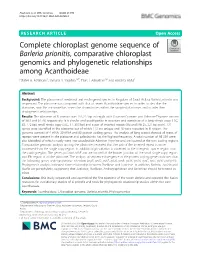
Alzahrani et al. BMC Genomics (2020) 21:393 https://doi.org/10.1186/s12864-020-06798-2 RESEARCH ARTICLE Open Access Complete chloroplast genome sequence of Barleria prionitis, comparative chloroplast genomics and phylogenetic relationships among Acanthoideae Dhafer A. Alzahrani1, Samaila S. Yaradua1,2*, Enas J. Albokhari1,3 and Abidina Abba1 Abstract Background: The plastome of medicinal and endangered species in Kingdom of Saudi Arabia, Barleria prionitis was sequenced. The plastome was compared with that of seven Acanthoideae species in order to describe the plastome, spot the microsatellite, assess the dissimilarities within the sampled plastomes and to infer their phylogenetic relationships. Results: The plastome of B. prionitis was 152,217 bp in length with Guanine-Cytosine and Adenine-Thymine content of 38.3 and 61.7% respectively. It is circular and quadripartite in structure and constitute of a large single copy (LSC, 83, 772 bp), small single copy (SSC, 17, 803 bp) and a pair of inverted repeat (IRa and IRb 25, 321 bp each). 131 genes were identified in the plastome out of which 113 are unique and 18 were repeated in IR region. The genome consists of 4 rRNA, 30 tRNA and 80 protein-coding genes. The analysis of long repeat showed all types of repeats were present in the plastome and palindromic has the highest frequency. A total number of 98 SSR were also identified of which mostly were mononucleotide Adenine-Thymine and are located at the non coding regions. Comparative genomic analysis among the plastomes revealed that the pair of the inverted repeat is more conserved than the single copy region. -
Compositions and Comparison of the Leaf and Stem Essential Oils from Nigerian Hypoestes Phyllostachya ‘ ’ Rosea P
id619187 pdfMachine by Broadgun Software - a great PDF writer! - a great PDF creator! - http://www.pdfmachine.com http://www.broadgun.com September 2009 Volume 5 Issue 3 NNaattuurraall PPrrAoon dIdnduuian ccJotutrnssal Trade Science Inc. Full Paper NPAIJ, 5(3), 2009 [116-119] Compositions and comparison of the leaf and stem essential oils from Nigerian Hypoestes phyllostachya ‘ ’ rosea p. Beau. [Acanthaceae] Dorcas Olufunke Moronkola*, Odunayo Christy Atewolara- Odule, Oseyemi Omowunmi Olubomehin Department of Chemical Sciences, Olabisi Onabanjo University, P.M.B. 2002, Ago-Iwoye, Ogun-State, (NIGERIA) E-mail : funkemoronkola@yahoo.com Received: 22nd May, 2009 ; Accepted: 2nd June, 2009 ABSTRACT KEYWORDS Leaf and stem volatile oils were obtained differently from Hypoestes Hypoestes phyllostachya ‘ ’ [HR] [Acanthaceae] in 0.36% and 0.13% respectively. ‘ ’ phyllostachya Rosea Rosea ; Fourteen main volatiles were identified in the stem part which had Acanthaceae; appreciable amount of sesquiterpenes with the most abundant compounds Naphthalenones; being 3,5,6,7,8,8a-hexahydro-4,8a-dimethyl-6-(1-methylethenyl)-2(1H) Cyclohexanes; naphthalenone (38.01%), 1-ethenyl-1-methyl-2(1-methylethenyl)-4-(1- Taxonomic compounds; methylethylidene) cyclohexane (14.26%) and tetramethylcyclopropylidene Hydrodistillation. methylbenzene(7.38%). Twenty-five compounds were identified in the leaf oil of HR which also contained appreciable amount of sesquiterpenes. The most abundant compounds were 3,5,6,7,8,8a-hexahydro-4,8a-dimethyl-6- (1-methylethenyl)-2(1H)naphthalenone(23.3%), and1-ethenyl-1-methyl-2- (1-methylethenyl)-4-(1-methylethylidene) cyclohexane(20.73%), which were the same as in the stem parts. The two most abundant compounds are common to both leaf and stem essential oils. -
ACANTHACEAE 爵床科 Jue Chuang Ke Hu Jiaqi (胡嘉琪 Hu Chia-Chi)1, Deng Yunfei (邓云飞)2; John R
ACANTHACEAE 爵床科 jue chuang ke Hu Jiaqi (胡嘉琪 Hu Chia-chi)1, Deng Yunfei (邓云飞)2; John R. I. Wood3, Thomas F. Daniel4 Prostrate, erect, or rarely climbing herbs (annual or perennial), subshrubs, shrubs, or rarely small trees, usually with cystoliths (except in following Chinese genera: Acanthus, Blepharis, Nelsonia, Ophiorrhiziphyllon, Staurogyne, and Thunbergia), isophyllous (leaf pairs of equal size at each node) or anisophyllous (leaf pairs of unequal size at each node). Branches decussate, terete to angular in cross-section, nodes often swollen, sometimes spinose with spines derived from reduced leaves, bracts, and/or bracteoles. Stipules absent. Leaves opposite [rarely alternate or whorled]; leaf blade margin entire, sinuate, crenate, dentate, or rarely pinnatifid. Inflo- rescences terminal or axillary spikes, racemes, panicles, or dense clusters, rarely of solitary flowers; bracts 1 per flower or dichasial cluster, large and brightly colored or minute and green, sometimes becoming spinose; bracteoles present or rarely absent, usually 2 per flower. Flowers sessile or pedicellate, bisexual, zygomorphic to subactinomorphic. Calyx synsepalous (at least basally), usually 4- or 5-lobed, rarely (Thunbergia) reduced to an entire cupular ring or 10–20-lobed. Corolla sympetalous, sometimes resupinate 180º by twisting of corolla tube; tube cylindric or funnelform; limb subactinomorphic (i.e., subequally 5-lobed) or zygomorphic (either 2- lipped with upper lip subentire to 2-lobed and lower lip 3-lobed, or rarely 1-lipped with 3 lobes); lobes ascending or descending cochlear, quincuncial, contorted, or open in bud. Stamens epipetalous, included in or exserted from corolla tube, 2 or 4 and didyna- mous; filaments distinct, connate in pairs, or monadelphous basally via a sheath (Strobilanthes); anthers with 1 or 2 thecae; thecae parallel to perpendicular, equally inserted to superposed, spherical to linear, base muticous or spurred, usually longitudinally dehis- cent; staminodes 0–3, consisting of minute projections or sterile filaments. -
Hoya Australis Subsp. Australis Click on Images to Enlarge
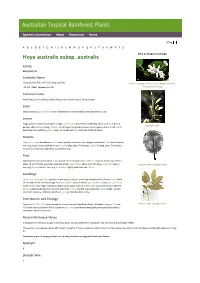
Species information Abo ut Reso urces Hom e A B C D E F G H I J K L M N O P Q R S T U V W X Y Z Hoya australis subsp. australis Click on images to enlarge Family Apocynaceae Scientific Name Hoya australis R.Br. ex J.Traill subsp. australis Flowers. Copyright Australian Plant Image Index (APII). Hill, K.D. (1989) Telopea 3(2): 250. Photographer: M. Fagg. Common name Wax Flower; Common Hoya; Native Hoya; Hoya, Native; Hoya, Common; Hoya Stem Climbs mainly by adventitious roots. A slender vine not exceeding a stem diameter of 2 cm. Leaves Twigs, petioles and leaves produce a milky exudate. Leaf blades thick and fleshy, about 2.4-8 x 1.8-4.5 cm, Copyright CSIRO petioles about 0.6-2 cm long. Colleters (small finger-like glands) present on the upper surface of the midrib near its junction with the petiole. Upper and lower leaf blade surfaces clothed in hairs. Flowers Inflorescence an umbelliform raceme which produces flowers over a long period of time. Calyx lobes about 4 mm long, outer surface clothed in hairs. Corolla lobes about 7 mm long. Corona 5-lobed, about 7 mm diam., formed from staminal outgrowths about 3 mm long. Fruit Individual fruiting carpels about 7-18 x 0.4-0.6 cm. Seeds numerous, each seed about 3-4 mm long. Plumes about 15-25 mm long, attached to one end of the seed. Embryo about 3-3.5 mm long, cotyledons about 2 Scale bar 10mm. Copyright CSIRO mm long. -

Preliminary Checklist of Hoya (Asclepiadaceae) in the Flora of Cambodia, Laos and Vietnam
Turczaninowia 20 (3): 103–147 (2017) ISSN 1560–7259 (print edition) DOI: 10.14258/turczaninowia.20.3.10 TURCZANINOWIA http://turczaninowia.asu.ru ISSN 1560–7267 (online edition) УДК 582.394:581.4 Preliminary checklist of Hoya (Asclepiadaceae) in the flora of Cambodia, Laos and Vietnam L. V. Averyanov1, Van The Pham2, T. V. Maisak1, Tuan Anh Le3, Van Canh Nguyen4, Hoang Tuan Nguyen5, Phi Tam Nguyen6, Khang Sinh Nguyen2, Vu Khoi Nguyen7, Tien Hiep Nguyen8, M. Rodda9 1 Komarov Botanical Institute, Prof. Popov, 2; St. Petersburg, RF-197376, Russia E-mails: av_leonid@mail.ru; av_leonid@yahoo.com 2 Institute of Ecology and Biological Resources, Vietnam Academy of Sciences and Technology, 18 Hoang Quoc Viet, Cau Giay, Ha Noi, Vietnam. E-mail: phamvthe@gmail.com 3Quang Tri Center of Science and Technology, Mientrung Institute for Scientific Research, 121 Ly Thuong Kiet, Dong Ha, Quang Tri, Vietnam. E-mail: tasa207@gmail.com 4 3/12/3 Vo Van Kiet Street, Buon Ma Thuot City, Dak Lak province, Vietnam. E-mail: nguyenvancanh@gmail.com 5Department of Pharmacognosy, Hanoi University of Pharmacy, 15 Le Thanh Tong, Hoan Kiem, Hanoi, Vietnam E-mail: tuandl50@yahoo.com 6Viet Nam Post and Telecommunications Group – VNPT, Lam Dong 8 Tran Phu Street, Da Lat City, Lam Dong Province, Vietnam. E-mail: phitam77@gmail.com 7Wildlife At Risk, 202/10 Nguyen Xi st., ward 26, Binh Thanh, Ho Chi Minh, Vietnam. E-mail: nvkhoi70@gmail.com 8Center for Plant Conservation, no. 25/32, lane 191, Lac Long Quan, Nghia Do, Cau Giay District, Ha Noi, Vietnam E-mail: hiep.nguyen@cpcvn.org 9Herbarium, Singapore Botanic Gardens, 1 Cluny Road, Singapore 259569.