The Origins of Contemporary Conflict
Total Page:16
File Type:pdf, Size:1020Kb
Load more
Recommended publications
-

Marshall Plan & Berlin Airlift
Objectives: 1. Explain how the Marshall Plan, the Berlin airlift, and the creation of NATO helped achieve American goals in postwar Europe. 2. Assess the impact of two Communist advances on American foreign policy. 3. Summarize the effects of the cold war on American life. Main Idea: As the cold war intensified, American policy focused on rebuilding and unifying Western Europe. At home, emotionally charged spy cases raised fears of Communist infiltration into American society and government. Marshall Plan & Berlin Airlift • Secretary of State George C. Marshall created an economic plan to rebuild Europe after World War II. The Soviet Union and their Eastern European allies refused to take part in the Marshall Plan, but 16 European countries did accept economic aid from the U.S. ($13 billion over 4 years). • In 1948, to keep people from fleeing communism, Stalin blockaded Berlin. To avoid a war, the U.S. and Britain airlifted supplies to Berlin for 15 months called the Berlin Airlift. 1948 Berlin Airlift NATO & Warsaw Pact In 1949, NATO created a military alliance between 10 Western European countries, the U.S., and Canada. The countries viewed an attack against one country, as an attack against them all. In 1949, China becomes communist and Soviets create their atomic bomb, causing the U.S. to drastically increase peacetime defense spending to enforce Containment. In the 1950s, President Eisenhower will continue with Containment, even though his Secretary of State John Dulles wanted to end communism. The U.S. did not interfere in situations involving Soviet Satellite Nations. President Eisenhower did not want the Cold War to become an actual war. -
Mali Overview Print Page Close Window
World Directory of Minorities Africa MRG Directory –> Mali –> Mali Overview Print Page Close Window Mali Overview Environment Peoples History Governance Current state of minorities and indigenous peoples Environment The Republic of Mali is a landlocked state in West Africa that extends into the Sahara Desert in the north, where its north-eastern border with Algeria begins. A long border with Mauritania extends from the north, then juts west to Senegal. In the west, Mali borders Senegal and Guinea; to the south, Côte d'Ivoire; to the south-east Burkina Faso, and in the east, Niger. The country straddles the Sahara and Sahel, home primarily to nomadic herders, and the less-arid south, predominately populated by farming peoples. The Niger River arches through southern and central Mali, where it feeds sizeable lakes. The Senegal river is an important resource in the west. Mali has mineral resources, notably gold and phosphorous. Peoples Main languages: French (official), Bambara, Fulfulde (Peulh), Songhai, Tamasheq. Main religions: Islam (90%), traditional religions (6%), Christian (4%). Main minority groups: Peulh (also called Fula or Fulani) 1.4 million (11%), Senoufo and Minianka 1.2 million (9.6%), Soninké (Saracolé) 875,000 (7%), Songhai 875,000 (7%), Tuareg and Maure 625,000 (5%), Dogon 550,000 (4.4%) Bozo 350,000 (2.8%), Diawara 125,000 (1%), Xaasongaxango (Khassonke) 120,000 (1%). [Note: The percentages for Peulh, Soninke, Manding (mentioned below), Songhai, and Tuareg and Maure, as well as those for religion in Mali, come from the U.S. State Department background note on Mali, 2007; Data for Senoufo and Minianka groups comes from Ethnologue - some from 2000 and some from 1991; for Dogon from Ethnologue, 1998; for Diawara and Xaasonggaxango from Ethnologue 1991; Percentages are converted to numbers and vice-versa using the State Department's 2007 estimated total population of 12.5 million.] Around half of Mali's population consists of Manding (or Mandé) peoples, including the Bambara (Bamana) and the Malinké. -

Potentil and Prospects of Pakistani Diaspora 1
Potentil and Prospects of Pakistani Diaspora 1 Potentil and Prospects of Pakistani Diaspora 2 Potentil and Prospects of Pakistani Diaspora 3 Potentil and Prospects of Pakistani Diaspora 4 ACKNOWLEDGEMENTS This volume is based on papers presented at the two-day international conference on ―Potential and Prospects of Pakistani Diaspora‖ held on November 14-15, 2012 at Islamabad Hotel, Islamabad. The Conference was jointly organised by the Islamabad Policy Research Institute (IPRI) and the Hanns Seidel Foundation, (HSF) Islamabad. The organisers of the Conference are especially thankful to Dr. Martin Axmann, Resident Representative HSF, Islamabad, for his co- operation and sharing the expense on the Conference. For the papers presented in this volume, we are grateful to all participants, as well as the chairpersons of the different sessions. We are also thankful to the scholars, students and professionals who accepted our invitation to participate in the conference. The successful completion of the Conference owes much to the untiring efforts and logistical support provided by the staff of the IPRI and the HSF. Finally, our thanks are due to all those whom it would not be possible to thank individually for their help in making the Conference a success. Potentil and Prospects of Pakistani Diaspora 5 ACRONYMS ACFROC All-China Federation of Returned Overseas Chinese AJK Azad Jammu and Kashmir ANP Awami National Party APPNA Association of Physicians of Pakistani Descent of North America BBC Urdu British Broadcasting Corporation Urdu BEOE Bureau -

A Review of the Social Science Literature on the Causes of Conflict
Research Report Understanding Conflict Trends A Review of the Social Science Literature on the Causes of Conflict Stephen Watts, Jennifer Kavanagh, Bryan Frederick, Tova C. Norlen, Angela O’Mahony, Phoenix Voorhies, Thomas S. Szayna Prepared for the United States Army Approved for public release; distribution unlimited ARROYO CENTER For more information on this publication, visit www.rand.org/t/rr1063z1 Published by the RAND Corporation, Santa Monica, Calif. © Copyright 2017 RAND Corporation R® is a registered trademark. Limited Print and Electronic Distribution Rights This document and trademark(s) contained herein are protected by law. This representation of RAND intellectual property is provided for noncommercial use only. Unauthorized posting of this publication online is prohibited. Permission is given to duplicate this document for personal use only, as long as it is unaltered and complete. Permission is required from RAND to reproduce, or reuse in another form, any of its research documents for commercial use. For information on reprint and linking permissions, please visit www.rand.org/pubs/permissions.html. The RAND Corporation is a research organization that develops solutions to public policy challenges to help make communities throughout the world safer and more secure, healthier and more prosperous. RAND is nonprofit, nonpartisan, and committed to the public interest. RAND’s publications do not necessarily reflect the opinions of its research clients and sponsors. Support RAND Make a tax-deductible charitable contribution at www.rand.org/giving/contribute www.rand.org Preface The recent spike in violence in places like Syria, Ukraine, and Yemen notwithstanding, the number of conflicts worldwide has fallen since the end of the Cold War, and few of those that remain are clashes between states. -
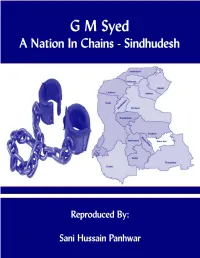
A Nation in Chains by G M Syed
About the book A thesis for a separate homeland for Sindhis. This book was first published in 1974. It laid the foundations for the Sindhi Nationalist Movement. A complete social, political, economical and philosophical argument supporting the formation of ‘Sindhudesh.’ A Nation in Chains; Copyright © www.panhwar.com 1 CHAPTER I Introduction Sindhu Desh was born with the birth of Mother Earth. Our attachment with it, too, is as old and ancient as that. As the days pass into nights and the seasons change, man, observes his regime of wakefulness and sleep and register the effect of the change. Like individuals, the peoples also have their cycles of hibernation and soulfulness of life and activity. At certain times of their history, they rise and took some giant steps on the road to civilization heights, and putting a mile stone or two on the path, they slow down and then step aside to catch breath some times even slide down dangerously and wait quietly for the chance to rise and get the way again. Sindhu Desh is the land of the people, noted for their ancient civilization and culture. They have had a remarkably magnificent past. For some period in their recent history, they hose to forget their status as a people and fell into a regret able bout of slumber, and permitted themselves to be overrun and ruled by alien peoples. We, the present generation of the people of Sindhu Desh are the product of that hapless period of our history. After separation of Sindhu from Bombay Presidency in India in 1936 when we found our political freedom, economic prosperity and cultural growth check mated at home, we over reacted, and largely misconceiving the situation, held the Hindu vested interests, to be responsible for it. -

Deepening Democracy and Cultural Context in the Republic of Mali, 1992-2002
DEEPENING DEMOCRACY AND CULTURAL CONTEXT IN THE REPUBLIC OF MALI, 1992-2002 by JONATHAN MICHAEL SEARS A thesis submitted to the Department of Political Studies in conformity with the requirements for the degree of Doctor of Philosophy Queen's University Kingston, Ontario, Canada September 2007 Copyright © Jonathan Michael Sears, 2007 Abstract This thesis challenges the view that the Republic of Mali is a model of democratization in Africa with the aim of opening the conceptual framework of democratic citizenship inherent in the democratization discourse to greater critical scrutiny. The ‘enthusiastic’ view is held and set forth by various segments of the unity-seeking ruling class (local and foreign, State and NGO) of bringing to Mali a Western-oriented, procedurally minimal democracy, and citizen identity commensurate with international financial institutions’ and donor countries’ vision of democratization as political and economic liberalization. Consequently, this hegemonic project co-opts selected indigenous and Islamic idioms of political and social identity, to reinvent democratization as ‘moral governance.’ Cosmopolitan upper and upper-middle class actors thus apologize for highly personalized politics at the national and local levels, and articulate these more broadly with idioms of recovering rectitude and social cohesion that preserve and reproduce hierarchical social norms. In Malian political culture and in the scholarship of Malian political change, the hegemonic project of citizen identity formation becomes more evident as a construction, as discourses, norms, and practices produced and reproduced by privileged actors. Moreover, the contested character of these constructions becomes evident only as we address the development and deployment of selectively synthesized indigenous, Islamic, and Western-democratic norms, practices, and institutions of citizenship in contemporary Mali. -

Social Science Department United States History II May 11-15 Content
Social Science Department United States History II May 11-15 Content Standard: Content Topic 5: United States and globalization: Cold war Flashpoints Practice Standard(s): 2. Develop focused questions or problem statements and conduct inquiries 3. Organize information and data from multiple primary or secondary sources 6. Argue or explain conclusions, using valid reasoning and evidence Weekly Learning Opportunities: 1. Cold War Primary Source Analysis 2. Cold War Annotated Timeline 3. Cold War Guided Readings 4. Newsela Text Set: Cold War Hot Spots Long Term Opportunities: 1. Cold War Impact on Other Countries DBQ 2. Historical Film Review Additional Resources: • The Cold War-CNN- The Complete Series: https://www.youtube.com/playlist?list=PL3H6z037pboGWTxs3xGP7HRGrQ5dOQdGc • California History Social Science Project: https://chssp.ucdavis.edu/programs/historyblueprint/coldwar • American Experience: Cold War Road Show on PBS.org: https://www.pbs.org/wgbh/americanexperience/films/roadshow/ Note to students: Your Social Science teacher will contact you with specifics regarding the above assignments in addition to strategies and recommendations for completion. Please email your teacher with specific questions and/or contact during office hours. Cold War Source Analysis Answer the following questions based on the resources provided. You should answer in complete sentences with evidence from the documents. Answer the questions in a new Word Document or handwrite the answers on a piece of paper. Send the file or a picture of your answers to your teacher. Soviet-American Confrontation 1.) From Stettin on the Baltic to Trieste on the Adriatic, an iron curtain has descended across the continent. Behind that line lie all the capitals of the ancient states of central and eastern Europe. -

Chapter One: the US and the Cold War: Historical Background
Dedication 1 I dedicate this Standard Essay to my beloved parents and my sister whom without their help, support, advices, cooperation, motivation, and prayers, I would not have taken up this study nor completed it. I also dedicate this work to all my friends who have supported me throughout the process. Also, to my teacher of secondary school “Mr. Moubarek” I’m thankful for all that he have done. Thank you all. Kenadessa Marwa I Dedication 2 I dedicate this work to the dearest, greatest and closest person to my heart, to my dear mother who passed away seven years ago. May Allah send his mercy upon her soul This was her dream; dear mother I did this work just for you. Goreini Amina II Acknowledgments First and foremost, all our gratitude, gratefulness, and thankfulness are directed to “ALLAH” for enabling us to complete this work. We would like to express our deepest gratitude to our supervisor “Dr. Zeghoudi Yahia”, who has gone with us through the ups and downs of this work and been invaluable source of knowledge and thoughtful advice. Thank you for giving us a wealth of ideas and generosity of time. Our utmost gratitude goes to Mr. Rahmoun Omar for his support and help. Personally, me Goreini amina, I would to thank you for your encouragement and due to your motivating words that I reach this stage of success. Special thanks go to our wonderful and greatest teacher Dr. Mouro Wassila for her assistance and guidance who without her help and support this work would not be done Great thanks to our teachers ‘Dr.Bensafa Abdelkader’, ‘Mr Kamech Mohamed’, ‘Benmeki Amine’ for their helpful advices We were fortunate to have been taught by such outstanding teachers during all the five years Finally, we would like to thank our beloved friends and families for their sustainment and their prayer for us without forgetting any name, thank you all. -

N I~ ~L 'Ш Я .N OI ~V Wl Lo ~N I
.NI~~l'ШЯ .NOI~VWllO~NI .Edltorlal This issue of СА/В focuses on the fascist connection, in par in Latin America or the U.S. The Kameradenwerk-the Nazi ticular the U.S. role in helping hundreds, perhaps thousands, old Ьоу network-remained active over the years, vigorous of prominent Nazis avoid retribution ·at the end of World War enough to have planned and carried out · the 1980 coup in 11. The CIA (originally the OSS) and the U.S. military, along Bolivia, for example, and to have held high places in with the Vatican, were instrumental in exfiltrating war crimi Pinochet's govemment in Chile. And they are major figures in nals not just to Latin America, but to the United States as well. the intemational arms and drug trades as well-traffic which As the Reagan administration attempts to rewrite history, it the U.S. tries to Ыаmе on the socialist countries. is worthwhile to examine carefully the wartime and postwar Hundreds of Nazis have been set up in scientific institutions machinations of the extreme Right. The President goes to Bit in this country. Ironically, it now appears that Star W ars is burg claiming it is time to forgive and forget, when in reality merely an extension of the Nazis' wartime rocket research. he is merely cutting а crude political deal with the reactionary Much of the U.S. space program was designed Ьу them. When West German govemment for its approval of Star Wars Ьу giv the Justice Department's Office of Special Investigations leam ing his absolution to the SS. -

The Role of Muttahida Qaumi Movement in Sindhi-Muhajir Controversy in Pakistan
ISSN: 2664-8148 (Online) Liberal Arts and Social Sciences International Journal (LASSIJ) https://doi.org/10.47264/idea.lassij/1.1.2 Vol. 1, No. 1, (January-June) 2017, 71-82 https://www.ideapublishers.org/lassij __________________________________________________________________ The Role of Muttahida Qaumi Movement in Sindhi-Muhajir Controversy in Pakistan Syed Mukarram Shah Gilani1*, Asif Salim1-2 and Noor Ullah Khan1-3 1. Department of Political Science, University of Peshawar, Peshawar Pakistan. 2. Department of Political Science, Emory University Atlanta, Georgia USA. 3. Department of Civics-cum-History, FG College Nowshera Cantt., Pakistan. …………………………………………………………………………………………………………… Abstract The partition of Indian sub-continent in 1947 was a historic event surrounded by many controversies and issues. Some of those ended up with the passage of time while others were kept alive and orchestrated. Besides numerous problems for the newly born state of Pakistan, one such controversy was about the Muhajirs (immigrants) who were settled in Karachi. The paper analyses the factors that brought the relation between the native Sindhis and Muhajirs to such an impasse which resulted in the growth of conspiracy theories, division among Sindhis; subsequently to the demand of Muhajir Suba (Province); target killings, extortion; and eventually to military clean-up operation in Karachi. The paper also throws light on the twin simmering problems of native Sindhis and Muhajirs. Besides, the paper attempts to answer the question as to why the immigrants could not merge in the native Sindhis despite living together for so long and why the native Sindhis remained backward and deprived. Finally, the paper aims at bringing to limelight the role of Muttahida Qaumi Movement (MQM). -

THE POLITICS and POLICY of DECENTRALIZATION in 1990S MALI
THE POLITICS AND POLICY OF DECENTRALIZATION IN 1990s MALI Elizabeth A. Pollard Submitted to the faculty of the University Graduate School in partial fulfillment of the requirements for the degree Master of Arts in the African Studies Program, Indiana University August 2014 Accepted by the Graduate Faculty, Indiana University, in partial fulfillment of the requirements for the degree of Master of Arts. Master’s Thesis Committee ____________________________________ Osita Afoaku, PhD ____________________________________ Maria Grosz-Ngaté, PhD ____________________________________ Jennifer N. Brass, PhD ii TABLE OF CONTENTS Title Page ………………………………………………………………………………………... i Acceptance Page ………………………………………………………………………………… ii Chapters Chapter 1 ………………………………………………………………………………… 1 Chapter 2 ……………………………………………………………………………….. 19 Chapter 3 ……………………………………………………………………………….. 35 Chapter 4 ……………………………………………………………………………….. 49 Chapter 5 ……………………………………………………………………………….. 72 Appendix ……………………………………………………………………………………….. 82 References ……………………………………………………………………………………… 84 Curriculum Vitae iii CHAPTER 1 Introduction A. Statement of the Problem At the end of the Cold War, the government of Mali, like governments across Africa, faced increased pressure from international donors and domestic civil society to undertake democratic reforms. In one notable policy shift, French President François Mitterrand made clear to his African counterparts at the June 1990 Franco-African summit, that while France was committed to supporting its former colonies through the economic -

American Hindu Activism and the Politics of Anxiety Arun Chaudhuri
American Hindu Activism and the Politics of Anxiety Arun Chaudhuri A Dissertation Submitted to the Faculty of Graduate Studies in Partial Fulfillment of the Requirements for the Degree of Doctor of Philosophy Graduate Program in Anthropology York University Toronto, Ontario September 2012 © Arun Chaudhuri, 2012 Library and Archives Bibliotheque et Canada Archives Canada Published Heritage Direction du 1+1 Branch Patrimoine de I'edition 395 Wellington Street 395, rue Wellington Ottawa ON K1A0N4 Ottawa ON K1A 0N4 Canada Canada Your file Votre reference ISBN: 978-0-494-92758-8 Our file Notre reference ISBN: 978-0-494-92758-8 NOTICE: AVIS: The author has granted a non L'auteur a accorde une licence non exclusive exclusive license allowing Library and permettant a la Bibliotheque et Archives Archives Canada to reproduce, Canada de reproduire, publier, archiver, publish, archive, preserve, conserve, sauvegarder, conserver, transmettre au public communicate to the public by par telecommunication ou par I'lnternet, preter, telecommunication or on the Internet, distribuer et vendre des theses partout dans le loan, distrbute and sell theses monde, a des fins commerciales ou autres, sur worldwide, for commercial or non support microforme, papier, electronique et/ou commercial purposes, in microform, autres formats. paper, electronic and/or any other formats. The author retains copyright L'auteur conserve la propriete du droit d'auteur ownership and moral rights in this et des droits moraux qui protege cette these. Ni thesis. Neither the thesis nor la these ni des extraits substantiels de celle-ci substantial extracts from it may be ne doivent etre imprimes ou autrement printed or otherwise reproduced reproduits sans son autorisation.