Manu National Park Bird List Southern - Peru
Total Page:16
File Type:pdf, Size:1020Kb
Load more
Recommended publications
-

A Giant Hummingbird from Paramo De Chingaza, Colombia.-On 10 October 1981, During an Ornithological Survey at 3250 M Elev
GENERAL NOTES 661 E. nigrivestis is timed to coincide with flowering of P. huigrensis (and other plants) which bloom seasonally at lower elevations. The general ecology of E. nigrivestis is similar to that recorded for the closely related species, the Glowing Puffleg (E. vextitus)(Snow and Snow 1980). Snow and Snow (1980) observed E. vestitus feeding principally at plants of similar general morphology (straight tubular corollas 10-20 mm in length) in similar taxonomic groups (Cnvenclishia; Ericaceae more often than Palicourea; Rubiaceae for E. vestitus). Territoriality in E. vestitus was pronounced while this was only suggested in the male E. nigrivestis we observed, perhaps a seasonal effect. Finally E. vestitus, like E. nigrivestis, did not occur in tall forested habitats at similar elevations (Snow and Snow [1980] study at 2400-2500 m). The evidence presented here suggests that the greatly restricted range of E. nigrivestis is not due to dietary specializations. Male nectar sources are from a broad spectrum of plants, and the principal food plant of both sexes, P. huigrensis, is a widespread Andean species. Nesting requirements of E. nigrivestis may still be threatened with extinction through habitat destruction, especially if the species requires specific habitats of natural vegetation at certain times of year, such as that found on nude ridge crests. The vegetation on nudes in particular is rapidly disappearing because nudes provide flat ground for cultivation in otherwise pre- cipitous terrain. In light of its restricted range and the threat of habitat destruction resulting from such close proximity to a major urban center, Quito, we consider E. -
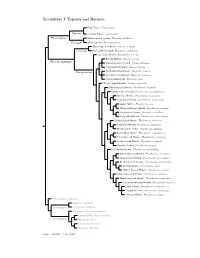
Topazes and Hermits
Trochilidae I: Topazes and Hermits Fiery Topaz, Topaza pyra Topazini Crimson Topaz, Topaza pella Florisuginae White-necked Jacobin, Florisuga mellivora Florisugini Black Jacobin, Florisuga fusca White-tipped Sicklebill, Eutoxeres aquila Eutoxerini Buff-tailed Sicklebill, Eutoxeres condamini Saw-billed Hermit, Ramphodon naevius Bronzy Hermit, Glaucis aeneus Phaethornithinae Rufous-breasted Hermit, Glaucis hirsutus ?Hook-billed Hermit, Glaucis dohrnii Threnetes ruckeri Phaethornithini Band-tailed Barbthroat, Pale-tailed Barbthroat, Threnetes leucurus ?Sooty Barbthroat, Threnetes niger ?Broad-tipped Hermit, Anopetia gounellei White-bearded Hermit, Phaethornis hispidus Tawny-bellied Hermit, Phaethornis syrmatophorus Mexican Hermit, Phaethornis mexicanus Long-billed Hermit, Phaethornis longirostris Green Hermit, Phaethornis guy White-whiskered Hermit, Phaethornis yaruqui Great-billed Hermit, Phaethornis malaris Long-tailed Hermit, Phaethornis superciliosus Straight-billed Hermit, Phaethornis bourcieri Koepcke’s Hermit, Phaethornis koepckeae Needle-billed Hermit, Phaethornis philippii Buff-bellied Hermit, Phaethornis subochraceus Scale-throated Hermit, Phaethornis eurynome Sooty-capped Hermit, Phaethornis augusti Planalto Hermit, Phaethornis pretrei Pale-bellied Hermit, Phaethornis anthophilus Stripe-throated Hermit, Phaethornis striigularis Gray-chinned Hermit, Phaethornis griseogularis Black-throated Hermit, Phaethornis atrimentalis Reddish Hermit, Phaethornis ruber ?White-browed Hermit, Phaethornis stuarti ?Dusky-throated Hermit, Phaethornis squalidus Streak-throated Hermit, Phaethornis rupurumii Cinnamon-throated Hermit, Phaethornis nattereri Little Hermit, Phaethornis longuemareus ?Tapajos Hermit, Phaethornis aethopygus ?Minute Hermit, Phaethornis idaliae Polytminae: Mangos Lesbiini: Coquettes Lesbiinae Coeligenini: Brilliants Patagonini: Giant Hummingbird Lampornithini: Mountain-Gems Tro chilinae Mellisugini: Bees Cynanthini: Emeralds Trochilini: Amazilias Source: McGuire et al. (2014).. -

Bird Ecology, Conservation, and Community Responses
BIRD ECOLOGY, CONSERVATION, AND COMMUNITY RESPONSES TO LOGGING IN THE NORTHERN PERUVIAN AMAZON by NICO SUZANNE DAUPHINÉ (Under the Direction of Robert J. Cooper) ABSTRACT Understanding the responses of wildlife communities to logging and other human impacts in tropical forests is critical to the conservation of global biodiversity. I examined understory forest bird community responses to different intensities of non-mechanized commercial logging in two areas of the northern Peruvian Amazon: white-sand forest in the Allpahuayo-Mishana Reserve, and humid tropical forest in the Cordillera de Colán. I quantified vegetation structure using a modified circular plot method. I sampled birds using mist nets at a total of 21 lowland forest stands, comparing birds in logged forests 1, 5, and 9 years postharvest with those in unlogged forests using a sample effort of 4439 net-hours. I assumed not all species were detected and used sampling data to generate estimates of bird species richness and local extinction and turnover probabilities. During the course of fieldwork, I also made a preliminary inventory of birds in the northwest Cordillera de Colán and incidental observations of new nest and distributional records as well as threats and conservation measures for birds in the region. In both study areas, canopy cover was significantly higher in unlogged forest stands compared to logged forest stands. In Allpahuayo-Mishana, estimated bird species richness was highest in unlogged forest and lowest in forest regenerating 1-2 years post-logging. An estimated 24-80% of bird species in unlogged forest were absent from logged forest stands between 1 and 10 years postharvest. -

BIOLOGICAL INVENTORIES REPORTS ARE PUBLISHED BY: Betty Moore Foundation./This Publication Has Been Funded in Part by the Gordon and Betty Moore Foundation
biological rapid inventories 12 Perú: Ampiyacu, Apayacu, Yaguas, Medio Putumayo Nigel Pitman, Richard Chase Smith, Corine Vriesendorp, Debra Moskovits, Renzo Piana, Guillermo Knell y/and Tyana Wachter, editores/editors ABRIL/APRIL 2004 Instituciones y Comunidades Participantes/ Participating Institutions and Communities The Field Museum Comunidades Nativas de los ríos Ampiyacu, Apayacu y Medio Putumayo/Indigenous Communities of the Ampiyacu, Apayacu and Medio Putumayo rivers FECONA FECONAFROPU Instituto del Bien Común Servicio Holandés de Cooperación al Desarrollo/ SNV Netherlands Development Organization Centro de Conservación, Investigación y Manejo de Áreas Naturales (CIMA-Cordillera Azul) Museo de Historia Natural de la Universidad Nacional Mayor de San Marcos LOS INVENTARIOS BIOLÓGICOS RÁPIDOS SON PUBLICADOS POR / Esta publicación ha sido financiada en parte por Gordon and RAPID BIOLOGICAL INVENTORIES REPORTS ARE PUBLISHED BY: Betty Moore Foundation./This publication has been funded in part by the Gordon and Betty Moore Foundation. THE FIELD MUSEUM Environmental and Conservation Programs Cita Sugerida/Suggested Citation: Pitman, N., R. C. Smith, 1400 South Lake Shore Drive C. Vriesendorp, D. Moskovits, R. Piana, G. Knell & T. Wachter Chicago, Illinois 60605-2496 USA (eds.). 2004. Perú: Ampiyacu, Apayacu, Yaguas, Medio Putumayo. T 312.665.7430, F 312.665.7433 Rapid Biological Inventories Report 12. Chicago, Illinois: www.fieldmuseum.org The Field Museum. Créditos Fotográficos/Photography credits: Editores/Editors: Nigel Pitman, Richard Chase Smith, Corine Vriesendorp, Debra Moskovits, Renzo Piana, Carátula/Cover: Un padre Bora con sus hijos atienden un taller en Guillermo Knell, Tyana Wachter Boras de Brillo Nuevo. Foto de Alvaro del Campo./A Bora father and his children attend a workshop in Boras de Brillo Nuevo. -

Gene Duplication and the Evolution of Hemoglobin Isoform Differentiation in Birds
View metadata, citation and similar papers at core.ac.uk brought to you by CORE provided by DigitalCommons@University of Nebraska University of Nebraska - Lincoln DigitalCommons@University of Nebraska - Lincoln Jay F. Storz Publications Papers in the Biological Sciences 11-2012 Gene Duplication and the Evolution of Hemoglobin Isoform Differentiation in Birds Michael T. Grispo University of Nebraska-Lincoln, mgrispo@gmail.com Chandrasekhar Natarajan University of Nebraska-Lincoln, chandrasekhar.natarajan@unl.edu Joana Projecto-Garcia University of Nebraska–Lincoln Hideaki Moriyama University of Nebraska-Lincoln, hmoriyama2@unl.edu Roy E. Weber Aarhus University, Denmark See next page for additional authors Follow this and additional works at: https://digitalcommons.unl.edu/bioscistorz Grispo, Michael T.; Natarajan, Chandrasekhar; Projecto-Garcia, Joana; Moriyama, Hideaki; Weber, Roy E.; and Storz, Jay F., "Gene Duplication and the Evolution of Hemoglobin Isoform Differentiation in Birds" (2012). Jay F. Storz Publications. 61. https://digitalcommons.unl.edu/bioscistorz/61 This Article is brought to you for free and open access by the Papers in the Biological Sciences at DigitalCommons@University of Nebraska - Lincoln. It has been accepted for inclusion in Jay F. Storz Publications by an authorized administrator of DigitalCommons@University of Nebraska - Lincoln. Authors Michael T. Grispo, Chandrasekhar Natarajan, Joana Projecto-Garcia, Hideaki Moriyama, Roy E. Weber, and Jay F. Storz This article is available at DigitalCommons@University of Nebraska - Lincoln: https://digitalcommons.unl.edu/ bioscistorz/61 Published in Journal of Biological Chemistry 287:45 (November 2, 2012), pp. 37647-37658; doi: 10.1074/jbc.M112.375600 Copyright © 2012 The American Society for Biochemistry and Molecular Biology, Inc. -

Hummingbird (Family Trochilidae) Research: Welfare-Conscious Study Techniques for Live Hummingbirds and Processing of Hummingbird Specimens
Special Publications Museum of Texas Tech University Number xx76 19xx January XXXX 20212010 Hummingbird (Family Trochilidae) Research: Welfare-conscious Study Techniques for Live Hummingbirds and Processing of Hummingbird Specimens Lisa A. Tell, Jenny A. Hazlehurst, Ruta R. Bandivadekar, Jennifer C. Brown, Austin R. Spence, Donald R. Powers, Dalen W. Agnew, Leslie W. Woods, and Andrew Engilis, Jr. Dedications To Sandra Ogletree, who was an exceptional friend and colleague. Her love for family, friends, and birds inspired us all. May her smile and laughter leave a lasting impression of time spent with her and an indelible footprint in our hearts. To my parents, sister, husband, and children. Thank you for all of your love and unconditional support. To my friends and mentors, Drs. Mitchell Bush, Scott Citino, John Pascoe and Bill Lasley. Thank you for your endless encouragement and for always believing in me. ~ Lisa A. Tell Front cover: Photographic images illustrating various aspects of hummingbird research. Images provided courtesy of Don M. Preisler with the exception of the top right image (courtesy of Dr. Lynda Goff). SPECIAL PUBLICATIONS Museum of Texas Tech University Number 76 Hummingbird (Family Trochilidae) Research: Welfare- conscious Study Techniques for Live Hummingbirds and Processing of Hummingbird Specimens Lisa A. Tell, Jenny A. Hazlehurst, Ruta R. Bandivadekar, Jennifer C. Brown, Austin R. Spence, Donald R. Powers, Dalen W. Agnew, Leslie W. Woods, and Andrew Engilis, Jr. Layout and Design: Lisa Bradley Cover Design: Lisa A. Tell and Don M. Preisler Production Editor: Lisa Bradley Copyright 2021, Museum of Texas Tech University This publication is available free of charge in PDF format from the website of the Natural Sciences Research Laboratory, Museum of Texas Tech University (www.depts.ttu.edu/nsrl). -

Provisional List of Birds of the Rio Tahuauyo Areas, Loreto, Peru
Provisional List of Birds of the Rio Tahuauyo areas, Loreto, Peru Compiled by Carol R. Foss, Ph.D. and Josias Tello Huanaquiri, Guide Status based on expeditions from Tahuayo Logde and Amazonia Research Center TINAMIFORMES: Tinamidae 1. Great Tinamou Tinamus major 2. White- throated Tinamou Tinamus guttatus 3. Cinereous Tinamou Crypturellus cinereus 4. Little Tinamou Crypturellus soui 5. Undulated Tinamou Crypturellus undulates 6. Variegated Tinamou Crypturellus variegatus 7. Bartlett’s Tinamou Crypturellus bartletti ANSERIFORMES: Anhimidae 8. Horned Screamer Anhima cornuta ANSERIFORMES: Anatidae 9. Muscovy Duck Cairina moschata 10. Blue-winged Teal Anas discors 11. Masked Duck Nomonyx dominicus GALLIFORMES: Cracidae 12. Spix’s Guan Penelope jacquacu 13. Blue-throated Piping-Guan Pipile cumanensis 14. Speckled Chachalaca Ortalis guttata 15. Wattled Curassow Crax globulosa 16. Razor-billed Curassow Mitu tuberosum GALLIFORMES: Odontophoridae 17. Marbled Wood-Quall Odontophorus gujanensis 18. Starred Wood-Quall Odontophorus stellatus PELECANIFORMES: Phalacrocoracidae 19. Neotropic Cormorant Phalacrocorax brasilianus PELECANIFORMES: Anhingidae 20. Anhinga Anhinga anhinga CICONIIFORMES: Ardeidae 21. Rufescent Tiger-Heron Tigrisoma lineatum 22. Agami Heron Agamia agami 23. Boat-billed Heron Cochlearius cochlearius 24. Zigzag Heron Zebrilus undulatus 25. Black-crowned Night-Heron Nycticorax nycticorax 26. Striated Heron Butorides striata 27. Cattle Egret Bubulcus ibis 28. Cocoi Heron Ardea cocoi 29. Great Egret Ardea alba 30. Cappet Heron Pilherodius pileatus 31. Snowy Egret Egretta thula 32. Little Blue Heron Egretta caerulea CICONIIFORMES: Threskiornithidae 33. Green Ibis Mesembrinibis cayennensis 34. Roseate Spoonbill Platalea ajaja CICONIIFORMES: Ciconiidae 35. Jabiru Jabiru mycteria 36. Wood Stork Mycteria Americana CICONIIFORMES: Cathartidae 37. Turkey Vulture Cathartes aura 38. Lesser Yellow-headed Vulture Cathartes burrovianus 39. -

Ecological Report April 2017 Inkaterra Association
ECOLOGICAL REPORT APRIL 2017 INKATERRA ASSOCIATION I. POINT COUNTS REPORT 1.1. SAMPLING ÁREA: Inkaterra Guides Field Station - Palmetum 1.2. DATE: April 06th, 2017 1.3. STARTING HOUR: 5:35 h CLOSING HOUR: 7:25 h 1.4. PARTICIPANTS: Noe Huaraca y Andreina Méndez 1.5. OBJECTIVES: 1.5.1 To complement bird wildlife diversity monitoring by including canopy and underbrush forest bird species of Inkaterra Guides Field Station. 1.5.2 To establish the registered bird species' abundance parameters patterns. 1.5.3 To understand the differences between bird wildlife compositions according by its habitat. 1.6. METODOLOGÍA: The Point Count method (Ralph et al., 1995; Ralph, 1996; MINAM, 2015) was employed, which consists in staying at a point station for 10 minutes, while recording all the birds seen and heard. The distance between points is 150 meters. This month, the evaluation was performed at the trail way depicted by Image 1. Inkaterra Guides Field Station Palmetum Image 1. Sampling area and Point Counts map 1.7. RESULTS: 8 point stations were evaluated, where 64 subjects were registered, all belonging to 19 Families and 11 Orders. All registered subjects indicated a richness of 46 species. The richest Order was Passeriformes with 21 species and 7 families (Thamnophilidae, Cotingidae, Formicariidae, Furnariidae, Icteridae, Trogloditydae y Tyrannidae), next were Psittaciformes (macaws, parrots and perakeet) with 6 species and 1 family, Galbuliformes (jacamar), and finally, Columbiformes (pigeons) with 4 species and 1 family per each one. Among the bird species registered, the most relatively abundant were parrots; the Pionus menstruus species (Blue headed Parrot) showed the highest number of subjects registered while flying (n=11), all spotted at counting point 2 (n=7) and counting point 3 (n=4). -
Contents Contents
Traveler’s Guide WILDLIFE WATCHINGTraveler’s IN PERU Guide WILDLIFE WATCHING IN PERU CONTENTS CONTENTS PERU, THE NATURAL DESTINATION BIRDS Northern Region Lambayeque, Piura and Tumbes Amazonas and Cajamarca Cordillera Blanca Mountain Range Central Region Lima and surrounding areas Paracas Huánuco and Junín Southern Region Nazca and Abancay Cusco and Machu Picchu Puerto Maldonado and Madre de Dios Arequipa and the Colca Valley Puno and Lake Titicaca PRIMATES Small primates Tamarin Marmosets Night monkeys Dusky titi monkeys Common squirrel monkeys Medium-sized primates Capuchin monkeys Saki monkeys Large primates Howler monkeys Woolly monkeys Spider monkeys MARINE MAMMALS Main species BUTTERFLIES Areas of interest WILD FLOWERS The forests of Tumbes The dry forest The Andes The Hills The cloud forests The tropical jungle www.peru.org.pe iperu@promperu.gob.pe 1 Traveler’s Guide WILDLIFE WATCHINGTraveler’s IN PERU Guide WILDLIFE WATCHING IN PERU ORCHIDS Tumbes and Piura Amazonas and San Martín Huánuco and Tingo María Cordillera Blanca Chanchamayo Valley Machu Picchu Manu and Tambopata RECOMMENDATIONS LOCATION AND CLIMATE www.peru.org.pe iperu@promperu.gob.pe 2 Traveler’s Guide WILDLIFE WATCHINGTraveler’s IN PERU Guide WILDLIFE WATCHING IN PERU Peru, The Natural Destination Peru is, undoubtedly, one of the world’s top desti- For Peru, nature-tourism and eco-tourism repre- nations for nature-lovers. Blessed with the richest sent an opportunity to share its many surprises ocean in the world, largely unexplored Amazon for- and charm with the rest of the world. This guide ests and the highest tropical mountain range on provides descriptions of the main groups of species Pthe planet, the possibilities for the development of the country offers nature-lovers; trip recommen- bio-diversity in its territory are virtually unlim- dations; information on destinations; services and ited. -

A Contact Zone Between Mountain and Carunculated Caracaras in Ecuador.-Parker Et Al
688 THE WILSON BULLETIN l Vol. 105, No. 4, December 1993 Wilson Bull., 105(4), 1993, pp. 688-691 A contact zone between Mountain and Carunculated Caracaras in Ecuador.-Parker et al. (1985) were first to report Mountain Caracaras (Phalcoboenus megalopterus) north of the Maranon depression at Cerro Chinguela in Peru. Fjeldsa and Krabbe (1990) found them on the border of Ecuador and Peru. Ortiz et al. (1990) did not consider the species present in Ecuador, but R. Williams (pers. comm.) found Mountain Caracaras to be fairly common on the Cordillera de Cyabanilla (4”34S,’ 79”22W)’ lo-15 km east of Amaluza in 1990. However, he saw none in this area in 199 1. Williams also recorded the species at 04”2 1S,‘ 79”45W’ near Sozoranga in 1990. E. P. Toyne (pers. comm.) recorded two adult Mountain Caracaras flying together at Ingapirca (3”41S,’ 79”13W)’ on 11 April 1992 immediately east of Acacana. I recorded Mountain Caracaras several times during ornithological fieldwork at 2950 m on the east side of Cerro Acacana (Acanama) (3”41S,’ 79”14W,’ Fig. l), Province of Loja, southern Ecuador, in May and June 1992 and report on those observations here. The area is characterized by “islands” of temperate cloud forest in an “ocean” of pastures. Just below and on the top of Acacana (3420 m), plramo vegetation was prevalent. I recorded Mountain Caracaras on 15 occasions, but never more than two together at one time. Fifteen records were of adults and four of juveniles. The greatest number of sightings in any one day was four. -
Avian Nesting and Roosting on Glaciers at High Elevation, Cordillera Vilcanota, Peru
The Wilson Journal of Ornithology 130(4):940–957, 2018 Avian nesting and roosting on glaciers at high elevation, Cordillera Vilcanota, Peru Spencer P. Hardy,1,4* Douglas R. Hardy,2 and Koky Castaneda˜ Gil3 ABSTRACT—Other than penguins, only one bird species—the White-winged Diuca Finch (Idiopsar speculifera)—is known to nest directly on ice. Here we provide new details on this unique behavior, as well as the first description of a White- fronted Ground-Tyrant (Muscisaxicola albifrons) nest, from the Quelccaya Ice Cap, in the Cordillera Vilcanota of Peru. Since 2005, .50 old White-winged Diuca Finch nests have been found. The first 2 active nests were found in April 2014; 9 were found in April 2016, 1 of which was filmed for 10 d during the 2016 nestling period. Video of the nest revealed infrequent feedings (.1 h between visits), slow nestling development (estimated 20–30 d), and feeding via regurgitation. The first and only active White-fronted Ground-Tyrant nest was found in October 2014, beneath the glacier in the same area. Three other unoccupied White-fronted Ground-Tyrant nests and an eggshell have been found since, all on glacier ice. At Quelccaya, we also observed multiple species roosting in crevasses or voids (caves) beneath the glacier, at elevations between 5,200 m and 5,500 m, including both White-winged Diuca Finch and White-fronted Ground-Tyrant, as well as Plumbeous Sierra Finch (Phrygilus unicolor), Rufous-bellied Seedsnipe (Attagis gayi), and Gray-breasted Seedsnipe (Thinocorus orbignyianus). These nesting and roosting behaviors are all likely adaptations to the harsh environment, as the glacier provides a microclimate protected from precipitation, wind, daily mean temperatures below freezing, and strong solar irradiance (including UV-B and UV-A). -

An Update of Wallacels Zoogeographic Regions of the World
REPORTS To examine the temporal profile of ChC produc- specification of a distinct, and probably the last, 3. G. A. Ascoli et al., Nat. Rev. Neurosci. 9, 557 (2008). tion and their correlation to laminar deployment, cohort in this lineage—the ChCs. 4. J. Szentágothai, M. A. Arbib, Neurosci. Res. Program Bull. 12, 305 (1974). we injected a single pulse of BrdU into pregnant A recent study demonstrated that progeni- CreER 5. P. Somogyi, Brain Res. 136, 345 (1977). Nkx2.1 ;Ai9 females at successive days be- tors below the ventral wall of the lateral ventricle 6. L. Sussel, O. Marin, S. Kimura, J. L. Rubenstein, tween E15 and P1 to label mitotic progenitors, (i.e., VGZ) of human infants give rise to a medial Development 126, 3359 (1999). each paired with a pulse of tamoxifen at E17 to migratory stream destined to the ventral mPFC 7. S. J. Butt et al., Neuron 59, 722 (2008). + 18 8. H. Taniguchi et al., Neuron 71, 995 (2011). label NKX2.1 cells (Fig. 3A). We first quanti- ( ). Despite species differences in the develop- 9. L. Madisen et al., Nat. Neurosci. 13, 133 (2010). fied the fraction of L2 ChCs (identified by mor- mental timing of corticogenesis, this study and 10. J. Szabadics et al., Science 311, 233 (2006). + phology) in mPFC that were also BrdU+. Although our findings raise the possibility that the NKX2.1 11. A. Woodruff, Q. Xu, S. A. Anderson, R. Yuste, Front. there was ChC production by E15, consistent progenitors in VGZ and their extended neurogenesis Neural Circuits 3, 15 (2009).