<I>Polyporus Submelanopus</I>
Total Page:16
File Type:pdf, Size:1020Kb
Load more
Recommended publications
-
Field Guide to Common Macrofungi in Eastern Forests and Their Ecosystem Functions
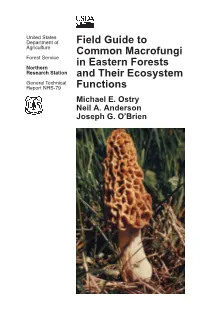
United States Department of Field Guide to Agriculture Common Macrofungi Forest Service in Eastern Forests Northern Research Station and Their Ecosystem General Technical Report NRS-79 Functions Michael E. Ostry Neil A. Anderson Joseph G. O’Brien Cover Photos Front: Morel, Morchella esculenta. Photo by Neil A. Anderson, University of Minnesota. Back: Bear’s Head Tooth, Hericium coralloides. Photo by Michael E. Ostry, U.S. Forest Service. The Authors MICHAEL E. OSTRY, research plant pathologist, U.S. Forest Service, Northern Research Station, St. Paul, MN NEIL A. ANDERSON, professor emeritus, University of Minnesota, Department of Plant Pathology, St. Paul, MN JOSEPH G. O’BRIEN, plant pathologist, U.S. Forest Service, Forest Health Protection, St. Paul, MN Manuscript received for publication 23 April 2010 Published by: For additional copies: U.S. FOREST SERVICE U.S. Forest Service 11 CAMPUS BLVD SUITE 200 Publications Distribution NEWTOWN SQUARE PA 19073 359 Main Road Delaware, OH 43015-8640 April 2011 Fax: (740)368-0152 Visit our homepage at: http://www.nrs.fs.fed.us/ CONTENTS Introduction: About this Guide 1 Mushroom Basics 2 Aspen-Birch Ecosystem Mycorrhizal On the ground associated with tree roots Fly Agaric Amanita muscaria 8 Destroying Angel Amanita virosa, A. verna, A. bisporigera 9 The Omnipresent Laccaria Laccaria bicolor 10 Aspen Bolete Leccinum aurantiacum, L. insigne 11 Birch Bolete Leccinum scabrum 12 Saprophytic Litter and Wood Decay On wood Oyster Mushroom Pleurotus populinus (P. ostreatus) 13 Artist’s Conk Ganoderma applanatum -
Phylogenetic Classification of Trametes
TAXON 60 (6) • December 2011: 1567–1583 Justo & Hibbett • Phylogenetic classification of Trametes SYSTEMATICS AND PHYLOGENY Phylogenetic classification of Trametes (Basidiomycota, Polyporales) based on a five-marker dataset Alfredo Justo & David S. Hibbett Clark University, Biology Department, 950 Main St., Worcester, Massachusetts 01610, U.S.A. Author for correspondence: Alfredo Justo, ajusto@clarku.edu Abstract: The phylogeny of Trametes and related genera was studied using molecular data from ribosomal markers (nLSU, ITS) and protein-coding genes (RPB1, RPB2, TEF1-alpha) and consequences for the taxonomy and nomenclature of this group were considered. Separate datasets with rDNA data only, single datasets for each of the protein-coding genes, and a combined five-marker dataset were analyzed. Molecular analyses recover a strongly supported trametoid clade that includes most of Trametes species (including the type T. suaveolens, the T. versicolor group, and mainly tropical species such as T. maxima and T. cubensis) together with species of Lenzites and Pycnoporus and Coriolopsis polyzona. Our data confirm the positions of Trametes cervina (= Trametopsis cervina) in the phlebioid clade and of Trametes trogii (= Coriolopsis trogii) outside the trametoid clade, closely related to Coriolopsis gallica. The genus Coriolopsis, as currently defined, is polyphyletic, with the type species as part of the trametoid clade and at least two additional lineages occurring in the core polyporoid clade. In view of these results the use of a single generic name (Trametes) for the trametoid clade is considered to be the best taxonomic and nomenclatural option as the morphological concept of Trametes would remain almost unchanged, few new nomenclatural combinations would be necessary, and the classification of additional species (i.e., not yet described and/or sampled for mo- lecular data) in Trametes based on morphological characters alone will still be possible. -
Mycology from the Library of Nils Fries
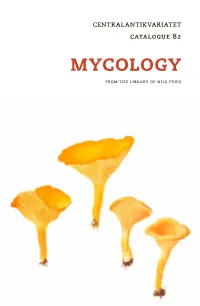
CENTRALANTIKVARIATET catalogue 82 MYCOLOGY from the library of nils fries CENTRALANTIKVARIATET catalogue 82 MYCOLOGY from the library of nils fries stockholm mmxvi 15 centralantikvariatet österlånggatan 53 111 31 stockholm +46 8 411 91 36 www.centralantikvariatet.se e-mail: info@centralant.se bankgiro 585-2389 medlem i svenska antikvariatföreningen member of ilab grafisk form och foto: lars paulsrud tryck: eo grafiska 2016 Vignette on title page from 194 PREFACE It is with great pleasure we are now able to present our Mycology catalogue, with old and rare books, many of them beautifully illustrated, about mushrooms. In addition to being fine mycological books in their own right, they have a great provenance, coming from the libraries of several members of the Fries family – the leading botanist and mycologist family in Sweden. All of the books are from the library of Nils Fries (1912–94), many from that of his grandfather Theodor (Thore) M. Fries (1832–1913), and a few from the library of Nils’ great grandfather Elias M. Fries (1794–1878), “fa- ther of Swedish mycology”. All three were botanists and professors at Uppsala University, as were many other members of the family, often with an orientation towards mycology. Nils Fries field of study was the procreation of mushrooms. Furthermore, Nils Fries has had a partiality for interesting provenances in his purchases – and many international mycologists are found among the former owners of the books in the catalogue. Four of the books are inscribed to Elias M. Fries, and it is probable that more of them come from his collection. Thore M. -
Biodiversity and Threats in Non-Protected Areas: a Multidisciplinary and Multi-Taxa Approach Focused on the Atlantic Forest
Heliyon 5 (2019) e02292 Contents lists available at ScienceDirect Heliyon journal homepage: www.heliyon.com Biodiversity and threats in non-protected areas: A multidisciplinary and multi-taxa approach focused on the Atlantic Forest Esteban Avigliano a,b,*, Juan Jose Rosso c, Dario Lijtmaer d, Paola Ondarza e, Luis Piacentini d, Matías Izquierdo f, Adriana Cirigliano g, Gonzalo Romano h, Ezequiel Nunez~ Bustos d, Andres Porta d, Ezequiel Mabragana~ c, Emanuel Grassi i, Jorge Palermo h,j, Belen Bukowski d, Pablo Tubaro d, Nahuel Schenone a a Centro de Investigaciones Antonia Ramos (CIAR), Fundacion Bosques Nativos Argentinos, Camino Balneario s/n, Villa Bonita, Misiones, Argentina b Instituto de Investigaciones en Produccion Animal (INPA-CONICET-UBA), Universidad de Buenos Aires, Av. Chorroarín 280, (C1427CWO), Buenos Aires, Argentina c Grupo de Biotaxonomía Morfologica y Molecular de Peces (BIMOPE), Instituto de Investigaciones Marinas y Costeras, Facultad de Ciencias Exactas y Naturales, Universidad Nacional de Mar del Plata (CONICET), Dean Funes 3350, (B7600), Mar del Plata, Argentina d Museo Argentino de Ciencias Naturales “Bernardino Rivadavia” (MACN-CONICET), Av. Angel Gallardo 470, (C1405DJR), Buenos Aires, Argentina e Laboratorio de Ecotoxicología y Contaminacion Ambiental, Instituto de Investigaciones Marinas y Costeras, Facultad de Ciencias Exactas y Naturales, Universidad Nacional de Mar del Plata (CONICET), Dean Funes 3350, (B7600), Mar del Plata, Argentina f Laboratorio de Biología Reproductiva y Evolucion, Instituto de Diversidad -

Short Title: Lentinus, Polyporellus, Neofavolus
In Press at Mycologia, preliminary version published on February 6, 2015 as doi:10.3852/14-084 Short title: Lentinus, Polyporellus, Neofavolus Phylogenetic relationships and morphological evolution in Lentinus, Polyporellus and Neofavolus, emphasizing southeastern Asian taxa Jaya Seelan Sathiya Seelan Biology Department, Clark University, 950 Main Street, Worcester, Massachusetts 01610, and Institute for Tropical Biology and Conservation (ITBC), Universiti Malaysia Sabah, 88400 Kota Kinabalu, Sabah, Malaysia Alfredo Justo Laszlo G. Nagy Biology Department, Clark University, 950 Main Street, Worcester, Massachusetts 01610 Edward A. Grand Mahidol University International College (Science Division), 999 Phuttamonthon, Sai 4, Salaya, Nakorn Pathom 73170, Thailand Scott A. Redhead ECORC, Science & Technology Branch, Agriculture & Agri-Food Canada, CEF, Neatby Building, Ottawa, Ontario, K1A 0C6 Canada David Hibbett1 Biology Department, Clark University, 950 Main Street Worcester, Massachusetts 01610 Abstract: The genus Lentinus (Polyporaceae, Basidiomycota) is widely documented from tropical and temperate forests and is taxonomically controversial. Here we studied the relationships between Lentinus subg. Lentinus sensu Pegler (i.e. sections Lentinus, Tigrini, Dicholamellatae, Rigidi, Lentodiellum and Pleuroti and polypores that share similar morphological characters). We generated sequences of internal transcribed spacers (ITS) and Copyright 2015 by The Mycological Society of America. partial 28S regions of nuc rDNA and genes encoding the largest subunit of RNA polymerase II (RPB1), focusing on Lentinus subg. Lentinus sensu Pegler and the Neofavolus group, combined these data with sequences from GenBank (including RPB2 gene sequences) and performed phylogenetic analyses with maximum likelihood and Bayesian methods. We also evaluated the transition in hymenophore morphology between Lentinus, Neofavolus and related polypores with ancestral state reconstruction. -

Decrypting the Polyporus Dictyopus Complex: Recovery of Atroporus Ryvarden and Segregation of Neodictyopus Gen
RESEARCH ARTICLE Decrypting the Polyporus dictyopus complex: Recovery of Atroporus Ryvarden and segregation of Neodictyopus gen. nov. (Polyporales, Basidiomyocta) Melissa Palacio1☯*, Gerardo Lucio Robledo2☯*, Mateus Arduvino Reck1, Emanuel Grassi3, AristoÂteles Go es-Neto4, Elisandro Ricardo Drechsler-Santos1* a1111111111 1 Programa de PoÂs-GraduacËão em Biologia de Fungos, Algas e Plantas, Departamento de BotaÃnica, Universidade Federal de Santa Catarina, FlorianoÂpolis, Santa Catarina, Brasil, 2 Instituto Multidisciplinario de a1111111111 BiologõÂa Vegetal, Universidad Nacional de CoÂrdoba, CoÂrdoba, Argentina, 3 Instituto Misionero de a1111111111 Biodiversidad (IMiBio), Puerto Iguazu - Misiones±Argentina, 4 Molecular and Computational Biology of Fungi a1111111111 Laboratory, Department of Microbiology, Institute of Biological Sciences, Federal University of Minas Gerais, a1111111111 Belo Horizonte, Minas Gerais, Brazil ☯ These authors contributed equally to this work. * melissapalacio@gmail.com (MP); glrobledo@yahoo.com (GR); e.ricardo@ufsc.br (ERD) OPEN ACCESS Citation: Palacio M, Robledo GL, Reck MA, Grassi Abstract E, GoÂes-Neto A, Drechsler-Santos ER (2017) Polyporus dictyopus, with a large number of heterotypic synonyms, has been traditionally Decrypting the Polyporus dictyopus complex: Recovery of Atroporus Ryvarden and segregation considered a species complex, characterized by wide morphological variation and geo- of Neodictyopus gen. nov. (Polyporales, graphic distribution. Thus, neotropical specimens previously identified as P. dictyopus from Basidiomyocta). PLoS ONE 12(10): e0186183. Amazonia, Cerrado and Atlantic Forest biomes were studied based on detailed macro- and https://doi.org/10.1371/journal.pone.0186183 micromorphological examination and phylogenetic analyses, using distinct ribosomal and Editor: Erika Kothe, Friedrich Schiller University, protein-coding genomic regions: the nuclear ribosomal internal transcribed spacer (nrITS), GERMANY nuclear ribosomal large subunit (nrLSU), and RNA polymerase II second subunit (RPB2). -
New Records of Polypores from Iran, with a Checklist of Polypores for Gilan Province
CZECH MYCOLOGY 68(2): 139–148, SEPTEMBER 27, 2016 (ONLINE VERSION, ISSN 1805-1421) New records of polypores from Iran, with a checklist of polypores for Gilan Province 1 2 MOHAMMAD AMOOPOUR ,MASOOMEH GHOBAD-NEJHAD *, 1 SEYED AKBAR KHODAPARAST 1 Department of Plant Protection, Faculty of Agricultural Sciences, University of Gilan, P.O. Box 41635-1314, Rasht 4188958643, Iran. 2 Department of Biotechnology, Iranian Research Organization for Science and Technology (IROST), P.O. Box 3353-5111, Tehran 3353136846, Iran; ghobadnejhad@gmail.com *corresponding author Amoopour M., Ghobad-Nejhad M., Khodaparast S.A. (2016): New records of polypores from Iran, with a checklist of polypores for Gilan Province. – Czech Mycol. 68(2): 139–148. As a result of a survey of poroid basidiomycetes in Gilan Province, Antrodiella fragrans, Ceriporia aurantiocarnescens, Oligoporus tephroleucus, Polyporus udus,andTyromyces kmetii are newly reported from Iran, and the following seven species are reported as new to this province: Coriolopsis gallica, Fomitiporia punctata, Hapalopilus nidulans, Inonotus cuticularis, Oligo- porus hibernicus, Phylloporia ribis,andPolyporus tuberaster. An updated checklist of polypores for Gilan Province is provided. Altogether, 66 polypores are known from Gilan up to now. Key words: fungi, hyrcanian forests, poroid basidiomycetes. Article history: received 28 July 2016, revised 13 September 2016, accepted 14 September 2016, published online 27 September 2016. Amoopour M., Ghobad-Nejhad M., Khodaparast S.A. (2016): Nové nálezy chorošů pro Írán a checklist chorošů provincie Gilan. – Czech Mycol. 68(2): 139–148. Jako výsledek systematického výzkumu chorošotvarých hub v provincii Gilan jsou publikovány nové druhy pro Írán: Antrodiella fragrans, Ceriporia aurantiocarnescens, Oligoporus tephroleu- cus, Polyporus udus a Tyromyces kmetii. -
Polypore Diversity in North America with an Annotated Checklist
Mycol Progress (2016) 15:771–790 DOI 10.1007/s11557-016-1207-7 ORIGINAL ARTICLE Polypore diversity in North America with an annotated checklist Li-Wei Zhou1 & Karen K. Nakasone2 & Harold H. Burdsall Jr.2 & James Ginns3 & Josef Vlasák4 & Otto Miettinen5 & Viacheslav Spirin5 & Tuomo Niemelä 5 & Hai-Sheng Yuan1 & Shuang-Hui He6 & Bao-Kai Cui6 & Jia-Hui Xing6 & Yu-Cheng Dai6 Received: 20 May 2016 /Accepted: 9 June 2016 /Published online: 30 June 2016 # German Mycological Society and Springer-Verlag Berlin Heidelberg 2016 Abstract Profound changes to the taxonomy and classifica- 11 orders, while six other species from three genera have tion of polypores have occurred since the advent of molecular uncertain taxonomic position at the order level. Three orders, phylogenetics in the 1990s. The last major monograph of viz. Polyporales, Hymenochaetales and Russulales, accom- North American polypores was published by Gilbertson and modate most of polypore species (93.7 %) and genera Ryvarden in 1986–1987. In the intervening 30 years, new (88.8 %). We hope that this updated checklist will inspire species, new combinations, and new records of polypores future studies in the polypore mycota of North America and were reported from North America. As a result, an updated contribute to the diversity and systematics of polypores checklist of North American polypores is needed to reflect the worldwide. polypore diversity in there. We recognize 492 species of polypores from 146 genera in North America. Of these, 232 Keywords Basidiomycota . Phylogeny . Taxonomy . species are unchanged from Gilbertson and Ryvarden’smono- Wood-decaying fungus graph, and 175 species required name or authority changes. -
Molecular Evaluation of Species Delimitation and Barcoding of Daedaleopsis Confragosa Specimens in Austria
ZOBODAT - www.zobodat.at Zoologisch-Botanische Datenbank/Zoological-Botanical Database Digitale Literatur/Digital Literature Zeitschrift/Journal: Österreichische Zeitschrift für Pilzkunde Jahr/Year: 2015 Band/Volume: 24 Autor(en)/Author(s): Mentrida Sonia, Krisai-Greilhuber Irmgard, Voglmayr Hermann Artikel/Article: Molecular evaluation of species delimitation and barcoding of Daedaleopsis confragosa specimens in Austria. 173-179 Österr. Z. Pilzk. 24 (2015) – Austrian J. Mycol. 24 (2015) 173 Molecular evaluation of species delimitation and barcoding of Daedaleopsis confragosa specimens in Austria SONIA MENTRIDA IRMGARD KRISAI-GREILHUBER HERMANN VOGLMAYR Department of Botany and Biodiversity research University of Vienna Rennweg 14 1030 Wien, Austria Email: sonia.mentrida@hotmail.com Accepted 25. November 2015 Key words: Polypores, Daedaleopsis, Polyporaceae. – ITS rDNA, species boundary, systematics. – Mycobiota of Austria. Abstract: Herbarium material of Daedaleopsis confragosa, D. tricolor and D. nitida collected in dif- ferent regions of Austria, Hungary, Italy and France was molecularly analysed. Species boundaries were tested by sequencing the fungal barcoding region ITS rDNA. The results confirm that Dae- daleopsis confragosa and D. tricolor cannot be separated on species level when using ITS data. The same conclusion has already been drawn for Czech specimens by KOUKOL & al. 2014 (Cech Mycol. 66: 107–119) with a multigene analysis. Zusammenfassung: Herbarmaterial von Daedaleopsis confragosa, D. tricolor und D. nitida aus verschiedenen Regionen in Österreich, aus Ungarn, Italien und Frankreich wurde moleku- lar analysiert. Die Artabgrenzung wurde durch Sequenzierung der pilzlichen Barcoderegion ITS rDNA getestet. Die Ergebnisse bestätigen, dass Daedaleopsis confragosa und D. tricolor unter Verwendung der ITS-Daten nicht auf Artniveau getrennt werden können. Diese Schlussfolgerung wurde bereits für tschechische Aufsammlungen anhand einer Multigen- Analyse durch KOUKOL & al. -

Moeszia9-10.Pdf
Tartalom Tanulmányok • Original papers .............................................................................................. 3 Contents Pál-Fám Ferenc, Benedek Lajos: Kucsmagombák és papsapkagombák Székelyföldön. Előfordulás, fajleírások, makroszkópikus határozókulcs, élőhelyi jellemzés .................................... 3 Ferenc Pál-Fám, Lajos Benedek: Morels and Elfin Saddles in Székelyland, Transylvania. Occurrence, Species Description, Macroscopic Key, Habitat Characterisation ........................... 13 Pál-Fám Ferenc, Benedek Lajos: A Kárpát-medence kucsmagombái és papsapkagombái képekben .................................................................................................................................... 18 Ferenc Pál-Fám, Lajos Benedek: Pictures of Morels and Elfin Saddles from the Carpathian Basin ....................................................................................................................... 18 Szász Balázs: Újabb adatok Olthévíz és környéke nagygombáinak ismeretéhez .......................... 28 Balázs Szász: New Data on Macrofungi of Hoghiz Region (Transylvania, Romania) ................. 42 Pál-Fám Ferenc, Szász Balázs, Szilvásy Edit, Benedek Lajos: Adatok a Baróti- és Bodoki-hegység nagygombáinak ismeretéhez ............................................................................ 44 Ferenc Pál-Fám, Balázs Szász, Edit Szilvásy, Lajos Benedek: Contribution to the Knowledge of Macrofungi of Baróti- and Bodoki Mts., Székelyland, Transylvania ..................... 53 Pál-Fám -

Manaus, BRAZIL Macrofungi of the Adolpho Ducke Botanical Garden
Manaus, BRAZIL Macrofungi of the Adolpho Ducke Botanical Garden 1 Douglas de Moraes Couceiro, Kely da Silva Cruz, Maria Aparecida da Silva & Maria Aparecida de Jesus Instituto Nacional de Pesquisas da Amazônia, Coordenação de Tecnologia e Inovação, Manaus - AM Photos by Douglas de Moraes Couceiro, Kely da Silva Cruz, Maria Aparecida da Silva, and Maria Aparecida de Jesus, except where indicated. Produced by: Douglas de Moraes Couceiro with support from the Laboratory of Wood Pathology. Abbreviations: Ascomycota (A), Basidiomycota (B), Pileus (P), Hymenophore (H) © Douglas Couceiro [douglasmcouceiro@gmail.com] [fieldguides.fieldmuseum.org] [929] version 1 9/2017 1 Auricularia delicata 2 Camillea leprieurii 3 Camillea leprieurii 4 Caripia montagnei Auriculariales, Auriculariaceae (B) Xylariales, Xylariaceae (A) Xylariales, Xylariaceae (A) Agaricales, Omphalotaceae (B) 5 Clavaria zollingeri 6 Cookeina tricholoma 7 Crepidotus cf. variabilis 8 Dacryopinax spathularia Agaricales, Clavariaceae (B) Pezizales, Sarcoscyphaceae (A) Agaricales, Inocybaceae (B) Dacrymycetales, Dacrymycetaceae (B) 9 Daldinia concentrica 10 Favolus tenuiculus 11 Favolus tenuiculus 12 Flabellophora obovata Xylariales, Xylariaceae (A) Polyporales, Polyporaceae (B, P) Polyporales, Polyporaceae (B, H) Polyporales, Polyporaceae (B) 13 Flavodon flavus 14 Fomes fasciatus 15 Fomes fasciatus 16 Ganoderma applanatum Polyporales, Meruliaceae (B, H) Polyporales, Polyporaceae (B, P) Polyporales, Polyporaceae (B, H) Polyporales, Ganodermataceae (B, P) 17 Ganoderma applanatum 18 Geastrum -

Taxonomic Study of Favolus and Neofavolus Gen. Nov. Segregated from Polyporus (Basidiomycota, Polyporales)
Taxonomic study of Favolus and Neofavolus gen. nov. segregated from Polyporus (Basidiomycota, Polyporales) Kozue Sotome, Yasunori Akagi, Su See Lee, Noemia K. Ishikawa & Tsutomu Hattori Fungal Diversity An International Journal of Mycology ISSN 1560-2745 Volume 58 Number 1 Fungal Diversity (2013) 58:245-266 DOI 10.1007/s13225-012-0213-6 1 23 Your article is protected by copyright and all rights are held exclusively by Mushroom Research Foundation. This e-offprint is for personal use only and shall not be self- archived in electronic repositories. If you wish to self-archive your work, please use the accepted author’s version for posting to your own website or your institution’s repository. You may further deposit the accepted author’s version on a funder’s repository at a funder’s request, provided it is not made publicly available until 12 months after publication. 1 23 Author's personal copy Fungal Diversity (2013) 58:245–266 DOI 10.1007/s13225-012-0213-6 Taxonomic study of Favolus and Neofavolus gen. nov. segregated from Polyporus (Basidiomycota, Polyporales) Kozue Sotome & Yasunori Akagi & Su See Lee & Noemia K. Ishikawa & Tsutomu Hattori Received: 31 July 2012 /Accepted: 24 October 2012 /Published online: 7 November 2012 # Mushroom Research Foundation 2012 Abstract We present a taxonomic study of ‘group Favolus’ clade, and revise the genus Favolus, typified by F. brasi- and related species in Polyporus. Phylogenetic analyses of liensis, for the latter clade. Neofavolus includes N. mikawai nurLSU and ITS regions revealed that the infrageneric and N. cremeoalbidus sp. nov., known only from temperate ‘group Favolus’ is divided into two main clades.