Practice Bulletin, Number 213, July 25, 2019, Female Sexual Dysfunction
Total Page:16
File Type:pdf, Size:1020Kb
Load more
Recommended publications
-
Hypersexuality in Neurological Disorders
HYPERSEXUALITY IN NEUROLOGICAL DISORDERS NATALIE AHMAD MAHMOUD TAYIM A thesis submitted to the Institute of Neurology in fulfilment of the requirements for the degree of Doctor of Philosophy (PhD) University College London January 2019 Declaration of originality I, Natalie Ahmad Mahmoud Tayim, confirm that the work presented in this thesis is my own. Where information has been derived from other sources, I confirm that this has been indicated in the thesis. _________________________________ Natalie Ahmad Mahmoud Tayim ii Abstract The issue of hypersexuality in neurological disorders is grossly underreported. More research has been done into sexual dysfunction (outside of hypersexuality) in neurological disorders such as erectile dysfunction and hyposexuality (loss of libido). Furthermore, in Parkinson’s disease research, most mention of hypersexuality has been in conjunction with other impulse control disorders and has therefore not been examined in depth on its own. Although in recent years hypersexuality has become more recognized as an issue in research, there is still very limited information regarding its manifestations, impact, and correlates. It is therefore important to explore this area in detail in order to broaden understanding associated with this sensitive issue. Perhaps in doing so, barriers will be broken and the issue will become more easily discussed and, eventually, more systematically assessed and better managed. This thesis aims to serve as an exploratory paper examining prevalence, clinical phenomenology, impact, and potential feasible psychological interventions for hypersexuality in patients with neurological disorders and their carers. The thesis is divided into three main studies: 1. Study I: systematic review assessing prevalence, clinical phenomenology, successful treatment modalities, implicated factors contributing to the development, and assessment tools for hypersexuality in specific neurological disorders. -
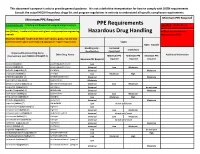
PPE Requirements Hazardous Drug Handling
This document’s purpose is only to provide general guidance. It is not a definitive interpretation for how to comply with DOSH requirements. Consult the actual NIOSH hazardous drugs list and program regulations in entirety to understand all specific compliance requirements. Minimum PPE Required Minimum PPE Required Universal (Green) - handling and disposed of using normal precautions. PPE Requirements High (Red) - double gloves, gown, eye and face protection in Low (Yellow) - handle at all times with gloves and appropriate engineering Hazardous Drug Handling addition to any necessary controls. engineering controls. Moderate (Orange) -handle at all times with gloves, gown, eye and face protection (with splash potential) and appropirate engineering controls. Tablet Open Capsule Handling only - Contained Crush/Split No alteration Crush/Split Dispensed/Common Drug Name Other Drug Name Additional Information (Formulation) and (NIOSH CATEGORY #) Minimum PPE Minimum PPE Minimum PPE Minimum PPE Required required required required abacavir (susp) (2) ziagen/epzicom/trizivir Low abacavir (tablet) (2) ziagen/epzicom/trizivir Universal Low Moderate acitretin (capsule) (3) soriatane Universal Moderate anastrazole (tablet) (1) arimidex Low Moderate High android (capsule) (3) methyltestosterone Universal Moderate apomorphine (inj sq) (2) apomorphine Moderate arthotec/cytotec (tablet) (3) diclofenac/misoprostol Universal Low Moderate astagraf XL (capsule) (2) tacrolimus Universal do not open avordart (capsule) (3) dutasteride Universal Moderate azathioprine -

Sexual Disorders and Gender Identity Disorder
CHAPTER :13 Sexual Disorders and Gender Identity Disorder TOPIC OVERVIEW Sexual Dysfunctions Disorders of Desire Disorders of Excitement Disorders of Orgasm Disorders of Sexual Pain Treatments for Sexual Dysfunctions What are the General Features of Sex Therapy? What Techniques Are Applied to Particular Dysfunctions? What Are the Current Trends in Sex Therapy? Paraphilias Fetishism Transvestic Fetishism Exhibitionism Voyeurism Frotteurism Pedophilia Sexual Masochism Sexual Sadism A Word of Caution Gender Identity Disorder Putting It Together: A Private Topic Draws Public Attention 177 178 CHAPTER 13 LECTURE OUTLINE I. SEXUAL DISORDERS AND GENDER-IDENTITY DISORDER A. Sexual behavior is a major focus of both our private thoughts and public discussions B. Experts recognize two general categories of sexual disorders: 1. Sexual dysfunctions—problems with sexual responses 2. Paraphilias—repeated and intense sexual urges and fantasies to socially inappropri- ate objects or situations C. In addition to the sexual disorders, DSM includes a diagnosis called gender identity dis- order, a sex-related pattern in which people feel that they have been assigned to the wrong sex D. Relatively little is known about racial and other cultural differences in sexuality 1. Sex therapists and sex researchers have only recently begun to attend systematically to the importance of culture and race II. SEXUAL DYSFUNCTIONS A. Sexual dysfunctions are disorders in which people cannot respond normally in key areas of sexual functioning 1. As many as 31 percent of men and 43 percent of women in the United States suffer from such a dysfunction during their lives 2. Sexual dysfunctions typically are very distressing and often lead to sexual frustra- tion, guilt, loss of self-esteem, and interpersonal problems 3. -
Steroids 78 (2013) 44–52
Steroids 78 (2013) 44–52 Contents lists available at SciVerse ScienceDirect Steroids journal homepage: www.elsevier.com/locate/steroids Alternative long-term markers for the detection of methyltestosterone misuse ⇑ C. Gómez a,b, O.J. Pozo a, J. Marcos a,b, J. Segura a,b, R. Ventura a,b, a Bioanalysis Research Group, IMIM-Hospital del Mar, Barcelona, Spain b Departament de Ciències Experimentals i de la Salut, Universitat Pompeu Fabra, Barcelona, Spain article info abstract Article history: Methyltestosterone (MT) is one of the most frequently detected anabolic androgenic steroids in doping Received 21 May 2012 control analysis. MT misuse is commonly detected by the identification of its two main metabolites Received in revised form 28 September excreted as glucuronide conjugates, 17a-methyl-5a-androstan-3a,17b-diol and 17a-methyl-5b-andro- 2012 stan-3a,17b-diol. The detection of these metabolites is normally performed by gas chromatography–mass Accepted 10 October 2012 spectrometry, after previous hydrolysis with b-glucuronidase enzymes, extraction and derivatization Available online 2 November 2012 steps. The aim of the present work was to study the sulphate fraction of MT and to evaluate their potential to improve the detection of the misuse of the drug in sports. MT was administered to healthy volunteers Keywords: and urine samples were collected up to 30 days after administration. After an extraction with ethyl ace- Methyltestosterone Sulphate tate, urine extracts were analysed by liquid chromatography tandem mass spectrometry using electro- Metabolism spray ionisation in negative mode by monitoring the transition m/z 385 to m/z 97. Three diol sulphate LC–MS/MS metabolites (S1, S2 and S3) were detected. -

Sexual Dysfunction and Related Factors in Pregnancy
Banaei et al. Systematic Reviews (2019) 8:161 https://doi.org/10.1186/s13643-019-1079-4 PROTOCOL Open Access Sexual dysfunction and related factors in pregnancy and postpartum: a systematic review and meta-analysis protocol Mojdeh Banaei1, Maryam Azizi2, Azam Moridi3, Sareh Dashti4, Asiyeh Pormehr Yabandeh3 and Nasibeh Roozbeh3* Abstract Background: Sexual dysfunction refers to a chain of psychiatric, individual, and couple’s experiences that manifests itself as a dysfunction in sexual desire, sexual arousal, orgasm, and pain during intercourse. The aim of this systematic review will be to assess the sexual dysfunction and determine the relevant factors to sexual dysfunction during pregnancy and postpartum. Methods and analysis: All observational studies, including descriptive, descriptive-analytic, case-control, and cohort studies published between 1990 and 2019, will be included in the study. Review articles, case studies, case reports, letter to editors, pilot studies, and editorial will be excluded from the study. The search will be conducted in the Cochrane Central Register, MEDLINE, Google Scholar, EMBASE, ProQuest, Scopus, WOS, and CINAHL databases. Eligible studies should assess at least one of the sexual dysfunction symptoms in pregnant women orinthefirstyearpostpartum.Quality assessment of studies will be performed by two authors independently based on the NOS checklist. This checklist is designed to assess the quality of observational studies. Data will be analyzed using Stata software ver. 11. Considering that the index investigated in the present study will be the level of sexual disorder, standard error will be calculated for each study using binomial distribution. The heterogeneity level will be investigated using Cochran’sQstatisticandI2 index in a chi-square test at a significance level of 1.1. -
Erectile Dysfunction and Premature Ejaculation
GUIDELINES ON MALE SEXUAL DYSFUNCTION: Erectile Dysfunction and Premature Ejaculation (Text update April 2014) K. Hatzimouratidis (chair), I. Eardley, F. Giuliano, D. Hatzichristou, I. Moncada, A. Salonia, Y. Vardi, E. Wespes Eur Urol 2006 May;49(5):806-15 Eur Urol 2010 May;57(5):804-14 Eur Urol 2012 Sep;62(3):543-52 ERECTILE DYSFUNCTION Definition, epidemiology and risk factors Erectile dysfunction (ED) is the persistent inability to attain and maintain an erection sufficient to permit satisfactory sex- ual performance. Although ED is a benign disorder, it affects physical and psychosocial health and has a significant impact on the quality of life (QoL) of sufferers and their partners. There is increasing evidence that ED can be an early mani- festation of coronary artery and peripheral vascular disease; thus, ED should not be regarded only as a QoL issue but also as a potential warning sign of cardiovascular disease includ- ing lack of exercise, obesity, smoking, hypercholesterolaemia, and the metabolic syndrome. The risk of ED may be reduced by modifying these risk factors, particularly taking exercise or losing weight. Another risk factor for ED is radical prostatec- tomy (RP) in any form (open, laparoscopic, or robotic) because of the risk of cavernosal nerve injury, poor oxygenation of the corpora cavernosa, and vascular insufficiency. 130 Male Sexual Dysfunction Diagnosis and work-up Basic work-up The basic work-up (minimal diagnostic evaluation) outlined in Fig. 1 must be performed in every patient with ED. Due to the potential cardiac risks associated with sexual activity, the three Princeton Consensus Conference stratified patients with ED wanting to initiate, or resume, sexual activity into three risk categories. -

Background Note on Human Rights Violations Against Intersex People Table of Contents 1 Introduction
Background Note on Human Rights Violations against Intersex People Table of Contents 1 Introduction .................................................................................................................. 2 2 Understanding intersex ................................................................................................... 2 2.1 Situating the rights of intersex people......................................................................... 4 2.2 Promoting the rights of intersex people....................................................................... 7 3 Forced and coercive medical interventions......................................................................... 8 4 Violence and infanticide ............................................................................................... 20 5 Stigma and discrimination in healthcare .......................................................................... 22 6 Legal recognition, including registration at birth ............................................................... 26 7 Discrimination and stigmatization .................................................................................. 29 8 Access to justice and remedies ....................................................................................... 32 9 Addressing root causes of human rights violations ............................................................ 35 10 Conclusions and way forward..................................................................................... 37 10.1 Conclusions -
Degradation of Doping-Relevant Steroids by Rh. Erythropolis
In: W Schänzer, H Geyer, A Gotzmann, U Mareck (eds.) Recent Advances In Doping Analysis (15). Sport und Buch Strauß - Köln 2007 J. Grosse1), C. Rautenberg1), L. Wassill2), D. Ganghofner2), D. Thieme3) Degradation of doping-relevant Steroids by Rh. Erythropolis 1) Institute of Doping Analysis and Sports Biochemistry, D-01731 Kreischa, Germany 2) Amplex Diagnostics GmbH, D-80337 Munich, Germany 3) Institute of Legal Medicine, D-80337 Munich, Germany Introduction Former studies have shown that steroids are potential substrates for microorganisms [1]. As an example, the degradation of testosterone induced by Rhodococcus erythropolis was observed. The formation of 4-androstene-3,17-dione, 1,4-androstadiene-3,17-dione (boldione) and 1,4-androstadiene-17β-hydroxy-3-one (boldenone) was confirmed [2]. Consequently a potential endogenous origin of boldenone and its metabolites has to be taken into consideration for the evaluation of routine doping control samples revealing the presence of these substances at low concentration level [3, 4]. This work presents results obtained from further studies related to the microbial conversion of steroid substrates being relevant in doping analysis. For this purpose incubation by Rh. erythropolis was applied to examine the influence of structural variations (A/B-ring structure, substitution at position 17, conjugation) on the initial steps of the degradation pathway. Experimental Rh. erythropolis culture grown on agar plate “Mueller-Hinton” was utilised. Altogether 16 substrates (see table 1) were examined in this study. The experiments were carried out in a blank urine of a male infant spiked with 1 µg/mL of the selected substrate. Two aliquots of each sample were prepared, one control without addition and one „active“ sample with addition of bacteria solution, and incubated at 30°C for 24 hours. -

Determination of 17 Hormone Residues in Milk by Ultra-High-Performance Liquid Chromatography and Triple Quadrupole Mass Spectrom
No. LCMSMS-065E Liquid Chromatography Mass Spectrometry Determination of 17 Hormone Residues in Milk by Ultra-High-Performance Liquid Chromatography and Triple Quadrupole No. LCMSMS-65E Mass Spectrometry This application news presents a method for the determination of 17 hormone residues in milk using Shimadzu Ultra-High-Performance Liquid Chromatograph (UHPLC) LC-30A and Triple Quadrupole Mass Spectrometer LCMS- 8040. After sample pretreatment, the compounds in the milk matrix were separated using UPLC LC-30A and analyzed via Triple Quadrupole Mass Spectrometer LCMS-8040. All 17 hormones displayed good linearity within their respective concentration range, with correlation coefficient in the range of 0.9974 and 0.9999. The RSD% of retention time and peak area of 17 hormones at the low-, mid- and high- concentrations were in the range of 0.0102-0.161% and 0.563-6.55% respectively, indicating good instrument precision. Method validation was conducted and the matrix spike recovery of milk ranged between 61.00-110.9%. The limit of quantitation was 0.14-0.975 g/kg, and it meets the requirement for detection of hormones in milk. Keywords: Hormones; Milk; Solid phase extraction; Ultra performance liquid chromatograph; Triple quadrupole mass spectrometry ■ Introduction Since 2008’s melamine-tainted milk scandal, the With reference to China’s national standard GB/T adulteration of milk powder has become a major 21981-2008 "Hormone Multi-Residue Detection food safety concern. In recent years, another case of Method for Animal-derived Food - LC-MS Method", dairy product safety is suspected to cause "infant a method utilizing solid phase extraction, ultra- sexual precocity" (also known as precocious puberty) performance liquid chromatography and triple and has become another major issue challenging the quadrupole mass spectrometry was developed for dairy industry in China. -

Delayed Ejaculation & Anorgasmia
Delayed ejaculation & anorgasmia EMMANUELE A. JANNINI Chair of Endocrinology & Sexual Medicine Tor Vergata University of Rome, Italy It Soc Androl & Sex Med – President-elect Taxonomy of ejaculatory disorders Epidemiology of ejaculatory disorders 25 a) timing 20 – PREMATURE EJACULATION 15 – DELAYED EJACULATION 10 Percentage 5 b) modality 0 E N IA R PE DE IO M AS ‐ RETROGRADE EJACULATION LAT G U R O JAC ‐ ANEJACULATION (impotentia ejaculationis) E AN AN Taxonomy of ejaculatory disorders • EMISSION PHASE DISORDERS: – Retrograde ejaculation • EJACULATION PHASE DISORDERS: – Premature ejaculation – Deficient ejaculation: • Delayed ejaculation • Anejaculation • ORGASM DISORDERS: – Anorgasmia – Postorgasmic illness syndrome Standard Operating Procedures (SOP) in Diagnosis and Treatment of Delayed Ejaculation/Anejaculation ISSM Standards Committee Meeting June 23-25, 2010 Hotel Agneshof Nürnberg, Germany Pierre Assalian Canada Emmanuele A. Jannini Italy Chris G McMahon (Chairman) Australia David Rowland USA Marcel Waldinger (Chairman) The Netherlands DELAYED EJACULATION Delayed ejaculation • Much less frequent than PE • A rare reason for medical help seeking • Underdiagnosed • Undertreated Is DE a disease? • girls are happy… …where is the problem? …but girls are not happy… Why so poor science? • Low prevalence • Few studies • Classically considered A new psychogenic in nature • Classically treated with behavioral therapies challenge • Definition(s) lacking • Etiologies largely unknown for • Pathogenesis obscure • Lack of awareness and Sexual acknowledgements -
Neurogenic Erectile Dysfunction. Where Do We Stand?
medicines Review Neurogenic Erectile Dysfunction. Where Do We Stand? Charalampos Thomas 1,* and Charalampos Konstantinidis 2 1 Urology Department, General Hospital of Corinth, 20131 Corinth, Greece 2 Urology & Neurourology Unit, National Rehabilitation Center, Ilion, 13122 Athens, Greece; konstantinidischaralampos@yahoo.com * Correspondence: babisthomas@yahoo.gr Abstract: Erectile Dysfunction (ED) is the persistent inability to attain and maintain an erection sufficient to permit satisfactory sexual performance, causing tremendous effects on both patients and their partners. The pathophysiology of ED remains a labyrinth. The underlying mechanisms of ED may be vasculogenic, neurogenic, anatomical, hormonal, drug-induced and/or psychogenic. Neurogenic ED consists of a large cohort of ED, accounting for about 10% to 19% of all cases. Its diversity does not allow an in-depth clarification of all the underlying mechanisms nor a “one size fits all” therapeutical approach. In this review, we focus on neurogenic causes of ED, trying to elucidate the mechanisms that lie beneath it and how we manage these patients. Keywords: erectile dysfunction (ED); neurogenic; sexual dysfunction (SD); phosphodiesterase type-5 inhibitors (PDE5I); spinal cord injury (SCI); multiple sclerosis (MS) 1. Introduction Erectile dysfunction (ED) is defined as the persistent inability to attain and maintain an erection sufficient to permit satisfactory sexual performance [1]. Besides the obvious, it has tremendous effects on the patient’s psychosocial health, and it affects not only their quality of life but the lives of their partners [2]. Citation: Thomas, C.; Konstantinidis, The pathophysiology of ED remains a labyrinth since many pathways can co-exist, C. Neurogenic Erectile Dysfunction. thus contributing negatively. Where Do We Stand? Medicines 2021, Traditionally ED was divided into three large cohorts, organic, psychogenic and of 8, 3. -

Download Article
Advances in Social Science, Education and Humanities Research, volume 356 2nd International Conference on Contemporary Education, Social Sciences and Ecological Studies (CESSES 2019) A New Exploration of the Combined Treatment of Symptoms and Social Work Psychology in Male Sexual Addiction Patients Chengchung Tsai Minyi Li School of Management School of Social Sciences Putian University University of Macau Putian, China Macau, China Abstract—Post-Orgasmic Illness Syndrome (POIS) was progesterone, low cholesterol, low dehydroepiandrosterone, first discovered by Professor Waldinger and Schweitzerl in low cortisol, high prolactin or hypothyroidism. Some cases 2002. After publishing several papers such as "POIS Records encountered by the author team indicate that when the of Emotional, Psychological and Behavioral Changes in Male mother was pregnant in the early years, she or her family had Patients" and "POIS Patients", "Clinical Observation Records smoking habits. Some mothers had long-term use of of Psychological and Behavioral Changes" and "POIS Male contraceptives or were used to eating animal internal organs. Disease Self-reports and Treatment Methods", in this paper, Even some cases were diagnosed as male gynecomastia. the author will cite the views of Chinese medicine practitioners on the treatment of POIS, and hope to provide more practical treatment methods and references for future research. TABLE I. SEVEN GROUPS OF POIS SYMPTOMS FOUND BY WALDINGER AND OTHER MEDICAL TEAMS Keywords—POIS; male; ejaculation; mental state; disorder; Body parts Various local sensations emotion Behavioral symptoms extreme fatigue, exhaustion, palpitations, forgetting words, being too lazy to talk, incoherent, inattention, irritability, I. INTRODUCTION photophobia, depression The main research objects of this paper are journalists, Flu symptoms fever, cold, hot, sweaty, trembling writers and other text workers, as well as creative designers Head symptoms head dizziness, groggy, confused and heavy who take creativity as the selling point as the research object.