Krstarenje Dunavom Kroz Istoriju
Total Page:16
File Type:pdf, Size:1020Kb
Load more
Recommended publications
-
Republic of Serbia Ipard Programme for 2014-2020
EN ANNEX Ministry of Agriculture and Environmental Protection Republic of Serbia REPUBLIC OF SERBIA IPARD PROGRAMME FOR 2014-2020 27th June 2019 1 List of Abbreviations AI - Artificial Insemination APSFR - Areas with Potential Significant Flood Risk APV - The Autonomous Province of Vojvodina ASRoS - Agricultural Strategy of the Republic of Serbia AWU - Annual work unit CAO - Competent Accrediting Officer CAP - Common Agricultural Policy CARDS - Community Assistance for Reconstruction, Development and Stabilisation CAS - Country Assistance Strategy CBC - Cross border cooperation CEFTA - Central European Free Trade Agreement CGAP - Code of Good Agricultural Practices CHP - Combined Heat and Power CSF - Classical swine fever CSP - Country Strategy Paper DAP - Directorate for Agrarian Payment DNRL - Directorate for National Reference Laboratories DREPR - Danube River Enterprise Pollution Reduction DTD - Dunav-Tisa-Dunav Channel EAR - European Agency for Reconstruction EC - European Commission EEC - European Economic Community EU - European Union EUROP grid - Method of carcass classification F&V - Fruits and Vegetables FADN - Farm Accountancy Data Network FAO - Food and Agriculture Organization FAVS - Area of forest available for wood supply FOWL - Forest and other wooded land FVO - Food Veterinary Office FWA - Framework Agreement FWC - Framework Contract GAEC - Good agriculture and environmental condition GAP - Gross Agricultural Production GDP - Gross Domestic Product GEF - Global Environment Facility GEF - Global Environment Facility GES -

Rivers and Lakes in Serbia
NATIONAL TOURISM ORGANISATION OF SERBIA Čika Ljubina 8, 11000 Belgrade Phone: +381 11 6557 100 Rivers and Lakes Fax: +381 11 2626 767 E-mail: office@serbia.travel www.serbia.travel Tourist Information Centre and Souvenir Shop Tel : +381 11 6557 127 in Serbia E-mail: info@serbia.travel NATIONAL TOURISM ORGANISATION OF SERBIA www.serbia.travel Rivers and Lakes in Serbia PALIĆ LAKE BELA CRKVA LAKES LAKE OF BOR SILVER LAKE GAZIVODE LAKE VLASINA LAKE LAKES OF THE UVAC RIVER LIM RIVER DRINA RIVER SAVA RIVER ADA CIGANLIJA LAKE BELGRADE DANUBE RIVER TIMOK RIVER NIŠAVA RIVER IBAR RIVER WESTERN MORAVA RIVER SOUTHERN MORAVA RIVER GREAT MORAVA RIVER TISA RIVER MORE RIVERS AND LAKES International Border Monastery Provincial Border UNESKO Cultural Site Settlement Signs Castle, Medieval Town Archeological Site Rivers and Lakes Roman Emperors Route Highway (pay toll, enterance) Spa, Air Spa One-lane Highway Rural tourism Regional Road Rafting International Border Crossing Fishing Area Airport Camp Tourist Port Bicycle trail “A river could be an ocean, if it doubled up – it has in itself so much enormous, eternal water ...” Miroslav Antić - serbian poet Photo-poetry on the rivers and lakes of Serbia There is a poetic image saying that the wide lowland of The famous Viennese waltz The Blue Danube by Johann Vojvodina in the north of Serbia reminds us of a sea during Baptist Strauss, Jr. is known to have been composed exactly the night, under the splendor of the stars. There really used to on his journey down the Danube, the river that connects 10 be the Pannonian Sea, but had flowed away a long time ago. -

Sustainable Tourism for Rural Lovren, Vojislavka Šatrić and Jelena Development” (2010 – 2012) Beronja Provided Their Contributions Both in English and Serbian
Environment and sustainable rural tourism in four regions of Serbia Southern Banat.Central Serbia.Lower Danube.Eastern Serbia - as they are and as they could be - November 2012, Belgrade, Serbia Impressum PUBLISHER: TRANSLATORS: Th e United Nations Environment Marko Stanojević, Jasna Berić and Jelena Programme (UNEP) and Young Pejić; Researchers of Serbia, under the auspices Prof. Branko Karadžić, Prof. Milica of the joint United Nations programme Jovanović Popović, Violeta Orlović “Sustainable Tourism for Rural Lovren, Vojislavka Šatrić and Jelena Development” (2010 – 2012) Beronja provided their contributions both in English and Serbian. EDITORS: Jelena Beronja, David Owen, PROOFREADING: Aleksandar Petrović, Tanja Petrović Charles Robertson, Clare Ann Zubac, Christine Prickett CONTRIBUTING AUTHORS: Prof. Branko Karadžić PhD, GRAPHIC PREPARATION, Prof. Milica Jovanović Popović PhD, LAYOUT and DESIGN: Ass. Prof. Vladimir Stojanović PhD, Olivera Petrović Ass. Prof. Dejan Đorđević PhD, Aleksandar Petrović MSc, COVER ILLUSTRATION: David Owen MSc, Manja Lekić Dušica Trnavac, Ivan Svetozarević MA, PRINTED BY: Jelena Beronja, AVANTGUARDE, Beograd Milka Gvozdenović, Sanja Filipović PhD, Date: November 2012. Tanja Petrović, Mesto: Belgrade, Serbia Violeta Orlović Lovren PhD, Vojislavka Šatrić. Th e designations employed and the presentation of the material in this publication do not imply the expression of any opinion whatsoever on the part of the United Nations Environment Programme concerning the legal status of any country, territory, city or area or of its authorities, or concerning delimitation of its frontiers or boundaries. Moreover, the views expressed do not necessarily represent the decision or the stated policy of the United Nations, nor does citing of trade names or commercial processes constitute endorsement. Acknowledgments Th is publication was developed under the auspices of the United Nations’ joint programme “Sustainable Tourism for Rural Development“, fi nanced by the Kingdom of Spain through the Millennium Development Goals Achievement Fund (MDGF). -

Diversity of Alien Macroinvertebrate Species in Serbian Waters
water Article Diversity of Alien Macroinvertebrate Species in Serbian Waters Katarina Zori´c* , Ana Atanackovi´c,Jelena Tomovi´c,Božica Vasiljevi´c,Bojana Tubi´c and Momir Paunovi´c Department for Hydroecology and Water Protection, Institute for Biological Research “Siniša Stankovi´c”—NationalInstitute of Republic of Serbia, University of Belgrade, Bulevar despota Stefana 142, 11060 Belgrade, Serbia; adjordjevic@ibiss.bg.ac.rs (A.A.); jelena.tomovic@ibiss.bg.ac.rs (J.T.); bozica@ibiss.bg.ac.rs (B.V.); bojana@ibiss.bg.ac.rs (B.T.); mpaunovi@ibiss.bg.ac.rs (M.P.) * Correspondence: katarinas@ibiss.bg.ac.rs Received: 29 September 2020; Accepted: 7 December 2020; Published: 15 December 2020 Abstract: This article provides the first comprehensive list of alien macroinvertebrate species registered and/or established in aquatic ecosystems in Serbia as a potential threat to native biodiversity. The list comprised field investigations, articles, grey literature, and unpublished data. Twenty-nine species of macroinvertebrates have been recorded since 1942, with a domination of the Ponto-Caspian faunistic elements. The majority of recorded species have broad distribution and are naturalized in the waters of Serbia, while occasional or single findings of seven taxa indicate that these species have failed to form populations. Presented results clearly show that the Danube is the main corridor for the introduction and spread of non-native species into Serbia. Keywords: Serbia; inland waters; allochthonous species; introduction 1. Introduction The Water Framework Directive (WFD) [1] represents key regulation and one of the most important documents in the European Union water legislation since it was adopted in 2000. -
Flash Floods
Emergency Plan of Action (EPoA) Serbia: Flash floods DREF Operation Operation n° MDRRS010 Glide n° FF-2014-000129-SRB Date of issue: 24 September2014 Date of disaster: 16 September 2014 Operation manager (responsible for this EPoA): Point of contact Djula Losonc Vesna Milenovic Disaster Management Coordinator, Secretary General, Red Cross of Serbia Red Cross of Serbia Email djula@redcross.org.rs Email secretary@redcross.org.rs Alberto Monguzzi IFRC Europe Zone Disaster Management Coordinator Email alberto.monguzzi@ifrc.org Operation start date: 15 September 2014. Expected timeframe: 4 months Overall operation budget: 152,646 CHF Number of people affected: 7,000 Number of people to be assisted: 3,100 (1,200 families) Host National Society presence (n° of volunteers, staff, branches): Red Cross of Serbia Number of engaged personnel in this operation: 100 staff and volunteers Other partner organizations actively involved in the operation: Emergency Management of the Ministry of Interior, members of the Municipal Emergency Response headquarters (municipal emergency services) A. Situation analysis Description of the disaster Massive rainfalls in the eastern parts of Serbia have caused major problems in the municipalities of Kladovo, Majdanpek and Negotin, where a state of emergency was declared on 16 September 2014, with the effort to save people`s lives and to reach those villages that are cut off. The floods have caused one death, at least three people are reported as missing, and some 400 people have been evacuated by police and civil protection rescue teams with vessels and helicopters and are temporarily sheltered in Kladovo. Landslides divided the village of Tekija into two parts, and rescuers are trying to break through the layers of soil with bulldozers. -
Influence of the Copper Mining Activities in Majdanpek on Danube
INFLUENCE OF THE COPPER MINING ACTIVITIES IN MAJDANPEK ON DANUBE RIVER Milan Trumić, Grozdanka Bogdanović, Maja Trumić, Bogdana Vujić, Zaklina Tasić, Ljubisa Andrić, Boban Spalović quality in significant cross-border nature reservations Djerdap / Iron Gate national park and Carska Bara special nature reserve, with population awareness raising works financed thru the Interreg IPA CBC Romania Serbia Programme 2014 - 2020 Project acronym: AEPS Project eMS code: RORS-462 Project webpage: http://aeps.upt.ro TIMISOARA, 2021 ISBN 978-973-0-33596-5 Contents Acknowledgment .................................................................................................................................... 2 1. National Park Đerdap ...................................................................................................................... 3 1.1. Introduction ............................................................................................................................ 3 1.2. Description of the Pek river basin ........................................................................................... 6 1.3. Mali Pek river basin ................................................................................................................. 7 1.4. Veliki Pek river basin ............................................................................................................... 7 1.5. The Porečka River ................................................................................................................... 8 2. Pollutants -

Подкласс Exogenia Collin, 1912
Research Article ISSN 2336-9744 (online) | ISSN 2337-0173 (print) The journal is available on line at www.ecol-mne.com Contribution to the knowledge of distribution of Colubrid snakes in Serbia LJILJANA TOMOVIĆ1,2,4*, ALEKSANDAR UROŠEVIĆ2,4, RASTKO AJTIĆ3,4, IMRE KRIZMANIĆ1, ALEKSANDAR SIMOVIĆ4, NENAD LABUS5, DANKO JOVIĆ6, MILIVOJ KRSTIĆ4, SONJA ĐORĐEVIĆ1,4, MARKO ANĐELKOVIĆ2,4, ANA GOLUBOVIĆ1,4 & GEORG DŽUKIĆ2 1 University of Belgrade, Faculty of Biology, Studentski trg 16, 11000 Belgrade, Serbia 2 University of Belgrade, Institute for Biological Research “Siniša Stanković”, Bulevar despota Stefana 142, 11000 Belgrade, Serbia 3 Institute for Nature Conservation of Serbia, Dr Ivana Ribara 91, 11070 Belgrade, Serbia 4 Serbian Herpetological Society “Milutin Radovanović”, Bulevar despota Stefana 142, 11000 Belgrade, Serbia 5 University of Priština, Faculty of Science and Mathematics, Biology Department, Lole Ribara 29, 38220 Kosovska Mitrovica, Serbia 6 Institute for Nature Conservation of Serbia, Vožda Karađorđa 14, 18000 Niš, Serbia *Corresponding author: E-mail: lili@bio.bg.ac.rs Received 28 March 2015 │ Accepted 31 March 2015 │ Published online 6 April 2015. Abstract Detailed distribution pattern of colubrid snakes in Serbia is still inadequately described, despite the long historical study. In this paper, we provide accurate distribution of seven species, with previously published and newly accumulated faunistic records compiled. Comparative analysis of faunas among all Balkan countries showed that Serbian colubrid fauna is among the most distinct (together with faunas of Slovenia and Romania), due to small number of species. Zoogeographic analysis showed high chorotype diversity of Serbian colubrids: seven species belong to six chorotypes. South-eastern Serbia (Pčinja River valley) is characterized by the presence of all colubrid species inhabiting our country, and deserves the highest conservation status at the national level. -
Migration and Population Origin of Negotin Municipality at the Beginning of the 20Th Century
Migration and Population Origin of Negotin Municipality at the Beginning of the 20th Century Review article UDC 314.7(497.11 Negotin)„19” Received: 3. July 2019; doi: 10.5937/zrgfub1902069A Received in revised form: 10. July 2019; Accepted: 20. July 2019; Available online: 20. July 2019 MIGRATION AND POPULATION ORIGIN OF NEGOTIN MUNICIPALITY AT THE BEGINNING OF THE 20TH CENTURY Zlatko Apanović 1 Abstract: The area of the municipality of Negotin, which belonged to the historically important area of Krajina, represented the polygon of intersection of migration flows of different intensity and directions. Studying the origins of the population enables us to understand the currently ethnic division of settlements created by the migrations and ethnic processes that influence the settlements which are the subject of this paper. This article aims to describe the migration flows that determined the origin of the population of the municipality of Negotin and the ethnic distribution of settlements. The results of anthropogeographic surveys conducted during the second and third decades of the 20th century, as well as ethnological research from the second half of the 20th century, can rightly be interpreted as supporting the claim that the origin of the population and the ethnic structure of settlements of the municipality of Negotin are largely the result of historical migration trends. Of the greatest importance for the ethnic distribution of population are its two migration flows. The first and the oldest migration flow from Kosovo and Metohija and stage areas for that migrant lineages (families who have a mutual ancestor) and the second and the most numerous migration flow is from Wallachia, in which the participating lineages of Serbian and Vlach origin which created conditions for further deepening of the differences between Serbian and Vlach settlements. -

Serbian Wine Routes
Serbian wine routes Вина са песка Wines from Sands Пут вина - Палић Palić Wine Route History of the Region’s Wines The entire Palić region lies on sandy terrain left tiles. These tanks have a total capacity of by the prehistoric Pannonian Sea. That's why between 33,000 and 67,000 liters. Locals say wines from this area are commonly referred to as that the biggest tank, which is as large as a small sand wines. The sandy soil, a moderate continen- dance hall, was used for parties hosted by Count tal climate and top grape varieties yield very Lederer, the cellar’s founder. appealing wines. The Subotica-Horgoš area has a winemaking tradition that goes back well over The Palić Cellar, founded in 1896, was built where 2,000 years. an agricultural school once stood. It preserved the ancient winemaking heritage of the In the Bačka region winemaking flourished after Subotica-Horgoš sandy heath. Today the WOW the phylloxera epidemic destroyed much of Winery continues the tradition. Europe’s viticulture.. At this time three wine cellars were founded in the vicinity of Palić , Čoka The Muscat Croquant grapevine variety was and in Biserno Ostrvo near Novi Bečej. These planted by count Lipot Rohonczi in Biserno cellars remain the backbone of the region's Ostrvo, where he built a small castle with a wine viticulture. cellar that still exists . The wine made from those grapes was sold in Budapest, London and other The Čoka Cellar, established in 1903, is among the European markets. rare and magnificent monuments of a great wine tradition. -
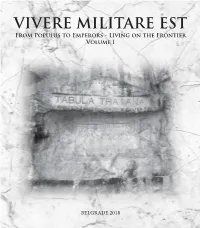
VIVERE MILITARE EST from Populus to Emperors - Living on the Frontier Volume I
VIVERE MILITARE EST From Populus to Emperors - Living on the Frontier Volume I BELGRADE 2018 VIVERE MILITARE EST From Populus to Emperors - Living on the Frontier INSTITUTE OF ARCHAEOLOGY MONOGRAPHIES No. 68/1 VIVERE MILITARE EST From Populus to Emperors - Living on the Frontier VOM LU E I Belgrade 2018 PUBLISHER PROOFREADING Institute of Archaeology Dave Calcutt Kneza Mihaila 35/IV Ranko Bugarski 11000 Belgrade Jelena Vitezović http://www.ai.ac.rs Tamara Rodwell-Jovanović institut@ai.ac.rs Rajka Marinković Tel. +381 11 2637-191 GRAPHIC DESIGN MONOGRAPHIES 68/1 Nemanja Mrđić EDITOR IN CHIEF PRINTED BY Miomir Korać DigitalArt Beograd Institute of Archaeology, Belgrade PRINTED IN EDITORS 500 copies Snežana Golubović Institute of Archaeology, Belgrade COVER PAGE Nemanja Mrđić Tabula Traiana, Iron Gate Institute of Archaeology, Belgrade REVIEWERS EDITORiaL BOARD Diliana Angelova, Departments of History of Art Bojan Ðurić, University of Ljubljana, Faculty and History Berkeley University, Berkeley; Vesna of Arts, Ljubljana; Cristian Gazdac, Faculty of Dimitrijević, Faculty of Philosophy, University History and Philosophy University of Cluj-Napoca of Belgrade, Belgrade; Erik Hrnčiarik, Faculty of and Visiting Fellow at the University of Oxford; Philosophy and Arts, Trnava University, Trnava; Gordana Jeremić, Institute of Archaeology, Belgrade; Kristina Jelinčić Vučković, Institute of Archaeology, Miomir Korać, Institute of Archaeology, Belgrade; Zagreb; Mario Novak, Institute for Anthropological Ioan Piso, Faculty of History and Philosophy Research, -

The Lack of Interpretation at Fortresses Along the Danube in Serbia
Geographica Timisiensis, vol. 19, nr. 2, 2010 (pp. 185-196) ● THE LACK OF INTERPRETATION AT FORTRESSES ALONG THE DANUBE IN SERBIA Aleksandra STANOJLOVIC, Andjelija IVKOV-DZIGURSKI, Aleksandra DRAGIN University of Novi Sad Abstract. One of the rules in tourism is that visitor demand depends on and is based on attractions. Talking about attraction interpretation necessitates is considering why a visitor at any time would like to visit a place, event or a site. Tourism in heritage sites is a relatively young and immature activity in Serbia, and the interpretation on these sites are lacking. This discussion examines the potential benefits of linking interpretation and heritage sites. Many heritage sites only recently have begun to pay serious attention to the implications of increasing visitor numbers and, that the level of tourism management and interpretation fall short of that appropriate for such important sites. Based on the literature and an exploratory study this paper argues that interpretation is essential to the management of such sites. The research focuses upon a case of Serbian fortresses, namely the observation of several well preserved fortresses along Danube river. It examines the activities and possibilities for visitation and interpretation on these fortresses, as it is considered that these fortresses have the great potential for tourism development. Rezumat. Lipsa de interpretare la cetăŃile din lungul Dunării din Serbia. Una dintre reguli în turism este aceea că cererea vizitatorilor depinde şi se bazează pe atracŃii. Interpretarea acestei reguli are în vedere raspunsul la întrebarea de ce un vizitator doreşte să viziteze intr-un anume moment, un anumit loc. -

Master Plan Donje Podunavlje
SADRŽAJ I ZADACI .............................................................................................................................................. 1 II PROCEDURE ..................................................................................................................................... 2 III SITUACIONA ANALIZA ..................................................................................................................... 5 1. Analiza prostornih karakteristika područja i društveno-ekonomskog okruženja ........................ 5 1.1. Republika Srbija............................................................................................................... 5 1.1.1. Geografske karakteristike Republike Srbije ........................................................... 5 1.1.2. Ekonomski razvoj Republike Srbije ........................................................................ 6 1.1.2.1. Osnovni strateški pravci i prioriteti privrednog razvoja Srbije ............................ 6 1.1.2.2. Makroekonomske projekcije razvoja Srbije do 2012. godine............................. 8 1.1.2.3. Mehanizmi i politike za ostvarivanje ciljeva nacionalne strategije ..................... 9 1.2. Turističko područje „Donje Podunavlje“ ......................................................................... 12 1.2.1. Geografske karakteristike .................................................................................... 12 1.2.2. Lokacija i društveno-ekonomski razvoj................................................................