Polycystic Ovary Syndrome: a Review for Dermatologists
Total Page:16
File Type:pdf, Size:1020Kb
Load more
Recommended publications
-

Prnu-BICALUTAMIDE
PRODUCT MONOGRAPH PrNU-BICALUTAMIDE Bicalutamide Tablets, 50 mg Non-Steroidal Antiandrogen NU-PHARM INC. DATE OF PREPARATION: 50 Mural Street, Units 1 & 2 October 16, 2009 Richmond Hill, Ontario L4B 1E4 Control#: 133521 Page 1 of 27 Table of Contents PART I: HEALTH PROFESSIONAL INFORMATION....................................................... 3 SUMMARY PRODUCT INFORMATION ............................................................................. 3 INDICATIONS AND CLINICAL USE ................................................................................... 3 CONTRAINDICATIONS ........................................................................................................ 3 WARNINGS AND PRECAUTIONS....................................................................................... 4 ADVERSE REACTIONS......................................................................................................... 5 DRUG INTERACTIONS ......................................................................................................... 9 DOSAGE AND ADMINISTRATION ................................................................................... 10 OVERDOSAGE...................................................................................................................... 10 ACTION AND CLINICAL PHARMACOLOGY.................................................................. 10 STORAGE AND STABILITY............................................................................................... 11 DOSAGE FORMS, COMPOSITION AND PACKAGING -
Symptom Management in the Last Days of Life This Is About Managing Symptoms in the Last Days of Life Where the Dying Process Has Set In
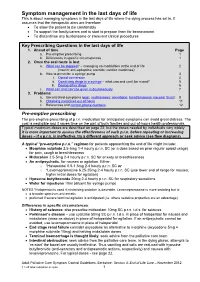
Symptom management in the last days of life This is about managing symptoms in the last days of life where the dying process has set in. It assumes that the therapeutic aims are therefore: To allow the patient to die comfortably To support the family/carers and to start to prepare them for bereavement To discontinue any burdensome or irrelevant clinical procedures Key Prescribing Questions in the last days of life 1. Ahead of time Page a. Pre-emptive prescribing 1 b. Differences in specific circumstances 1 2. Once the oral route is lost a. What can be stopped? – managing co-morbidities at the end of life 2 (insulin; anti-epileptics; steroids; cardiac medicines) b. How to prescribe a syringe pump 3 i. Opioid conversion 4 ii. Combining drugs in a syringe – what can and can’t be mixed? 5 iii. Dosing other drugs 6 c. What can and can’t be given subcutaneously 7 3. Problems a. Uncontrolled symptoms (pain; restlessness; secretions; breathlessness; nausea; thirst) 8 b. Obtaining medicines out of hours 11 c. References and contact phone numbers 12 Pre-emptive prescribing The pre-emptive prescribing of p.r.n. medication for anticipated symptoms can avoid great distress. The cost is negligible and it saves time on the part of both families and out-of-hours health professionals. Typical maximum doses are described on page 22, but the doses needed by individuals vary widely: it is more important to assess the effectiveness of each p.r.n. before repeating or increasing doses – if a p.r.n. is ineffective, try a different approach or seek advice (see flow diagrams) A typical “pre-emptive p.r.n.” regimen for patients approaching the end of life might include: Morphine sulphate 2.5-5mg 1-4 hourly p.r.n. -

Context-Specific Efficacy of Apalutamide Therapy in Preclinical
cancers Article Context-Specific Efficacy of Apalutamide Therapy in Preclinical Models of Pten-Deficient Prostate Cancer Marco A. De Velasco 1,2,* , Yurie Kura 1,2, Naomi Ando 1, Noriko Sako 1, Eri Banno 1, Kazutoshi Fujita 1, Masahiro Nozawa 1, Kazuhiro Yoshimura 1 , Kazuko Sakai 2, Kazuhiro Yoshikawa 3, Kazuto Nishio 2 and Hirotsugu Uemura 1,* 1 Department of Urology Kindai, University Faculty of Medicine, Osaka-Sayama 589-8511, Japan; y.kurakindai@med.kindai.ac.jp (Y.K.); ulo_norika@yahoo.co.jp (N.A.); miminoki216@gmail.com (N.S.); ebanno@med.kindai.ac.jp (E.B.); fujita@uro.med.osaka-u.ac.jp (K.F.); nozawa06@med.kindai.ac.jp (M.N.); yoshimur@med.kindai.ac.jp (K.Y.) 2 Department of Genome Biology, Kindai University Faculty of Medicine, Osaka-Sayama 589-8511, Japan; kasakai@med.kindai.ac.jp (K.S.); knishio@med.kindai.ac.jp (K.N.) 3 Research Creation Support Center, Aichi Medical University, Nagakute 480-1195, Japan; yoshikaw@aichi-med-u.ac.jp * Correspondence: mdev@med.kindai.ac.jp (M.A.D.V.); huemura@med.kindai.ac.jp (H.U.) Simple Summary: Next-generation antiandrogens have transformed the therapeutic landscape for castration-resistant prostate cancer. Their utility in other indications, such as high-risk castration- sensitive cancers and as combination therapy, are being investigated. Our aim was to profile the in vivo antitumor activity of apalutamide in phenotypically distinct mouse models of Pten-deficient castration-naïve and castration-resistant prostate cancer, using both early- and late-stage disease Citation: De Velasco, M.A.; Kura, Y.; models, and to profile the molecular responses. -

Future Directions for Intrathecal Pain Management 93
NEUROMODULATION: TECHNOLOGY AT THE NEURAL INTERFACE Volume 11 • Number 2 • 2008 http://www.blackwell-synergy.com/loi/ner ORIGINAL ARTICLE FBlackwell uturePublishing Inc Directions for Intrathecal Pain Management: A Review and Update From the Interdisciplinary Polyanalgesic Consensus Conference 2007 Timothy Deer, MD* • Elliot S. Krames, MD† • Samuel Hassenbusch, MD, PhD‡ • Allen Burton, MD§ • David Caraway, MD¶ • Stuart Dupen, MD** • James Eisenach, MD†† • Michael Erdek, MD‡‡ • Eric Grigsby, MD§§ • Phillip Kim, MD¶¶ • Robert Levy, MD, PhD*** • Gladstone McDowell, MD††† • Nagy Mekhail, MD‡‡‡ • Sunil Panchal, MD§§§ • Joshua Prager, MD¶¶¶ • Richard Rauck, MD**** • Michael Saulino, MD†††† •Todd Sitzman, MD‡‡‡‡ • Peter Staats, MD§§§§ • Michael Stanton-Hicks, MD¶¶¶¶ • Lisa Stearns, MD***** • K. Dean Willis, MD††††† • William Witt, MD‡‡‡‡‡ • Kenneth Follett, MD, PhD§§§§§ • Mark Huntoon, MD¶¶¶¶¶ • Leong Liem, MD****** • James Rathmell, MD†††††† • Mark Wallace, MD‡‡‡‡‡‡ • Eric Buchser, MD§§§§§§ • Michael Cousins, MD¶¶¶¶¶¶ • Ann Ver Donck, MD******* *Charleston, WV; †San Francisco, CA; ‡Houston, TX; §Houston, TX; ¶Huntington, WV; **Bellevue, WA; ††Winston Salem, NC; ‡‡Baltimore, MD; §§Napa, CA; ¶¶Wilmington, DE; ***Chicago, IL; †††Columbus, OH; ‡‡‡Cleveland, OH; §§§Tampa, FL; ¶¶¶Los Angeles, CA; ****Winston Salem, NC; ††††Elkings Park, PA; ‡‡‡‡Hattiesburg, MS; §§§§Colts Neck, NJ; ¶¶¶¶Cleveland, OH; *****Scottsdale, AZ; †††††Huntsville, AL; ‡‡‡‡‡Lexington, KY; §§§§§Iowa City, IA; ¶¶¶¶¶Rochester, NY; ******Nieuwegein, The Netherlands; ††††††Boston, MA; ‡‡‡‡‡‡La Jolla, CA; §§§§§§Switzerland; ¶¶¶¶¶¶Australia; and *******Brugge, Belgium ABSTRACT Background. Expert panels of physicians and nonphysicians, all expert in intrathecal (IT) therapies, convened in the years 2000 and 2003 to make recommendations for the rational use of IT analgesics, based on the preclinical and clinical literature known up to those times, presentations of the expert panels, discussions on current practice and standards, and the result of surveys of physicians using IT agents. -

Hyoscine Butylbromide, Levomepromazine, Metoclopramide, Midazolam, Ondansetron
TRUST WIDE/DIVISIONAL DOCUMENT Delete as appropriate Policy/Standard Operating Procedure/ Clinical Guideline Policy and Procedure for the T34 Ambulatory Syringe Pump DOCUMENT TITLE: in adults (Palliative Care) DOCUMENT ELHT/CP22 Version 5.3 NUMBER: DOCUMENT REPLACES Which ELHT/CP22 Version 5.2 Version LEAD EXECUTIVE DIRECTOR DGM AUTHOR(S): Note Syringe pump policy task and finish group chaired by should not include Palliative Medicine Consultant names TARGET AUDIENCE: Medical and Nursing Staff 1 To provide a clear governance framework to ensure a safe and consistent approach to the use of the T34 Ambulatory Syringe Pump DOCUMENT 2 To provide details of how to set up and administer PURPOSE: medication by a T34 Ambulatory Syringe Pump 3 To provide easily accessible information about the common medicines used in a Syringe Pump Clinical Practice Summary. Guidance on consensus approaches To be read in to managing palliative care symptoms. Lancashire and South conjunction with Cumbria consensus guidance – August 2017 (identify which internal C064 V5 Medicines Management Policy documents) IC24 V4 Aseptic non touch technique (ANTT) policy East Lancashire Hospital NHS Trust – Policies & Procedures, Protocols, Guidelines ELHT/CP22 v5.2 May 2020 Page 1 of 77 Nursing and Midwifery Council - Standards for Medicines Management 2015 Dickman et al (2016) The Syringe Driver, 4th edition, Oxford Press T. Mitten, (2000) Subcutaneous drug infusions, a review of problems and solutions. International Journal of Palliative Nursing Vol 7, No 2. Twycross et al (2017) 6th Edition Palliative Care SUPPORTING Formulary and Palliative Care Formulary online, REFERENCES accessed June 2018 Twycross R., Wilcock A., (2001) Symptom Management in Advanced Cancer 3rd edition Radcliffe medical press Oxon. -
Approach to the Poisoned Patient
PED-1407 Chocolate to Crystal Methamphetamine to the Cinnamon Challenge - Emergency Approach to the Intoxicated Child BLS 08 / ALS 75 / 1.5 CEU Target Audience: All Pediatric and adolescent ingestions are common reasons for 911 dispatches and emergency department visits. With greater availability of medications and drugs, healthcare professionals need to stay sharp on current trends in medical toxicology. This lecture examines mind altering substances, initial prehospital approach to toxicology and stabilization for transport, poison control center resources, and ultimate emergency department and intensive care management. Pediatric Toxicology Dr. James Burhop Pediatric Emergency Medicine Children’s Hospital of the Kings Daughters Objectives • Epidemiology • History of Poisoning • Review initial assessment of the child with a possible ingestion • General management principles for toxic exposures • Case Based (12 common pediatric cases) • Emerging drugs of abuse • Cathinones, Synthetics, Salvia, Maxy/MCAT, 25I, Kratom Epidemiology • 55 Poison Centers serving 295 million people • 2.3 million exposures in 2011 – 39% are children younger than 3 years – 52% in children younger than 6 years • 1-800-222-1222 2011 Annual report of the American Association of Poison Control Centers Toxic Exposure Surveillance System Introduction • 95% decline in the number of pediatric poisoning deaths since 1960 – child resistant packaging – heightened parental awareness – more sophisticated interventions – poison control centers Epidemiology • Unintentional (1-2 -

Endocrine Drugs
PharmacologyPharmacologyPharmacology DrugsDrugs thatthat AffectAffect thethe EndocrineEndocrine SystemSystem TopicsTopicsTopics •• Pituitary Pituitary DrugsDrugs •• Parathyroid/Thyroid Parathyroid/Thyroid DrugsDrugs •• Adrenal Adrenal DrugsDrugs •• Pancreatic Pancreatic DrugsDrugs •• Reproductive Reproductive DrugsDrugs •• Sexual Sexual BehaviorBehavior DrugsDrugs FunctionsFunctionsFunctions •• Regulation Regulation •• Control Control GlandsGlandsGlands ExocrineExocrine EndocrineEndocrine •• Secrete Secrete enzymesenzymes •• Secrete Secrete hormoneshormones •• Close Close toto organsorgans •• Transport Transport viavia bloodstreambloodstream •• Require Require receptorsreceptors NervousNervous EndocrineEndocrine WiredWired WirelessWireless NeurotransmittersNeurotransmitters HormonesHormones ShortShort DistanceDistance LongLong Distance Distance ClosenessCloseness ReceptorReceptor Specificity Specificity RapidRapid OnsetOnset DelayedDelayed Onset Onset ShortShort DurationDuration ProlongedProlonged Duration Duration RapidRapid ResponseResponse RegulationRegulation MechanismMechanismMechanism ofofof ActionActionAction HypothalamusHypothalamusHypothalamus HypothalamicHypothalamicHypothalamic ControlControlControl PituitaryPituitaryPituitary PosteriorPosteriorPosterior PituitaryPituitaryPituitary Target Actions Oxytocin Uterus ↑ Contraction Mammary ↑ Milk let-down ADH Kidneys ↑ Water reabsorption AnteriorAnteriorAnterior PituitaryPituitaryPituitary Target Action GH Most tissue ↑ Growth TSH Thyroid ↑ TH secretion ACTH Adrenal ↑ Cortisol Cortex -

Effect of Chronic Treatment with Rosiglitazone on Leydig Cell Steroidogenesis in Rats
Couto et al. Reproductive Biology and Endocrinology 2010, 8:13 http://www.rbej.com/content/8/1/13 RESEARCH Open Access Effect of chronic treatment with Rosiglitazone on Leydig cell steroidogenesis in rats: In vivo and ex vivo studies Janaína A Couto1, Karina LA Saraiva2, Cleiton D Barros3, Daniel P Udrisar4, Christina A Peixoto2, Juliany SB César Vieira4, Maria C Lima3, Suely L Galdino3, Ivan R Pitta3, Maria I Wanderley4* Abstract Background: The present study was designed to examine the effect of chronic treatment with rosiglitazone - thiazolidinedione used in the treatment of type 2 diabetes mellitus for its insulin sensitizing effects - on the Leydig cell steroidogenic capacity and expression of the steroidogenic acute regulatory protein (StAR) and cholesterol side-chain cleavage enzyme (P450scc) in normal adult rats. Methods: Twelve adult male Wistar rats were treated with rosiglitazone (5 mg/kg) administered by gavage for 15 days. Twelve control animals were treated with the vehicle. The ability of rosiglitazone to directly affect the production of testosterone by Leydig cells ex vivo was evaluated using isolated Leydig cells from rosiglitazone- treated rats. Testosterone production was induced either by activators of the cAMP/PKA pathway (hCG and dbcAMP) or substrates of steroidogenesis [22(R)-hydroxy-cholesterol (22(R)-OH-C), which is a substrate for the P450scc enzyme, and pregnenolone, which is the product of the P450scc-catalyzed step]. Testosterone in plasma and in incubation medium was measured by radioimmunoassay. The StAR and P450scc expression was detected by immunocytochemistry. Results: The levels of total circulating testosterone were not altered by rosiglitazone treatment. A decrease in basal or induced testosterone production occurred in the Leydig cells of rosiglitazone-treated rats. -
Sandostatin® Injection
Sandostatin® octreotide acetate Injection Rx Only T2002-XX XXXXXXXX DESCRIPTION Sandostatin® (octreotide acetate) Injection, a cyclic octapeptide prepared as a clear sterile solution of octreotide, acetate salt, in a buffered lactic acid solution for administration by deep subcutaneous (intrafat) or intravenous injection. Octreotide acetate, known chemically as L-Cysteinamide, D-phenylalanyl-L-cysteinyl-L-phenylalanyl-D-tryptophyl-L-lysyl-L- threonyl-N-[2-hydroxy-1-(hydroxymethyl)propyl]-, cyclic (2→7)-disulfide; [R-(R*, R*)] acetate salt, is a long-acting octapeptide with pharmacologic actions mimicking those of the natural hormone somatostatin. Sandostatin® (octreotide acetate) Injection is available as: sterile 1 mL ampuls in 3 strengths, containing 50, 100, or 500 mcg octreotide (as acetate), and sterile 5 mL multi-dose vials in 2 strengths, containing 200 and 1000 mcg/mL of octreotide (as acetate). Each ampul also contains: lactic acid, USP............................................................ 3.4 mg mannitol, USP .............................................................. 45 mg sodium bicarbonate, USP.............................qs to pH 4.2 ± 0.3 water for injection, USP ........................................ qs to 1 mL Each mL of the multi-dose vials also contains: lactic acid, USP ........................................................... 3.4 mg mannitol, USP .............................................................. 45 mg phenol, USP ................................................................ 5.0 mg sodium -

WO 2018/111890 Al 21 June 2018 (21.06.2018) W !P O PCT
(12) INTERNATIONAL APPLICATION PUBLISHED UNDER THE PATENT COOPERATION TREATY (PCT) (19) World Intellectual Property Organization International Bureau (10) International Publication Number (43) International Publication Date WO 2018/111890 Al 21 June 2018 (21.06.2018) W !P O PCT (51) International Patent Classification: EE, ES, FI, FR, GB, GR, HR, HU, IE, IS, IT, LT, LU, LV, C07K 16/28 (2006.01) A61K 31/4166 (2006.01) MC, MK, MT, NL, NO, PL, PT, RO, RS, SE, SI, SK, SM, 59/595 (2006.01) TR), OAPI (BF, BJ, CF, CG, CI, CM, GA, GN, GQ, GW, KM, ML, MR, NE, SN, TD, TG). (21) International Application Number: PCT/US20 17/065841 Declarations under Rule 4.17: (22) International Filing Date: — as to applicant's entitlement to apply for and be granted a 12 December 2017 (12.12.2017) patent (Rule 4.1 7(H)) — as to the applicant's entitlement to claim the priority of the (25) Filing Language: English earlier application (Rule 4.17(Hi)) (26) Publication Langi English — of inventorship (Rule 4.1 7(iv)) (30) Priority Data: Published: 62/433,158 12 December 2016 (12.12.2016) US — with international search report (Art. 21(3)) — with sequence listing part of description (Rule 5.2(a)) (71) Applicant (for all designated States except AL, AT, BE, BG, CH, CN, CY, CZ, DE, DK, EE, ES, FI, FR, GB, GR, HR, HU, IE, IN, IS, IT, LT, LU, LV, MC, MK, MT, NL, NO, PL, P T RO, RS, SE, SI, SK, SM, TR): GENENTECH, INC. [US/US]; 1 DNA Way, South San Francisco, CA 94080-4990 (US). -
Acute Poisoning: Understanding 90% of Cases in a Nutshell S L Greene, P I Dargan, a L Jones
204 REVIEW Postgrad Med J: first published as 10.1136/pgmj.2004.027813 on 5 April 2005. Downloaded from Acute poisoning: understanding 90% of cases in a nutshell S L Greene, P I Dargan, A L Jones ............................................................................................................................... Postgrad Med J 2005;81:204–216. doi: 10.1136/pgmj.2004.024794 The acutely poisoned patient remains a common problem Paracetamol remains the most common drug taken in overdose in the UK (50% of intentional facing doctors working in acute medicine in the United self poisoning presentations).19 Non-steroidal Kingdom and worldwide. This review examines the initial anti-inflammatory drugs (NSAIDs), benzodiaze- management of the acutely poisoned patient. Aspects of pines/zopiclone, aspirin, compound analgesics, drugs of misuse including opioids, tricyclic general management are reviewed including immediate antidepressants (TCAs), and selective serotonin interventions, investigations, gastrointestinal reuptake inhibitors (SSRIs) comprise most of the decontamination techniques, use of antidotes, methods to remaining 50% (box 1). Reductions in the price of drugs of misuse have led to increased cocaine, increase poison elimination, and psychological MDMA (ecstasy), and c-hydroxybutyrate (GHB) assessment. More common and serious poisonings caused toxicity related ED attendances.10 Clinicians by paracetamol, salicylates, opioids, tricyclic should also be aware that severe toxicity can result from exposure to non-licensed pharmaco- -
Androgen Receptor Is Targeted to Distinct Subcellular Compartments in Response to Different Therapeutic Antiandrogens
7392 Vol. 10, 7392–7401, November 1, 2004 Clinical Cancer Research Androgen Receptor Is Targeted to Distinct Subcellular Compartments in Response to Different Therapeutic Antiandrogens Hayley C. Whitaker,1 Sarah Hanrahan,3 informed sequential treatment regime may benefit prostate Nick Totty,3 Simon C. Gamble,1 cancer patients. The observed subnuclear and subcytoplas- Jonathan Waxman,1 Andrew C. B. Cato,4 mic associations of the AR suggest new areas of study to 2 1 investigate the role of the AR in the response and resistance Helen C. Hurst, and Charlotte L. Bevan of prostate cancer to antiandrogen therapy. 1Prostate Cancer Research Group and 2Cancer Research UK Molecular Oncology Unit, Department of Cancer Medicine, Faculty of Medicine, Imperial College London, London, United Kingdom; INTRODUCTION 3Protein Analysis, Cancer Research UK, London Research Institute, Prostate cancer is the most commonly diagnosed male London, United Kingdom; and 4Forschungszentrum Karlsruhe, cancer in the United States and the second leading cause of male Institute of Toxicology and Genetics, Karlsruhe, Germany cancer death (1). Prostate growth is initially androgen depend- ent; thus, treatment involves reducing circulating androgen lev- ABSTRACT els using leuteinizing hormone-releasing hormone analogs and opposing androgen action using antiandrogens. Little is known Purpose: Antiandrogens are routinely used in the treat- about how antiandrogens elicit their effects, although they act at ment of prostate cancer. Although they are known to pre- the level of the androgen receptor (AR), which mediates the vent activation of the androgen receptor (AR), little is effects of all androgens including the major circulating androgen known about the mechanisms involved. This report repre- testosterone and the more potent dihydrotestosterone (DHT).