The American Family Saga in Jeffrey Eugenides' Middlesex And
Total Page:16
File Type:pdf, Size:1020Kb
Load more
Recommended publications
-

PHILIP ROTH and the STRUGGLE of MODERN FICTION by JACK
PHILIP ROTH AND THE STRUGGLE OF MODERN FICTION by JACK FRANCIS KNOWLES A THESIS SUBMITTED IN PARTIAL FULFILLMENT OF THE REQUIREMENTS FOR THE DEGREE OF DOCTOR OF PHILOSOPHY in THE FACULTY OF GRADUATE AND POSTDOCTORAL STUDIES (English) THE UNIVERSITY OF BRITISH COLUMBIA (Vancouver) July 2020 © Jack Francis Knowles, 2020 The following individuals certify that they have read, and recommend to the Faculty of Graduate and Postdoctoral Studies for acceptance, the dissertation entitled: Philip Roth and The Struggle of Modern Fiction in partial fulfillment of the requirements submitted by Jack Francis Knowles for the degree of Doctor of Philosophy in English Examining Committee: Ira Nadel, Professor, English, UBC Supervisor Jeffrey Severs, Associate Professor, English, UBC Supervisory Committee Member Michael Zeitlin, Associate Professor, English, UBC Supervisory Committee Member Lisa Coulthard, Associate Professor, Film Studies, UBC University Examiner Adam Frank, Professor, English, UBC University Examiner ii ABSTRACT “Philip Roth and The Struggle of Modern Fiction” examines the work of Philip Roth in the context of postwar modernism, tracing evolutions in Roth’s shifting approach to literary form across the broad arc of his career. Scholarship on Roth has expanded in both range and complexity over recent years, propelled in large part by the critical esteem surrounding his major fiction of the 1990s. But comprehensive studies of Roth’s development rarely stray beyond certain prominent subjects, homing in on the author’s complicated meditations on Jewish identity, a perceived predilection for postmodern experimentation, and, more recently, his meditations on the powerful claims of the American nation. This study argues that a preoccupation with the efficacies of fiction—probing its epistemological purchase, questioning its autonomy, and examining the shaping force of its contexts of production and circulation— roots each of Roth’s major phases and drives various innovations in his approach. -

11 Th Grade American Literature Summer Assignment (20192020 School Y Ear)
6/26/2019 American Lit Summer Reading 2019-20 - Google Docs 11 th Grade American Literature Summer Assignment (20192020 School Y ear) Welcome to American Literature! This summer assignment is meant to keep your reading and writing skills fresh. You should choose carefully —select books that will be interesting and enjoyable for you. Any assignments that do not follow directions exactly will not be accepted. This assignment is due Friday, August 16, 2019 to your American Literature Teacher. This will count as your first formative grade and be used as a diagnostic for your writing ability. Directions: For your summer assignment, please choose o ne of the following books to read. You can choose if your book is Fiction or Nonfiction. Fiction Choices Nonfiction Choices Catch 22 by Joseph Heller The satirical story of a WWII soldier who The Short and Tragic Life of Robert Peace by Jeff Hobbs. An account thinks everyone is trying to kill him and hatches plot after plot to keep of a young African‑American man who escaped Newark, NJ, to attend from having to fly planes again. Yale, but still faced the dangers of the streets when he returned is, Bastard Out of Carolina by Dorothy Allison The story of an abusive “nuanced and shattering” ( People ) and “mesmeric” ( The New York Southern childhood. Times Book Review ) . The Known World by Edward P. Jones The story of a black, slave Outliers / Blink / The Tipping Point by Malcolm Gladwell Fascinating owning family. statistical studies of everyday phenomena. For Whom the Bell Tolls by Ernest Hemingway A young American The Hot Zone: A Terrifying True Story by Richard Preston There is an anti‑fascist guerilla in the Spanish civil war falls in love with a complex outbreak of ebola virus in an American lab, and other stories of germs woman. -

"The Story of a Dead Man" Was Published in the 1978 Short Story Collection, Elbow Room by James Alan Mcpherson
"The Story of a Dead Man" was published in the 1978 short story collection, Elbow Room by James Alan McPherson. That collection won the 1978 Pulitzer Prize for fiction the first awarded to an African American for fiction writing. Prof. McPherson taught at the prestigious Iowa Writer's Workshop at U of IA for decades, where he mentored some of our best living writers. He died in the summer of 2016. Please be aware: This story contains strong language, both racist and misogynistic. The story contains a degree of violence and criminality. Nonetheless, the story is profoundly humorous and humane. Please pay special attention to the way McPherson is using class distinctions in his story. -rgk The Story of a Dead Man 33 The Story way back from Harvey after reclaiming a defaulted of a Dead Man Chevy. Neither is it true, as certain of his enemies have maintained, that Billy's left eye was lost during a rumble with that red-neck storekeep outside Limehouse, South '- Carolina. That eye, I now have reason to believe, was lost during domestic troubles. That is quite another story. But I have this full account of the Limehouse difficulty: Billy had stopped off there en route to Charleston to repossess another defaulting car for this same Mr. Floyd Dil lingham. He entered the general store with the sole inten tion of buying a big orange soda. However, the owner of the joint, a die-hard white supremacist, refused to execute I T is not true that Billy Renfro was killed during that the transaction. -

Verbal Pentimento in Donna Tartt’S the Goldfinch
Vilnius University Faculty of Philology Department of English Philology Marija Petravičiūtė The Art of Mourning: Verbal Pentimento in Donna Tartt’s The Goldfinch Thesis submitted in partial fulfilment of requirements for the degree of MA in English Studies Academic advisor: dr. Rūta Šlapkauskaitė 2017 Contents: Abstract ................................................................................................................. 3 1. Introduction ..................................................................................................... 4 2. The Matter of Matter: A Theoretical Frame ................................................. 11 3. The Denial of Death: Art and the Illusion of Presence ................................. 20 4. Conclusions ................................................................................................... 36 Summary in Lithuanian ....................................................................................... 37 References ........................................................................................................... 38 Appendix ............................................................................................................. 40 2 Abstract The present MA paper aims to examine Donna Tartt’s The Goldfinch (2013), a novel which is primarily preoccupied with the themes of art and death. Seeing as one of the purposes of this thesis is to establish relevant connections between the logic of still life paintings, the protagonist’s life choices and, consequently, his -
READING JOHN STEINBECK ^ Jboctor of $Iitldfi
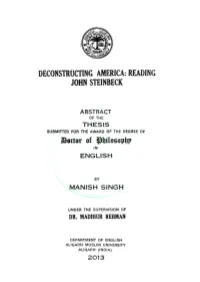
DECONSTRUCTING AMERICA: READING JOHN STEINBECK ABSTRACT OF THE THESIS SUBMITTED FOR THE AWARD OF THE DEGREE OF ^ JBoctor of $IitlDfi;opI)p IN ENGLISH \ BY MANISH SINGH UNDER THE SUPERVISION OF DR. MADIHUR REHMAN DEPARTMENT OF ENGLISH ALIGARH MUSLIM UNIVERSITY ALIGARH (INDIA) 2013 Abstract The first chapter of the thesis, "The Path to Doom: America from Idea to Reality;'" takes the journey of America from its conception as an idea to its reality. The country that came into existence as a colony of Great Britain and became a refuge of the exploited and the persecuted on one hand and of the outlaws on other hand, soon transformed into a giant machine of exploitation, persecution and lawlessness, it is surprising to see how the noble ideas of equality, liberty and democracy and pursuit of happiness degenerated into callous profiteering. Individuals insensitive to the needs and happiness of others and arrogance based on a sense of racial superiority even before they take root in the virgin soil of the Newfoundland. The effects cf this degenerate ideology are felt not only by the Non-White races within America and the less privileged countries of the third world, but even by the Whites within America. The concepts of equality, freedom, democracy and pursuit of happiness were manufactured and have been exploited by the American ruling class.The first one to experience the crawling effects of the Great American Dream were original inhabitants of America, the Red Indians and later Blacks who were uprooted from their home and hearth and taken to America as slaves. -

Opening the Rachel Carson Music and Campus Center
MiddlesexFall 2018 Opening the Rachel Carson Music and Campus Center MIDDLESEX FALL 2018 i From the Head of School Becoming through Bonding Last week, I heard a marvelous sentence attrib- delight, or any experience that reveals the uted to the American poet e e cummings— human spirit.” Issues can engage us, and that’s “It takes courage to grow up and become who important, the capacity to engage and want you really are”—and yes, when we articulate to contribute; and urgency can inspire us, the values of honesty, gratitude, kindness, galvanize our ability to organize, to plan, respect, and courage, that is the kind of cour- to strategize. But building relationships— age perhaps most important to the formation the real connections with others, based on of identity: the courage of integrity. At its understanding, respect, and yes, true affec- most basic, integrity requires a unity of mind, tion—is what will sustain us, motivate us, body, spirit, principles, and actions. Achieving and ultimately, over the hopefully long run that unity with consistency—building integ- of our lives, come to satisfy us. In the words rity into our lives as habit—makes us people of Carmen Beaton, our beloved, now-retired worthy of others’ trust. I would offer that any colleague, they are “the gift we give each definition of success in “finding the promise” other”—and they are the proverbial gifts that presupposes that we are worthy of trust. keep on giving, in that they join us together, Integrity is a significant challenge for all past, present, and future. -
2008 – 2009 Course Catalog
MIDDLESEX COUNTY COLLEGE CATALOG 08/09 imagine WWW.MIDDLESEXCC.EDU MIDDLESEX C O U N T Y COLLEGE 2600 Woodbridge Avenue P.O. Box 3050 Edison, New Jersey 08818-3050 732.548.6000 MIDDLESEX C O U N T Y COLLEGE Course Catalog 08 -09 MIDDLESEX COUNTY COLLEGE 2008 - 2009 Catalog MAIN CAMPus 2600 Woodbridge Avenue P.O. Box 3050 Edison, New Jersey 0888 732.548.6000 New BRUNswicK CENTER 40 New Street New Brunswick, NJ 0890 732.745.8866 PeRTH AmboY CENTER 60 Washington Street Perth Amboy, NJ 0886 732.324.0700 Foreword: The catalog is the contract between the College and the student. This catalog provides information for students, faculty, and administrators regarding the College’s policies. Requirements, course offerings, schedules, activities, tuition and fees in this catalog are subject to change without notice at any time at the sole discretion of the administration. Such changes may be of any nature, including but not limited to the elimination of programs, classes, or activities; the relocation or modification of the content of any of the foregoing; and the cancellation of a schedule of classes or other academic activities. Payment of tuition or attendance in any class shall constitute a student’s acceptance of the administration’s rights as set forth above. The Office of theR egistrar prepares the catalog. Any questions about its contents should be directed to the Registrar in Chambers Hall. Cover painting by Frank McGinley © 2007. Used by permission. The most current information can be found on the MCC website: www.middlesexcc.edu FINAL REVISED JULY , 2008, JULY 6, 2008, JULY 22, 2008, September , 2008 WWW.MIDDLESEXCC.EDU Middlesex County College MIDDLESEX COUNTY BOARD OF CHOSEN FREEHOLDERS Affirmative Action and Compliance David B. -

Names in Marilynne Robinson's <I>Gilead</I> and <I>Home</I>
names, Vol. 58 No. 3, September, 2010, 139–49 Names in Marilynne Robinson’s Gilead and Home Susan Petit Emeritus, College of San Mateo, California, USA The titles of Marilynne Robinson’s complementary novels Gilead (2004) and Home (2008) and the names of their characters are rich in allusions, many of them to the Bible and American history, making this tale of two Iowa families in 1956 into an exploration of American religion with particular reference to Christianity and civil rights. The books’ titles suggest healing and comfort but also loss and defeat. Who does the naming, what the name is, and how the person who is named accepts or rejects the name reveal the sometimes difficult relationships among these characters. The names also reinforce the books’ endorsement of a humanistic Christianity and a recommitment to racial equality. keywords Bible, American history, slavery, civil rights, American literature Names are an important source of meaning in Marilynne Robinson’s prize-winning novels Gilead (2004) and Home (2008),1 which concern the lives of two families in the fictional town of Gilead, Iowa,2 in the summer of 1956. Gilead is narrated by the Reverend John Ames, at least the third Congregationalist minister of that name in his family, in the form of a letter he hopes his small son will read after he grows up, while in Home events are recounted in free indirect discourse through the eyes of Glory Boughton, the youngest child of Ames’ lifelong friend, Robert Boughton, a retired Presbyterian minister. Both Ames, who turns seventy-seven3 that summer (2004: 233), and Glory, who is thirty-eight, also reflect on the past and its influence on the present. -

Marilynne Robinson, Wallace Stevens, and Louis Althusser in the Post/Secular Wilderness: Generosity, Jérémiade, and the Aesthetic Effect
humanities Article Marilynne Robinson, Wallace Stevens, and Louis Althusser in the Post/Secular Wilderness: Generosity, Jérémiade, and the Aesthetic Effect Daniel Muhlestein Department of English, Brigham Young University, Provo, UT 84602, USA; daniel_muhlestein@byu.edu Received: 3 September 2019; Accepted: 29 March 2020; Published: 7 April 2020 Abstract: In Restless Secularism (2017), Matthew Mutter points out that Wallace Stevens described three related techniques that could be used to attempt to purge secular life of its religious residue: adaptation, substitution, and elimination. Marilynne Robinson pushes back against such secularizing strategies by employing three related techniques of her own: negotiation, grafting, and invitation. She does so to attempt to bridge the gap between religious and humanistic perspectives and—in the process—mounts a spirited defense of religious faith and practice. Robinson uses a fourth technique as well: jérémiade. In its usual sacred form, jérémiade is a lamentation that denounces self-righteousness, religious hypocrisy, and social injustice. Much of what Robinson says about the Christian Right is essentially jérémiade. Robinson’s critique of parascientists is jérémiade as well, although its grounding assumptions are secular rather than sacred. While Robinson’s jérémiades against the Christian Right and against parascientists are effective in isolation, in aggregate they sometimes undercut her more generous and inclusive attempts at negotiation, grafting, and invitation. This may be because Robinson’s essays do not undergo the moderating influence of what Louis Althusser called the aesthetic effect of art, which in Housekeeping (1980), Gilead (2004), Home (2008), and Lila (2014) helps counterbalance the flashes of anger and tendencies toward judgement that periodically surface elsewhere in Robinson’s work. -

The Pulitzer Prize for Fiction Honors a Distinguished Work of Fiction by an American Author, Preferably Dealing with American Life
Pulitzer Prize Winners Named after Hungarian newspaper publisher Joseph Pulitzer, the Pulitzer Prize for fiction honors a distinguished work of fiction by an American author, preferably dealing with American life. Chosen from a selection of 800 titles by five letter juries since 1918, the award has become one of the most prestigious awards in America for fiction. Holdings found in the library are featured in red. 2017 The Underground Railroad by Colson Whitehead 2016 The Sympathizer by Viet Thanh Nguyen 2015 All the Light we Cannot See by Anthony Doerr 2014 The Goldfinch by Donna Tartt 2013: The Orphan Master’s Son by Adam Johnson 2012: No prize (no majority vote reached) 2011: A visit from the Goon Squad by Jennifer Egan 2010:Tinkers by Paul Harding 2009:Olive Kitteridge by Elizabeth Strout 2008:The Brief and Wondrous Life of Oscar Wao by Junot Diaz 2007:The Road by Cormac McCarthy 2006:March by Geraldine Brooks 2005 Gilead: A Novel, by Marilynne Robinson 2004 The Known World by Edward Jones 2003 Middlesex by Jeffrey Eugenides 2002 Empire Falls by Richard Russo 2001 The Amazing Adventures of Kavalier & Clay by Michael Chabon 2000 Interpreter of Maladies by Jhumpa Lahiri 1999 The Hours by Michael Cunningham 1998 American Pastoral by Philip Roth 1997 Martin Dressler: The Tale of an American Dreamer by Stephan Milhauser 1996 Independence Day by Richard Ford 1995 The Stone Diaries by Carol Shields 1994 The Shipping News by E. Anne Proulx 1993 A Good Scent from a Strange Mountain by Robert Olen Butler 1992 A Thousand Acres by Jane Smiley -
A Word from the Editor
JAMES SCHIFF A Word from the Editor It’s been five years since our first issue appeared in November 2011, which calls for modest celebration, some self-examination, and thoughts on where we’re headed. From the beginning, the objective of the John Updike Review has been, sim- ply, to provide a space where those interested in writing about John Updike can participate in discussion. In five years we have released eight issues, containing thirty-six essays, fifteen critical responses to five works of fiction (“Leaves,” “Ges- turing,” “Trust Me,” The Widows of Eastwick, and Villages), twelve book reviews, two tributes, one panel discussion, and one bibliography—sixty-seven pieces in all, excluding the three reprinted short stories. A respectable start. Though the novels, particularly the Rabbit novels, have historically garnered the lion’s share of attention in Updike studies, in our pages the short stories have drawn the most interest: ten essays, nine responses in the “Three Writers” section, and two reviews, which comes to twenty-one pieces, nearly a third of our offerings. This is good news. Many have argued that the short story is Updike’s strongest suit, a genre in which he has few rivals, so this focus is gratifying, especially given how often short fiction is neglected. As for the novels discussed in theJUR , attention has been spread rather evenly, with the Rabbit books holding a slight edge over Couples, In the Beauty of the Lilies, Toward the End of Time, Gertrude and Claudius, and Villages. I’m hesitant, though, to read much significance here—one or two new essays could alter these preliminary findings. -

Pearl Buck Is One of the Most Popular Novelists of Early Twentieth Century
ELK Asia Pacific Journals – Special Issue ISBN: 978-81-930411-2-3 TRAJECTORIES OF MULTICULTURAL CONSCIOUSNESS IN PEARL BUCK’S NOVEL ‘COME, MY BELOVED’ Dr.Jeyashree G.Iyer. Associate Professor/ HOD, English Department, Dr. Ambedkar College, Wadala. Mumbai. ABSTRACT: Pearl Buck is one of the most popular novelists of twentieth century. Her novel ‘The Good Earth’ fetched her Pulitzer Prize and the Howells medal in 1935. She was the first American woman to win Nobel Prize for Literature in 1938. Her father was in Christian Missionary who lived in China for forty two years to teach Christianity. Her visit to different countries facilitated her to infuse the essence of multiculturalism in her novels. Her novel ‘Come, My Beloved’ portrays colonial Indian society and duly records the religious confrontation of the east and the west. The dialectical presentation of the motif reveals the expertise of the novelist. The novel registers life journey of three generations of a rich American family, in India during colonial period. This paper attempts to exude how multicultural environment of India confuses a foreigner and also reveals how the west perceives Indian culture and society. Most part of the novel is engaged in intercultural dialogue illuminating clash of ideologies pertaining to culture and religion. The novel displays diverse points of view, plurality of descriptions of the same events. The theme of the novel is chronologically arranged highlighting cultural tensions prevail in India during colonial period. The theme is very relevant today as scholars and philosophers attempt to establish religious tolerance for better society. Pearl Buck’s sincere efforts to create the democratic utopia are lucidly evident but the novel ends with the blatant truth that social inequality and racial discrimination cannot be eradicated from a society easily.