London's Cockney in the Twentieth Century
Total Page:16
File Type:pdf, Size:1020Kb
Load more
Recommended publications
-

Social and Cultural Functions of the Local Press in Preston, Lancashire, 1855-1900
Reading the local paper: Social and cultural functions of the local press in Preston, Lancashire, 1855-1900 by Andrew Hobbs A thesis submitted in partial fulfilment for the requirements of the degree of Doctor of Philosophy at the University of Central Lancashire November 2010 ABSTRACT This thesis demonstrates that the most popular periodical genre of the second half of the nineteenth century was the provincial newspaper. Using evidence from news rooms, libraries, the trade press and oral history, it argues that the majority of readers (particularly working-class readers) preferred the local press, because of its faster delivery of news, and because of its local and localised content. Building on the work of Law and Potter, the thesis treats the provincial press as a national network and a national system, a structure which enabled it to offer a more effective news distribution service than metropolitan papers. Taking the town of Preston, Lancashire, as a case study, this thesis provides some background to the most popular local publications of the period, and uses the diaries of Preston journalist Anthony Hewitson as a case study of the career of a local reporter, editor and proprietor. Three examples of how the local press consciously promoted local identity are discussed: Hewitson’s remoulding of the Preston Chronicle, the same paper’s changing treatment of Lancashire dialect, and coverage of professional football. These case studies demonstrate some of the local press content that could not practically be provided by metropolitan publications. The ‘reading world’ of this provincial town is reconstructed, to reveal the historical circumstances in which newspapers and the local paper in particular were read. -

London's Soap Industry and the Development of Global Ghost Acres
London’s Soap Industry and the Development of Global Ghost Acres in the Nineteenth Century John Knight won a prize medal at the Great Exhibition in 1851 for his soaps, which included an ‘excellent Primrose or Pale-yellow-soap, made with tallow, American rosin, and soda’.1 In the decades that followed the prize, John Knight’s Royal Primrose Soap emerged as one of the United Kingdom’s leading laundry soap brands. In 1880, the firm moved down the Thames from Wapping in East London to a significantly larger factory in West Ham’s Silvertown district.2 The new soap works was capable of producing between two hundred and three hundred tons of soap per week, along with a considerable number of candles, and extracting oil from four hundred tons of cotton seeds.3 To put this quantity of soap into context, the factory could manufacture more soap in a year than the whole of London produced in 1832.4 The prize and relocation together represented the industrial and commercial triumph of this nineteenth-century family business. A complimentary article from 1888, argued the firm’s success rested on John Knights’ commitment ‘to make nothing but the very best articles, to sell them at the very lowest possible prices, and on no account to trade beyond his means’.5 The publication further explained that before the 1830s, soap ‘was dark in colour, and the 1 Charles Wentworth Dilke, Exhibition of the Works of Industry of All Nations, 1851: Catalogue of a Collection of Works On, Or Having Reference To, the Exhibition of 1851, 1852, 614. -

Origins of NZ English
Origins of NZ English There are three basic theories about the origins of New Zealand English, each with minor variants. Although they are usually presented as alternative theories, they are not necessarily incompatible. The theories are: • New Zealand English is a version of 19th century Cockney (lower-class London) speech; • New Zealand English is a version of Australian English; • New Zealand English developed independently from all other varieties from the mixture of accents and dialects that the Anglophone settlers in New Zealand brought with them. New Zealand as Cockney The idea that New Zealand English is Cockney English derives from the perceptions of English people. People not themselves from London hear some of the same pronunciations in New Zealand that they hear from lower-class Londoners. In particular, some of the vowel sounds are similar. So the vowel sound in a word like pat in both lower-class London English and in New Zealand English makes that word sound like pet to other English people. There is a joke in England that sex is what Londoners get their coal in. That is, the London pronunciation of sacks sounds like sex to other English people. The same joke would work with New Zealanders (and also with South Africans and with Australians, until very recently). Similarly, English people from outside London perceive both the London and the New Zealand versions of the word tie to be like their toy. But while there are undoubted similarities between lower-class London English and New Zealand (and South African and Australian) varieties of English, they are by no means identical. -
London and Middlesex in the 1660S Introduction: the Early Modern
London and Middlesex in the 1660s Introduction: The early modern metropolis first comes into sharp visual focus in the middle of the seventeenth century, for a number of reasons. Most obviously this is the period when Wenceslas Hollar was depicting the capital and its inhabitants, with views of Covent Garden, the Royal Exchange, London women, his great panoramic view from Milbank to Greenwich, and his vignettes of palaces and country-houses in the environs. His oblique birds-eye map- view of Drury Lane and Covent Garden around 1660 offers an extraordinary level of detail of the streetscape and architectural texture of the area, from great mansions to modest cottages, while the map of the burnt city he issued shortly after the Fire of 1666 preserves a record of the medieval street-plan, dotted with churches and public buildings, as well as giving a glimpse of the unburned areas.1 Although the Fire destroyed most of the historic core of London, the need to rebuild the burnt city generated numerous surveys, plans, and written accounts of individual properties, and stimulated the production of a new and large-scale map of the city in 1676.2 Late-seventeenth-century maps of London included more of the spreading suburbs, east and west, while outer Middlesex was covered in rather less detail by county maps such as that of 1667, published by Richard Blome [Fig. 5]. In addition to the visual representations of mid-seventeenth-century London, a wider range of documentary sources for the city and its people becomes available to the historian. -

The Ice Age in North Hertfordshire
The Ice Age in North Hertfordshire What do we mean by ‘the Ice Age’? Thinking about ‘the Ice Age’ brings up images of tundra, mammoths, Neanderthals and great sheets of ice across the landscape. This simple picture is wrong in many ways. Firstly, there have been many different ‘Ice Ages’ in the history of the earth. The most dramatic happened between 2.4 and 2.1 billion years ago, known as the Huronian Glaciation. About the same time, earth’s atmosphere suddenly became rich in oxygen, and some scientists believe that the atmospheric changes reduced the temperature so much that the whole planet became covered in ice. 1: an Arctic ice sheet (© Youino Joe, USFWS, used under a Creative Commons licence) Another global cover of ice happened 650 million years ago when the first multi-celled animals were evolving. Geologists sometimes refer to this period as the ‘Snowball Earth’ and biologists know it as the Proterozoic. Temperatures were so low that the equator was as cold as present-day Antarctica. They began to rise again as concentrations of carbon dioxide in the atmosphere rose to about 13%, 350 times greater than today. Some carbon dioxide came from volcanic eruptions, but some was excreted by microbial life, which was beginning to diversify and increase in numbers. Neither of these Ice Ages is the one that dominates the popular imagination. Both happened many millions of years before life moved on to land. There were no humans, no mammals, no dinosaurs: none of the creatures familiar from The Flintstones. The period most people think about as the ‘real’ Ice Age is the geologists’ Pleistocene era, from more than two-and-a-half million years ago to the beginning of the Holocene, almost 12,000 years ago. -

Barrow-In-Furness, Cumbria
BBC VOICES RECORDINGS http://sounds.bl.uk Title: Barrow-in-Furness, Cumbria Shelfmark: C1190/11/01 Recording date: 2005 Speakers: Airaksinen, Ben, b. 1987 Helsinki; male; sixth-form student (father b. Finland, research scientist; mother b. Barrow-in-Furness) France, Jane, b. 1954 Barrow-in-Furness; female; unemployed (father b. Knotty Ash, shoemaker; mother b. Bootle, housewife) Andy, b. 1988 Barrow-in-Furness; male; sixth-form student (father b. Barrow-in-Furness, shop sales assistant; mother b. Harrow, dinner lady) Clare, b. 1988 Barrow-in-Furness; female; sixth-form student (father b. Barrow-in-Furness, farmer; mother b. Brentwood, Essex) Lucy, b. 1988 Leeds; female; sixth-form student (father b. Pudsey, farmer; mother b. Dewsbury, building and construction tutor; nursing home activities co-ordinator) Nathan, b. 1988 Barrow-in-Furness; male; sixth-form student (father b. Dalton-in-Furness, IT worker; mother b. Barrow-in-Furness) The interviewees (except Jane France) are sixth-form students at Barrow VI Form College. ELICITED LEXIS ○ see English Dialect Dictionary (1898-1905) ∆ see New Partridge Dictionary of Slang and Unconventional English (2006) ◊ see Green’s Dictionary of Slang (2010) ♥ see Dictionary of Contemporary Slang (2014) ♦ see Urban Dictionary (online) ⌂ no previous source (with this sense) identified pleased chuffed; happy; made-up tired knackered unwell ill; touch under the weather; dicky; sick; poorly hot baking; boiling; scorching; warm cold freezing; chilly; Baltic◊ annoyed nowty∆; frustrated; pissed off; miffed; peeved -

LANGUAGE VARIETY in ENGLAND 1 ♦ Language Variety in England
LANGUAGE VARIETY IN ENGLAND 1 ♦ Language Variety in England One thing that is important to very many English people is where they are from. For many of us, whatever happens to us in later life, and however much we move house or travel, the place where we grew up and spent our childhood and adolescence retains a special significance. Of course, this is not true of all of us. More often than in previous generations, families may move around the country, and there are increasing numbers of people who have had a nomadic childhood and are not really ‘from’ anywhere. But for a majority of English people, pride and interest in the area where they grew up is still a reality. The country is full of football supporters whose main concern is for the club of their childhood, even though they may now live hundreds of miles away. Local newspapers criss-cross the country in their thousands on their way to ‘exiles’ who have left their local areas. And at Christmas time the roads and railways are full of people returning to their native heath for the holiday period. Where we are from is thus an important part of our personal identity, and for many of us an important component of this local identity is the way we speak – our accent and dialect. Nearly all of us have regional features in the way we speak English, and are happy that this should be so, although of course there are upper-class people who have regionless accents, as well as people who for some reason wish to conceal their regional origins. -
Enregisterment in Historical Contexts
0 Enregisterment in Historical Contexts: A Framework Paul Stephen Cooper A thesis submitted to the University of Sheffield for the degree of Doctor of Philosophy in the School of English Literature, Language and Linguistics February 2013 1 ABSTRACT In this thesis I discuss how the phenomena of indexicality and enregisterment (Silverstein 2003; Agha 2003) can be observed and studied in historical contexts via the use of historical textual data. I present a framework for the study of historical enregisterment which compares data from corpora of both nineteenth-century and modern Yorkshire dialect material, and the results of an online survey of current speakers so as to ascertain the validity of the corpus data and to use ‘the present to explain the past’ (Labov 1977:226). This framework allows for the identification of enregistered repertoires of Yorkshire dialect in both the twenty-first and nineteenth centuries. This is achieved by combining elicited metapragmatic judgements and examples of dialect features from the online survey with quantitative frequency analysis of linguistic features from Yorkshire dialect literature and literary dialect (Shorrocks 1996) and qualitative metapragmatic discourse (Johnstone et al 2006) from sources such as dialect dictionaries, dialect grammars, travel writing, and glossaries. I suggest that processes of enregisterment may operate along a continuum and that linguistic features may become ‘deregistered’ as representative of a particular variety; I also suggest that features may become ‘deregistered’ to the point of becoming ‘fossil forms’, which is more closely related to Labov’s (1972) definition of the ultimate fate of a linguistic stereotype. I address the following research questions: 1. -
Internal Migration, England and Wales: Year Ending June 2015
Statistical bulletin Internal migration, England and Wales: Year Ending June 2015 Residential moves between local authorities and regions in England and Wales, as well as moves to or from the rest of the UK (Scotland and Northern Ireland). Contact: Release date: Next release: Nicola J White 23 June 2016 June 2017 migstatsunit@ons.gsi.gov.uk +44 (0)1329 444647 Notice 22 June 2017 From mid-2016 Population Estimates and Internal Migration were combined in one Statistical Bulletin. Page 1 of 16 Table of contents 1. Main points 2. Things you need to know 3. Tell us what you think 4. Moves between local authorities in England and Wales 5. Cross-border moves 6. Characteristics of movers 7. Area 8. International comparisons 9. Where can I find more information? 10. References 11. Background notes Page 2 of 16 1 . Main points There were an estimated 2.85 million residents moving between local authorities in England and Wales between July 2014 and June 2015. This is the same level shown in the previous 12-month period. There were 53,200 moves from England and Wales to Northern Ireland and Scotland, compared with 45,600 from Northern Ireland and Scotland to England and Wales. This means there was a net internal migration loss for England and Wales of 7,600 people. For the total number of internal migration moves the sex ratio is fairly neutral; in the year to June 2015, 1.4 million (48%) of moves were males and 1.5 million (52%) were females. Young adults were most likely to move, with the biggest single peak (those aged 19) reflecting moves to start higher education. -
Making Sense of "Bad English"
MAKING SENSE OF “BAD ENGLISH” Why is it that some ways of using English are considered “good” and others are considered “bad”? Why are certain forms of language termed elegant, eloquent, or refined, whereas others are deemed uneducated, coarse, or inappropriate? Making Sense of “Bad English” is an accessible introduction to attitudes and ideologies towards the use of English in different settings around the world. Outlining how perceptions about what constitutes “good” and “bad” English have been shaped, this book shows how these principles are based on social factors rather than linguistic issues and highlights some of the real-life consequences of these perceptions. Features include: • an overview of attitudes towards English and how they came about, as well as real-life consequences and benefits of using “bad” English; • explicit links between different English language systems, including child’s English, English as a lingua franca, African American English, Singlish, and New Delhi English; • examples taken from classic names in the field of sociolinguistics, including Labov, Trudgill, Baugh, and Lambert, as well as rising stars and more recent cutting-edge research; • links to relevant social parallels, including cultural outputs such as holiday myths, to help readers engage in a new way with the notion of Standard English; • supporting online material for students which features worksheets, links to audio and news files, further examples and discussion questions, and background on key issues from the book. Making Sense of “Bad English” provides an engaging and thought-provoking overview of this topic and is essential reading for any student studying sociolinguistics within a global setting. -
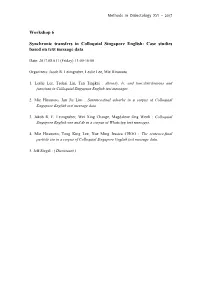
Workshop 6 Synchronic Transfers in Colloquial Singapore English: Case Studies Based on Text Message Data
Methods in Dialectology XVI – 2017 Workshop 6 Synchronic transfers in Colloquial Singapore English: Case studies based on text message data Date: 2017.08.011 (Friday) 13:00-16:00 Organizers: Jacob R. Leimgruber, Leslie Lee, Mie Hiramoto 1. Leslie Lee, Taohai Lin, Ten Tingkai : Already, le, and liao:distributions and functions in Colloquial Singapore English text messages. 2. Mie Hiramoto, Jun Jie Lim : Sentence-final adverbs in a corpus of Colloquial Singapore English text message data. 3. Jakob R. E. Leimgruber, Wei Xing Change, Magdalene Ong Wenli : Colloquial Singapore English one and de in a corpus of WhatsApp text messages. 4. Mie Hiramoto, Tong King Lee, Xue Ming Jessica CHOO : The sentence-final particle sia in a corpus of Colloquial Singapore English text message data. 5. Jeff Siegel : ( Discussant ) Workshop 6: Synchronic transfers in Colloquial Singapore English: Case studies based on text message data Date: 2017.08.011 (Friday) 13:00-16:00 Organizers: Jacob R. Leimgruber, Leslie Lee, Mie Hiramoto Abstract: This sociolinguistic workshop aims to investigate how specific grammatical features are exhibited in Colloquial Singapore English (CSE) in the course of social media communication, namely, WhatsApp text messaging. McWhoter (2013) calls text message conversations ‘finger speech’ and discusses highly colloquial features in the texting language. Similarly, Thurlow (2003) explains text messaging data to be extremely rich resources for linguistic analysis. For this workshop, the data were collected by students at a university in Singapore between 2014 and 2016. The studies presented in this workshop are based on a 1.2 million-word sub-corpus of the data collected. -

The History of London
The History of London STUDENT A The Romans came to England in ____________ ( when? ) and built the town of Londinium on the River Thames. Londinium soon grew bigger and bigger. Ships came there from all over Europe and the Romans built _____________ ( what? ) from Londinium to other parts of Britain. By the year 400, there were 50,000 people in the city. Soon after 400 the Romans left, and we do not know much about London between 400 and 1000. In __________ (when? ) William the Conqueror came to England from Normandy in France. William became King of England and lived in ___________ ( where? ). But William was afraid of the people of London, so he built a big building for himself – the White Tower. Now it is part of the Tower of London and many ____________ ( who? ) visit it to see the Crown Jewels – the Queen’s gold and diamonds. London continued to grow. By 1600 there were ______________ ( how many? ) people in the city and by 1830 the population was one and a half million people. The railways came and there were ___________ ( what? ) all over the city. This was the London that Dickens New and wrote about – a city of very rich and very poor people. At the start of the 20th century, _____________ ( how many? ) people lived in London. Today the population of Greater London is seven and a half million. ______________ ( how many ?) tourists visit London every year and you can her 300 different languages on London’s streets! ----------------------------------------------------------------------------------------------------------------- STUDENT B The Romans came to England in AD43 and built the town of Londinium ____________ (where? ).