Aflps Do Not Support Deep Phylogenetic Relationships Among Darters (Teleostei: Percidae: Etheostomatinae)
Total Page:16
File Type:pdf, Size:1020Kb
Load more
Recommended publications
-

A Thesis Entitled Molecular, Morphological, and Biogeographic Resolution of Cryptic Taxa in the Greenside Darter Etheostoma Blen
A Thesis Entitled Molecular, morphological, and biogeographic resolution of cryptic taxa in the Greenside Darter Etheostoma blennioides complex By Amanda E. Haponski Submitted as partial fulfillment of the requirements for The Master of Science Degree in Biology (Ecology-track) ____________________________ Advisor: Dr. Carol A. Stepien ____________________________ Committee Member: Dr. Timothy G. Fisher ____________________________ Committee Member: Dr. Johan F. Gottgens ____________________________ College of Graduate Studies The University of Toledo December 2007 Copyright © 2007 This document is copyrighted material. Under copyright law, no parts of this document may be reproduced without the expressed permission of the author. An Abstract of Molecular, morphological, and biogeographic resolution of cryptic taxa in the Greenside Darter Etheostoma blennioides complex Amanda E. Haponski Submitted as partial fulfillment of the requirements for The Master of Science Degree in Biology (Ecology-track) The University of Toledo December 2007 DNA sequencing has led to the resolution of many cryptic taxa, which are especially prevalent in the North American darter fishes (Family Percidae). The Greenside Darter Etheostoma blennioides commonly occurs in the lower Great Lakes region, where two putative subspecies, the eastern “Allegheny” type E. b. blennioides and the western “Prairie” type E. b. pholidotum , overlap. The objective of this study was to test the systematic identity and genetic divergence distinguishing the two subspecies in areas of sympatry and allopatry in comparison to other subspecies and close relatives. DNA sequences from the mtDNA cytochrome b gene and control region and the nuclear S7 intron 1 comprising a total of 1,497 bp were compared from 294 individuals across 18 locations, including the Lake Erie basin and the Allegheny, Meramec, Obey, Ohio, Rockcastle, Susquehanna, and Wabash River systems. -

C:\Fish\Eastern Sand Darter Sa.Wpd
EASTERN SAND DARTER STATUS ASSESSMENT Prepared by: David Grandmaison and Joseph Mayasich Natural Resources Research Institute University of Minnesota 5013 Miller Trunk Highway Duluth, MN 55811-1442 and David Etnier Ecology and Evolutionary Biology University of Tennessee 569 Dabney Hall Knoxville, TN 37996-1610 Prepared for: U.S. Fish and Wildlife Service Region 3 1 Federal Drive Fort Snelling, MN 55111 January 2004 NRRI Technical Report No. NRRI/TR-2003/40 DISCLAIMER This document is a compilation of biological data and a description of past, present, and likely future threats to the eastern sand darter, Ammocrypta pellucida (Agassiz). It does not represent a decision by the U.S. Fish and Wildlife Service (Service) on whether this taxon should be designated as a candidate species for listing as threatened or endangered under the Federal Endangered Species Act. That decision will be made by the Service after reviewing this document; other relevant biological and threat data not included herein; and all relevant laws, regulations, and policies. The result of the decision will be posted on the Service's Region 3 Web site (refer to: http://midwest.fws.gov/eco_serv/endangrd/lists/concern.html). If designated as a candidate species, the taxon will subsequently be added to the Service's candidate species list that is periodically published in the Federal Register and posted on the World Wide Web (refer to: http://endangered.fws.gov/wildlife.html). Even if the taxon does not warrant candidate status it should benefit from the conservation recommendations that are contained in this document. ii TABLE OF CONTENTS DISCLAIMER................................................................... -
Ruffe (Gymnocephalus Cernua) Ecological Risk Screening Summary
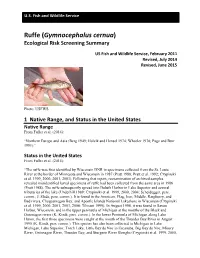
U.S. Fish and Wildlife Service Ruffe (Gymnocephalus cernua) Ecological Risk Screening Summary US Fish and Wildlife Service, February 2011 Revised, July 2014 Revised, June 2015 Photo: USFWS 1 Native Range, and Status in the United States Native Range From Fuller et al. (2014): “Northern Europe and Asia (Berg 1949; Holcik and Hensel 1974; Wheeler 1978; Page and Burr 1991).” Status in the United States From Fuller et al. (2014): “The ruffe was first identified by Wisconsin DNR in specimens collected from the St. Louis River at the border of Minnesota and Wisconsin in 1987 (Pratt 1988; Pratt et al. 1992; Czypinski et al. 1999, 2000, 2001, 2003). Following that report, reexamination of archived samples revealed misidentified larval specimens of ruffe had been collected from the same area in 1986 (Pratt 1988). The ruffe subsequently spread into Duluth Harbor in Lake Superior and several tributaries of the lake (Underhill 1989; Czypinski et al. 1999, 2000, 2004; Scheidegger, pers. comm.; J. Slade, pers. comm.). It is found in the Amnicon, Flag, Iron, Middle, Raspberry, and Bad rivers, Chequamegon Bay, and Apostle Islands National Lakeshore in Wisconsin (Czypinski et al. 1999, 2000, 2001, 2003, 2004; Tilmant 1999). In August 1994, it was found in Saxon Harbor, Wisconsin, and in the upper peninsula of Michigan at the mouths of the Black and Ontonagon rivers (K. Kindt, pers. comm.). In the lower Peninsula of Michigan along Lake Huron, the first three specimens were caught at the mouth of the Thunder Bay River in August 1995 (K. Kindt, pers. comm.). This species has also been collected in Michigan in Lake Michigan, Lake Superior, Torch Lake, Little Bay de Noc in Escanaba, Big Bay de Noc, Misery River, Ontonagon River, Thunder Bay, and Sturgeon River Sloughs (Czypinski et al. -

A Synopsis of the Biology and Life History of Ruffe
J. Great Lakes Res. 24(2): 170-1 85 Internat. Assoc. Great Lakes Res., 1998 A Synopsis of the Biology and Life History of Ruffe Derek H. Ogle* Northland College Mathematics Department Ashland, Wisconsin 54806 ABSTRACT. The ruffe (Gymnocephalus cernuus), a Percid native to Europe and Asia, has recently been introduced in North America and new areas of Europe. A synopsis of the biology and life history of ruffe suggests a great deal of variability exists in these traits. Morphological characters vary across large geographical scales, within certain water bodies, and between sexes. Ruffe can tolerate a wide variety of conditions including fresh and brackish waters, lacustrine and lotic systems, depths of 0.25 to 85 m, montane and submontane areas, and oligotrophic to eutrophic waters. Age and size at maturity dif- fer according to temperature and levels of mortality. Ruffe spawn on a variety ofsubstrates, for extended periods of time. In some populations, individual ruffe may spawn more than once per year. Growth of ruffe is affected by sex, morphotype, water type, intraspecific density, and food supply. Ruffe feed on a wide variety of foods, although adult ruffe feed predominantly on chironomid larvae. Interactions (i.e., competition and predation) with other species appear to vary considerably between system. INDEX WORDS: Ruffe, review, taxonomy, reproduction, diet, parasite, predation. INTRODUCTION DISTRIBUTION This is a review of the existing literature on Ruffe are native to all of Europe except for along ruffe, providing a synopsis of its biology and life the Mediterranean Sea, western France, Spain, Por- history. A review of the existing literature is tugal, Norway, northern Finland, Ireland, and Scot- needed at this time because the ruffe, which is na- land (Collette and Banarescu 1977, Lelek 1987). -

Eurasian Ruffe (Gymnocephalus Cernua), Native to Northern Europe and Asia, Have Threatened the Great Lakes and Surrounding States Since the Late 1980S
State of Michigan’s Status and Strategy for Eurasian Ruffe Management Scope Invasive Eurasian ruffe (Gymnocephalus cernua), native to northern Europe and Asia, have threatened the Great Lakes and surrounding states since the late 1980s. The goals of this document are to: • Summarize the current understanding level of the biology and ecology of Eurasian ruffe. • Summarize the current management options for Eurasian ruffe in Michigan. • Identify possible future directions of Eurasian ruffe management in Michigan. Biology and Ecology I. Identification Eurasian ruffe, also known as blacktail Gary Cholwek – National Biological Service or river ruffe, is a member of genus Gymnocephalus within Percidae. Eurasian ruffe is a small, aggressive, benthic fish native to Europe and Asia. The species resemble yellow perch with distinct walleye markings (McLean 1997). The Eurasian ruffe can be distinguished from other perch by their large, jointed dorsal fin composed of 11 to 16 spines with rows of dark spots between each spine. Adult ruffe are typically five to six inches long with large individuals rarely exceeding 10 inches. They have a small, downturned mouth, lack scales on their head, and are slimy when handled (McLean 1997). Eurasian ruffe have two dorsal fins, one spiny (anterior) and one soft (posterior), and are commonly mistaken for troutperch, which have only a single dorsal fin. Their coloration consists of an olive-brown dorsal surface, pale sides, and a yellow underside (Fuller 2014, Hajjar 2002). Eurasian ruffe have two ventral fins with sharp spines on the leading edges; the anterior fin has only one spine where the posterior fin has two spines. -
Underwater Observation and Habitat Utilization of Three Rare Darters
University of Tennessee, Knoxville TRACE: Tennessee Research and Creative Exchange Masters Theses Graduate School 5-2010 Underwater observation and habitat utilization of three rare darters (Etheostoma cinereum, Percina burtoni, and Percina williamsi) in the Little River, Blount County, Tennessee Robert Trenton Jett University of Tennessee - Knoxville, trent.jett@gmail.com Follow this and additional works at: https://trace.tennessee.edu/utk_gradthes Part of the Natural Resources and Conservation Commons Recommended Citation Jett, Robert Trenton, "Underwater observation and habitat utilization of three rare darters (Etheostoma cinereum, Percina burtoni, and Percina williamsi) in the Little River, Blount County, Tennessee. " Master's Thesis, University of Tennessee, 2010. https://trace.tennessee.edu/utk_gradthes/636 This Thesis is brought to you for free and open access by the Graduate School at TRACE: Tennessee Research and Creative Exchange. It has been accepted for inclusion in Masters Theses by an authorized administrator of TRACE: Tennessee Research and Creative Exchange. For more information, please contact trace@utk.edu. To the Graduate Council: I am submitting herewith a thesis written by Robert Trenton Jett entitled "Underwater observation and habitat utilization of three rare darters (Etheostoma cinereum, Percina burtoni, and Percina williamsi) in the Little River, Blount County, Tennessee." I have examined the final electronic copy of this thesis for form and content and recommend that it be accepted in partial fulfillment of the equirr ements for the degree of Master of Science, with a major in Wildlife and Fisheries Science. James L. Wilson, Major Professor We have read this thesis and recommend its acceptance: David A. Etnier, Jason G. -

Zootaxa,Three New Percid Fishes (Percidae: Percina)
Zootaxa 1549: 1–28 (2007) ISSN 1175-5326 (print edition) www.mapress.com/zootaxa/ ZOOTAXA Copyright © 2007 · Magnolia Press ISSN 1175-5334 (online edition) Three new percid fishes (Percidae: Percina) from the Mobile Basin drainage of Alabama, Georgia, and Tennessee JAMES D. WILLIAMS¹, DAVID A. NEELY², STEPHEN J. WALSH³ & NOEL M. BURKHEAD³ ¹Florida Museum of Natural History, University of Florida, Gainesville, Florida 32611, USA. E-mail: fishwilliams@gmail.com ²Department of Ichthyology, California Academy of Sciences, San Francisco, California 904103, USA. E-mail: dave.neely@gmail.com ³U.S. Geological Survey, 7920 NW 71st Street, Gainesville, Florida 32653, USA. E-mail: swalsh@usgs.gov; nburkhead@usgs.gov Abstract Three new species of Percina are described from upland drainages of the Mobile Basin. Two of the three species are nar- rowly distributed: P. kusha, the Bridled Darter, is currently known only from the Conasauga River drainage in Georgia and Tennessee and Etowah River drainage in Georgia, both tributaries of the Coosa River, and P. s ip si, the Bankhead Darter, which is restricted to tributaries of Sipsey Fork of the Black Warrior River in northwestern Alabama. The third species, P. smithvanizi, the Muscadine Darter, occurs above the Fall Line in the Tallapoosa River drainage in eastern Ala- bama and western Georgia. In a molecular analysis using mitochondrial cytochrome b sequence data, P. kusha and P. smithvanizi were recovered as sister species, while Percina sipsi was recovered in a clade consisting of P. aurolineata (P. sciera + P. sipsi). Two of the three species, P. kusha and P. sipsi, are considered to be imperiled species and are in need of conservation actions to prevent their extinction. -
Fish of a Fish of A
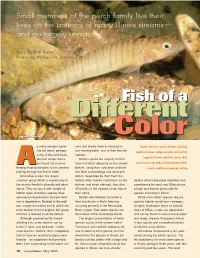
Small members of the perch family live their lives on the bottoms of many Illinois streams— and go largely unnoticed. Story By Rob Miller Photos By William N. Roston DDiiffffeeFFiirrsshheeoonnff atat Logperch darter CCoolloorr s many amateur aquar - umn, but allows them to stay put in Darters feed on a variety of items, including ists will attest, perhaps fast-moving water, one of their favorite small crustaceans, midges, mayflies and crayfish. some of the most beau - habitats. Logperch ( Percina caprodes ) can use their tiful and unique fishes Darters spend the majority of their are found not in some lives in relative obscurity on the stream snout to turn over rocks to find food and will do Afaraway tropical paradise, but in streams bottom, using their coloration to blend A so quite readily in an aquarium setting. running through the Prairie State. into their surroundings and avoid pre - Diminutive in size, this largely dation. Supported by their front fins, unknown group of fish is second only to darters often remain motionless on the darters which have pallid coloration and the minnow family in diversity and abun - bottom, and when alarmed, they dart a preference for sand; and Etheostoma , dance. They occupy a wide variety of off quickly to the nearest cover, hence a large and diverse genus with 16 habitat types, but many species have their name. species occurring in Illinois. specialized requirements and are sensi - Darters are relatively restricted in While most darter species require tive to degradation. Related to the wall - their distribution in North America, specific habitat conditions—swamps, eye, sauger and yellow perch, which are occurring primarily in the Mississippi sloughs, backwater areas or specific more familiar to most anglers, this group River system. -

OCCASIONAL PAPERS of the MUSEUM of ZOOLOGY UNIVERSITY of MICHIGAN Asx ARBOR,MICHIGAN
OCCASIONAL PAPERS OF THE MUSEUM OF ZOOLOGY UNIVERSITY OF MICHIGAN Asx ARBOR,MICHIGAN ETHEOSTOAPA ACUTICEPS, .A NET41 DARTER FROM THE TENNESSEE RIVER SYSTEM, TWITH REMARKS ON THE SUBGENUS NOTHOATOTUS PRIOR10 the impoundment of the South Fork of thc I-Iolston River, Tennessee, a qualitative fish survey oT the area to be inundated was conducted by a party representing the Tennessee Valley Authority, the Tennessee Department of Conservation, and The University of Michigan. On the last day of field operations, September, 1947, two specimens of an undescribed darter were secured. In an attempt to obtain additional material the locality was revisited in June, 1949, by Gerald P. Cooper, John D. Kilby, and myself. Low water made success possible, because we found that the species was apparently confined to the deeper, faster riffles near the center of the stream. The darter was so rare that only four individuals were seined in three hours. The South Holston Reservoir is now full and the only known locality for Etheostomn acuticeps lies beneath 190 feet of water. Since it is unlikely that this swift-water species can tolerate quiet water, it is hoped that other stations of occurrence may be disco~.ered.To my companions in the field work, the late R. W. Eschmeyer, then with the Tennessee Valley Authority, Jack Chance, formerly with the Tennessee Department of Conservation, Gerald P. Cooper, Michigan Department of Conservation, and John D. Kilby, University of Flor- ida, I am sincerely grateful. For several years I have been assembling data leading toward a revision of the bluebreast darters (subgenus Nothonotus). -

Proceedings of the United States National Museum
Proceedings of the United States National Museum SMITHSONIAN INSTITUTION . WASHINGTON, D.C. Volume 119 1966 Number 3550 CATALOG OF TYPE SPECIMENS OF THE DARTERS (PISCES, PERCIDAE, ETHEOSTOMATINI) ^ By Bruce B. Collette and Leslie W. Knapp ^ Introduction The darters are a tribe of small freshwater fishes restricted to North America. Some 212 specific and subspecific names have been pro- posed for the approximately 100 vahd described species. About a dozen species await description. As part of a long-term study of these fishes, we have prepared this catalog of type specimens. We hope that our efforts will be of value in furthering systematic research and stabilizing the nomenclature of this most fascinating group of North American fishes. In preparing this catalog we have attempted to examine or at least to verify the location of the type specimens of all nominal forms of the three presently recognized genera of darters: Percina, Ammo- crypta, and Etheostoma. By type specimens we mean holotypes, lectotypes, syntypes, paralectotypes, and paratypes. Each form is ' Fifth paper in a series on the systematics of the Percidae by the senior author. 2 Collette: Assistant Laboratory Director, Bureau of Commercial Fisheries Ichthyological Laboratory, Division of Fishes, U.S. National Museum; Knapp: Supervisor in charge of vertebrates, Oceanographic Sorting Center, Smithsonian Institution. a 2 PROCEEDINGS OF THE NATIONAL MUSEUM vol. 119 listed in alphabetical order by the generic and specific name used in the original description. If subgeneric allocation was made in the original description, that name has been placed in parentheses between the genus and the species. Holotypes or lectotypes are listed before paratypes or paralectotypes. -
Proceedings of the Indiana Academy of Science 1 1 8(2): 143—1 86
2009. Proceedings of the Indiana Academy of Science 1 1 8(2): 143—1 86 THE "LOST" JORDAN AND HAY FISH COLLECTION AT BUTLER UNIVERSITY Carter R. Gilbert: Florida Museum of Natural History, University of Florida, Gainesville, Florida 32611 USA ABSTRACT. A large fish collection, preserved in ethanol and assembled by Drs. David S. Jordan and Oliver P. Hay between 1875 and 1892, had been stored for over a century in the biology building at Butler University. The collection was of historical importance since it contained some of the earliest fish material ever recorded from the states of South Carolina, Georgia, Mississippi and Kansas, and also included types of many new species collected during the course of this work. In addition to material collected by Jordan and Hay, the collection also included specimens received by Butler University during the early 1880s from the Smithsonian Institution, in exchange for material (including many types) sent to that institution. Many ichthyologists had assumed that Jordan, upon his departure from Butler in 1879. had taken the collection. essentially intact, to Indiana University, where soon thereafter (in July 1883) it was destroyed by fire. The present study confirms that most of the collection was probably transferred to Indiana, but that significant parts of it remained at Butler. The most important results of this study are: a) analysis of the size and content of the existing Butler fish collection; b) discovery of four specimens of Micropterus coosae in the Saluda River collection, since the species had long been thought to have been introduced into that river; and c) the conclusion that none of Jordan's 1878 southeastern collections apparently remain and were probably taken intact to Indiana University, where they were lost in the 1883 fire. -

Geological Survey of Alabama Calibration of The
GEOLOGICAL SURVEY OF ALABAMA Berry H. (Nick) Tew, Jr. State Geologist ECOSYSTEMS INVESTIGATIONS PROGRAM CALIBRATION OF THE INDEX OF BIOTIC INTEGRITY FOR THE SOUTHERN PLAINS ICHTHYOREGION IN ALABAMA OPEN-FILE REPORT 1210 by Patrick E. O'Neil and Thomas E. Shepard Prepared in cooperation with the Alabama Department of Environmental Management and the Alabama Department of Conservation and Natural Resources Tuscaloosa, Alabama 2012 TABLE OF CONTENTS Abstract ............................................................ 1 Introduction.......................................................... 2 Acknowledgments .................................................... 6 Objectives........................................................... 7 Study area .......................................................... 7 Southern Plains ichthyoregion ...................................... 7 Methods ............................................................ 9 IBI sample collection ............................................. 9 Habitat measures............................................... 11 Habitat metrics ........................................... 12 The human disturbance gradient ................................... 16 IBI metrics and scoring criteria..................................... 20 Designation of guilds....................................... 21 Results and discussion................................................ 23 Sampling sites and collection results . 23 Selection and scoring of Southern Plains IBI metrics . 48 Metrics selected for the