Iraq After the Surge I: the New Sunni Landscape
Total Page:16
File Type:pdf, Size:1020Kb
Load more
Recommended publications
-

Ambtsbericht Veiligheidssituatie in Irak
Ambtsbericht Veiligheidssituatie in Irak Datum September 2014 Pagina 1 van 61 Ambtsbericht Veiligheidssituatie in Irak | september 2014 Colofon Plaats Den Haag Opgesteld door Cluster Ambtsberichten en Terugkeer Redacteur(en): CAT Pagina 2 van 61 Ambtsbericht Veiligheidssituatie in Irak | september 2014 Inhoudsopgave Colofon ......................................................................................................2 Inhoudsopgave ............................................................................................3 Inleiding .....................................................................................................4 1 Politieke context ...................................................................................... 7 2 Veiligheidssituatie...................................................................................14 2.1 Algemeen .................................................................................................14 2.2 Bagdad..................................................................................................... 18 2.2.1 Bagdad (stad) ...........................................................................................18 2.2.2 Bagdad (provincie).....................................................................................19 2.3 Anbar.......................................................................................................20 2.4 Ninewa.....................................................................................................22 2.5 Salaheddin................................................................................................25 -

Homeland, Identity and Wellbeing Amongst the Beni-Amer in Eritrea-Sudan and Diasporas
IM/MOBILITY: HOMELAND, IDENTITY AND WELLBEING AMONGST THE BENI-AMER IN ERITREA-SUDAN AND DIASPORAS Thesis Submitted for the Degree of Doctor of Philosophy at the University of Leicester Saeid Hmmed BSc MSc (OU) Department of Geography University of Leicester September 2017 i Abstract This thesis focuses on how mobility, identity, conceptions of homeland and wellbeing have been transformed across time and space amongst the Beni-Amer. Beni-Amer pastoralist societies inhabit western Eritrea and eastern Sudan; their livelihoods are intimately connected to livestock. Their cultural identities, norms and values, and their indigenous knowledge, have revolved around pastoralism. Since the 1950s the Beni-Amer have undergone rapid and profound socio-political and geographic change. In the 1950s the tribe left most of their ancestral homeland and migrated to Sudan; many now live in diasporas in Western and Middle Eastern countries. Their mobility, and conceptions of homeland, identity and wellbeing are complex, mutually constitutive and cannot be easily untangled. The presence or absence, alteration or limitation of one of these concepts affects the others. Qualitatively designed and thematically analysed, this study focuses on the multiple temporalities and spatialities of Beni-Amer societies. The study subjected pastoral mobility to scrutiny beyond its contemporary theoretical and conceptual framework. It argues that pastoral mobility is currently understood primarily via its role as a survival system; as a strategy to exploit transient concentration of pasture and water across rangelands. The study stresses that such perspectives have contributed to the conceptualization of pastoral mobility as merely physical movement, a binary contrast to settlement; pastoral societies are therefore seen as either sedentary or mobile. -

Temple in Jerusalem Coordinates: 31.77765, 35.23547 from Wikipedia, the Free Encyclopedia
Log in / create account article discussion edit this page history Temple in Jerusalem Coordinates: 31.77765, 35.23547 From Wikipedia, the free encyclopedia Bet HaMikdash ; "The Holy House"), refers to Part of a series of articles on ,שדקמה תיב :The Temple in Jerusalem or Holy Temple (Hebrew a series of structures located on the Temple Mount (Har HaBayit) in the old city of Jerusalem. Historically, two Jews and Judaism navigation temples were built at this location, and a future Temple features in Jewish eschatology. According to classical Main page Jewish belief, the Temple (or the Temple Mount) acts as the figurative "footstool" of God's presence (Heb. Contents "shechina") in the physical world. Featured content Current events The First Temple was built by King Solomon in seven years during the 10th century BCE, culminating in 960 [1] [2] Who is a Jew? ∙ Etymology ∙ Culture Random article BCE. It was the center of ancient Judaism. The Temple replaced the Tabernacle of Moses and the Tabernacles at Shiloh, Nov, and Givon as the central focus of Jewish faith. This First Temple was destroyed by Religion search the Babylonians in 587 BCE. Construction of a new temple was begun in 537 BCE; after a hiatus, work resumed Texts 520 BCE, with completion occurring in 516 BCE and dedication in 515. As described in the Book of Ezra, Ethnicities Go Search rebuilding of the Temple was authorized by Cyrus the Great and ratified by Darius the Great. Five centuries later, Population this Second Temple was renovated by Herod the Great in about 20 BCE. -

Title: Location: Date: Artist: Period/Style: Patron
TITLE:Buddha LOCATION:Bamiyan, Afghanistan DATE: C. 400-800 C.E. ARTIST: PERIOD/STYLE: Gandharan PATRON: MATERIAL/TECHNIQUE:Cut sandstone with plaster and polychrome paint. FORM: Details such as facial features and hands were modeled using mud mixed with straw and then coated with stucco and painted bright colors. Stucco is a kind of plaster that is sometimes put on the exterior of houses as a protective coating against the elements. The stucco wore off long ago, but we do know that the larger Buddha figure was painted a deep red and the smaller Buddha was multi-colored with both jewels and copper. The legs were carved in the round which allowed for circumambulation. FUNCTION: The Silk Road comprosed an overland network of trade routes linking China and Central Asia with India and ultimately the Medi- terranean Sea. The Bamiyan Valley’s fertile fields attracted merchants and Buddhist missionaries. Thus between 500 and 750, the region served as both a commercial hub and an important Buddhist spiritual center. CONTENT: The Bamiyan Buddhas served as centerpieces of a flourishing Buddhist community. Both statues manifested the power and piety of their royal benefactors. Visible for miles, they provided pilgrims and merchants with a dramatic reminder to follow Buddhist practices, The two timeless images also marked a momentous development in Buddhist art. The gigantic Bamiyan statues represented Buddha as more than a gifted teacher; he was now presented as a guiding, enduring, and universal spiritual presence. CONTEXT: Bamiyan was situated right on the Silk Route as it went through the Hindu Kush mountain region in the Bamiyan valley of Afghanistan. -
What the Pen Reveals About the Sword: Rhetoric-Based Mapping of Insurgency Factional Structure in Iraq
What the Pen Reveals About the Sword: Rhetoric-Based Mapping of Insurgency Factional Structure in Iraq Michael Gabbay Information Systems Laboratories, Inc. 200 W. Mercer St., Ste 410 Seattle, WA 98119 mgabbay@islinc.com Paper presented at the Annual Meeting of the International Studies Association March 28, 2008 Note: A condensed version of this paper appeared as \Mapping the Structure of the Sunni Insurgency in Iraq," CTC Sentinel, 1(4):10{12, March 2008 ISL What the Pen Reveals About the Sword M. Gabbay 1 Introduction The Iraq conflict is a complex fusion of a rebellion against foreign occu- pation and an internal civil war | a conflict that seems intent on explor- ing almost all axes of violence between its participants. Divisions within the Sunni insurgency in Iraq have critically influenced the evolution of the conflict and will no doubt bear critically upon its subsequent course and resolution. Major points of contention between nationalist-leaning insur- gents and caliphate-minded, pan-Islamic jihadists have been, among others, Sunni participation in elections, the indiscriminate targeting of Shiite civil- ians, and the nature of the threat posed by United States-backed Sunni militias, known as \awakening councils." Understanding the divisions be- tween insurgents at the level of speci¯c insurgent groups is key to devising e®ective counterinsurgency and conflict resolution strategies. In Iraq, this task is complicated by the proliferation of insurgent groups, most of whom claim an Islamist mantle, and the murky nature of their origins, composi- tion, and leadership. In this paper, we describe a quantitative methodology for constructing diagrams that characterize and clarify insurgency factional structure using insurgent rhetoric as data. -

UNIVERSITY of CENTRAL OKLAHOMA Edmond, Oklahoma Jackson College of Graduate Studies
UNIVERSITY OF CENTRAL OKLAHOMA Edmond, Oklahoma Jackson College of Graduate Studies Indiana Jones and the Displaced Daddy: Spielberg’s Quest for the Good Father, Adulthood, and God A THESIS SUBMITTED TO THE GRADUATE FACULTY in partial fulfillment of the requirements for the degree of MASTER OF ARTS IN ENGLISH 20th & 21st Century Studies, Film By Evan Catron Edmond, Oklahoma 2010 ABSTRACT OF THESIS UNIVERSITY OF CENTRAL OKLAHOMA Edmond, Oklahoma NAME: Evan Catron TITLE OF THESIS: Indiana Jones and the Displaced Daddy: Spielberg’s Quest for the Good Father, Adulthood, and God DIRECTOR OF THESIS: Dr. Kevin Hayes PAGES: 127 The Indiana Jones films define adventure as perpetual adolescence: idealized yet stifling emotional maturation. The series consequently resonates with the search for a good father and a confirmation for modernist man that his existence has “meaning;” success is always contingent upon belief. Examination of intertextual variability reveals cultural perspectives and Judaeo-Christian motifs unifying all films along with elements of inclusivism and pluralism. An accessible, comprehensive guide to key themes in all four Indiana Jones films studies the ideological imperative of Spielbergian cinema: patriarchal integrity is intimately connected with the quest for God, moral authority, national supremacy, and adulthood. iii Acknowledgements I would like to thank the professors who encouraged me to pursue the films for which I have a passion as subjects for my academic study: Dr. John Springer and Dr. Mary Brodnax, members of my committee; and Dr. Kevin Hayes, chairman of my committee, whose love of The Simpsons rivals my own. I also want to thank Dr. Amy Carrell, who always answered my endless questions, and Dr. -

Iraq CRISIS Situation Report No. 49 (17 June – 23 June 2015)
Iraq CRISIS Situation Report No. 49 (17 June – 23 June 2015) This report is produced by OCHA Iraq in collaboration with humanitarian partners. It covers the period from 17 – 23 June. Due to the rapidly changing situation it is possible that the numbers and locations listed in this report may no longer be accurate. The next report will be issued on or around 3 July. Highlights More than 1,500 families return to Tikrit. Returnees need humanitarian assistance Close to 300,000 individuals displaced from Ramadi since 8 April NGOs respond to Sulaymaniyah checkpoint closures Concern over humanitarian conditions in Ameriyat al-Fallujah and Habbaniya Insufficient funding continues to limit humanitarian response capacity The boundaries and names shown and the designations used on this map do not imply official endorsement or acceptance by the United Nations. Map created 25 June 2015. Situation Overview More than 1,500 families (approximately 9,000 individuals) returned to Tikrit City and surrounding areas between 14 and 23 June, after the area was retaken by Iraqi Security Forces in April, according to the Displacement Tracking Matrix (DTM) of the International Organization for Migration (IOM). Most of those who returned were Government civil servants who were requested to return. Approximately 80 per cent of Government employees have gone back to the area, local authorities report. Returnees reportedly were required to submit to ID checks, body and vehicle searches before being allowed through manned checkpoints. Authorities have reportedly dismantled 1,700 improvised explosive devices (IEDs) and cleared more than 200 booby-trapped houses. The recent returns brings the estimated total number of returnees in Tikrit District to 16,384 families (over 98,000 individuals), according to a partner NGO. -

CTX Vol 2 No 4
Vol. 2, No. 4 | CTX EDITORIAL STAFF From the Editor MICHAEL FREEMAN Executive Editor Welcome to our first special issue of CTX, “Social Media in Jihad and ANNA SIMONS Executive Editor Counterterrorism,” which is devoted to a wide-ranging exploration of social ELIZABETH SKINNER Managing Editor media and counterterrorism. Social media have become valuable tools for RYAN STUART Design & Layout combating crime and terrorism. According to LexisNexis® Risk Solutions, four out of five respondents to their survey of law enforcement professionals EDITORIAL REVIEW BOARD reported using social media, particularly Facebook and YouTube, to aid VICTOR ASAL investigations. One officer said he believed his department’s use of social University at Albany SUNY media allowed personnel to defuse a terrorist threat involving students at a ALEJANDRA BOLANOS local high school. Two-thirds said they thought access to social media helps National Defense University solve crimes more quickly. LAWRENCE CLINE Naval Postgraduate School To better understand the role of social media in combating terrorism, the Naval Postgraduate School (NPS) in Monterey, California held a small STEPHEN DI RIENZO workshop on Social Media and Counterterrorism this past June. Sponsored National Intelligence University by the Combating Terrorism Fellowship Program, the workshop brought SAJJAN GOHEL together a diverse group of people, including researchers, law enforcement Asia Pacific Foundation and military officers, and media experts from the United States, Ireland, and SEBASTIAN GORKA the Philippines. Participants were invited to submit papers for inclusion in National Defense University this special issue of CTX. JAKUB GRYGIEL School of Advanced International We are delighted to present here six papers that we received from partici- Studies pants of the workshop. -
IRAQ, YEAR 2019: Update on Incidents According to the Armed Conflict Location & Event Data Project (ACLED) Compiled by ACCORD, 23 June 2020
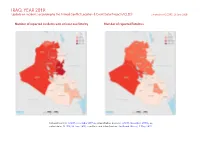
IRAQ, YEAR 2019: Update on incidents according to the Armed Conflict Location & Event Data Project (ACLED) compiled by ACCORD, 23 June 2020 Number of reported incidents with at least one fatality Number of reported fatalities National borders: GADM, November 2015a; administrative divisions: GADM, November 2015b; in- cident data: ACLED, 20 June 2020; coastlines and inland waters: Smith and Wessel, 1 May 2015 IRAQ, YEAR 2019: UPDATE ON INCIDENTS ACCORDING TO THE ARMED CONFLICT LOCATION & EVENT DATA PROJECT (ACLED) COMPILED BY ACCORD, 23 JUNE 2020 Contents Conflict incidents by category Number of Number of reported fatalities 1 Number of Number of Category incidents with at incidents fatalities Number of reported incidents with at least one fatality 1 least one fatality Explosions / Remote Conflict incidents by category 2 1282 452 1253 violence Development of conflict incidents from 2016 to 2019 2 Protests 845 12 72 Battles 719 541 1735 Methodology 3 Riots 242 72 390 Conflict incidents per province 4 Violence against civilians 191 136 240 Strategic developments 190 6 7 Localization of conflict incidents 4 Total 3469 1219 3697 Disclaimer 7 This table is based on data from ACLED (datasets used: ACLED, 20 June 2020). Development of conflict incidents from 2016 to 2019 This graph is based on data from ACLED (datasets used: ACLED, 20 June 2020). 2 IRAQ, YEAR 2019: UPDATE ON INCIDENTS ACCORDING TO THE ARMED CONFLICT LOCATION & EVENT DATA PROJECT (ACLED) COMPILED BY ACCORD, 23 JUNE 2020 Methodology on what level of detail is reported. Thus, towns may represent the wider region in which an incident occured, or the provincial capital may be used if only the province The data used in this report was collected by the Armed Conflict Location & Event is known. -
Contrasting the Challenges of Liberating Fallujah and Mosul by Zana Gulmohamad
OCTOBER 2016 CTC SENTINEL 1 Unseating the Caliphate: Contrasting the Challenges of Liberating Fallujah and Mosul By Zana Gulmohamad This article draws on interviews1 with key Iraqi political and mil- The successful liberation of Fallujah from the Islamic itary players, including in Anbar and Nineveh, to outline and assess State by a constellation of Iraqi forces in June provides the operation that recaptured Fallujah in June and to compare and pointers for the more challenging mission of liberating contrast the challenges faced there with those of the just launched the much larger city of Mosul. Relatively efective co- Mosul ofensive. It analyses the constellation of forces set to march ordination of Iraqi forces, coalition airpower, and vital on the northern Iraqi city, the Islamic State’s ability to defend the intelligence from Sunni tribes and townspeople led to city, and the political and military dynamics that will determine the ultimate success and failure of the war in Iraq against the Islamic the Islamic State being driven out more quickly than ex- State. pected, despite the fact that an unauthorized incursion by Shi`a militias risked compromising the ofensive, as Part 1: The Fallujah Operation well as attempts to secure and rebuild the town. Mosul will be harder to take because Islamic State fighters are Why Fallujah Was First less likely to flee in large numbers. It may be possible to Fallujah, 37 miles west of Baghdad, is the second-largest city in make significant progress in the coming weeks because of Anbar governorate and was the second most symbolic territorial weakening Islamic State capabilities and morale and the prize in Iraq for the Islamic State.2 The Iraqi government’s deci- emergence of resistance forces in the city providing key sion to liberate Fallujah first, despite U.S. -

Nighthawks Over Iraq: a Chronology of the F-117A Stealth Fighter in Operations Desert Shield and Desert Storm
NIGHTHAWKS OVER IRAQ: A CHRONOLOGY OF THE F-117A STEALTH FIGHTER IN OPERATIONS DESERT SHIELD AND DESERT STORM SPECIAL STUDY: 37FW/H0-91-1 SAUDI ARABIA OFFICE OF HISTORY HEADQUARTERS 37TH FIGHTER WING TWELFTH AIR FORCE TACTICAL AIR COMMAND ..,..... - . WlAI . t&WCfW¥ . 0 '~ j Nighthawks Over Iraq: A Chronology of the F-117A Stealth Fighter : ... in Operations Desert Shield and Desert Storm Special Study: 37FW/H0-91-l Compiled by: HAROLD P. MYERS, SMSgt (Ret) Historian Revised & Edited by: Reviewed by: ~~~-· VINCENT ~~R~~ ALTON C. WHITLEY SMSgt, USAF Colonel, USAF I Historian Commander Office of History Headquarters 37th Fighter Wing Twelfth Air Force Tactical Air Command Preface This unclassified account of the 37th Tactical Fighter Wing's accomplishments during Operations DESERT SHIELD and DESERT STORM was prepared to permit members of the "Team Stealth" community to reflect with pride on their contribu tion to sustained world peace. They proved their mettle in battle and have earned the title of American warrior. It is a testament to their love for country and their willingness to sacrifice for the ideals they defend every day of their lives. The peoples of the United States and the entire Free World are forever in their debt. Nighthawks Over Iraq is based entirely on the contingency historical reports developed by SMSgt Phil Myers during his visit to Saudi Arabia as historian of the 37th Tactical Fighter Wing and the mission tally sheets developed by the wing's operations network. 2 On 5 October 1989, the 37th Tactical Fighter Wing (TFW) relocated to Tonopah Test Range, Nevada, to take up the role as the Air Force's only Stealth Fighter unit. -
Preparatory Surevey Report on the Construction and Development of Telecommunications Network for Major Provinces in Iraq
Republic of Iraq Ministry of Communications Iraqi Telecommunications and Post Company State Company for Internet Service PREPARATORY SUREVEY REPORT ON THE CONSTRUCTION AND DEVELOPMENT OF TELECOMMUNICATIONS NETWORK FOR MAJOR PROVINCES IN IRAQ MARCH 2011 JAPAN INTERNATIONAL COOPERATION AGENCY NIPPON KOEI CO., LTD. 42 44 46 48 ° Hakkâri ° Lake Urmia ° ° TURKEY Orumiyeh Mianeh Q e (Umia) ze l O Zakhu wz DAHUK an Al Qamishli Dahuk Miandowab 'Aqrah Rayat Zanjan ab Z t ARBIL Mosul A Sinjar a re Tall 'Afar G S 36 Ar Raqqah Arbil S ° U NINAWA 36° L r Kuysanjaq - u Al Qayyarah A - b Makhmur a Y h M K l Al Hadr a A As r b N h a Sulaymaniyah a Z e AT I Sanandaj Dayr az Zawr N l Kirkuk Y itt L A Halabjah TA'MIM H SYRIAN ARAB Bayji N T a ISLAMIC REPUBLIC OF i hr Tawuq g a r l á REPUBLIC is 'U - l a z y Hamadan a i y m D s r IRAN rate Buhayrat al h Euph - SALAH AD a Abu Kamal Qadisiyah N Anah DIN Qasr-e Shirin A l Khanaqin Kermanshah Thartha Samarra' 34 Q ° a Al Hadithah Lake DIYALA 34 'im - ° - Borujerd Al H Ba'qubah abba Akashat ni - Hit ya Al Walid wran h Ilam Ha - -i R -- - i Ar Ramadi Baghdad u- Khorramabad ad dh W ha- Habbaniyah h BAGHDAD ne ja h-y Lake u Mehran e S - a ll im Al F ar Ar Rutbah AL ANBAR eh -i Trebil - Gha¸daw - di al Razzaza WASIT Dehloran Wa - - Lake Karbala' BABIL Shaykh Sa'd Al Hillah KARBALA'- Al Kut JORDAN 'Ali al Gharbi Dezful Al Hayy MAYSAN bayyid 32 -i al U ¸ ° -ad Ad Diwaniyah 32 W Nukhayb An Najaf ° - S Al 'Amarah h Abu Sukhayr T AL QADISIYAH a i t Qal'at Sukkar g t r a i s - l Qal'at Salih DHI QAR Judayyidat 'Ar'ar Qaryat