Hymenoptera: Braconidae)
Total Page:16
File Type:pdf, Size:1020Kb
Load more
Recommended publications
-

Title Butterflies Collected in and Around Lambir Hills National Park
Butterflies collected in and around Lambir Hills National Park, Title Sarawak, Malaysia in Borneo ITIOKA, Takao; YAMAMOTO, Takuji; TZUCHIYA, Taizo; OKUBO, Tadahiro; YAGO, Masaya; SEKI, Yasuo; Author(s) OHSHIMA, Yasuhiro; KATSUYAMA, Raiichiro; CHIBA, Hideyuki; YATA, Osamu Contributions from the Biological Laboratory, Kyoto Citation University (2009), 30(1): 25-68 Issue Date 2009-03-27 URL http://hdl.handle.net/2433/156421 Right Type Departmental Bulletin Paper Textversion publisher Kyoto University Contn bioL Lab, Kyoto Univ., Vot. 30, pp. 25-68 March 2009 Butterflies collected in and around Lambir Hills National ParK SarawaK Malaysia in Borneo Takao ITioKA, Takuji YAMAMo'rD, Taizo TzucHiyA, Tadahiro OKuBo, Masaya YAGo, Yasuo SEKi, Yasuhiro OHsHIMA, Raiichiro KATsuyAMA, Hideyuki CHiBA and Osamu YATA ABSTRACT Data ofbutterflies collected in Lambir Hills National Patk, Sarawak, Malaysia in Borneo, and in ks surrounding areas since 1996 are presented. In addition, the data ofobservation for several species wimessed but not caught are also presented. In tota1, 347 butterfly species are listed with biological information (habitat etc.) when available. KEY WORDS Lepidoptera! inventory1 tropical rainforesti species diversity1 species richness! insect fauna Introduction The primary lowland forests in the Southeast Asian (SEA) tropics are characterized by the extremely species-rich biodiversity (Whitmore 1998). Arthropod assemblages comprise the main part of the biodiversity in tropical rainforests (Erwin 1982, Wilson 1992). Many inventory studies have been done focusing on various arthropod taxa to reveal the species-richness of arthropod assemblages in SEA tropical rainforests (e.g. Holloway & lntachat 2003). The butterfly is one of the most studied taxonomic groups in arthropods in the SEA region; the accumulated information on the taxonomy and geographic distribution were organized by Tsukada & Nishiyama (1980), Yata & Morishita (1981), Aoki et al. -
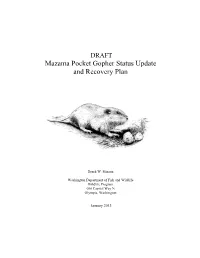
2013 Draft Mazama Pocket Gopher Status Update and Recovery Plan
DRAFT Mazama Pocket Gopher Status Update and Recovery Plan Derek W. Stinson Washington Department of Fish and Wildlife Wildlife Program 600 Capitol Way N Olympia, Washington January 2013 In 1990, the Washington Wildlife Commission adopted procedures for listing and de-listing species as endangered, threatened, or sensitive and for writing recovery and management plans for listed species (WAC 232-12-297, Appendix A). The procedures, developed by a group of citizens, interest groups, and state and federal agencies, require preparation of recovery plans for species listed as threatened or endangered. Recovery, as defined by the U.S. Fish and Wildlife Service, is the process by which the decline of an endangered or threatened species is arrested or reversed, and threats to its survival are neutralized, so that its long-term survival in nature can be ensured. This is the Draft Washington State Status Update and Recovery Plan for the Mazama Pocket Gopher. It summarizes what is known of the historical and current distribution and abundance of the Mazama pocket gopher in Washington and describes factors affecting known populations and its habitat. It prescribes strategies to recover the species, such as protecting populations and existing habitat, evaluating and restoring habitat, and initiating research and cooperative programs. Target population objectives and other criteria for down-listing to state Sensitive are identified. As part of the State’s listing and recovery procedures, the draft recovery plan is available for a 90-day public comment period. Please submit written comments on this report by 19 April 2013 via e-mail to: TandEpubliccom@dfw.wa.gov, or by mail to: Endangered Species Section Washington Department of Fish and Wildlife 600 Capitol Way North Olympia, WA 98501-1091 This report should be cited as: Stinson, D. -

A Compilation and Analysis of Food Plants Utilization of Sri Lankan Butterfly Larvae (Papilionoidea)
MAJOR ARTICLE TAPROBANICA, ISSN 1800–427X. August, 2014. Vol. 06, No. 02: pp. 110–131, pls. 12, 13. © Research Center for Climate Change, University of Indonesia, Depok, Indonesia & Taprobanica Private Limited, Homagama, Sri Lanka http://www.sljol.info/index.php/tapro A COMPILATION AND ANALYSIS OF FOOD PLANTS UTILIZATION OF SRI LANKAN BUTTERFLY LARVAE (PAPILIONOIDEA) Section Editors: Jeffrey Miller & James L. Reveal Submitted: 08 Dec. 2013, Accepted: 15 Mar. 2014 H. D. Jayasinghe1,2, S. S. Rajapaksha1, C. de Alwis1 1Butterfly Conservation Society of Sri Lanka, 762/A, Yatihena, Malwana, Sri Lanka 2 E-mail: himesh.jayasinghe1@gmail.com Abstract Larval food plants (LFPs) of Sri Lankan butterflies are poorly documented in the historical literature and there is a great need to identify LFPs in conservation perspectives. Therefore, the current study was designed and carried out during the past decade. A list of LFPs for 207 butterfly species (Super family Papilionoidea) of Sri Lanka is presented based on local studies and includes 785 plant-butterfly combinations and 480 plant species. Many of these combinations are reported for the first time in Sri Lanka. The impact of introducing new plants on the dynamics of abundance and distribution of butterflies, the possibility of butterflies being pests on crops, and observations of LFPs of rare butterfly species, are discussed. This information is crucial for the conservation management of the butterfly fauna in Sri Lanka. Key words: conservation, crops, larval food plants (LFPs), pests, plant-butterfly combination. Introduction Butterflies go through complete metamorphosis 1949). As all herbivorous insects show some and have two stages of food consumtion. -
A Preliminary List of Lepidopteran Insects from Palkot Wildlife
Journal of Entomology and Zoology Studies 2017; 5(3): 654-661 E-ISSN: 2320-7078 P-ISSN: 2349-6800 A preliminary list of lepidopteran insects from JEZS 2017; 5(3): 654-661 © 2017 JEZS Palkot Wildlife Sanctuary, Jharkhand Received: 01-03-2017 Accepted: 02-04-2017 Navneet Singh Navneet Singh and Jalil Ahmad Zoological Survey of India, Gangetic Plains Regional Centre, Abstract Sector-8, Bahadurpur Housing Colony, Patna-800 026, Bihar, The present research paper deals with the preliminary data on the diversity of Lepidopteran insects of India Palkot WLS. The information is based on a survey tour conducted during October 11-13, 2015. Around 0 the Palkot three sites were selected for the collection. Two sites were selected on Gobarsilli (22 53.058N, 0 0 0 Jalil Ahmad 084 39.229E), and one site was selected on Kura Pahar (22 51.621 N, 084 38.123 E).The collection Zoological Survey of India, survey and identification yielded a total of 89 species of Lepidoptera including 30 species of Butterflies Gangetic Plains Regional Centre, under 26 genera and 59 species of Moths under 42 genera. As far as Butterflies are concerned, Sector-8, Bahadurpur Housing Nymphalidae with 64% of total reported Butterflies dominated the group whereas, in moths, Erebidae Colony, Patna-800 026, Bihar, dominated with 73% of the collected moth species. India Keywords: Inventory, Lepidoptera, Jharkhand, Gumla, Palkot Wildlife Sanctuary 1. Introduction The Palkot Wildlife Sanctuary falls within the districts of Gumla and Simdega of state of 0 0 0 0 [1] Jharkhand and lies between 22 45’N and 23 N longitude and 84 30’E to 84 45E latitude . -

Download Download
OPEN ACCESS The Journal of Threatened Taxa is dedicated to building evidence for conservaton globally by publishing peer-reviewed artcles online every month at a reasonably rapid rate at www.threatenedtaxa.org. All artcles published in JoTT are registered under Creatve Commons Atributon 4.0 Internatonal License unless otherwise mentoned. JoTT allows unrestricted use of artcles in any medium, reproducton, and distributon by providing adequate credit to the authors and the source of publicaton. Journal of Threatened Taxa Building evidence for conservaton globally www.threatenedtaxa.org ISSN 0974-7907 (Online) | ISSN 0974-7893 (Print) Communication A preliminary checklist of butterflies from the northern Eastern Ghats with notes on new and significant species records including three new reports for peninsular India Rajkamal Goswami, Ovee Thorat, Vikram Aditya & Seena Narayanan Karimbumkara 26 November 2018 | Vol. 10 | No. 13 | Pages: 12769–12791 10.11609/jot.3730.10.13.12769-12791 For Focus, Scope, Aims, Policies and Guidelines visit htps://threatenedtaxa.org/index.php/JoTT/about/editorialPolicies#custom-0 For Artcle Submission Guidelines visit htps://threatenedtaxa.org/index.php/JoTT/about/submissions#onlineSubmissions For Policies against Scientfc Misconduct visit htps://threatenedtaxa.org/index.php/JoTT/about/editorialPolicies#custom-2 For reprints contact <info@threatenedtaxa.org> Publisher & Host Partners Member Threatened Taxa Journal of Threatened Taxa | www.threatenedtaxa.org | 26 November 2018 | 10(13): 12769–12791 A preliminary -

Cynipidae, Curculionoidea E Cecidomyiidae Galligeni in Sicilia: Stato Delle Conoscenze E Nuovi Dati
Dottorato in Scienze Agrarie e Forestali Dipartimento Scienze Agrarie e Forestali Settore Scientifico Disciplinare Entomologia generale e applicata CYNIPIDAE, CURCULIONOIDEA E CECIDOMYIIDAE GALLIGENI IN SICILIA: STATO DELLE CONOSCENZE E NUOVI DATI IL DOTTORE IL COORDINATORE GIULIANO CERASA STEFANO COLAZZA IL TUTOR IL CO-TUTOR VIRGILIO CALECA BRUNO MASSA CICLO XXV ANNO 2015 Indice Introduzione …………………………………………………….………..……………….……….. 2 Scopi della ricerca ………………………………………………………………………......…...… 5 Sintesi dell’attività svolta nel triennio 2012-2014 ……………………………….……………..... 5 Elencazione e individuazione in Sicilia dei Cynipidae galligeni segnalati nei lavori di De Stefani: sinonimie e combinazioni nomenclatoriali ………………………………………………7 Capitolo 1 - Nuovi reperti di insetti galligeni ed inquilini in alcuni paesi del Mediterraneo, con note biologiche ...……….…………..………………………………….…………….………………..... 21 Capitolo 2 - Nuovi reperti di Cinipidi galligeni e inquilini per l‟Italia e la Sicilia e loro piante ospiti nuove per la Regione Paleartica …………………………………………………………………... 44 Capitolo 3 - Description of asexual generation of a new Chilaspis Mayr (Hymenoptera, Cynipidae) on Quercus suber ...………………………………………………………………………………... 61 Capitolo 4 – Nuove segnalazioni e nuove specie di cecidomidi delle galle (Diptera Cecidomyiidae) per la Sicilia ……………………………………………………………………………..………… 73 Capitolo 5 - Quattro nuovi coleotterocecidi di Sicilia e altri reperti interessanti ………..……... 106 Capitolo 6 - Nuovi lavori di Teodosio De Stefani non presenti nei precedenti elenchi -

Issn 0972- 1800
ISSN 0972- 1800 VOLUME 22, NO. 2 QUARTERLY APRIL-JUNE, 2020 Date of Publication: 28th June, 2020 BIONOTES A Quarterly Newsletter for Research Notes and News On Any Aspect Related with Life Forms BIONOTES articles are abstracted/indexed/available in the Indian Science Abstracts, INSDOC; Zoological Record; Thomson Reuters (U.S.A); CAB International (U.K.); The Natural History Museum Library & Archives, London: Library Naturkundemuseum, Erfurt (Germany) etc. and online databases. Founder Editor Manuscripts Dr. R. K. Varshney, Aligarh, India Please E-mail to petersmetacek@gmail.com. Board of Editors Guidelines for Authors Peter Smetacek, Bhimtal, India BIONOTES publishes short notes on any aspect of biology. Usually submissions are V.V. Ramamurthy, New Delhi, India reviewed by one or two reviewers. Jean Haxaire, Laplune, France Kindly submit a manuscript after studying the format used in this journal Vernon Antoine Brou, Jr., Abita Springs, (http://www.entosocindia.org/). Editor U.S.A. reserves the right to reject articles that do not Zdenek F. Fric, Ceske Budejovice, Czech adhere to our format. Please provide a contact Republic telephone number. Authors will be provided Stefan Naumann, Berlin, Germany with a pdf file of their publication. R.C. Kendrick, Hong Kong SAR Address for Correspondence Publication Policy Butterfly Research Centre, Bhimtal, Information, statements or findings Uttarakhand 263 136, India. Phone: +91 published are the views of its author/ source 8938896403. only. Email: butterflyresearchcentre@gmail.com From Volume 21 Published by the Entomological Society of India (ESI), New Delhi (Nodal Officer: V.V. Ramamurthy, ESI, New Delhi) And Butterfly Research Centre, Bhimtal Executive Editor: Peter Smetacek Assistant Editor: Shristee Panthee Butterfly Research Trust, Bhimtal Published by Dr. -

A Preliminary Observation on Butterflies of Seshachalam Biosphere Reserve, Eastern Ghats Andhra Pradesh, India
World Journal of Zoology 7 (1): 83-89, 2012 ISSN 1817-3098 © IDOSI Publications, 2012 DOI: 10.5829/idosi.wjz.2012.7.1.61323 A Preliminary Observation on Butterflies of Seshachalam Biosphere Reserve, Eastern Ghats Andhra Pradesh, India M. Bubesh Guptha, P.V. Chalapathi Rao, D. Srinivas Reddy, S.R.S.C. Sekhar Maddala and P. Madhu Babu Wildlife Management Circle, Tirupati Andhra Pradesh - 517 507, India Abstract: Seshachalam hills, one of the first Biosphere Reserve in Andhra Pradesh, located in southern Eastern Ghats of Chittoor and Kadapa districts. It is spread over 4755.99 Km2 . The vegetation is a unique mix of the dry deciduous and moist deciduous types. A detailed survey of butterflies was conducted from August 2011 to January 2012. The objective of the observation is to determine the presence of butterflies. The reserve area has different habitats like scrub jungle, open forest and trial path. Each zone was explored on the basis of possibility and availability of butterflies. A total of 50 species of butterflies were recorded under five families. The family Nymphalidae and Lycaenidae were found dominant with 20 species and 12 species, respectively, followed by Pieridae (11 species), Papilionidae (5 species) and two species from the family Hesperiidae. More number of species was observed in Talakona followed by Mamandur, Balapalli, Tirumala, Jungle Book and Divyaram. Observed species were grouped in five categories on basis of number of sighting in the field. The butterflies were categorized as Very Common (VC) 40% (20 species), Common (C) 36% 18 species, Uncommon (UC) 10% (5 species), Occasional (O) 8 % (4 species) and Rare (R) 6 % (3 species). -

Promylea Lunigerella Glendella Dyar (Pyralidae) Feeds on Both Conifers
This file was created by scanning the printed publication. Errors identified by the software have been corrected; however, some errors may remain. Journal of the Lepidopterists' Society 57(1 ),2003,47-53 PROMYLEA LUNIGERELLA GLENDELLA DYAR (PYRALIDAE) FEEDS ON BOTH CONIFERS AND PARASITIC DWARF MISTLETOE (ARCEUTHOBIUM SPP.): ONE EXAMPLE OF FOOD PLANT SHIFTING BETWEEN PARASITIC PLANTS AND THEIR HOSTS KAlLEN A, MOONEY Department of EPO Riology, University of Colorado [Boulder 1. Boulder, Colorado 80309-0334, USA, Email: kailen.mooney@colorado.edu ABSTRACT, Larvae of Pmmylea lunigerella glendella Dyar (Pyralidae, Phycitinae) feed on Arceuthohium vaginatum SU5p. cryptopodum (Hawks,) (Viscaceae), the Southwestern dwarf mistletoe, a parasite of Pinus ponderosa (Laws. ) scopulorllm (Pinaceae) at the Manitou Experi mental Forest, U,S,D.A, Rocky Mountain Research Station, Woodland Park, Colorado, A previous food plant record for P. lunigerella describes the laIvae as feeding on a variety of conifers. A careful evaluation of this record suggests it is reliable, and I conclude that P. lunigerella is actively shifting between dwarf mistletoe and conifer feeding, or has done 50 recently. My review of the literature on food plant use by lepidopteran her bivores of dwarf mistletoe and their relatives suggests that food plant shifts between parasitic plants and their hosts, and vice versa, have oc curred multiple times and may be common among taxa that fced on parasitic and parasitized plants. These findings support a model of food plant shifting in which the close proximity necessarily maintained by paraSitic plants and their hosts provides an ecological opportunity that fa cilitates food plant shifts between these taxonomically and chemically very dissimilar plants, Finally, I describe the life history of P. -

Butterfly Diversity of Phansad – Preliminary Study
100 Butterfly diversity of Phansad – Preliminary study Amol P Patwardhan Department of Zoology, K. J. Somaiya College of Science and Commerce, Vidyavihar, Mumbai 400077, Maharashtra, India. Email: amolppatwardhan@gmail.com Abstract: Total 153 species of butterflies distributed in five families have been reported from Phansad wildlife sanctuary. Further to this there are seven species which might be existing in the area. Nymphalidae and Lycaenidae were the co-dominant families with 47 species each. Pieridae represented by 17 species, Hesperidae by 31 species and Papilionidae by 11 species. Key words : Phansad, butterflies Introduction Results and discussion Phansad wildlife sanctuary (73.05908°N 18.3441°E) is Total 153 species distributed in five families have been located in Raigad district of the Konkan region of identified from the study area. Lycaenidae and Nymphalidae Maharashtra. It is spread over 6979 hectares. It was declared were co-dominant family with 47 species each (30.72% each) as sanctuary in 1986. Before independence it was the private followed by Hesperidae 31 species (20.26%), Pieridae 17 hunting ground of the Nawabs of the princely state of Murud species (11.11%). The swallowtail family was the least diverse Janjira. Some parts of the sanctuary touch the Arabian Sea. with 11 species (7.19%). (Fig. 1) Geographically it can roughly be divided into north and south part; the arm extending north north west of Supegaon 8 and the other arm extending south south east of Supegaon. 8 8 The primary forest type is moist deciduous dominated by :]1C1QJ1R:V Anjani Memecylon umbalatum. On the western boundary 1V`1R:V are some regions of broad leaved forest dominated by Teak 7H:VJ1R:V Tectona grandis. -

Global Journal of Science Frontier Research: C Biological Science Botany & Zology
Online ISSN : 2249-4626 Print ISSN : 0975-5896 DOI : 10.17406/GJSFR DiversityofButterflies RevisitingMelaninMetabolism InfluenceofHigh-FrequencyCurrents GeneticStructureofSitophilusZeamais VOLUME20ISSUE4VERSION1.0 Global Journal of Science Frontier Research: C Biological Science Botany & Zology Global Journal of Science Frontier Research: C Biological Science Botany & Zology Volume 20 Issue 4 (Ver. 1.0) Open Association of Research Society Global Journals Inc. © Global Journal of Science (A Delaware USA Incorporation with “Good Standing”; Reg. Number: 0423089) Frontier Research. 2020 . Sponsors:Open Association of Research Society Open Scientific Standards All rights reserved. This is a special issue published in version 1.0 Publisher’s Headquarters office of “Global Journal of Science Frontier Research.” By Global Journals Inc. Global Journals ® Headquarters All articles are open access articles distributed 945th Concord Streets, under “Global Journal of Science Frontier Research” Framingham Massachusetts Pin: 01701, Reading License, which permits restricted use. United States of America Entire contents are copyright by of “Global USA Toll Free: +001-888-839-7392 Journal of Science Frontier Research” unless USA Toll Free Fax: +001-888-839-7392 otherwise noted on specific articles. No part of this publication may be reproduced Offset Typesetting or transmitted in any form or by any means, electronic or mechanical, including G lobal Journals Incorporated photocopy, recording, or any information storage and retrieval system, without written 2nd, Lansdowne, Lansdowne Rd., Croydon-Surrey, permission. Pin: CR9 2ER, United Kingdom The opinions and statements made in this book are those of the authors concerned. Packaging & Continental Dispatching Ultraculture has not verified and neither confirms nor denies any of the foregoing and no warranty or fitness is implied. -

The Insect Microcosm of Western Juniper Berries by Lindsay A
The Insect Microcosm of Western Juniper Berries By Lindsay A. Dimitri, Kirk C. Tonkel, William S. Longland, and Brian G. Rector On the Ground closure reducing availability of herbaceous understory plants • Expansion of western juniper has been a major to livestock and wildlife, and intense wildfires that result in concern of ranchers and managers working on conversion to invasive annual grasslands. Extensive efforts rangelands. have been made to remove western juniper and restore the • Insects and mites associated with juniper berries shrublands being replaced. Management practices such as can impact juniper seed production, but little is prescribed burning, mechanical removal (chaining, felling known about arthropods inhabiting western juni- with chainsaws) and herbicides are used to thin or eliminate per or their effects on seeds. juniper in a given area. Despite the extensive literature de- • Our study of insects and other arthropods found tailing western juniper expansion, there are many aspects of inside juniper berries at two sites in northeastern its ecology that remain understudied, including interactions California found 37 species of insects and one with seed predators and seed dispersers that are potentially mite species, ranging from those that eat berries important aspects of the ongoing expansion. Like other juni- or seeds to parasitoid insects that develop from per species, western juniper does not reproduce vegetatively eggs laid inside other insects, ultimately killing (for example, by root sprouting), so this expansion is exclu- their host, and hyperparasitoids that parasitize sively attributable to the establishment of new seedlings. other parasitoids. Therefore, documenting the seed and seedling ecology of • We identified several granivores that consume western juniper is essential to understanding the rapid ex- western juniper seeds and, when abundant, may pansion of this species.