A Single-Dose Live-Attenuated YF17D-Vectored SARS-Cov2 Vaccine Candidate
Total Page:16
File Type:pdf, Size:1020Kb
Load more
Recommended publications
-
The Management of Sepsis: What's New in 2013
The Management of Sepsis: What’s New in 2013 Mitchell M. Levy MD, FCCM Professor of Medicine Chief, Division of Pulmonary, Sleep, and Critical Care Warren Alpert Medical School of Brown University Providence, RI Disclosures • Personal: – Financial: • None • SSC – Financial: • None • No industry support since 2006 Projected Incidence of Severe Sepsis in the US: 2001‐2050 1,800 600 Severe Sepsis Cases ) 3 US Population 1,600 500 1,400 1,200 400 Sepsis Cases (x10 1,000 800 300 Total US Population (million) US Total 2001 2025 2050 Angus DC, et al. JAMA 2000;284:2762-70. Year Angus DC, et al. Crit Care Med 2001. In Press. Pathophysiology Sepsis as Cytokine Storm • Sepsis presentation – Fever, shock, respiratory failure • Pro‐inflammatory cytokines TNFα, IL‐1, IL‐6 – All increased in sepsis • Encouraging results in animal models pre‐ treated with therapeutics that blocked pro‐ inflammatory cytokines Traditional view of sepsis and its pathophysiology Virulent pathogens (pneumococci, meningococcus, • VirulentGroup A strep, pathogens: S. aureus, Clostrida spp.) pneumococcus,Pro-inflammatory markers-cytokines, S. aureus, Groupchemokines A strep,C’ Clostridia, meningococci C, ROS RNS kinins, procoagulants • Proinflammatory mediators- Early onset septic shock, MODS cytokines, chemokines, procoagulants, kinins, ROI, RNI, C’ • Young, previously healthy patients with rapid onset septic shock - fits our animal models (Hotchkiss and Karl N Engl J Med 2003;348:138) /8 TLR’s are the major pattern recognition receptors of innate immunity PAMPs DAMPs HSP Heparan Hyaluronate Fibrinogen Microorganisms Biglycan Surfactant A HMGB-1 Heme MRP8/14 Histone 5 PRRs Immune cells NLRs TLRs CLRs CDRs RLHs ASC Caspase-1 & 5 NF-κB ASC NALP1 & 3 Pyrin Host-derived mediators Cinel and Opal CCM 2009:291 Genomic Storm Xiao et al. -

Yellow Fever Vaccine See Hojas De Información Sobre Vacunas Están Disponibles En Español Y En Muchos Otros What You Need to Know Idiomas
VACCINE INFORMATION STATEMENT Many Vaccine Information Statements are available in Spanish and other languages. Yellow Fever Vaccine See www.immunize.org/vis Hojas de información sobre vacunas están disponibles en español y en muchos otros What You Need to Know idiomas. Visite www.immunize.org/vis 1 What is yellow fever? 3 Yellow fever vaccine Yellow fever is a serious disease caused by the yellow Yellow fever vaccine is a live, weakened virus. It is fever virus. It is found in certain parts of Africa and given as a single shot. For people who remain at risk, a South America. booster dose is recommended every 10 years. Yellow fever is spread through the bite of an infected Yellow fever vaccine may be given at the same time as mosquito. It cannot be spread person to person by direct most other vaccines. contact. Who should get yellow fever vaccine? People with yellow fever disease usually have to be • Persons 9 months through 59 years of age traveling hospitalized. Yellow fever can cause: to or living in an area where risk of yellow fever is • fever and flu-like symptoms known to exist, or traveling to a country with an entry • jaundice (yellow skin or eyes) requirement for the vaccination. • bleeding from multiple body sites • Laboratory personnel who might be exposed to yellow • liver, kidney, respiratory and other organ failure fever virus or vaccine virus. • death (20% - 50% of serious cases) Information for travelers can be found online through CDC (www.cdc.gov/travel), the World Health 2 How can I prevent yellow fever? Organization (www.who.int), and the Pan American Health Organization (www.paho.org). -

Recombivax HB , YF-Vax – Drug Shortages
Recombivax HB®, YF-Vax® – Drug shortages • The drug shortages of Recombivax HB (hepatitis B vaccine, recombinant) and YF-Vax (yellow fever virus strain 17d-204 live antigen) are ongoing. Recombivax HB and YF-Vax have been unavailable for at least 90 days. Product Description NDC # Recombivax HB (hepatitis B vaccine, recombinant) 0.5 mL (5 mcg) 0006-4981-00, 0006- pediatric/adolescent formulation 4093-02, 0006-4093-09 single-dose vials and prefilled syringes Recombivax HB (hepatitis B vaccine, 0006-4995-00, 0006- recombinant) 1 mL (10 mcg) adult 4995-41, 0006-4094-02, formulation single-dose vials and 0006-4094-09 prefilled syringes YF-Vax (yellow fever virus strain 17-d- 49281-0915-01, 49281- 2014 live antigen) single- and multi- 0915-05 dose vials — The shortage of Recombivax HB is due to increased global demand. — The Recombivax HB pediatric/adolescent and adult formulations are estimated to be available in the first half of 2018 and the first half of 2019, respectively. — The Recombivax HB dialysis formulation is available; however, the dose is different than the adult and pediatric/adolescent formulations. — YF-Vax is unavailable because the manufacturer, Sanofi Pasteur, is transitioning production to a new facility in 2018. YF-Vax is estimated to be available by mid-2018. • Recombivax HB is indicated for prevention of infection caused by all known subtypes of hepatitis B virus. — Engerix-B™ (hepatitis B vaccine, recombinant) is another currently available vaccine that carries the same indication as Recombivax HB. Engerix-B is not in shortage. — Heplisav-B™ (hepatitis B vaccine, recombinant) was recently approved and carries the same indication as Recombivax HB. -
Yellow Fever Vaccine Program Manual
Vaccine Preventable Disease Program Yellow Fever Vaccine Program Manual New Jersey Department of Health Vaccine Preventable Disease Program P.O. Box 369 Trenton, NJ 08625 Phone 609-826-4860 Table of Contents Yellow Fever Certification ......................................................... 1 Certified Uniform Yellow Fever Stamp Holder .......................... 1 Certified Yellow Fever Vaccine Uniform Stamp ........................ 1 Who Can Apply? ...................................................................... 2 Application Requirements ........................................................ 2 Responsibilities of Uniform Stamp Holder ................................ 3 Period of Certification/Recertification ........................................ 4 Responsibilities of Yellow Fever Vaccine Coordinator .............. 4 Registries ................................................................................. 4 Change Notifications ................................................................ 5 Replacement Stamp ................................................................. 5 Standards, Recordkeeping, and Storage .................................. 5 YEL LOW FEVER VACCINE PR OGRAM Yellow Fever Certification According to International Health Regulations, yellow fever vaccine must be administered at certified yellow fever vaccination centers. Healthcare providers are authorized to administer the vaccine by state health departments and the states then report certified providers to the Centers for Disease Control and Prevention -

Yellow Fever Vaccine
Yellow Fever Vaccine: Current Supply Outlook UNICEF Supply Division May 2016 0 Yellow Fever Vaccine - Current Supply Outlook May 2016 This update provides revised information on yellow fever vaccine supply availability and increased demand. Despite slight improvements in availability and the return of two manufacturers from temporary suspension, a constrained yellow fever vaccine market will persist through 2017, exacerbated by current emergency outbreak response requirements. 1. Summary Yellow fever vaccine (YFV) supply through UNICEF remains constrained due to limited production capacity. Despite the return of two manufacturers from temporary suspension, the high demand currently generated from the yellow fever (YF) outbreak in Angola, in addition to potential increased outbreak response requirements in other geographic regions, outweigh supply. The demand in response to the current YF outbreak in Angola could negatively impact the supply availability for some routine immunization programme activities. UNICEF anticipates a constrained global production capacity to persist through 2017. UNICEF has long-term arrangements (LTAs) with four YFV suppliers to cover emergency stockpile, routine immunization, and preventative campaign requirements. During 2015, UNICEF increased total aggregate awards to suppliers to reach approximately 98 million doses for 2016- 2017. However, whereas supply can meet emergency stockpile and routine requirements, it is insufficient to meet all preventive campaign demands, which increased the total demand through UNICEF to 109 million doses. The weighted average price (WAP) per dose for YFV increased 7% a year on average since 2001, from US$ 0.39 to reach US$ 1.04 in 2015. Given the continued supply constraints, UNICEF anticipates a YFV WAP per dose of US$1.10 in the near-term. -

The Mechanism Behind Influenza Virus Cytokine Storm
viruses Review The Mechanism behind Influenza Virus Cytokine Storm Yinuo Gu, Xu Zuo, Siyu Zhang, Zhuoer Ouyang, Shengyu Jiang, Fang Wang * and Guoqiang Wang * Department of Pathogeny Biology, College of Basic Medical Sciences, Jilin University, Changchun 130021, China; guyn20@mails.jlu.edu.cn (Y.G.); zuoxu18@mails.jlu.edu.cn (X.Z.); zsy20@mails.jlu.edu.cn (S.Z.); oyze@mails.jlu.edu.cn (Z.O.); jsy20@mails.jlu.edu.cn (S.J.) * Correspondence: wf@jlu.edu.cn (F.W.); wanggq20@jlu.edu.cn (G.W.); Tel.: +86-0431-8561-9486 (F.W. & G.W.) Abstract: Influenza viruses are still a serious threat to human health. Cytokines are essential for cell-to-cell communication and viral clearance in the immune system, but excessive cytokines can cause serious immune pathology. Deaths caused by severe influenza are usually related to cytokine storms. The recent literature has described the mechanism behind the cytokine–storm network and how it can exacerbate host pathological damage. Biological factors such as sex, age, and obesity may cause biological differences between different individuals, which affects cytokine storms induced by the influenza virus. In this review, we summarize the mechanism behind influenza virus cytokine storms and the differences in cytokine storms of different ages and sexes, and in obesity. Keywords: influenza virus; cytokine storm; age; sex; obesity 1. Introduction Citation: Gu, Y.; Zuo, X.; Zhang, S.; The COVID-19 pandemic showed the catastrophic impact of a new type of virus on Ouyang, Z.; Jiang, S.; Wang, F.; Wang, human health. Since the H1N1 Spanish influenza outbreak in 1918, there have been many G. -
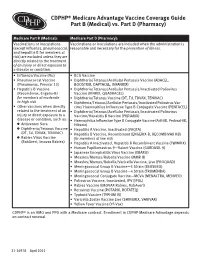
2021 Medicare Vaccine Coverage Part B Vs Part D
CDPHP® Medicare Advantage Vaccine Coverage Guide Part B (Medical) vs. Part D (Pharmacy) Medicare Part B (Medical): Medicare Part D (Pharmacy): Vaccinations or inoculations Vaccinations or inoculations are included when the administration is (except influenza, pneumococcal, reasonable and necessary for the prevention of illness. and hepatitis B for members at risk) are excluded unless they are directly related to the treatment of an injury or direct exposure to a disease or condition. • Influenza Vaccine (Flu) • BCG Vaccine • Pneumococcal Vaccine • Diphtheria/Tetanus/Acellular Pertussis Vaccine (ADACEL, (Pneumovax, Prevnar 13) BOOSTRIX, DAPTACEL, INFANRIX) • Hepatitis B Vaccine • Diphtheria/Tetanus/Acellular Pertussis/Inactivated Poliovirus (Recombivax, Engerix-B) Vaccine (KINRIX, QUADRACEL) for members at moderate • Diphtheria/Tetanus Vaccine (DT, Td, TDVAX, TENIVAC) to high risk • Diphtheria/Tetanus/Acellular Pertussis/Inactivated Poliovirus Vac • Other vaccines when directly cine/ Haemophilus Influenzae Type B Conjugate Vaccine (PENTACEL) related to the treatment of an • Diphtheria/Tetanus/Acellular Pertussis/Inactivated Poliovirus injury or direct exposure to a Vaccine/Hepatitis B Vaccine (PEDIARIX) disease or condition, such as: • Haemophilus Influenzae Type B Conjugate Vaccine (ActHIB, PedvaxHIB, • Antivenom Sera Hiberix) • Diphtheria/Tetanus Vaccine • Hepatitis A Vaccine, Inactivated (VAQTA) (DT, Td, TDVAX, TENIVAC) • Hepatitis B Vaccine, Recombinant (ENGERIX-B, RECOMBIVAX HB) • Rabies Virus Vaccine for members at low risk (RabAvert, -
Optimizing Vaccine Allocation for COVID-19 Vaccines Shows The
ARTICLE https://doi.org/10.1038/s41467-021-23761-1 OPEN Optimizing vaccine allocation for COVID-19 vaccines shows the potential role of single-dose vaccination ✉ Laura Matrajt 1 , Julia Eaton 2, Tiffany Leung 1, Dobromir Dimitrov1,3, Joshua T. Schiffer1,4,5, David A. Swan1 & Holly Janes1 1234567890():,; Most COVID-19 vaccines require two doses, however with limited vaccine supply, policy- makers are considering single-dose vaccination as an alternative strategy. Using a mathe- matical model combined with optimization algorithms, we determined optimal allocation strategies with one and two doses of vaccine under various degrees of viral transmission. Under low transmission, we show that the optimal allocation of vaccine vitally depends on the single-dose efficacy. With high single-dose efficacy, single-dose vaccination is optimal, preventing up to 22% more deaths than a strategy prioritizing two-dose vaccination for older adults. With low or moderate single-dose efficacy, mixed vaccination campaigns with com- plete coverage of older adults are optimal. However, with modest or high transmission, vaccinating older adults first with two doses is best, preventing up to 41% more deaths than a single-dose vaccination given across all adult populations. Our work suggests that it is imperative to determine the efficacy and durability of single-dose vaccines, as mixed or single-dose vaccination campaigns may have the potential to contain the pandemic much more quickly. 1 Vaccine and Infectious Disease Division, Fred Hutchinson Cancer Research Center, Seattle, WA, USA. 2 School of Interdisciplinary Arts and Sciences, University of Washington, Tacoma, WA, USA. 3 Department of Applied Mathematics, University of Washington, Seattle, WA, USA. -

The Present and Future of Yellow Fever Vaccines
pharmaceuticals Review The Present and Future of Yellow Fever Vaccines Clairissa A. Hansen 1 and Alan D. T. Barrett 1,2,* 1 Department of Pathology, University of Texas Medical Branch, Galveston, TX 77555-4036, USA; clahanse@utmb.edu 2 Sealy Institute for Vaccine Sciences, University of Texas Medical Branch, Galveston, TX 77555-4036, USA * Correspondence: abarrett@utmb.edu Abstract: The disease yellow fever (YF) is prevented by a live-attenuated vaccine, termed 17D, which has been in use since the 1930s. One dose of the vaccine is thought to give lifelong (35+ years) protective immunity, and neutralizing antibodies are the correlate of protection. Despite being a vaccine-preventable disease, YF remains a major public health burden, causing an estimated 109,000 severe infections and 51,000 deaths annually. There are issues of supply and demand for the vaccine, and outbreaks in 2016 and 2018 resulted in fractional dosing of the vaccine to meet demand. The World Health Organization (WHO) has established the “Eliminate Yellow Fever Epidemics” (EYE) initiative to reduce the burden of YF over the next 10 years. As with most vaccines, the WHO has recommendations to assure the quality, safety, and efficacy of the YF vaccine. These require the use of live 17D vaccine only produced in embryonated chicken eggs, and safety evaluated in non- human primates only. Thus, any second-generation vaccines would require modification of WHO recommendations if they were to be used in endemic countries. There are multiple second-generation YF vaccine candidates in various stages of development that must be shown to be non-inferior to the current 17D vaccine in terms of safety and immunogenicity to progress through clinical trials to potential licensing. -
Oklahoma State Department of Health 01-2018 Revised Immunization
Oklahoma State Department of Health 01-2018 Revised IMMUNIZATION I. DEFINITION: The process whereby a person is made immune or resistant to an infectious disease. This term is often used interchangeably with vaccination or inoculation. II. CLINICAL FEATURES: (ACTIVE IMMUNITY) Results when exposure to a disease organism triggers the immune system to produce antibodies to that disease. Exposure to the disease organism can occur through infection with the actual disease (resulting in natural immunity), or introduction of a killed or weakened form of the disease organism through vaccination (vaccine-induced immunity). Active immunity is long-lasting, and sometimes life-long. III. MANAGEMENT PLAN: A. Administer immunizations provided by the health department per the most current recommendations of the Advisory Committee on Immunization Practices (ACIP) and the Centers for Disease and Control (CDC). B. The PHN is to administer all immunizations due at the visit. If this does not occur, the PHN is to document the reason in the client record. The parent is to be educated on the safety concerns and issues raised by not immunizing their child as recommended. C. For Mass Clinic Administration: Do NOT prefill syringes or pre-open syringes/needles. This compromises sterility and vaccine competency. D. Immunization for International Travelers: Information concerning the specific recommendations and requirements for immunization of international travelers can be found in the Centers for Disease Control and Prevention (CDC) publication Health Information for International Travel, the “Yellow Book”. This publication may be accessed online at http://www.cdc.gov/travel/yb/index.htm. For the most current information, travelers may be referred to CDC’s website at www.cdc.gov/travel. -

Consequences of Viral Toxicities and Host Immune Response
Current Cardiology Reports (2020) 22:32 https://doi.org/10.1007/s11886-020-01292-3 HOT TOPIC Cardiovascular Complications in Patients with COVID-19: Consequences of Viral Toxicities and Host Immune Response Han Zhu1,2,3 & June-Wha Rhee1,2,3 & Paul Cheng1,2,3 & Sarah Waliany1 & Amy Chang1,4 & Ronald M. Witteles1,3 & Holden Maecker5,6 & Mark M. Davis5,6,7 & Patricia K. Nguyen 1,2,3 & Sean M. Wu1,2,3 # Springer Science+Business Media, LLC, part of Springer Nature 2020 Abstract Purpose of Review Coronavirus disease of 2019 (COVID-19) is a cause of significant morbidity and mortality worldwide. While cardiac injury has been demonstrated in critically ill COVID-19 patients, the mechanism of injury remains unclear. Here, we review our current knowledge of the biology of SARS-CoV-2 and the potential mechanisms of myocardial injury due to viral toxicities and host immune responses. Recent Findings A number of studies have reported an epidemiological association between history of cardiac disease and worsened outcome during COVID infection. Development of new onset myocardial injury during COVID-19 also increases mortality. While limited data exist, potential mechanisms of cardiac injury include direct viral entry through the angiotensin- converting enzyme 2 (ACE2) receptor and toxicity in host cells, hypoxia-related myocyte injury, and immune-mediated cytokine release syndrome. Potential treatments for reducing viral infection and excessive immune responses are also discussed. Summary COVID patients with cardiac disease history or acquire new cardiac injury are at an increased risk for in-hospital morbidity and mortality. More studies are needed to address the mechanism of cardiotoxicity and the treatments that can minimize permanent damage to the cardiovascular system. -
Routine Immunizations
Drug and Biologic Coverage Policy Effective Date ............................................... 7/1/2021 Next Review Date ......................................... 4/1/2022 Coverage Policy Number .................................. 9001 Routine Immunizations Table of Contents Related Coverage Resources Coverage Policy ................................................... 1 Preventive Care Services General Background ............................................ 2 Covid-19 Vaccine Coding/Billing Information .................................... 3 References .......................................................... 7 INSTRUCTIONS FOR USE The following Coverage Policy applies to health benefit plans administered by Cigna Companies. Certain Cigna Companies and/or lines of business only provide utilization review services to clients and do not make coverage determinations. References to standard benefit plan language and coverage determinations do not apply to those clients. Coverage Policies are intended to provide guidance in interpreting certain standard benefit plans administered by Cigna Companies. Please note, the terms of a customer’s particular benefit plan document [Group Service Agreement, Evidence of Coverage, Certificate of Coverage, Summary Plan Description (SPD) or similar plan document] may differ significantly from the standard benefit plans upon which these Coverage Policies are based. For example, a customer’s benefit plan document may contain a specific exclusion related to a topic addressed in a Coverage Policy. In the event