The Murray Crayfish – Euastacus Armatus As a Vulnerable Species
Total Page:16
File Type:pdf, Size:1020Kb
Load more
Recommended publications
-

Murrumbidgee Regional Fact Sheet
Murrumbidgee region Overview The Murrumbidgee region is home The river and national parks provide to about 550,000 people and covers ideal spots for swimming, fishing, 84,000 km2 – 8% of the Murray– bushwalking, camping and bird Darling Basin. watching. Dryland cropping, grazing and The Murrumbidgee River provides irrigated agriculture are important a critical water supply to several industries, with 42% of NSW grapes regional centres and towns including and 50% of Australia’s rice grown in Canberra, Gundagai, Wagga Wagga, the region. Narrandera, Leeton, Griffith, Hay and Balranald. The region’s villages Chicken production employs such as Goolgowi, Merriwagga and 350 people in the area, aquaculture Carrathool use aquifers and deep allows the production of Murray bores as their potable supply. cod and cotton has also been grown since 2010. Image: Murrumbidgee River at Wagga Wagga, NSW Carnarvon N.P. r e v i r e R iv e R v i o g N re r r e a v i W R o l g n Augathella a L r e v i R d r a W Chesterton Range N.P. Charleville Mitchell Morven Roma Cheepie Miles River Chinchilla amine Cond Condamine k e e r r ve C i R l M e a nn a h lo Dalby c r a Surat a B e n e o B a Wyandra R Tara i v e r QUEENSLAND Brisbane Toowoomba Moonie Thrushton er National e Riv ooni Park M k Beardmore Reservoir Millmerran e r e ve r i R C ir e e St George W n i Allora b e Bollon N r e Jack Taylor Weir iv R Cunnamulla e n n N lo k a e B Warwick e r C Inglewood a l a l l a g n u Coolmunda Reservoir M N acintyre River Goondiwindi 25 Dirranbandi M Stanthorpe 0 50 Currawinya N.P. -

Correcting Misconceptions About the Names Applied to Tasmania’S Giant Freshwater Crayfish Astacopsis Gouldi (Decapoda: Parastacidae)
Papers and Proceedings of the Royal Society of Tasmania, Volume 152, 2018 21 CORRECTING MISCONCEPTIONS ABOUT THE NAMES APPLIED TO TASMANIA’S GIANT FRESHWATER CRAYFISH ASTACOPSIS GOULDI (DECAPODA: PARASTACIDAE) by Terrence D. Mulhern (with three plates) Mulhern, T.D. 2018 (14:xii) Correcting misconceptions about the names applied to Tasmania’s Giant Freshwater Crayfsh Astacopsis gouldi (Decapoda:Parastacidae). Papers and Proceedings of the Royal Society of Tasmania 152: 21–26. https://doi.org/10.26749/rstpp.152.21 ISSN 0080–4703. Department of Biochemistry and Molecular Biology, School of Biomedical Sciences, The University of Melbourne, Vic 3010, Australia. Email: tmulhern@unimelb.edu.au Tasmania is home to around 35 species of freshwater crayfsh, all but three of which are endemic. Among the endemic freshwater crayfsh, there are three large stream-dwelling species: the Giant Freshwater Crayfsh, Astacopsis gouldi – the world’s largest freshwater invertebrate, the medium-sized A. tricornis and smaller A. franklinii. Errors and confusion surrounding the appropriate Aboriginal names for these species, and the origin and history of the scientifc name of Astacopsis gouldi are outlined. Key Words: Tasmanian freshwater crayfsh, giant freshwater lobster, Giant Freshwater Crayfsh, Astacopsis gouldi Aboriginal words, lutaralipina, tayatitja, scientifc names, William Buelow Gould, Charles Gould. INTRODUCTION tribe in the far south. Plomley also lists a further two variants from Joseph Milligan’s later vocabulary: ‘tayatea’ (Oyster Bay) Tasmania is home to three species of large stream-dwelling and ‘tay-a-teh’ (Bruny Island/South) (Milligan 1859). It is freshwater crayfsh assigned to the endemic genus Astacopsis. important to note that these were English transliterations of Of these three species, Astacopsis gouldi Clark, 1936, known Aboriginal words, as heard by the recorders, none of whom commonly as the Giant Freshwater Crayfsh, or ‘lobster’, is were trained linguists, and interpretation of the signifcance the world’s largest freshwater invertebrate. -
How the Red Swamp Crayfish Took Over the World Running Title Invasion
1 Title 2 One century away from home: how the red swamp crayfish took over the world 3 Running Title 4 Invasion history of Procambarus clarkii 5 Authors 6 Francisco J. Oficialdegui1*, Marta I. Sánchez1,2,3, Miguel Clavero1 7 8 Affiliations 9 1. Estación Biológica de Doñana (EBD-CSIC). Avenida Américo Vespucio 26, 10 Isla de la Cartuja. 41092. Seville, Spain 11 2. Instituto Universitario de Investigación Marina (INMAR) Campus de Excelencia 12 Internacional/Global del Mar (CEI·MAR) Universidad de Cádiz. Puerto Real, 13 Cadiz (Spain). 14 3. Present address: Departamento de Biología Vegetal y Ecología, Facultad de 15 Biología, Universidad de Sevilla, Apartado 1095, 41080, Seville, Spain 16 17 Contact: oficialdegui@ebd.csic.es Francisco J. Oficialdegui. Department of Wetland 18 Ecology. Estación Biológica de Doñana (EBD-CSIC). C/Américo Vespucio 26. Isla de 19 la Cartuja. 41092. Seville (Spain). Phone: 954466700. ORCID: 0000-0001-6223-736X 20 21 Marta I. Sánchez. msanchez85@us.es ORCID: 0000-0002-8349-5410 22 Miguel Clavero. miguelclavero@ebd.csic.es ORCID: 0000-0002-5186-0153 23 24 Keywords: Alien species; GBIF; Global translocations; Historical distributions; 25 iNaturalist; Invasive species; Pathways of introduction; Procambarus clarkii; 26 1 27 ABSTRACT 28 The red swamp crayfish (Procambarus clarkii) (hereafter RSC), native to the southern 29 United States and north-eastern Mexico, is currently the most widely distributed 30 crayfish globally as well as one of the invasive species with most devastating impacts 31 on freshwater ecosystems. Reconstructing the introduction routes of invasive species 32 and identifying the motivations that have led to those movements, is necessary to 33 accurately reduce the likelihood of further introductions. -

Euastacus Armatus
Developing population models for informing the sustainable management of the Murray spiny crayfish (Euastacus armatus) and the Glenelg spiny crayfish (E. bispinosus) in Victoria Potts, J.M.1 and C.R. Todd Arthur Rylah Institute for Environmental Research, 123 Brown St, Heidelberg 3084, Victoria. 1E-Mail: Joanne.Potts@dse.vic.gov.au Keywords: freshwater crayfish, population model, uncertainty, model structure. EXTENDED ABSTRACT We found that data on both species were lacking, including vital information about their life history Population models can be a useful tool for characteristics. In particular, it remains unclear identifying knowledge gaps to guide future whether moulting impedes the capacity of females research, ranking different management scenarios, to reproduce. Therefore, we propose two stage- and assessing the risk of extinction and based model structures to accommodate this conservation status of a target species. The process uncertainty. The ‘non-moult’ model defines two involves specifying a set of rules based on the life protected stages (ie. below the legal limit): history of the species that govern how the number juveniles, that are reproductively immature, and and distribution of individuals within the protected adults (that are reproductively mature). population change over time. There is one un-protected stage (ie. above the legal limit), that contains reproductively mature adults Data availability and quality can be a limiting available for harvesting. The final stage contains factor in model development, influencing the individuals who have died from harvesting (as estimation of parameters and the understanding of distinct from natural mortality). In addition, the important environmental processes. In such ‘moult’ model contains an additional two stages circumstances, uncertainty arises from a plethora for moulting females. -

Phylogeny and Biogeography of the Freshwater Crayfish Euastacus
Molecular Phylogenetics and Evolution 37 (2005) 249–263 www.elsevier.com/locate/ympev Phylogeny and biogeography of the freshwater crayWsh Euastacus (Decapoda: Parastacidae) based on nuclear and mitochondrial DNA Heather C. Shull a, Marcos Pérez-Losada a, David Blair b, Kim Sewell b,c, Elizabeth A. Sinclair a, Susan Lawler d, Mark Ponniah e, Keith A. Crandall a,¤ a Department of Integrative Biology, Brigham Young University, Provo, UT 84602-5181, USA b School of Tropical Biology, James Cook University, Townsville, Qld, Australia c Centre for Microscopy and Microanalysis, University of Queensland, Qld 4072, Australia d Department of Environmental Management and Ecology, La Trobe University, Wodonga, Vic. 3689, Australia e Australian School of Environmental Studies, GriYth University, Nathan, Qld 4111, Australia Received 17 November 2004; revised 7 April 2005; accepted 29 April 2005 Available online 18 July 2005 Abstract Euastacus crayWsh are endemic to freshwater ecosystems of the eastern coast of Australia. While recent evolutionary studies have focused on a few of these species, here we provide a comprehensive phylogenetic estimate of relationships among the species within the genus. We sequenced three mitochondrial gene regions (COI, 16S, and 12S) and one nuclear region (28S) from 40 species of the genus Euastacus, as well as one undescribed species. Using these data, we estimated the phylogenetic relationships within the genus using maximum-likelihood, parsimony, and Bayesian Markov Chain Monte Carlo analyses. Using Bayes factors to test diVerent model hypotheses, we found that the best phylogeny supports monophyletic groupings of all but two recognized species and suggests a widespread ancestor that diverged by vicariance. -

Invasion by the Exotic Crayfish, Cherax Destructor Clark (Parastacidae), Into Habitats of Local Crayfish Near Perth, Western Australia
Invasion by the exotic crayfish, Cherax destructor Clark (Parastacidae), into habitats of local crayfish near Perth, Western Australia. LYNAS, J., STOREY, A., ARMSTRONG, K., PRINCE, J. & KNOTT, B. School of Animal Biology (M092), The University of Western Australia, 35 Stirling Highway, Crawley, Western Australia 6009. AUSTRALIA. ABSTRACT The yabby, Cherax destructor Clark, was introduced into Western Australia in 1932, when ten yabbies were translocated from Victoria to a farm dam near Narembeen. Following subsequent dispersal, this crayfish now co- occurs with two local species C. quinquecarinatus and C. cainii in river systems in the environs of Perth. Congeneric crayfish may persist in sympatry through microhabitat separation. To elucidate the means for co- existance, microhabitat characteristics of the three species were measured in the Canning River system near Perth. Yabbies were associated with sediments having higher clay content than marron; gilgies occurred in river reaches having higher flow than marron. The distribution of the crayfish within this system displayed a mosaic pattern of sympatric distributions, which would allow for competitive interactions between these species. To investigate one aspect of interactions between the introduced yabby and local crayfish species, laboratory-based sediment competition experiments were performed. Similar-sized yabbies displaced both marron and gilgies from preferred substrates. Superior competitive ability under laboratory conditions was manifested through interference, with yabbies preventing local crayfish species from procuring a limiting resource. This study indicates the potential for the introduced yabby to displace local crayfish species. Keywords: introduced crayfish, microhabitat separation, competitive exclusion INTRODUCTION The parastacid freshwater crayfish of the Canning River system, Perth, Western Australia, constitute a fauna of composite origins. -
Comparing Murray Crayfish (Euastacus Armatus) Population Parameters Between Recreationally Fished and Non-Fished Areas
Freshwater Crayfish 19(2):153–160, 2013 Copyright ©2013 International Association of Astacology ISSN:2076-4324 (Print), 2076-4332 (Online) doi: 10.5869/fc.2013.v19-2.153 Comparing Murray Crayfish (Euastacus armatus) Population Parameters Between Recreationally Fished and Non-fished Areas Sylvia Zukowski,1,2 Nick S. Whiterod 2,* and Robyn J. Watts 1 1 Institute for Land, Water and Society, Charles Sturt University, PO Box 789, Albury, NSW 2640, Australia. 2 Aquasave – Nature Glenelg Trust, 7 Kemp Street, Goolwa Beach, SA 5214, Australia. *Corresponding Author. —nick.whiterod@aquasave.com.au Abstract.— The implementation of fishing regulations becomes increasingly complex where the natural state of fisheries resources is unknown. Comparing populations in fished and non-fished areas can provide information that is vital for the management and protection of species. We conducted field surveys ofEuastacus armatus in non-fished and fished reservoirs and provide comparisons with a heavily fished area of the River Murray. The non-fished population (Talbingo Reservoir) ofE. armatus exhibited almost equal sex ratios, robust normally-distributed population structure and a high proportion of mature and berried females. The parameters defining two fished populations (Blowering Reservoir and the River Murray) deviated significantly, to varying degrees, from the benchmark population (Talbingo). These differences suggest that recreational fishing may impose a considerable impact on the population parameters of E. armatus. Comparison with the benchmark defined in the present study will allow tracking of the population recovery under the new fishing regulations forE. armatus in the southern Murray-Darling Basin. [Keywords.— Euastacus armatus; non-fished areas; population parameters; recreational fishing pressure]. -

NSW Recreational Freshwater Fishing Guide 2020-21
NSW Recreational Freshwater Fishing Guide 2020–21 www.dpi.nsw.gov.au Report illegal fishing 1800 043 536 Check out the app:FishSmart NSW DPI has created an app Some data on this site is sourced from the Bureau of Meteorology. that provides recreational fishers with 24/7 access to essential information they need to know to fish in NSW, such as: ▢ a pictorial guide of common recreational species, bag & size limits, closed seasons and fishing gear rules ▢ record and keep your own catch log and opt to have your best fish pictures selected to feature in our in-app gallery ▢ real-time maps to locate nearest FADs (Fish Aggregation Devices), artificial reefs, Recreational Fishing Havens and Marine Park Zones ▢ DPI contact for reporting illegal fishing, fish kills, ▢ local weather, tide, moon phase and barometric pressure to help choose best time to fish pest species etc. and local Fisheries Offices ▢ guides on spearfishing, fishing safely, trout fishing, regional fishing ▢ DPI Facebook news. Welcome to FishSmart! See your location in Store all your Contact Fisheries – relation to FADs, Check the bag and size See featured fishing catches in your very Report illegal Marine Park Zones, limits for popular species photos RFHs & more own Catch Log fishing & more Contents i ■ NSW Recreational Fishing Fee . 1 ■ Where do my fishing fees go? .. 3 ■ Working with fishers . 7 ■ Fish hatcheries and fish stocking . 9 ■ Responsible fishing . 11 ■ Angler access . 14 ■ Converting fish lengths to weights. 15 ■ Fishing safely/safe boating . 17 ■ Food safety . 18 ■ Knots and rigs . 20 ■ Fish identification and measurement . 27 ■ Fish bag limits, size limits and closed seasons . -

Euastacus Bispinosus Glenelg Spiny Freshwater Crayfish
The Minister included this species in the endangered category, effective from 15 February 2011 Advice to the Minister for Sustainability, Environment, Water, Population and Communities from the Threatened Species Scientific Committee (the Committee) on Amendment to the list of Threatened Species under the Environment Protection and Biodiversity Conservation Act 1999 (EPBC Act) 1. Name Euastacus bispinosus This species is commonly known as Glenelg spiny freshwater crayfish. It is also known regionally as 'pricklyback'. It is in the Family Parastacidae. 2. Reason for Conservation Assessment by the Committee This advice follows assessment of information provided by a public nomination to list the Glenelg spiny freshwater crayfish. The nominator suggested listing in the endangered category of the list. This is the Committee’s first consideration of the species under the EPBC Act. 3. Summary of Conclusion The Committee judges that the species has been demonstrated to have met sufficient elements of Criterion 1 to make it eligible for listing as vulnerable. The Committee judges that the species has been demonstrated to have met sufficient elements of Criterion 2 to make it eligible for listing as endangered. The Committee judges that the species has been demonstrated to have met sufficient elements of Criterion 3 to make it eligible for listing as vulnerable. The highest category for which the species is eligible to be listed is endangered. 4. Taxonomy The species is conventionally accepted as Euastacus bispinosus Clark, 1936 (Glenelg spiny freshwater crayfish). 5. Description The Glenelg spiny freshwater crayfish is a large, long-lived freshwater crayfish of the Euastacus genus. The Euastacus crayfish, also commonly known as spiny crayfish, are one of two groups of fully aquatic freshwater crayfish in Australia, the other being the smooth-shelled Cherax crayfish, commonly known as yabbies. -

A Revision of the Tasmanian Freshwater Crayfish Genus Astacopsis Huxley (Decapoda: Parastacidae)
Papers and Proceedings of the Royal Society of Tasmania, Volume 126, 1992 91 A REVISION OF THE TASMANIAN FRESHWATER CRAYFISH GENUS ASTACOPSIS HUXLEY (DECAPODA: PARASTACIDAE). by Premek Hamr (with three text-figures) HAMR, P., 1992 (31 :x): A revision of the Tasmanian freshwater crayfish genus Astacopsis Huxley (Dccapoda: ·Parastacidae). Pap. Proc. R. Soc. Tasm. 126: 91-94. ISSN 0080-4703. 28 Undercliffe Ave, Hamilton, Ontario, L8P 3HI, Canada: formerly Department of Zoology, University of Tasmania. During a broad study of the biology of the freshwater in rhe Tasmanian genus fWO distinct forms of Astacopsis franklinii were recognised. These "forms" were found to diffcr in terms of their general morphology and distribution. As a result, the taxonomy of Astacopsis has been revised to re-establish the three species originally described by Ellen Clark. Astacopsis franklinii Gray has been divided into fWO separate species, the eastern Astacopsis franklinti and the western Astacopsis tricorn is, while the status ofArtacopsis gouldi remains unaltered. Key Words: Astacopsis, Tasmania, distribution, taxonomy. INTRODUCTION to vary greatly in size and spininess. In their re-examination of the various morphological characters, Swain et al. (1982) The members of the genus Astacopsis, which include the found that the variation in spininess and size had a world's largest freshwater crayfish (and therefore invertebrate) geographical basis. It will be shown in this study that this species, are associated with riverine and lacustrine habitats variation is, in fact, at least partly due to the occurrence of throughout Tasmania (Swain et al. 1982). Taxonomically two distinct forms within A. franklinii, and it is further and ecologically their closest relatives are the crayfishes of the proposed that these two forms should be treated as two genera Euastacus and Astacoides (Hobbs 1987,1988, Riek separate species. -
The Eastern Swamp Crayfish Gramastacus Lacus Sp. N. (Decapoda, Parastacidae) a New Species of Freshwater Crayfish from Coastal New South Wales, Australia
A peer-reviewed open-access journal ZooKeysThe 398: eastern 53–67 (2014)swamp crayfishGramastacus lacus sp. n. (Decapoda, Parastacidae) a new species... 53 doi: 10.3897/zookeys.398.7544 RESEARCH ARTICLE www.zookeys.org Launched to accelerate biodiversity research The eastern swamp crayfish Gramastacus lacus sp. n. (Decapoda, Parastacidae) a new species of freshwater crayfish from coastal New South Wales, Australia Robert B. McCormack1,† 1 Australian Crayfish Project, c/-Australian Aquatic Biological Pty Ltd, P.O. Box 3, Karuah, NSW, 2324 Australia † http://zoobank.org/8394B989-88DB-4BDC-AD43-34A5822A9419 Corresponding author: Robert B. McCormack (info@aabio.com.au) Academic editor: N. Bruce | Received 19 March 2014 | Accepted 20 March 2014 | Published 4 April 2014 http://zoobank.org/DBBC0B8E-2B97-4C66-BC6F-3FB29C89D2DB Citation: McCormack RB (2014) The eastern swamp crayfishGramastacus lacus sp. n. (Decapoda, Parastacidae) a new species of freshwater crayfish from coastal New South Wales, Australia. ZooKeys 398: 53–67. doi: 10.3897/ zookeys.398.7544 Abstract Gramastacus lacus sp. n., is described from coastal lowlands of the Central and Mid North Coast regions of New South Wales, Australia. Gramastacus lacus has a restricted distribution in ephemeral habitats, be- ing dependent on regular natural flooding and drying cycles, and burrows for survival during temporary dry cycles. Documented are population distributions in lowland habitats (3–48 m, a.s.l.) from Wamberal Lagoon, north along the coastal strip to Wallis Lake. The species is small, reaching a maximum weight of 7 grams and 21.3 mm OCL, and distinguished by a large male genital papilla, large raised post orbital ridges, laterally compressed carapace and elongated chelae. -
Yabby (Cherax Destructor) Ecological Risk Screening Summary
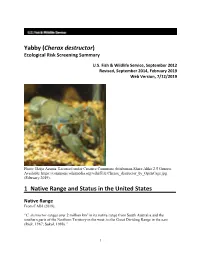
Yabby (Cherax destructor) Ecological Risk Screening Summary U.S. Fish & Wildlife Service, September 2012 Revised, September 2014, February 2019 Web Version, 7/12/2019 Photo: Daiju Azuma. Licensed under Creative Commons Attribution-Share Alike 2.5 Generic. Available: https://commons.wikimedia.org/wiki/File:Cherax_destructor_by_OpenCage.jpg. (February 2019). 1 Native Range and Status in the United States Native Range From CABI (2019): “C. destructor ranges over 2 million km2 in its native range from South Australia and the southern parts of the Northern Territory in the west, to the Great Dividing Range in the east (Riek, 1967; Sokol, 1988).” 1 “It appears that yabbies were largely restricted to lower altitude habitats in inland areas of southeastern Australia including the Murray-Darling Basin before European settlement, with the Euastacus spp. found in higher altitude habitats and the coastal river systems.” Status in the United States No records of Cherax destructor in the wild in the United States were found. From CABI (2019): “[…] the specimens [Cherax destructor] came from a crayfish farm in California (USA) […]” From USFWS (2016a): “The yabby was officially listed as an injurious wildlife species by the U.S. Fish and Wildlife Service in 2016 under the Lacey Act (18.U.S.C.42). Importation and shipping between the continental United States and the District of Columbia, the Commonwealth of Puerto Rico, or any territory or possession of the United States is prohibited.” From USFWS (2016b): “Of the 11 species, four species (crucian carp, Nile perch, wels catfish, and yabby) have been imported in only small numbers since 2011 […]” The Florida Fish and Wildlife Conservation Commission has listed the crayfish, Cherax destructor as a prohibited species.