USDAFS Silvics of North America
Total Page:16
File Type:pdf, Size:1020Kb
Load more
Recommended publications
-

Birds, Reptiles, Amphibians, Vascular Plants, and Habitat in the Gila River Riparian Zone in Southwestern New Mexico
Birds, Reptiles, Amphibians, Vascular Plants, and Habitat in the Gila River Riparian Zone in Southwestern New Mexico Kansas Biological Survey Report #151 Kelly Kindscher, Randy Jennings, William Norris, and Roland Shook September 8, 2008 Birds, Reptiles, Amphibians, Vascular Plants, and Habitat in the Gila River Riparian Zone in Southwestern New Mexico Cover Photo: The Gila River in New Mexico. Photo by Kelly Kindscher, September 2006. Kelly Kindscher, Associate Scientist, Kansas Biological Survey, University of Kansas, 2101 Constant Avenue, Lawrence, KS 66047, Email: Kindscher@KU.edu Randy Jennings, Professor, Department of Natural Sciences, Western New Mexico University, PO Box 680, 1000 W. College Ave., Silver City, NM 88062, Email: jenningsr@wnmu.edu William Norris, Associate Professor, Department of Natural Sciences, Western New Mexico University, PO Box 680, 1000 W. College Ave., Silver City, NM 88062, Email: norrisw@wnmu.edu Roland Shook, Emeritus Professor, Biology, Department of Natural Sciences, Western New Mexico University, PO Box 680, 1000 W. College Ave., Silver City, NM 88062, Email: shookr@wnmu.edu Citation: Kindscher, K., R. Jennings, W. Norris, and R. Shook. Birds, Reptiles, Amphibians, Vascular Plants, and Habitat in the Gila River Riparian Zone in Southwestern New Mexico. Open-File Report No. 151. Kansas Biological Survey, Lawrence, KS. ii + 42 pp. Abstract During 2006 and 2007 our research crews collected data on plants, vegetation, birds, reptiles, and amphibians at 49 sites along the Gila River in southwest New Mexico from upstream of the Gila Cliff Dwellings on the Middle and West Forks of the Gila to sites below the town of Red Rock, New Mexico. -
Element Occurrence Data Standard
ELEMENT OCCURRENCE DATA STANDARD February 6, 2002 NatureServe in cooperation with the Network of Natural Heritage Programs and Conservation Data Centers iii Table of Contents PREFACE.....................................................................................................................................currently under revision ACKNOWLEDGMENTS.....................................................................................................currently under revision ABSTRACT..................................................................................................................................currently under revision 1 INTRODUCTION.........................................................................................................currently under revision 2 EO DEFINITION .................................................................................................................................................10 2.1 Principal EOs........................................................................................................................................................10 2.2 Sub-EOs.................................................................................................................................................................12 2.3 Feature Labels.......................................................................................................................................................13 2.4 Location Use Class..............................................................................................................................................13 -

State of New York City's Plants 2018
STATE OF NEW YORK CITY’S PLANTS 2018 Daniel Atha & Brian Boom © 2018 The New York Botanical Garden All rights reserved ISBN 978-0-89327-955-4 Center for Conservation Strategy The New York Botanical Garden 2900 Southern Boulevard Bronx, NY 10458 All photos NYBG staff Citation: Atha, D. and B. Boom. 2018. State of New York City’s Plants 2018. Center for Conservation Strategy. The New York Botanical Garden, Bronx, NY. 132 pp. STATE OF NEW YORK CITY’S PLANTS 2018 4 EXECUTIVE SUMMARY 6 INTRODUCTION 10 DOCUMENTING THE CITY’S PLANTS 10 The Flora of New York City 11 Rare Species 14 Focus on Specific Area 16 Botanical Spectacle: Summer Snow 18 CITIZEN SCIENCE 20 THREATS TO THE CITY’S PLANTS 24 NEW YORK STATE PROHIBITED AND REGULATED INVASIVE SPECIES FOUND IN NEW YORK CITY 26 LOOKING AHEAD 27 CONTRIBUTORS AND ACKNOWLEGMENTS 30 LITERATURE CITED 31 APPENDIX Checklist of the Spontaneous Vascular Plants of New York City 32 Ferns and Fern Allies 35 Gymnosperms 36 Nymphaeales and Magnoliids 37 Monocots 67 Dicots 3 EXECUTIVE SUMMARY This report, State of New York City’s Plants 2018, is the first rankings of rare, threatened, endangered, and extinct species of what is envisioned by the Center for Conservation Strategy known from New York City, and based on this compilation of The New York Botanical Garden as annual updates thirteen percent of the City’s flora is imperiled or extinct in New summarizing the status of the spontaneous plant species of the York City. five boroughs of New York City. This year’s report deals with the City’s vascular plants (ferns and fern allies, gymnosperms, We have begun the process of assessing conservation status and flowering plants), but in the future it is planned to phase in at the local level for all species. -

Pala Park Habitat Assessment
Pala Park Bank Stabilization Project: Geotechnical Exploration TABLE OF CONTENTS SECTION 1.0 COUNTY OF RIVERSIDE ATTACHMENTS Biological Report Summary Report (Attachment E-3) Level of Significance Checklist (Attachment E-4) Biological Resources Map (Attachment E-5) Site Photographs (Attachment E-6) SECTION 2.0 HABITAT ASSESSMENT General Site Information ............................................................................................................... 1 Methods ........................................................................................................................................ 2 Existing Conditions ....................................................................................................................... 4 Special Status Resources ............................................................................................................. 8 Other Issues ................................................................................................................................ 14 Recommendations ...................................................................................................................... 14 References .................................................................................................................................. 16 LIST OF TABLES Page 1 Special Status Plant Species Known to Occur in the Vicinity of the Survey Area ........... 10 2 Chaparral Sand-Verbena Populations Observed in the Survey Area ............................. 12 3 Paniculate Tarplant -
Wisconsin Native Trees and Shrubs
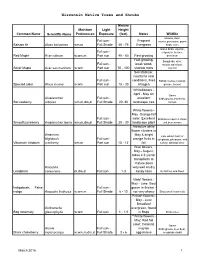
Wisconsin Native Trees and Shrubs Mature Moisture Light Height Common Name Scientific Name Preferences Exposure (feet) Notes Wildlife Grouse, deer, Full sun - Fragrant moose,porcupine, game Balsam fir Abies balsamea wm,m Full Shade 40 - 75 Evergreen birds, mice Game birds, squirrel, Full sun - chipmunk, beaver, Red Maple Acer rubrum w,wm,m Part sun 40 - 60 Fast growing deer,bear Fast growing, Songbirds, deer, Full sun - weak wood, racoon,waterfowl, Silver Maple Acer saccharinum w,wm Part sun 75 - 100 shallow roots squirrel Soil stablizer, neutral to acid Full sun - conditions, fixes Rabbit,moose,muskrat, Specled alder Alnus incana w,wm Part sun 15 - 30 nitrogen grouse, beaver Whiteflowers - April - May An Game Amelanchier Full sun - excellent birds,grouse,skunk,fox, Serviceberry arborea wm,m,dm,d Full Shade 20 -30 landscape tree racoon White flowers - May Orange fall Full sun - color Excellent Birds,bear,squirrel,chipm Smooth juneberry Amelanchier laevis wm,m,dm,d Full Shade 20 - 30 landscape plant unk,deer,moose Attractive white flower clusters in American May & bright Late winter food for Highbush Full sun - orange fruits in songbirds, pheasant, wild Viburnum trilobum cranberry wm,m Part sun 10 - 13' fall turkey, whitetail deer Blue flowers, May - August; takes 2-3 yrs for transplants to mature;does Amorpha very well on dry Leadplant canescens m,dm,d Full sun 1-3 sandy sites Butterflies and Bees Violet flowers - May - June Best Indigobush; False Full sun - grown in thicket - indigo Amorpha fruticosa w,wm,m Full Shade 6 - 12 not very -
Botanical Name Common Name
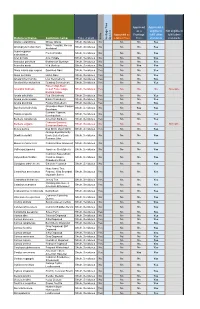
Approved Approved & as a eligible to Not eligible to Approved as Frontage fulfill other fulfill other Type of plant a Street Tree Tree standards standards Heritage Tree Tree Heritage Species Botanical Name Common name Native Abelia x grandiflora Glossy Abelia Shrub, Deciduous No No No Yes White Forsytha; Korean Abeliophyllum distichum Shrub, Deciduous No No No Yes Abelialeaf Acanthropanax Fiveleaf Aralia Shrub, Deciduous No No No Yes sieboldianus Acer ginnala Amur Maple Shrub, Deciduous No No No Yes Aesculus parviflora Bottlebrush Buckeye Shrub, Deciduous No No No Yes Aesculus pavia Red Buckeye Shrub, Deciduous No No Yes Yes Alnus incana ssp. rugosa Speckled Alder Shrub, Deciduous Yes No No Yes Alnus serrulata Hazel Alder Shrub, Deciduous Yes No No Yes Amelanchier humilis Low Serviceberry Shrub, Deciduous Yes No No Yes Amelanchier stolonifera Running Serviceberry Shrub, Deciduous Yes No No Yes False Indigo Bush; Amorpha fruticosa Desert False Indigo; Shrub, Deciduous Yes No No No Not eligible Bastard Indigo Aronia arbutifolia Red Chokeberry Shrub, Deciduous Yes No No Yes Aronia melanocarpa Black Chokeberry Shrub, Deciduous Yes No No Yes Aronia prunifolia Purple Chokeberry Shrub, Deciduous Yes No No Yes Groundsel-Bush; Eastern Baccharis halimifolia Shrub, Deciduous No No Yes Yes Baccharis Summer Cypress; Bassia scoparia Shrub, Deciduous No No No Yes Burning-Bush Berberis canadensis American Barberry Shrub, Deciduous Yes No No Yes Common Barberry; Berberis vulgaris Shrub, Deciduous No No No No Not eligible European Barberry Betula pumila -

Responses of Black Willow (Salix Nigra) Cuttings to Simulated Herbivory and flooding
Acta Oecologica 28 (2005) 173–180 www.elsevier.com/locate/actoec Original article Responses of black willow (Salix nigra) cuttings to simulated herbivory and flooding Shuwen Li a,*, Lili T. Martin a, S. Reza Pezeshki a, F. Douglas Shields Jr. b a Department of Biology, The University of Memphis, Memphis, TN 38152, USA b USDA-ARS National Sedimentation Laboratory, P.O. Box 1157, Oxford, MS 38655, USA Received 7 January 2004; accepted 31 March 2005 Available online 04 May 2005 Abstract Herbivory and flooding influence plant species composition and diversity in many wetland ecosystems. Black willow (Salix nigra) natu- rally occurs in floodplains and riparian zones of the southeastern United States. Cuttings from this species are used as a bioengineering tool for streambank stabilization and habitat rehabilitation. The present study was conducted to evaluate the photosynthetic and growth responses of black willow to simulated herbivory and flooding. Potted cuttings were subjected to three levels of single-event herbivory: no herbivory (control), light herbivory, and heavy herbivory; and three levels of flooding conditions: no flooding (control), continuous flooding, and peri- odic flooding. Results indicated that elevated stomatal conductance partially contributed to the increased net photosynthesis noted under both levels of herbivory on day 30. However, chlorophyll content was not responsible for the observed compensatory photosynthesis. Cuttings subjected to heavy herbivory accumulated the lowest biomass even though they had the highest height growth by the conclusion of the experiment. In addition, a reduction in root/shoot ratio was noted for plants subjected to continuous flooding with no herbivory. However, continuously flooded, lightly clipped plants allocated more resources to roots than shoots. -

Salix Nigra Marsh
Salix nigra Marsh Salix nigra Marsh. Black Willow Salicaceae -- Willow family J. A. Pitcher and J. S. McKnight Black willow (Salix nigra) is the largest and the only commercially important willow of about 90 species native to North America. It is more distinctly a tree throughout its range than any other native willow; 27 species attain tree size in only part of their range (3). Other names sometimes used are swamp willow, Goodding willow, southwestern black willow, Dudley willow, and sauz (Spanish). This short-lived, fast-growing tree reaches its maximum size and development in the lower Mississippi River Valley and bottom lands of the Gulf Coastal Plain (4). Stringent requirements of seed germination and seedling establishment limit black willow to wet soils near water courses (5), especially floodplains, where it often grows in pure stands. Black willow is used for a variety of wooden products and the tree, with its dense root system, is excellent for stabilizing eroding lands. Habitat Native Range Black willow is found throughout the Eastern United States and adjacent parts of Canada and Mexico. The range extends from southern New Brunswick and central Maine west in Quebec, southern Ontario, and central Michigan to southeastern Minnesota; south and west to the Rio Grande just below its confluence with the Pecos River; and east along the gulf coast, through the Florida panhandle and southern Georgia. Some authorities consider Salix gooddingii as a variety of S. nigra, which extends the range to the Western United States (3,9). http://www.na.fs.fed.us/spfo/pubs/silvics_manual/volume_2/salix/nigra.htm (1 of 9)1/4/2009 4:08:21 PM Salix nigra Marsh -The native range of black willow. -
Native Plant List Trees.XLS
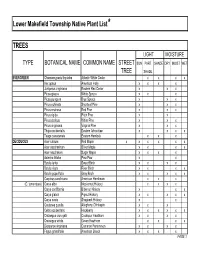
Lower Makefield Township Native Plant List* TREES LIGHT MOISTURE TYPE BOTANICAL NAME COMMON NAME STREET SUN PART SHADE DRY MOIST WET TREE SHADE EVERGREEN Chamaecyparis thyoides Atlantic White Cedar x x x x IIex opaca American Holly x x x x Juniperus virginiana Eastern Red Cedar x x x Picea glauca White Spruce x x x Picea pungens Blue Spruce x x x Pinus echinata Shortleaf Pine x x x Pinus resinosa Red Pine x x x Pinus rigida Pitch Pine x x Pinus strobus White Pine x x x Pinus virginiana Virginia Pine x x x Thuja occidentalis Eastern Arborvitae x x x x Tsuga canadensis Eastern Hemlock xx x DECIDUOUS Acer rubrum Red Maple x x x x x x Acer saccharinum Silver Maple x x x x Acer saccharum Sugar Maple x x x x Asimina triloba Paw-Paw x x Betula lenta Sweet Birch x x x x Betula nigra River Birch x x x x Betula populifolia Gray Birch x x x x x Carpinus caroliniana American Hornbeam x x x (C. tomentosa) Carya alba Mockernut Hickory x x x x Carya cordiformis Bitternut Hickory x x x Carya glabra Pignut Hickory x x x x x Carya ovata Shagbark Hickory x x Castanea pumila Allegheny Chinkapin xx x Celtis occidentalis Hackberry x x x x x x Crataegus crus-galli Cockspur Hawthorn x x x x Crataegus viridis Green Hawthorn x x x x Diospyros virginiana Common Persimmon x x x x Fagus grandifolia American Beech x x x x PAGE 1 Exhibit 1 TREES (cont'd) LIGHT MOISTURE TYPE BOTANICAL NAME COMMON NAME STREET SUN PART SHADE DRY MOIST WET TREE SHADE DECIDUOUS (cont'd) Fraxinus americana White Ash x x x x Fraxinus pennsylvanica Green Ash x x x x x Gleditsia triacanthos v. -
Vegetation Community Monitoring at Ocmulgee National Monument, 2011
National Park Service U.S. Department of the Interior Natural Resource Stewardship and Science Vegetation Community Monitoring at Ocmulgee National Monument, 2011 Natural Resource Data Series NPS/SECN/NRDS—2014/702 ON THE COVER Duck potato (Sagittaria latifolia) at Ocmulgee National Monument. Photograph by: Sarah C. Heath, SECN Botanist. Vegetation Community Monitoring at Ocmulgee National Monument, 2011 Natural Resource Data Series NPS/SECN/NRDS—2014/702 Sarah Corbett Heath1 Michael W. Byrne2 1USDI National Park Service Southeast Coast Inventory and Monitoring Network Cumberland Island National Seashore 101 Wheeler Street Saint Marys, Georgia 31558 2USDI National Park Service Southeast Coast Inventory and Monitoring Network 135 Phoenix Road Athens, Georgia 30605 September 2014 U.S. Department of the Interior National Park Service Natural Resource Stewardship and Science Fort Collins, Colorado The National Park Service, Natural Resource Stewardship and Science office in Fort Collins, Colorado, publishes a range of reports that address natural resource topics. These reports are of interest and applicability to a broad audience in the National Park Service and others in natural resource management, including scientists, conservation and environmental constituencies, and the public. The Natural Resource Data Series is intended for the timely release of basic data sets and data summaries. Care has been taken to assure accuracy of raw data values, but a thorough analysis and interpretation of the data has not been completed. Consequently, the initial analyses of data in this report are provisional and subject to change. All manuscripts in the series receive the appropriate level of peer review to ensure that the information is scientifically credible, technically accurate, appropriately written for the intended audience, and designed and published in a professional manner. -

AN AUTECOLOGICAL STUDY of SALIX NIGRA, ESPECIALLY FACTORS TJ:JAT MIGHT LIMIT ITS DISTRIBUTION Major Field: Botany and Plant Pathology
AN AUTECOLOGICAL STUDY OF SALIX NIGRA, ESPECIALLY FACTORS THAT MIGHT LIMIT ITS DISTRIBUTION By Kenneth William ~cLeod 1 Bachelor of Science Oklahoma State University Stillwater, Oklahoma 1969 Submitted to the Faculty of the Graduate College of the Oklahoma State University in partial fulfillment of the requirements for the Degree of MASTER OF SCIENCE July, 1971 AN AUTECOLOGICAL STUDY OF SALIX NIGRA, ESPECIALLY FACTORS THAT MIGHT LIMIT ITS DISTRIBUTION The~is Approved: ~~~ Q~ - ACKNOWLEDGE$NTS I wish to express my sincere appreciation to my major adviser, Dr. James K. McPherson, under whose direction this study was conducted. His concern and suggestions for this study and manuscript are very much appreciated. I should also like to thank the members of my committee, Dr. John E. Thomas and Dr. Eddie Basler, Jr. for their suggestions in the writ ing of this manuscript. Thanks are also due Dr. Robert Morrison for his work on the statistical evaluation, Dr. Glenn W. Todd for his help with the water relations work, Dr. Paul E. Richardson for his assist ance with the anatomical portions, Dr. James Davidson for his help with the soil testing, and Dr. Arthur G. Carroll for his faith in my work the past three years. Finally I would like to express my sincerest gratitude to Miss Lyn Robinson, for her assistance and sacrifice the past two years. Also due many thanks are my many friends and fellow graduate students who gave of their time to assist me in this research. My family deserves much gratitude and thanks for their cheerful support and faith in me. -

Germination Requirements of Key Southwestern Woody Riparian Species
Germination Requirements of Key Southwestern Woody Riparian Species Item Type Article Authors Siegel, Richard S.; Brock, John H. Publisher University of Arizona (Tucson, AZ) Journal Desert Plants Rights Copyright © Arizona Board of Regents. The University of Arizona. Download date 29/09/2021 04:10:45 Link to Item http://hdl.handle.net/10150/609112 Siegel and Brock Germination Requirements 3 Introduction Germination Riparian habitats in the Southwestern United States are known not only for their diversity in both plant and animal life but also for the water that these areas provide. However Requirements of Key in recent years, riparian habitats have been degraded, or de- stroyed by flooding, channelization, phreatophyte control, Southwestern Woody agricultural practices, overgrazing, recreation, and off -road vehicle abuse. (Davis, 1977; Carothers, 1977). Flooding has Riparian Species been responsible for the destruction of many mature ripar- ian forest stands in the Southwest, but flooding is also necessary for the establishment of many stands (Brady et al., 1985). Riparian forests play a major role in the mainte- S. nance of this unique ecosystem which provides shade and Richard Siegel cover for wildlife during hot summer months, and sanctu- Department of Water Resources, State of Arizona ary for numerous species of birds. Therefore, it is important that the damage to riparian zone be mitigated by the estab- and John H. Brock lishment or riparian vegetation. Revegetation research of Southwestern riparian habitats of Agribusiness and Environmental Resources, School within the past ten years has been centered on the woody Arizona State University, Tempe species of the ecosystem. Anderson et al., (1978), York (1985) and Swenson and Mullins (1985) have reported on re- vegetation techniques using poles or dormant stubs as veg- etative propagules.