Specialist Group on Storks, Ibises and Spoonbills Newsletier
Total Page:16
File Type:pdf, Size:1020Kb
Load more
Recommended publications
-

First Record of an Extinct Marabou Stork in the Neogene of South America
First record of an extinct marabou stork in the Neogene of South America JORGE IGNACIO NORIEGA and GERARDO CLADERA Noriega, J.I. and Cladera, G. 2008. First record of an extinct marabou stork in the Neogene of South America. Acta Palaeontologica Polonica 53 (4): 593–600. We describe a new large species of marabou stork, Leptoptilus patagonicus (Ciconiiformes, Ciconiidae, Leptoptilini), from the late Miocene Puerto Madryn Formation, Chubut Province, Argentina. The specimen consists mainly of wing and leg bones, pelvis, sternum, cervical vertebrae, and a few fragments of the skull. We provisionally adopt the traditional system− atic scheme of ciconiid tribes. The specimen is referred to the Leptoptilini on the basis of similarities in morphology and intramembral proportions with the extant genera Ephippiorhynchus, Jabiru,andLeptoptilos. The fossil specimen resembles in overall morphology and size the species of Leptoptilos, but also exhibits several exclusive characters of the sternum, hu− merus, carpometacarpus, tibiotarsus, and pelvis. Additionally, its wing proportions differ from those of any living taxon, providing support to erect a new species. This is the first record of the tribe Leptoptilini in the Tertiary of South America. Key words: Ciconiidae, Leptoptilos, Miocene, Argentina, South America. Jorge I. Noriega [cidnoriega@infoaire.com.ar], Laboratorio de Paleontología de Vertebrados, CICYTTP−CONICET, Matteri y España, 3105 Diamante, Argentina; Gerardo Cladera [gcladera@mef.org.ar], Museo Paleontológico Egidio Feruglio, Avenida Fontana 140, 9100 Trelew, Argentina. Introduction Institutional abbreviations.—BMNH, Natural History Mu− seum, London, UK; CICYTTP, Centro de Investigaciones The stork family (Ciconiidae) is a well−defined group of Científicas y Transferencia de Tecnología a la Producción, waterbirds, traditionally divided into three tribes: the Myc− Diamante, Argentina; CNAR−KB3, collections of locality 3 of teriini, the Ciconiini, and the Leptoptilini (Kahl 1971, 1972, the Kossom Bougoudi area, Centre National d’Appui à la 1979). -

Theristicus Caudatus;Argentina
The Condor96:99&1002 Q The cooper omith&gical society1994 BREEDING PERFORMANCE IN RELATION TO NEST-SITE SUBSTRATUM IN A BUFF-NECKED IBIS (THHWTICUS CA UDATUS) POPULATION IN PATAGONIA ’ Jose A. DONAZAR Estacidn Biologica de Doiiana, CSIC, Avda I%@Luisa s.n., 41013 Sevilla, Spain OLGA CEBALL~S Grupo de EstudiosBiologicos Ugarra, Carlos III 19, 31002 Pamplona, Spain ALEJANDRO TRAVAINI AND ALFJANDRO RODRIGUEZ EstacirinBiologica de Doiiana, CSIC Avda M Luisa s.n., 41013 Sevilla, Spain MARTIN FUNES Centro de Ecologia Aplicada de1Neuquen, Casilla de Correos92, 8371 Junin de 10sAndes, Neuquen, Argentina FERNANDO HIRAL~ Estacion Biologicade Dofiana, CSIC Avda M Luisa sn., 41013 Sevilla, Spain Abstract. In northern Argentinean Patagonia, Buff-necked Ibis (Theristicuscaudatus) nest on different substrata:cliffs, trees, and marsh vegetation. According to the ideal-free distribution hypothesis,this polymorphism may be due to the occupationofthe bestbreeding habitats by dominant individuals and the relegation of the subdominant birds to marginal substratawith a lower probability of achieving successfulbreeding. We investigatedwhether there were any variations in the breeding performance among colonies and whether these variations were related to the breeding substratum.Laying date varied from the third week of September to the last week of October, laying occurring earlier in colonies at lower elevations. Clutch size per colony varied between 1.8 and 2.0 (X 1.9, n = 106), but significant differences were not detected among colonies. Brood size per colony varied significantly, rangingbetween 1.3 and 2.0 (52= 1.8, n = 164). The substratumof breedingdid not influence variations in any of these three parameters. The physical condition of the chicks did not vary among substrata,but there was inter-colony variation in broods of two chicks. -
Spread-Wing Postures and Their Possible Functions in the Ciconiidae
THE AUK A QUARTERLY JOURNAL OF ORNITHOLOGY Von. 88 Oc:roBE'a 1971 No. 4 SPREAD-WING POSTURES AND THEIR POSSIBLE FUNCTIONS IN THE CICONIIDAE M. P. KAI-IL IN two recent papers Clark (19'69) and Curry-Lindahl (1970) have reported spread-wingpostures in storks and other birds and discussed someof the functionsthat they may serve. During recent field studies (1959-69) of all 17 speciesof storks, I have had opportunitiesto observespread-wing postures. in a number of speciesand under different environmentalconditions (Table i). The contextsin which thesepostures occur shed somelight on their possible functions. TYPES OF SPREAD-WING POSTURES Varying degreesof wing spreadingare shownby at least 13 species of storksunder different conditions.In somestorks (e.g. Ciconia nigra, Euxenuragaleata, Ephippiorhynchus senegalensis, and ]abiru mycteria) I observedno spread-wingpostures and have foundno referenceto them in the literature. In the White Stork (Ciconia ciconia) I observedonly a wing-droopingposture--with the wings held a short distanceaway from the sidesand the primaries fanned downward--in migrant birds wetted by a heavy rain at NgorongoroCrater, Tanzania. Other species often openedthe wingsonly part way, in a delta-wingposture (Frontis- piece), in which the forearmsare openedbut the primariesremain folded so that their tips crossin front o.f or below the. tail. In some species (e.g. Ibis leucocephalus)this was the most commonly observedspread- wing posture. All those specieslisted in Table i, with the exception of C. ciconia,at times adopted a full-spreadposture (Figures i, 2, 3), similar to those referred to by Clark (1969) and Curry-Lindahl (1970) in severalgroups of water birds. -
Effects of Fish Kills on Fish Consumers and Other Water-Dependent Fauna: Exploring the Potential Effect of Mass Mortality of Carp in Australia
Marine and Freshwater Research, 2020, 71, 156–169 © CSIRO 2020 https://doi.org/10.1071/MF19035 Supplementary material Effects of fish kills on fish consumers and other water-dependent fauna: exploring the potential effect of mass mortality of carp in Australia Heather M. McGinnessA,F, Alexandra PatonA, Ben GawneB, Alison KingC, R. Keller Kopf D, Ralph Mac NallyB and Paul J. McInerneyE ACommonwealth Scientific and Industrial Research Organisation (CSIRO), Land and Water, GPO Box 1700, Canberra, ACT 2601, Australia. BInstitute for Applied Ecology, The University of Canberra, Canberra, ACT 2601, Australia. CResearch Institute for Environment and Livelihoods, Charles Darwin University, Darwin, NT 0815, Australia. DInstitute for Land Water and Society, Charles Sturt University, Albury, NSW 2640, Australia. ECentre for Freshwater Ecosystems, La Trobe University, Wodonga, Vic. 3690, Australia. FCorresponding author. Email: heather.mcginness@csiro.au Page 1 of 7 Marine and Freshwater Research © CSIRO 2020 https://doi.org/10.1071/MF19035 Table S1. Aquatic fauna components of the diets of birds that consume freshwater fish in the Murray–Darling Basin, Australia Primary sources for all species are the published compilations of data by Barker and Vestjens (1989); and Marchant and Higgins (1990). Other species- specific sources are listed in the table. Parentheses indicate components not listed by name in sources but likely to be consumed considering other known food items, feeding techniques, foraging habitats, and gape size Family Taxon name Taxon -
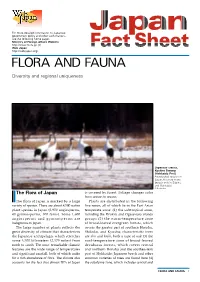
FLORA and FAUNA Diversity and Regional Uniqueness
For more detailed information on Japanese government policy and other such matters, see the following home pages. Ministry of Foreign Affairs Website http://www.mofa.go.jp/ Web Japan http://web-japan.org/ FLORA AND FAUNA Diversity and regional uniqueness Japanese cranes, Kushiro Swamp (Hokkaido Pref.) A protected species in Japan, this rare crane breeds only in Siberia and Hokkaido. © Kodansha The Flora of Japan is covered by forest. Foliage changes color from season to season. The flora of Japan is marked by a large Plants are distributed in the following variety of species. There are about 4,500 native five zones, all of which lie in the East Asian plant species in Japan (3,950 angiosperms, temperate zone: (1) the subtropical zone, 40 gymnosperms, 500 ferns). Some 1,600 including the Ryukyu and Ogasawara islands angiosperms and gymnosperms are groups (2) the warm-temperature zone indigenous to Japan. of broad-leaved evergreen forests, which The large number of plants reflects the covers the greater part of southern Honshu, great diversity of climate that characterizes Shikoku, and Kyushu; characteristic trees the Japanese archipelago, which stretches are shii and kashi, both a type of oak (3) the some 3,500 kilometers (2,175 miles) from cool-temperature zone of broad-leaved north to south. The most remarkable climatic deciduous forests, which covers central features are the wide range of temperatures and northern Honshu and the southeastern and significant rainfall, both of which make part of Hokkaido; Japanese beech and other for a rich abundance of flora. The climate also common varieties of trees are found here (4) accounts for the fact that almost 70% of Japan the subalpine zone, which includes central and FLORA AND FAUNA 1 northern Hokkaido; characteristic plants are the Sakhalan fir and Yesso spruce (5) the alpine zone in the highlands of central Honshu and the central portion of Hokkaido; characteristic plants are alpine plants, such as komakusa (Dicentra peregrina). -

A Global Synthesis of Animal Phenological Responses to Climate Change
LETTERS https://doi.org/10.1038/s41558-018-0067-3 Corrected: Publisher correction A global synthesis of animal phenological responses to climate change Jeremy M. Cohen *, Marc J. Lajeunesse and Jason R. Rohr Shifts in phenology are already resulting in disruptions to the whether the broad geographical heterogeneity in these climate vari- timing of migration and breeding, and asynchronies between ables impacts their power to explain and predict ecological trends. interacting species1–5. Recent syntheses have concluded that Second, recent syntheses have relied on country-level data, and no trophic level1, latitude6 and how phenological responses are synthesis in over a decade has addressed phenological responses measured7 are key to determining the strength of phenologi- to climate change across the globe. Global analyses are important cal responses to climate change. However, researchers still because they cover a greater extent of climatic conditions than local lack a comprehensive framework that can predict responses or regional analyses. For example, global syntheses are critical to to climate change globally and across diverse taxa. Here, we test broad-scale latitudinal hypotheses about phenological shifts, synthesize hundreds of published time series of animal phe- such as the hypothesis that the climatic factors driving seasonal- nology from across the planet to show that temperature pri- ity across latitudes also drive phenological changes. Third, it is marily drives phenological responses at mid-latitudes, with unclear why some species show delayed spring phenologies despite precipitation becoming important at lower latitudes, prob- an overall trend towards advancement10,17. Finally, it is also unclear ably reflecting factors that drive seasonality in each region. -

New Australian White Ibis Rookery at Salamander Bay
The Whistler 10 (2016): 54-55 New Australian White Ibis rookery at Salamander Bay Lois Wooding 14/4 Muller Street, Salamander Bay, NSW 2317, Australia Australian White Ibis Threskiornis moluccus have the Wanda Wetlands colony at around 50 birds and established a new rookery at Salamander Waters relatively stable in numbers. Estate, Salamander Bay, NSW (32⁰43'33.48"S, 152⁰04'48.65"E). The new location is The new rookery is located in the first of two approximately one kilometre from a long- catchment ponds designed to drain the Salamander established colony in the Wanda Wetlands Sports Complex (Figure 1), which is built on (32⁰43'50.85"S, 152⁰04'48.65"E). Whether the saltmarsh reclaimed by infill generated by the new colony is the result of over-population at the neighbouring waste disposal facility. The site is Wanda Wetlands site or an influx of new “urban part of a BirdLife Australia atlassing route (Site ID ibis” to the area is unknown. Accurate assessment 267484-5; Fixed Route 1-2hrs). Australian White of both sites is hampered by difficult access and Ibis have been recorded on 92% of the monthly restricted visibility. bird surveys conducted since January 2007 (Figure 2). Surveys between 2007 and 2009 recorded the The Wanda Wetlands site was colonized in the presence of one to five ibis foraging in the pond, early 90s. The location, which is roughly but from July 2009 numbers have slowly equidistant (~1km) from two sports grounds, the increased, although no evidence of colonization Port Stephens Estuary and the Salamander waste was observed. -

(Ciconia Maguari) in the Pampa Eco-Region of South
NORTH-WESTERN JOURNAL OF ZOOLOGY 17 (1): 106-110 ©NWJZ, Oradea, Romania, 2021 Article No.: e201603 http://biozoojournals.ro/nwjz/index.html Citizen science for the knowledge of tropical birds: the diet of the Maguari Stork (Ciconia maguari) in the Pampa ecoregion of southern Brazil Dárius Pukenis TUBELIS1* and Milena WACHLEVSKI2 1. Department of Biosciences, Universidade Federal Rural do Semi-Árido, Mossoró, RN, 59625-900, Brazil. 2. Laboratory of Animal Behavior and Ecology, Department of Biosciences, Universidade Federal Rural do Semi-Árido, Mossoró, RN, 59625-900, Brazil. * Corresponding author, D.P. Tubelis, E-mail: darius.tubelis@gmail.com Received: 04. October 2020 / Accepted: 01. December 2020 / Available online: 15. December 2020 / Printed: June 2021 Abstract.The Maguari Stork (Ciconia maguari) occurs extensively in South America where it inhabits mainly wetlands. Despite being common in some regions, information on several aspects of its ecology is lacking. The objective of this study was to investigate the diet of Maguari Storks in the Pampa ecoregion of southern Brazil using citizen science. A compilation of records of foraging birds was done in two on-line databases - WikiAves and e-Bird Brasil. A total of 36 records, obtained by citizens between 2008 and 2020, reported storks holding preys with their bills. The most frequent food item was the muçum fish (Synbranchus marmoratus), representing 39% of the preys. Squamate reptiles and anuran amphibians comprised 33% and 19% of the food items, respectively. Most preys had a serpentiform body shape, being represented mainly by muçum and snakes. This study suggests that our knowledge regarding the natural history of Brazilian birds can increase through citizen science. -

Produced by Illawarra Birders Birds of Paddocks, Parks and Gardens Creature on Earth
Sulphur-crested Cockatoo Yellow-tailed Black-Cockatoo Crimson Rosella Superb Fairy-Wren Rainbow Lorikeet Produced by Illawarra Birders www.illawarrabirders.org Crested Pigeon Laughing Sometimes wrongly called Kookaburra Eastern Spinebill Grey Butcherbird a Topknot Pigeon (which is One of the largest members A beautiful honey- eater with Little Wattlebird Red-browed Finch So-called as it stores prey a different bird). Makes a of the kingfisher family – but a beak designed for probing A noisy wattlebird with no Also known as the Red- in a tree fork, using its distinctive whistling sound it doesn’t catch fish. When deep inside flowers to extract wattles. Common in gardens browed Firetail, this is the hooked beak to tear it up into when it flies. (42cm) a family group starts their their nectar. (16cm) and heathland, feeding on commonest local finch. bite-sized chunks. But it’s noisy chorus of laughter it’s banksias, grevilleas etc. Firetails are so-called a handsome bird and sings their way of saying ‘this is our (28cm) because of their bright red beautifully! (28cm) territory’. (40cm) rumps. (12cm) Nankeen Kestrel The Kestrel, a type of falcon, is the smallest Australian bird of prey. It’s one of the Noisy Miner New Holland few birds that can hover, This native bird has a large whilst looking for prey on the Masked Lapwing Honeyeater repertoire of different calls. Willie Wagtail Welcome Swallow ground. (Another is the mainly Large plovers are known as Not a shy bird, it likes to sit on It lives in colonies which A feisty little bird, ready to A master of flight, especially white Black-shouldered Kite.) lapwings, and this one is the top of bushes and advertise aggressively exclude other take on others many times low level, high-speed (32cm) world’s largest. -

Royal Spoonbill in Distress Looking out of My Lounge Window I Saw Something on the Edge of the River Where the Royal Spoonbills Like to Loaf
Waikanae Estuary Newsletter No 48 February 2011 www.kapitibirdtours.co.nz partners to Nature Coast Bird Trail www.naturecoastbirdtrail.co.nz Waikanae Estuary bird tours 9051001 Royal Spoonbill in Distress Looking out of my lounge window I saw something on the edge of the river where the royal spoonbills like to loaf. It looked like a piece of white plastic, even after looking through my telescope, so I thought no more about it. Later, in the morning having a cuppa tea with our friend Eileen, Moira, my wife remarked that there was a white bird flapping about. It wasn’t a piece of plastic at all. It was a royal spoonbill in distress. Eileen and I went down and I threw a sheet over the bird realising it was in a bad way. I decided to take it to the Nga Manu wildlife reserve. Eileen wanted to know how we were going to get it there as we didn’t have a box to put it in. “Don’t worry you are going to nurse it” I said as I put a towel over her lap and passed her the bird wrapped in a sheet. Bruce at Nga Manu met us at the door and we passed the bird to him. “Feel the ribcage Mik” he said and there was absolutely no meat there. Extending from both sides of its head were about thirty bloodsucking ticks with their bodies extended with blood sucked from the bird. I left the bird with Bruce and with the help of Rhys their wild life expert, they, with tweezers removed the ticks and some lice which were also affecting the bird. -

Rivers for Life Proceedings of the International Symposium on River Biodiversity: Ganges-Brahmaputra-Meghna River System
Rivers for Life Proceedings of the International Symposium on River Biodiversity: Ganges-Brahmaputra-Meghna River System Editors Ravindra Kumar Sinha Benazir Ahmed Ecosystems for Life: A Bangladesh-India Initiative The designation of geographical entities in this publication, figures, pictures, maps, graphs and the presentation of all the material, do not imply the expression of any opinion whatsoever on the part of IUCN concerning the legal status of any country, territory, administration, or concerning the delimitation of its frontiers or boundaries. The views expressed in this publication are authors’ personal views and do not necessarily reflect those of IUCN. This initiative is supported by the Embassy of the Kingdom of the Netherlands (EKN), Bangladesh. Produced by: IUCN International Union for Conservation of Nature Copyright: © 2014 IUCN International Union for Conservation of Nature and Natural Resources Reproduction of this material for education or other non-commercial purposes is authorised without prior written permission from the copyright holder provided the source is fully acknowledged. Reproduction of this publication for resale or other commercial purposes is prohibited without prior written permission of the copyright holder. Citation: Sinha, R. K. and Ahmed, B. (eds.) (2014). Rivers for Life - Proceedings of the International Symposium on River Biodiversity: Ganges-Brahmaputra-Meghna River System, Ecosystems for Life, A Bangladesh-India Initiative, IUCN, International Union for Conservation of Nature, 340 pp. ISBN: ISBN 978-93-5196-807-8 Process Coordinator: Dilip Kumar Kedia, Research Associate, Environmental Biology Laboratory, Department of Zoology, Patna University, Patna, India Copy Editing: Alka Tomar Designed & Printed by: Ennovate Global, New Delhi Cover Photo by: Rubaiyat Mowgli Mansur, WCS Project Team: Brian J. -

Pantanal Checklist
PANTANAL CHECKLIST Birds English Name Portuguese Name Scientific Name Date Time Location # ID Anhinga Carará / biguatinga Anhinga anhinga Great ani Anu-coroca Crotophaga major Smooth-billed ani Anu-preto Crotophaga ani Mato grosso antbird Chororó-Do-Pantanal Cercomacra melanaria Barred antshrike Choca-Barrada Thamnophilus doliatus Great antshrike Taraba Major Taraba major Chestnut-eared araçari Araçari-Castanho Pteroglossus castanotis Chopi blackbird Gnorimopsar chopi Scarlet-headed blackbird Cardeal-Do-Banhado Amblyramphus holosericeus Shiny blackbird Molothrus bonariensis Solitary cacique Iraúna-De-Bico-Branco Cacicus solitaris Yellow-rumped cacique Cacicus Cela Cacicus cela Southern caracara Caracará Caracara plancus Yellow-billed cardinal Cardeal-Do-Pantanal Paroaria capitata Chaco chachalaca Aracuã-Do-Pantanal Ortalis canicollis Neotropical cormorant Biguá Phalacrocorax brasilianus Guira cuckoo Anu-Branco Guira guira Little cuckoo Piaya Minuta Coccycua minuta Squirrel cuckoo Piaya Cayana Piaya cayana Bare-faced curassow Mutum-De-Penacho Crax fasciolata Donacobius Japacanim Donacobius atricapilla Eared dove Avoante Zenaida auriculata Picui ground dove Rolinha-Picui Columbina picui Ruddy ground dove Rolinha-Roxa Columbina talpacoti Scaled dove Fogo-Apagou Scardafella squammata Black bellied whistling duck Marreca-Cabocla Dendrocygna autumnalis Muscovy duck Pato-Selvagem Cairina moschata White-faced whistling duck Irerê Dendrocygna viduata Cattle egret Bubulcus Ibis Bubulcus ibis Snowy egret Garça-Branca-Pequena Egretta thula Great